
Why do two organizations of similar size often face a cost of iso 27001 certification that differs by tens of thousands of dollars? You’re likely grappling with the ambiguity of software fees versus consulting value; it’s a common struggle for leaders who want to avoid unexpected budget overruns. You understand that security isn’t just a checkbox, yet the fear of a failed audit after a heavy investment remains a valid concern. This discrepancy usually stems from a failure to account for indirect friction and the complexity of internal systems.
This guide provides the financial clarity required to build a predictable budget roadmap for 2026. We’ll move beyond surface-level quotes to examine the total cost of ownership across the entire three-year cycle, ensuring your investment is both transparent and defensible. You’ll gain the insights needed to justify ROI to your board and select a readiness partner that aligns with your long-term growth goals. We’ll explore the direct audit fees, internal resource allocations, and the strategic investments that define a successful implementation. By the end of this analysis, you’ll have a comprehensive understanding of how to secure your infrastructure without compromising your bottom line.
Key Takeaways
- Categorize your investment into the three pillars of preparation, implementation, and technical deployment to ensure every facet of the project is appropriately funded.
- Identify the hidden “internal labor tax” that often inflates the total cost of iso 27001 certification well beyond the initial auditor’s quote.
- Develop a precise three-year financial forecast that accounts for recurring surveillance audits and the ongoing evolution of your Information Security Management System.
- Mitigate the risk of expensive remediation cycles by utilizing professional readiness assessments to resolve critical gaps before the formal certification process begins.
- Transform compliance from a perceived expense into a strategic asset that builds board confidence and facilitates sustainable corporate growth.
The Variable Landscape of ISO 27001 Investment
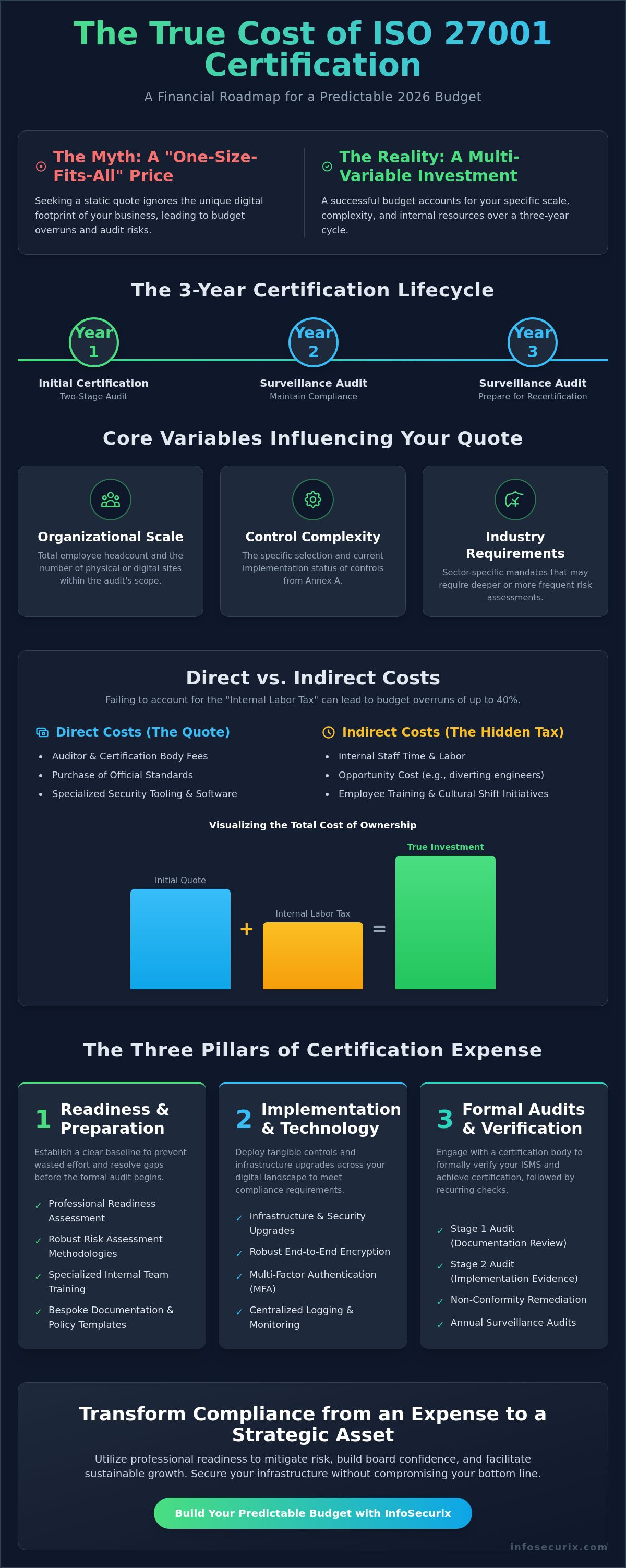
Achieving compliance is a journey of precision, not a simple procurement exercise. The financial commitment required to secure a certification often extends far beyond the initial invoice provided by a certification body. Many leadership teams fall into the trap of seeking a “one size fits all” price tag, yet this approach is a dangerous myth that ignores the bespoke nature of modern information security. Every organization possesses a unique digital footprint; therefore, a static quote cannot account for the specific vulnerabilities or operational nuances of your business. In 2026, the cost of iso 27001 certification is a multi-variable investment that integrates technological resilience, internal culture, and strategic risk management.
Understanding this expenditure requires a long-term perspective. The ISO/IEC 27001 Standard operates on a three-year cycle, beginning with an initial two-stage audit followed by annual surveillance assessments. This structure ensures that your Information Security Management System (ISMS) remains robust against evolving threats. Your total expenditure is directly influenced by your organizational maturity. A firm with established security protocols will naturally face lower implementation hurdles than one starting from scratch. It’s a process of continuous alignment rather than a one-time fee.
Core Variables Influencing Your Quote
Several factors dictate the breadth of your financial roadmap. Your employee headcount and the complexity of your digital infrastructure serve as the primary drivers for auditor day-rates. Key variables include:
- Organizational Scale: Total headcount and the number of physical or digital sites within the audit scope.
- Control Complexity: The specific selection of controls from Annex A and their current implementation status.
- Industry Requirements: Sector-specific mandates that may necessitate deeper, more frequent risk assessments.
Direct vs. Indirect Costs: A Strategic Distinction
A successful budget must distinguish between visible expenses and the often-overlooked “internal labor tax.” Direct costs are easily identified. These include auditor fees, the purchase of the official standards, and specialized security tooling required for compliance. Indirect costs are more subtle but equally impactful. They encompass internal staff time, the opportunity cost of diverting engineers from product development, and the resources needed for cultural shift training. Industry observations suggest that neglecting these indirect factors can lead to budget overruns as high as 40 percent. By recognizing these variables early, you transform an unpredictable expense into a controlled, strategic investment that protects your firm’s future.
Breaking Down the Three Pillars of Certification Expense
To demystify the financial commitment, we must view the investment through three distinct lenses: preparation, implementation, and formal verification. This structured approach allows leadership to allocate resources with surgical precision. While the headline cost of iso 27001 certification often captures the most attention, the underlying value lies in the maturity gained during each phase. Each pillar serves as a building block for a resilient Information Security Management System (ISMS) that does more than just pass an audit; it protects your competitive edge in a global market.
Phase 1: Readiness and Preparation Costs
Success begins with a clear understanding of your current posture. Engaging in a professional ISO 27001 certification readiness assessment provides a baseline that prevents wasted effort and redundant spending. This phase requires budgeting for robust risk assessment methodologies and specialized training for your internal team. While generic toolkits might seem cost-effective initially, bespoke documentation templates offer a superior return on investment. They align perfectly with your unique operational workflows, ensuring that your policies are practical rather than just performative. Pairing your readiness assessment with a comprehensive iso 27001 readiness checklist ensures that every control and documentation requirement is systematically addressed before your budget is committed to the formal audit process.
Phase 2: Implementation and Technology
This pillar focuses on the tangible deployment of controls across your digital landscape. You’ll likely need to invest in infrastructure upgrades, such as robust encryption, multi-factor authentication (MFA), and centralized logging solutions. Beyond hardware, budgeting for employee awareness training is vital to foster a security-first culture. Conducting a professional information security internal audit during this phase acts as a critical dress rehearsal. It identifies control weaknesses before they become expensive failures during the final assessment, effectively capping your total cost of iso 27001 certification by avoiding remediation delays.
Phase 3: Certification Body and Audit Fees
The final pillar involves the engagement of an external, accredited certification body. Fees are generally structured around a two-stage process: Stage 1 involves a high-level documentation review, while Stage 2 is the formal, evidence-based audit. Industry data from 2026 suggests these external audit fees can range from $4,500 to $25,000, heavily influenced by the number of days an auditor must spend reviewing your systems. Total costs also fluctuate based on whether the audit is conducted on-site or remotely, as travel expenses and administrative fees add up quickly. It’s tempting to select the lowest bidder, but choosing a reputable body ensures your certification carries the necessary weight with international partners.
Evaluating these pillars reveals that each dollar spent isn’t just a compliance fee; it’s a strategic shield. Strengthening these areas enhances your global data protection posture, opening doors to enterprise-level contracts that demand high-tier security assurance. If you’re looking to streamline this process, beginning with a comprehensive readiness assessment can clarify your specific financial roadmap.
Hidden Costs and the Financial Risk of Audit Failure
While the visible line items on a quote are manageable, the true cost of iso 27001 certification often hides within the operational friction of an unprepared organization. Leaders frequently underestimate the “Internal Labor Tax,” which represents the financial burden of diverting high-value staff from revenue-generating projects to administrative compliance tasks. When engineers or product managers spend hundreds of hours on documentation rather than innovation, the business pays a silent but significant price. This opportunity cost can often exceed the auditor’s fees by a factor of three or four.
Failing an audit creates a compounding financial crisis known as the remediation trap. If an auditor identifies major non-conformities, you don’t just lose the certification: you lose the initial investment and must fund a second round of audits. This effectively doubles your certification spend while delaying market entry. Beyond the audit room, technical debt poses a long-term risk. Implementing “quick-fix” security controls to satisfy an immediate requirement often necessitates expensive overhauls later. These temporary patches lack the scalability required for a growing enterprise, leading to a cycle of constant, costly correction.
The High Cost of Inadequate Readiness
Relying solely on “Automation Only” platforms is a common path to Stage 1 audit failure. These tools often prioritize software snapshots over the deep cultural integration required by the standard. When an auditor discovers that policies exist only on a dashboard and not in daily practice, they’ll halt the process. Repeating a Stage 2 audit due to major non-conformities is not just a scheduling headache; it’s a direct financial hit. Strategic corrective actions must be budgeted for post-audit, ensuring that improvements are sustainable rather than reactive. This foresight prevents the certification from becoming a recurring financial drain.
Internal Resource Allocation
The burden of compliance is distributed across the entire executive suite. IT departments typically bear the brunt of technical control implementation, while HR must manage training records and Legal handles contractual security obligations. A Security Lead or CISO must orchestrate these moving parts, often dedicating 20 percent of their annual capacity to ISMS maintenance. Industry reports indicate that engaging professional guidance reduces internal labor requirements by 50 percent, allowing your team to remain focused on core business objectives. This strategic partnership ensures that the cost of iso 27001 certification remains a controlled investment rather than an open-ended liability. Consider the price of being unable to sign enterprise contracts due to a delayed or failed certification: it’s a lost opportunity cost that can stifle your firm’s growth for years. For growing firms navigating these pressures with limited resources, understanding how ISO 27001 for small business can serve as a flexible growth lever rather than a rigid constraint is an essential first step toward protecting both operations and revenue.
Total Cost of Ownership and Budgeting for 2026
Securing board approval for an Information Security Management System (ISMS) requires a shift from viewing compliance as a single event to managing it as a continuous strategic asset. In 2026, the cost of iso 27001 certification must be projected over a three-year lifecycle to capture the true total cost of ownership. This period encompasses the initial certification, two annual surveillance audits, and the final recertification milestone. Forward-thinking leaders are also factoring in the intersection of ISO 27001 with emerging standards like ISO 42001 for AI security. As supply chain complexity grows, the resources required to vet third-party vendors and integrate their risk profiles into your own ISMS have become a permanent fixture of the modern security budget.
Year 2 and 3: Surveillance Audit Expenses
Maintaining your status involves annual “check-up” audits to verify that your controls remain effective and your documentation stays current. These surveillance audits typically cost between $3,000 and $12,000 each, depending on the breadth of your operations and any significant organizational changes. Beyond auditor fees, you should budget approximately $1,000 annually for formal staff training and roughly $5,000 for essential monitoring tools. An ISMS is a living system; it requires consistent nurturing to prevent the “compliance drift” that leads to expensive findings during later reviews.
Recertification: The Year 3 Milestone
The third year marks the full recertification audit, a comprehensive evaluation similar in depth to the initial Stage 2 assessment. While the effort remains rigorous, many organizations find efficiency gains by refining their ISO 27001 certification process based on previous years’ evidence. Recertification is the ideal time to future-proof your investment against evolving global standards and regulatory shifts. By establishing a structured, multi-year budget that includes internal labor and external fees, you present a narrative of stability and foresight to executive stakeholders. If you need a precise roadmap to justify these investments to your board, our experts can help you develop a comprehensive risk assessment and budget framework tailored to your 2026 objectives.
The InfoSecurix Advantage: Readiness as a Cost-Saving Strategy
Professional readiness serves as the ultimate hedge against the financial volatility we’ve explored in previous sections. While many organizations struggle with the unpredictable cost of iso 27001 certification, our approach prioritizes fiscal transparency and operational precision. We utilize fixed-fee readiness engagements to eliminate the budget uncertainty that often derails compliance projects. By providing a clear, upfront investment structure, we empower leadership to commit to security standards without the fear of hidden surcharges or mid-project price hikes.
Our methodology is built on a foundation of 25 years of industry experience. We’ve seen every possible audit scenario and remain unfazed by the most complex digital environments. This legacy of success allows us to identify and neutralize the most common, and costly, audit mistakes before you ever meet an external assessor. We don’t just aim for compliance; we strive for a state of perpetual “Audit-Ready” status that minimizes the need for last-minute, expensive corrections. This proactive stance ensures your first-time certification is a milestone of achievement rather than a source of financial stress.
Bespoke Consulting vs. Generic Toolkits
Relying on generic software toolkits often leads to a false sense of security. These “one size fits all” solutions typically fail to capture the nuances of your specific workflows, leading to significant friction during the implementation phase. Tailored ISMS documentation reduces both implementation time and long-term maintenance costs by aligning perfectly with your existing culture. A seasoned guide understands how to interpret auditor expectations; they ensure your controls are robust enough to pass scrutiny without being overly burdensome. Our strategic risk management approach protects your data while simultaneously safeguarding your bottom line.
Securing Your Competitive Edge
Viewing ISO 27001 as a mere expense ignores its potential as a measurable growth engine. Achieving this standard allows your firm to pursue high-value enterprise contracts that were previously out of reach. Beyond market expansion, robust standards often lead to reduced insurance premiums and lower legal liabilities by demonstrating a commitment to industry-recognized best practices. We help you translate technical processes into a narrative of corporate excellence that resonates with your board and your clients alike. To begin your journey with a partner invested in your long-term success, Partner with InfoSecurix for a Meticulous Readiness Assessment.
Securing Your Future with Strategic Precision
Navigating the cost of iso 27001 certification requires a fundamental shift from viewing compliance as a hurdle to managing it as a strategic asset. By accounting for the full three-year lifecycle and the internal resource demands we’ve discussed, you establish a predictable financial roadmap for 2026. True success lies in moving beyond generic toolkits toward bespoke frameworks that reflect your unique operational reality. This clarity ensures that your investment yields a resilient infrastructure rather than just a certificate. It’s about building a foundation of trust that supports your firm’s long-term growth.
InfoSecurix leverages over 25 years of information security excellence to guide your organization through this complex landscape. We specialize in preparing firms for first-time audit success using a proven methodology that seamlessly integrates SOC2 and ISO standards into a cohesive security posture. Our seasoned advisors help you avoid the remediation traps that frequently lead to budget overruns; we’re committed to your long-term achievement. We don’t just help you pass an audit; we help you future-proof your business against evolving global threats.
Request a Strategic ISO 27001 Readiness Consultation
Take the next step toward a future where your commitment to excellence becomes your greatest competitive advantage. We’re ready to partner with you to turn these standards into a legacy of success.
Frequently Asked Questions
What is the average cost of ISO 27001 certification for a small business in 2026?
For small entities with one to ten employees, the investment for a UKAS accredited audit in 2026 is approximately £6,250. If your organization chooses a DIY toolkit approach for implementation, the total first-year cost of iso 27001 certification typically starts at £8,250. Larger tech startups with around 50 employees should prepare for a broader range between £15,000 and £40,000 to account for increased system complexity. Organizations at this stage can benefit from reviewing a dedicated ISO 27001 for small business strategic guide to understand how to attain enterprise-level trust without overextending limited budgets.
Can we achieve ISO 27001 certification without hiring a consultant?
Yes, it’s possible to achieve certification using internal resources and specialized toolkits. While this path starts at roughly £8,250, it frequently leads to higher “internal labor tax” as staff are diverted from revenue-generating projects. Without a seasoned guide, the risk of Stage 1 audit failure increases, which can ultimately double your total expenditure through required remediation and re-auditing fees.
How much should we budget for the external certification body fees?
External audit fees generally range from $5,000 to $35,000 depending on the size and complexity of your organization. For smaller firms with fewer than 50 employees, these costs typically fall between $5,000 and $10,000. Auditors usually calculate their fees based on a daily rate, which is currently estimated at approximately $1,500 per day in 2026.
Does the cost of ISO 27001 include the price of security software?
No, the certification fee covers only the formal assessment by the registrar. Organizations should budget an additional $5,000 for essential tools such as network security monitoring and encryption software to meet Annex A requirements. These technical investments are separate from the cost of iso 27001 certification audits but are vital for maintaining a compliant Information Security Management System.
How long does the certification process take, and how does that impact cost?
The journey to certification typically spans six to twelve months. A longer implementation timeline directly inflates your total spend by increasing the internal resources dedicated to documentation and control testing. Efficient project management is essential to minimize these indirect costs; delays often result in higher administrative overhead and potential price increases from service providers.
What happens to the cost if our organization grows during the certification cycle?
Significant growth in headcount or digital footprint often expands the scope of your audit. When your complexity increases, the certification body will likely require more auditor days to verify your controls during surveillance visits. It’s vital to communicate major changes to your registrar early to ensure your budget reflects the updated scale of your operations.
Are there any recurring annual fees after we receive the certificate?
Yes, you must budget for annual surveillance audits in years two and three, which typically cost between $3,000 and $12,000 each. You’ll also face recurring expenses of roughly $1,000 for annual staff training and the ongoing costs of security software. These investments ensure your ISMS remains a living system that adapts to the evolving threat landscape.
Is there a difference in cost between ISO 27001 and SOC 2 certification?
Initial implementation costs are often comparable, but the long-term financial structures differ significantly. ISO 27001 operates on a three-year cycle with less intensive annual surveillance, whereas SOC 2 typically requires a full, comprehensive assessment every year. Choosing between them depends on whether your clients prioritize a global management standard or a specific report on control effectiveness.