

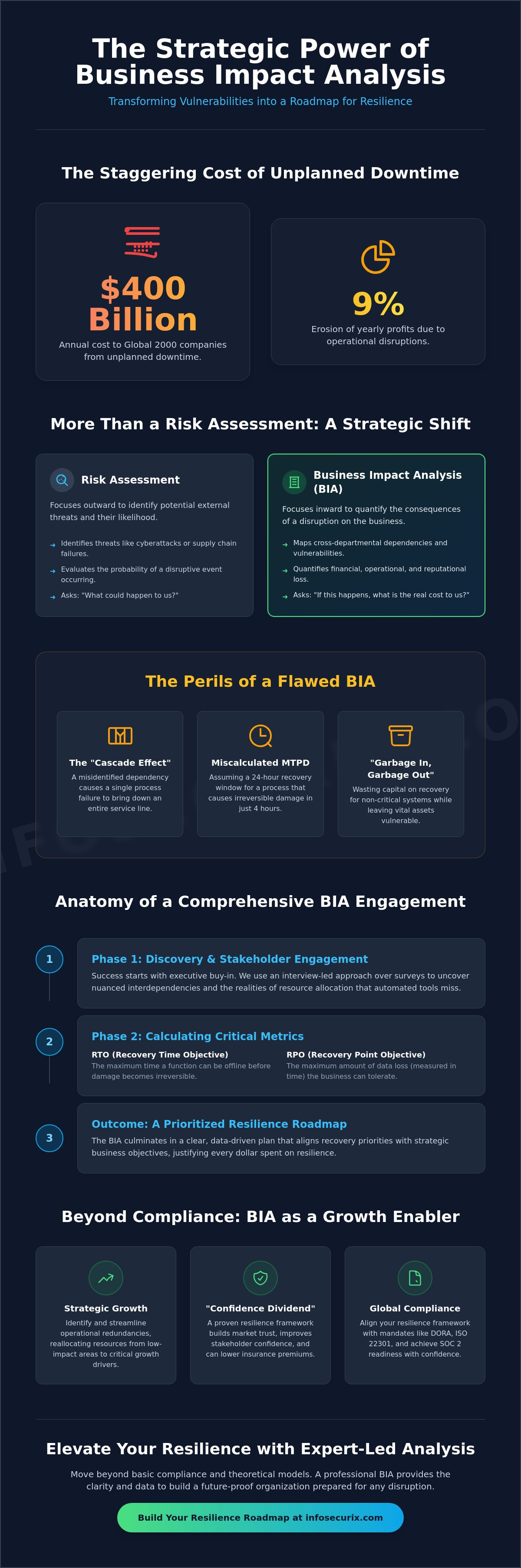
Unplanned downtime costs Global 2000 companies nearly $400 billion annually, a figure that represents a staggering 9% erosion of yearly profits. For many leaders, the challenge isn’t just acknowledging the risk; it’s the daunting complexity of mapping every cross-departmental dependency without getting lost in theoretical models that lack real-world application. You need more than a static report to protect your legacy. Professional business impact analysis services act as a strategic catalyst, turning these intricate vulnerabilities into a clear, prioritized roadmap for recovery.
We understand that true resilience requires a balance of authoritative expertise and a collaborative partnership. This guide explores how sophisticated methodologies transform operational uncertainty into a position of absolute strength. You’ll discover how to align your framework with the Digital Operational Resilience Act (DORA), which has been fully enforceable since January 17, 2025, and maintain the rigorous standards of ISO 22301:2019. By moving beyond basic compliance, you can build a future-proof organization that remains unfazed by complexity and prepared for any disruption.
Key Takeaways
- Understand the distinction between a standard risk assessment and a strategic investment in your organization’s longevity.
- Discover how professional business impact analysis services quantify the real-world financial and operational consequences of downtime.
- Learn why expert-led facilitation is essential to prevent the data inaccuracies common in software-only platforms.
- Identify how to align your recovery priorities with the requirements of ISO 22301 Business Continuity and SOC 2 readiness.
- Gain a clear methodology for transforming organizational vulnerabilities into a prioritized roadmap for strategic resilience.
The Strategic Necessity of Business Impact Analysis Services
Securing the longevity of a modern enterprise requires moving beyond the reactive postures of the past. While many organizations view business continuity planning as a regulatory checkbox, elite firms recognize that business impact analysis services represent a proactive investment in corporate durability. This process isn’t merely about identifying what might go wrong. It’s about understanding the precise value at risk when operations cease and ensuring that recovery efforts align with the organization’s most vital priorities.
Distinguishing between a standard risk assessment and a strategic impact analysis is vital for executive clarity. A risk assessment identifies external threats, such as cyberattacks or supply chain failures, and evaluates their likelihood. In contrast, a business impact analysis focuses inward to determine how those disruptions ripple through the organization. By quantifying the potential loss of brand reputation and shareholder value, this analysis provides the data necessary to justify resilience spending to the board. In the volatile market of 2026, where digital operational resilience is now a regulatory mandate under DORA, a “standard” plan is no longer sufficient to protect enterprise value.
Beyond Compliance: BIA as a Growth Enabler
Mapping cross-departmental dependencies often reveals operational redundancies that, once streamlined, result in leaner and more efficient workflows. This clarity allows leaders to reallocate resources from low-impact areas to critical growth drivers. When stakeholders see a proven and tested resilience framework, it creates a “Confidence Dividend” that can lower insurance premiums and improve market trust. A business impact analysis serves as the essential bridge between technical recovery capabilities and overarching business objectives.
The Consequences of Inadequate Analysis
Miscalculating the Maximum Tolerable Period of Disruption (MTPD) can lead to catastrophic financial outcomes. If a recovery strategy assumes a 24-hour window for a process that actually causes irreversible damage after four hours, the resulting “Cascade Effect” can bring down an entire service line. Poorly facilitated business impact analysis services often result in “Garbage In, Garbage Out” scenarios. In these cases, organizations waste capital on expensive recovery infrastructure for non-critical systems while leaving their most vital assets vulnerable. Meticulous data collection ensures every dollar spent on resilience directly supports the survival of the enterprise.
The Anatomy of a Comprehensive BIA Engagement
Executing an effective BIA requires a transition from passive data collection to a highly consultative engagement. While some organizations attempt to simplify this process through automated surveys, professional business impact analysis services recognize that the most critical insights often lie in the nuances of human interaction and departmental interdependencies. A comprehensive engagement is designed to peel back the layers of organizational complexity, revealing not just what functions exist, but which ones are truly indispensable to your survival. This systematic approach ensures that your resilience strategy is built on a foundation of hard financial and operational metrics rather than subjective “High” or “Low” labels.
Phase 1: Discovery and Stakeholder Engagement
Success begins with securing absolute executive buy-in. Without a clear mandate from leadership, data collection often stalls in the face of departmental silos. We favor an interview-led approach over anonymous surveys because it allows for the exploration of “what-if” scenarios that a form simply cannot capture. These conversations help identify shared critical assets and uncover the political realities of resource allocation. Adhering to Business Impact Analysis guidance ensures the process remains grounded in industry-recognized best practices while maintaining the flexibility to address your unique corporate culture.
Phase 2: Calculating RTO and RPO Metrics
Defining your Recovery Time Objective (RTO) and Recovery Point Objective (RPO) is a critical exercise in business realism. RTO represents the duration of time a function can be offline before the damage becomes irreversible. RPO identifies the maximum amount of data loss, measured in time, that your business can tolerate. Experts validate these metrics against real-world resource constraints to ensure they’re achievable. It’s common for stakeholder expectations to exceed technical capabilities; our role is to facilitate the reconciliation process, ensuring your recovery targets are both ambitious and grounded in reality.
Phase 3: Dependency Mapping and Resource Requirements
Mapping the invisible connections between your four pillars of resources—People, Facilities, Technology, and Third-Party Vendors—is where the most significant value is realized. A comprehensive analysis often reveals hidden dependencies, such as a niche software API that connects your payment gateway to your ledger. If that single point of failure isn’t identified, the rest of your recovery infrastructure becomes irrelevant. This meticulous data serves as the critical foundation for subsequent business continuity plan development. By the end of this phase, you’ll possess a prioritized recovery roadmap that informs every aspect of your technical strategy. To see how these insights can be tailored to your specific infrastructure, consider exploring our bespoke risk assessments.
Evaluating Service Providers: Methodology vs. Software-Only Approaches
Selecting the right partner to facilitate your resilience strategy is a high-stakes decision that requires a discerning eye for the distinction between a tool and a strategy. While the market is flooded with automated platforms promising rapid results, business impact analysis services are fundamentally rooted in methodology and expert insight. A software-only approach often falls victim to the “Garbage In, Garbage Out” phenomenon: if the data entered by department heads is flawed or overly optimistic, the resulting recovery roadmap will be dangerously inaccurate. Relying solely on a dashboard without the intervention of a seasoned guide leaves your organization vulnerable to the very disruptions you’re attempting to mitigate.
The Case for Expert-Led Facilitation
Professional consultants bring a level of objectivity that internal staff often lack. They’re trained to identify “Optimism Bias,” where department heads inadvertently under-report recovery requirements to appear more efficient or resilient than they truly are. By leveraging cross-industry experience, an expert can identify non-obvious risks that a standardized template might miss. This bespoke approach ensures your analysis is grounded in reality. As highlighted in FEMA’s guide to business impact analysis, the process must be systematic and thorough to be effective. An expert-led engagement provides the necessary friction to challenge assumptions and ensure that your RTO and RPO metrics are technically achievable.
Comparison Framework for BIA Services
When evaluating potential providers, it’s helpful to categorize them based on their delivery model and the depth of their analysis. The most expensive option isn’t always the one that provides the greatest resilience. Consider these three common archetypes:
- SaaS-Only Platforms: These offer high speed and lower costs but lack strategic depth. They’re best suited for organizations with mature internal teams who only need a repository for data.
- Big Four Firms: These providers offer global scale but often rely on junior staff and rigid, generalist auditing templates. The cost is high, yet the analysis can feel detached from your specific operational nuances.
- Boutique Consultancies: These firms offer a “Seasoned Guide” approach, focusing on high-touch facilitation and actionable outcomes. They prioritize the strategic impact of technical processes, ensuring your business impact analysis services result in a resilient, future-proof framework.
Before engaging a consultant, ask targeted questions to gauge their depth of experience. Inquire how they handle conflicting recovery expectations between business units and IT. Ask for specific examples of hidden dependencies they’ve uncovered in similar organizational landscapes. Most importantly, ensure their methodology aligns with rigorous standards like ISO 22301 or the SOC 2 Trust Services Criteria. A provider who can’t articulate the bridge between data collection and strategic advisory is likely just a generalist auditor, not a partner in your long-term success.
Aligning BIA with Global Compliance Standards
Operational resilience has evolved from a best practice into a rigorous regulatory requirement. For organizations operating within the European Union or serving global financial sectors, the Digital Operational Resilience Act (DORA) represents a significant shift in expectations. Since becoming fully enforceable on January 17, 2025, DORA mandates a harmonized approach to ICT risk management where business impact analysis services serve as a foundational element. Professional auditors no longer simply check for a completed report; they scrutinize the underlying methodology to ensure that impact types and timing are grounded in empirical data rather than executive guesswork. Compliance is not optional. Demonstrating a systematic approach to identifying critical functions is now a prerequisite for maintaining market access in highly regulated environments.
ISO 22301: The Gold Standard for Impact Analysis
Within the ISO 22301:2019 framework, Clause 8.2.2 establishes the specific requirements for conducting a BIA. It demands that organizations identify the types of impact that result from disruptions and establish the timing at which these impacts become unacceptable. This data directly informs the business continuity planning services framework by defining the recovery priorities that keep the business solvent. By mapping the relationship between functions and supporting resources, the BIA ensures that your recovery strategies are both proportionate and effective. Auditors demand empirical proof. Achieving ISO 22301 certification is impossible without a validated BIA that proves your recovery objectives are aligned with actual organizational needs. Organizations that want to understand precisely where their current program falls short should consider conducting an ISO 22301 gap analysis to identify the missing links before they are exposed by an auditor or a real-world outage.
BIA in the Context of SOC 2 and ISO 27001
The insights gained from a BIA are equally vital for cybersecurity frameworks, particularly regarding the SOC 2 Trust Services Criteria of Availability and Security. A thorough analysis informs the iso 27001 certification readiness process by identifying which information assets require the most robust controls based on their business criticality. This creates a direct intersection with the information security internal audit cycle: the audit verifies that the controls in place actually protect the functions identified as critical. By utilizing professional business impact analysis services, you ensure that your risk treatment plan is focused on the areas that matter most to your stakeholders, rather than applying a one-size-fits-all security model.
Integrating these complex requirements into a single, cohesive strategy requires a partner who understands the nuances of both business operations and technical compliance. For organizations seeking to align their resilience with these global standards, our SOC 2 readiness assessments provide the expert-led guidance necessary to transform compliance from a burden into a strategic advantage.
InfoSecurix: Elevating Resilience Through Expert-Led Analysis
Navigating the intricate layers of a modern enterprise requires a partner who has seen every possible scenario and remains unfazed by complexity. At InfoSecurix, we leverage over 25 years of experience to transform organizational vulnerabilities into strategic assets. Our business impact analysis services go far beyond simple data collection; we provide the strategic advisory necessary to bridge the gap between technical recovery and business survival. By utilizing a “Top-Down” methodology, we ensure that executive priorities are perfectly aligned with operational realities, creating a resilient framework that stands the test of time.
The transition from a completed analysis to a fully realized recovery strategy is where our expertise becomes most visible. We don’t just deliver a static report. We provide a dynamic blueprint that informs your technical strategy and recovery investments, ensuring that every resource is allocated with precision. This methodical approach supports the core functions that drive enterprise value, allowing you to move forward with absolute confidence in your operational durability.
A Partnership Built on Absolute Confidence
We view our engagements as a collaborative alliance. We’re allies, not just auditors, deeply invested in your long-term success and growth. Our commitment to future-proofing your business involves applying meticulous standards, such as ISO 22301 Business Continuity, to every facet of our analysis. With a national reach, we possess the specialized capability to serve complex, multi-site organizations, providing a steady and reliable presence across your entire footprint. This established legacy of success allows us to project a sense of security that empowers your leadership to focus on expansion rather than disruption.
Your Roadmap to Resilience Starts Here
Embarking on a resilience journey begins with an initial consultation where we listen to your specific concerns and objectives. You can expect a bespoke reporting process that translates technical jargon into actionable insights for both IT leadership and the Board of Directors. Our business impact analysis services provide the clarity needed to make informed decisions under pressure, ensuring that your organization remains steady during unforeseen events. It’s time to secure your organization’s future through precision analysis and expert-led guidance. Contact InfoSecurix today to begin your ISO 22301 Business Continuity implementation or to schedule a comprehensive Risk Assessment.
Securing Your Enterprise Legacy through Strategic Resilience
Building a resilient organization requires a shift from viewing continuity as a burden to recognizing it as a competitive advantage. You’ve seen how precise data collection and expert-led facilitation transform theoretical risks into a prioritized roadmap for recovery. By aligning your recovery objectives with global standards like ISO 22301 and the mandates of DORA, you ensure your business remains steady even during the most complex disruptions. Relying on professional business impact analysis services provides the clarity needed to bridge the gap between technical infrastructure and your most vital business objectives.
InfoSecurix stands as your seasoned guide, bringing over 25 years of information security excellence to every engagement. As national compliance experts and specialists in ISO 22301 and SOC 2, we provide the authoritative expertise required to protect your growth. It’s time to move beyond static reports and embrace a dynamic strategy for longevity. Partner with InfoSecurix for a Strategic Business Impact Analysis and gain the absolute confidence that comes from meticulous, expert-led standards. Your future-proofed organization is within reach.
Frequently Asked Questions
What is the primary goal of business impact analysis services?
The primary goal is to identify and prioritize the business functions that are most critical to your organization’s survival. By quantifying the operational and financial impacts of a disruption, these services help leaders establish realistic recovery timeframes. This process ensures that your resilience strategy is grounded in data rather than assumptions. It bridges the gap between technical recovery capabilities and the overarching business objectives that drive long-term growth.
How often should a business impact analysis be updated?
You should update your analysis at least annually or whenever a significant change occurs within your organizational structure. Rapid growth, the adoption of new technologies, or shifts in regulatory requirements can quickly render previous data obsolete. Regular reviews ensure your recovery priorities remain accurate. This steady cadence reflects a commitment to meticulous standards and helps maintain the integrity of your broader business continuity management system.
What is the difference between a BIA and a Risk Assessment?
A risk assessment identifies external threats and evaluates the likelihood of their occurrence. In contrast, business impact analysis services focus inward to determine the consequences of those threats on specific functions. While the risk assessment asks “what could happen,” the BIA asks “how much will it cost if this process stops.” Together, they provide a comprehensive view of your vulnerability and prioritize your recovery efforts.
How long does a typical BIA engagement take to complete?
A typical engagement usually spans between four and twelve weeks depending on the complexity and scale of your organization. This timeframe allows for thorough stakeholder interviews, data validation, and the mapping of intricate dependencies. Larger, multi-site enterprises may require additional time to ensure every department is accurately represented. A methodical approach is essential to avoid the inaccuracies that often plague rushed, software-only assessments.
What data do I need to provide for a successful BIA?
Successful engagements require detailed information regarding your core business processes and their supporting resources. You’ll need to provide data on internal and external dependencies, including technology platforms, key personnel, and third-party vendor contracts. Quantifying the financial loss per hour of downtime is also vital. This specific information allows our consultants to build a bespoke recovery roadmap that aligns with your actual resource constraints and operational needs.
Can a BIA help reduce my cyber insurance premiums?
Demonstrating a mature BIA process can often lead to more favorable terms or reduced premiums from cyber insurance providers. Insurers look for evidence that an organization understands its critical dependencies and has a validated plan for recovery. By proving your operational resilience through business impact analysis services, you position your brand as a lower-risk client. This proactive stance instills confidence in underwriters and reinforces your commitment to rigorous security standards.
Is a BIA required for ISO 27001 certification?
While ISO 27001 doesn’t explicitly name the BIA in its main clauses, it’s a fundamental tool for meeting the standard’s requirements for information availability. It provides the business context needed to determine which assets require the most robust security controls. For those pursuing ISO 22301 Business Continuity, the BIA is a mandatory requirement. Integrating these processes ensures your certification readiness is built on a foundation of strategic accuracy.
What are the most common mistakes in a DIY business impact analysis?
The most common mistakes in a self-led analysis include falling victim to optimism bias and overlooking hidden dependencies. Many internal teams focus exclusively on IT systems while ignoring the human and facility requirements necessary for recovery. Failing to reconcile stakeholder expectations with technical capabilities also leads to unrealistic recovery targets. Engaging a seasoned guide helps eliminate these blind spots, ensuring your analysis results in a truly actionable and resilient strategy.