
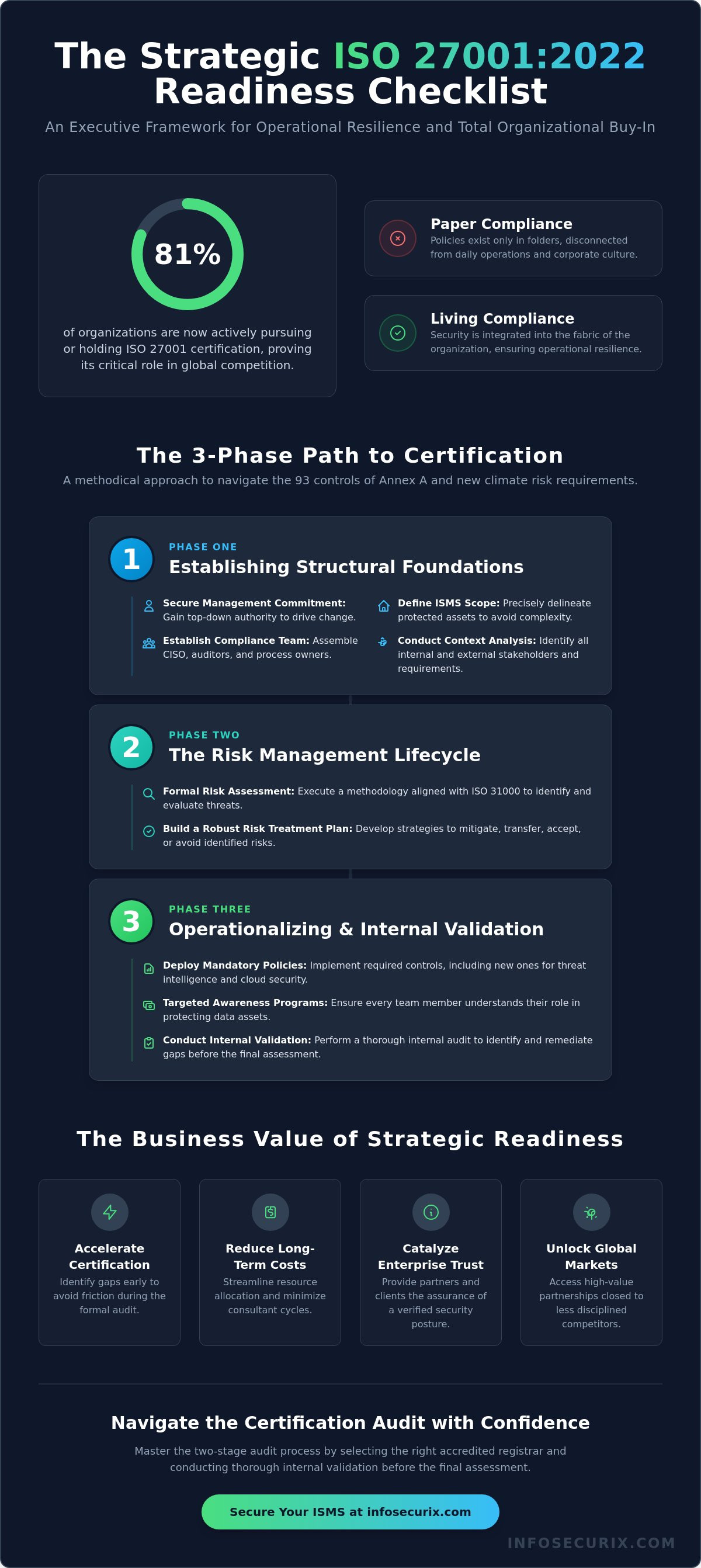
Did you know that 81% of organizations are now actively pursuing or holding ISO 27001 certification? This significant rise from 2024 proves that rigorous security standards are no longer optional for those seeking to compete on a global stage. You likely view certification as a vital badge of trust: a necessary step to protect your reputation and secure high-value partnerships. Yet, the complexity of documentation and the challenge of aligning diverse departments often create a sense of unease. Our iso 27001 readiness checklist provides the clarity you need; it’s a sophisticated, executive-level framework built to foster resilience and secure total organizational buy-in.
We’ve crafted this guide to ensure you master every phase of the ISO/IEC 27001:2022 journey while minimizing operational disruption. You’ll learn how to navigate the 93 essential controls and the recent climate change risk requirements with absolute confidence. This article previews the strategic milestones of the certification process: offering a logical path from the initial risk assessment to a successful final audit that positions your firm as a protective force in the market.
Key Takeaways
- Transition from static documentation to “Living Compliance” to ensure your security framework supports long-term operational resilience.
- Secure formal management commitment and delineate your ISMS scope with a sophisticated iso 27001 readiness checklist designed for executive oversight.
- Execute a formal risk assessment methodology aligned with ISO 31000; it’s the most effective way to build a robust Risk Treatment Plan.
- Operationalize your strategy by deploying mandatory policies and targeted awareness programs.
- Master the two-stage audit process by selecting the right accredited registrar and conducting thorough internal validation before the final assessment.
Beyond the Basics: Defining Strategic ISO 27001 Readiness
Establishing a comprehensive iso 27001 readiness checklist is the first step toward moving beyond mere compliance. Achieving a state of true readiness involves more than simply ticking off technical tasks; it represents a mature alignment where your organization is both audit-ready and operationally resilient. This distinction is critical because many firms fall into the trap of “Paper Compliance.” This occurs when policies exist only in digital folders, disconnected from daily operations. In contrast, “Living Compliance” integrates security into the very fabric of your corporate culture. It ensures that every team member understands their role in protecting data assets through active, integrated processes.
The ISO/IEC 27001 standard provides the blueprint for this integration. While the transition to the 2022 version has fundamentally shifted requirements, automated scans alone cannot replace the deep analysis required by the updated framework. Your Information Security Management System (ISMS) functions as the central nervous system of your business. It coordinates responses to threats and ensures that security remains a proactive, rather than reactive, discipline. It’s the mechanism that translates high-level risk appetite into daily operational controls that protect your most valuable assets.
The Business Value of Strategic Readiness
Investing in strategic readiness significantly accelerates the ISO 27001 certification process. By identifying gaps early, you avoid the friction of last-minute remediation during a formal audit. This foresight directly impacts the long-term cost of ISO 27001 certification by streamlining resource allocation and reducing the need for repetitive consultant cycles. Beyond the financial metrics, readiness serves as a powerful catalyst for enterprise trust. It opens doors to global market access that remain closed to less disciplined competitors. Partners and clients seek the assurance that your security posture is verified, not just claimed.
Why a Checklist is Your Strategic Compass
An effective iso 27001 readiness checklist acts as a strategic compass for executive leadership. It’s not merely an IT task list; it is a tool for oversight that ensures accountability across all levels of the organization. Tracking progress against the 93 controls of Annex A requires a methodical approach that balances technical precision with organizational goals. This includes evaluating new controls like threat intelligence and cloud security that demand active management rather than passive monitoring. Readiness is the seamless alignment of people, processes, and technology.
Phase 1 Checklist: Establishing the Structural Foundations
Building a resilient security framework begins with the structural integrity of your governance model. This initial phase of your iso 27001 readiness checklist focuses on the high-level mandates that dictate the success or failure of the entire Information Security Management System (ISMS). You can’t treat this as a simple technical task; it’s a top-down mandate that requires formal commitment from Top Management. Without this leadership, the ISMS lacks the authority to drive cross-departmental change and secure the necessary resources for long-term sustainability.
Once commitment is secured, the next step involves defining the ISMS Scope. You must clearly delineate what assets and processes are protected to avoid operational bloat. Following this, you’ll establish your Compliance Team. This group typically includes the Chief Information Security Officer (CISO), an Internal Auditor, and various Process Owners who manage specific controls. Finally, conducting a Context Analysis ensures you’ve identified all internal and external stakeholders. This process accounts for the regulatory requirements that govern your specific industry, aligning your strategy with the leading globally recognized information security standard.
Defining the Scope: The Most Critical Readiness Step
Precision in scoping is a strategic necessity. An overly broad scope often inflates implementation costs and creates unnecessary complexity, while a narrow scope might leave critical data vulnerable. Clause 4 of the standard requires you to understand the “Context of the Organization,” which serves as the foundation for your boundaries. To ensure your iso 27001 readiness checklist is accurate, you should map your data flows and identify critical assets using these criteria:
- Identify all physical and digital repositories where sensitive data resides.
- Map third-party access points and vendor dependencies.
- Categorize data based on sensitivity and regulatory impact.
- Delineate geographic locations and legal jurisdictions involved in data processing.
If you’re unsure where to draw these lines, our team can help you conduct a formal scope validation to prevent future audit non-conformities.
Securing Executive Buy-in and Resource Allocation
Top Management holds specific responsibilities under Clause 5, including the integration of security requirements into the organization’s business processes. This isn’t just about approval; it’s about active resource allocation. For instance, the approach to ISO 27001 for small business entities often requires a more concentrated budget compared to large enterprises with existing security departments. Appointing a “Security Champion” is equally vital. This individual bridges the gap between technical teams and executive leadership, driving the cultural change necessary for long-term compliance. They ensure that security isn’t seen as a hurdle but as a business enabler that fosters growth and trust.
Phase 2 Checklist: The Risk Management Lifecycle
The transition from governance to execution defines the second stage of your iso 27001 readiness checklist. While the first phase established who is responsible, Phase 2 determines exactly what must be done based on your organization’s unique risk profile. This phase acts as the engine of the Information Security Management System; it’s the point where theoretical framework meets operational reality. You must execute a formal Risk Assessment using a methodology that aligns with ISO 31000. Unlike simple technical scans that only identify software vulnerabilities, a strategic assessment evaluates the business impact of data loss, the likelihood of human error, and the reliability of physical security measures.
Performing a comprehensive Gap Analysis is essential to compare your current state against the ISO 27001 certification readiness baseline. This analysis identifies exactly where your existing controls fall short of the standard’s requirements. It allows you to prioritize remediation efforts where they’ll have the most significant impact on your security posture. This process turns a daunting list of requirements into a manageable, prioritized project plan that your team can execute with precision.
Mastering the Statement of Applicability (SoA)
The Statement of Applicability is the most scrutinized document during an external audit. It serves as the definitive list of which Annex A controls you’ve chosen to implement and, crucially, why you’ve excluded others. With the transition to the 2022 version, the control set has been consolidated from 114 to 93. You must provide clear, logical justifications for any exclusions. Auditors look for deep alignment here; they want to see that your decisions are rooted in the findings of your risk assessment rather than a desire to avoid difficult implementations.
Risk Treatment: Beyond Technical Mitigation
Risk treatment isn’t always about building a bigger firewall. You have four distinct options when addressing a vulnerability: Treat, Transfer, Tolerate, or Terminate. Treating a risk involves implementing controls to reduce its impact or likelihood. Transferring it might involve cyber insurance or third-party agreements. Tolerating a risk occurs when the cost of mitigation outweighs the potential loss, while terminating it means stopping the activity that creates the risk altogether. Management must formally accept any “Residual Risk” that remains after treatment. The Risk Treatment Plan serves as the bridge between theory and operation.
Phase 3 Checklist: Operationalizing and Internal Validation
The third phase of your iso 27001 readiness checklist marks the transition from strategic design to active operational life. This is where your policies stop being concepts and start being practiced. You must deploy the mandatory documentation, including specific procedures and evidence logs, while simultaneously launching security awareness training for all personnel. This cultural shift ensures that security is a collective responsibility rather than a siloed IT function. Once these processes have been running for several months, you’ll need to conduct an internal audit to validate the effectiveness of your Information Security Management System (ISMS) before the external registrar arrives.
Following the audit, you must hold a formal Management Review Meeting. This isn’t just a status update; it’s a high-level validation where leadership reviews audit findings, assesses the need for changes, and authorizes specific improvements. This step closes the loop on the Plan-Do-Check-Act cycle, demonstrating to future auditors that your organization is committed to the continuous improvement of its security posture. It’s the final proof that your framework is functioning as intended.
The Internal Audit: Your Final Dress Rehearsal
The internal audit serves as a critical stress test for your ISMS. A fundamental requirement of the standard is auditor independence; you simply cannot audit your own work. This objectivity is why many organizations choose to hire a specialized cybersecurity internal audit firm to conduct this review. A professional third-party auditor provides the unbiased perspective necessary to identify hidden non-conformities that internal teams might overlook. During this phase, you should gather a comprehensive set of “Audit Evidence” for Annex A controls, including:
- User access logs and periodic review records.
- Documented results of recent vulnerability scans and penetration tests.
- Records of security awareness training completion for all staff.
- Physical security logs and visitor registration records.
- Incident response logs and post-incident review reports.
If you need to ensure your framework is truly audit-ready, you can schedule a professional internal audit with our seasoned consultants today.
Documentation: Quality Over Quantity
Auditors value precision over volume. You should avoid using generic “boilerplate” templates that don’t reflect your actual operations, as these are easily spotted and often lead to non-conformities. Your documentation must be bespoke to your business. Every auditor will look for these five mandatory documents first: the Information Security Policy, the Risk Assessment Report, the Statement of Applicability (SoA), the Inventory of Assets, and the Access Control Policy. Ensure these documents follow a strict version control and approval workflow. This discipline proves that your ISMS is a managed, deliberate system rather than a collection of static files.
Navigating the Certification Audit with InfoSecurix
Selecting an accredited registrar represents the final strategic decision in your certification journey. You should prioritize a body with a reputation for rigor to ensure your certificate commands global recognition and respect. The formal audit begins with Stage 1: a meticulous document review where the auditor confirms that your ISMS framework is theoretically sound. This stage verifies that your iso 27001 readiness checklist has been translated into a compliant set of policies and procedures. Stage 2 is the operational test; it’s the moment where you demonstrate that your organization truly lives the standards you’ve authored. During this phase, auditors interview staff and observe processes to confirm that your “Living Compliance” is an everyday reality. Should any minor non-conformities emerge, corrective action planning provides the opportunity to refine your system with strategic precision before the final recommendation for certification.
The InfoSecurix Advantage: Expert-Led Readiness
Automated compliance platforms often emphasize speed over substance, yet they frequently miss the nuanced organizational context that sophisticated auditors demand. InfoSecurix offers a boutique consultancy experience: bringing over 25 years of mastery in navigating complex regulatory landscapes. We don’t believe in generic solutions. Instead, we provide a bespoke Readiness Assessment that functions as a powerful risk-reduction strategy for the final audit. This assessment identifies subtle gaps in your iso 27001 readiness checklist implementation: ensuring your team is unfazed when the external auditor begins their scrutiny. Our seasoned guides have seen every possible scenario and remain calm under the pressure of high-stakes assessments.
Your Next Steps Toward Global Compliance
Transitioning from the preparation phase to a formal engagement is the most reliable way to secure your organization’s future. We position ourselves as a collaborative ally, invested in your long-term growth and resilience. Our partnership model focuses on building a sustainable security culture that transcends the audit date. Securing enterprise-level trust from global partners requires a methodical, top-down approach that only a dedicated expert can provide. We invite you to take the next step by scheduling a strategic readiness consultation. Let’s work together to transform your compliance journey into a narrative of achievement and enduring security.
Securing Your Enterprise Future through Strategic Resilience
Mastering the path to certification requires a deliberate transition from passive documentation to active, living compliance. By utilizing a structured iso 27001 readiness checklist, you’ve moved from securing essential management commitment to operationalizing a risk-based culture that protects your most vital data assets. This journey isn’t just about passing a single audit. It’s about building an enduring foundation of trust that enables global growth and ensures long-term operational stability. True readiness transforms security from a technical hurdle into a powerful business enabler.
InfoSecurix stands ready to guide you through these complexities with over 25 years of elite information security consultancy. Our deep expertise across ISO 27001, SOC2, and ISO 22301 provides your organization with proven corrective action strategies designed specifically for complex enterprises. We don’t just help you meet the standard; we help you future-proof your business against an evolving threat landscape with absolute precision and professional care. Your path to global compliance is a strategic investment in your brand’s integrity.
Secure Your Strategic ISO 27001 Readiness Consultation
We look forward to partnering with you to achieve this significant milestone and elevate your security posture to world-class standards.
Frequently Asked Questions
What is the most common reason organizations fail an ISO 27001 readiness assessment?
The most frequent cause for failure is a lack of active leadership involvement and an improperly defined ISMS scope. When executives treat certification as a siloed IT task rather than a strategic mandate, the system fails to integrate into daily operations. This disconnect leads to insufficient resource allocation and a lack of cultural buy-in. An effective iso 27001 readiness checklist ensures that management commitment is the very first milestone addressed.
How long does it typically take to complete the ISO 27001 readiness checklist?
Most organizations require between six and twelve months to move from the initial planning stage to full audit readiness. The specific timeline depends on the maturity of your existing security controls and the complexity of your organizational structure. Larger enterprises with diverse data flows may take longer to validate every requirement. Following a structured iso 27001 readiness checklist helps streamline this timeline by identifying critical gaps early in the process.
Can we use an automated platform instead of a readiness checklist?
Automated platforms serve as excellent tools for evidence collection and monitoring, but they can’t replace the strategic oversight of a readiness checklist. ISO 27001 is fundamentally about risk management and human processes, which require qualitative judgment. While software can flag a missing document, it can’t evaluate the cultural alignment or the effectiveness of your internal governance. A checklist ensures that you address the high-level strategic requirements that automated tools often overlook.
Is the Statement of Applicability (SoA) mandatory for ISO 27001:2022?
The Statement of Applicability remains a mandatory requirement for the ISO 27001:2022 version. It serves as the definitive record of which Annex A controls your organization has implemented and provides the justification for any exclusions. Auditors scrutinize this document to ensure your security decisions align with your formal risk assessment. It’s the central document that bridges your risk management strategy with the actual technical and organizational controls in place.
What is the difference between an internal audit and a readiness assessment?
A readiness assessment is a preliminary gap analysis designed to identify what your organization needs to build or improve. It’s a collaborative tool used to create a roadmap toward compliance. In contrast, an internal audit is a formal, independent review required by the standard to verify that your system is functioning effectively. While the assessment focuses on preparation, the audit acts as a final stress test before the external certification body arrives.
How often should the ISO 27001 readiness checklist be updated?
You should treat your checklist as a living document that evolves alongside your business. It’s best practice to review and update it whenever there are significant changes to your IT infrastructure, business processes, or regulatory requirements. At a minimum, an annual review ensures that your controls remain effective against emerging threats. Regular updates prevent your security framework from becoming a static set of papers that no longer reflect your operational reality.
What are the mandatory documents required for ISO 27001 certification?
Mandatory documentation includes the ISMS scope, the Information Security Policy, and the formal Risk Assessment and Treatment methodology. You must also produce the Statement of Applicability and documented evidence of competence and awareness training. Auditors require these records to prove that your system is managed and deliberate. Beyond these core files, you must maintain evidence logs for operational controls, such as access reviews and incident response reports, to demonstrate ongoing compliance.
Who should be on the ISO 27001 implementation team?
A successful implementation team requires a cross-functional group led by a Chief Information Security Officer or a dedicated project manager. It should include representatives from IT, Human Resources, Legal, and physical facilities management to ensure comprehensive coverage of all 93 controls. Including “Security Champions” from different departments helps drive the necessary cultural changes across the organization. This collaborative approach ensures that security is viewed as a shared responsibility rather than an isolated technical requirement.