
In a landscape where verifiable security is a prerequisite for US enterprise growth, the pressure to demonstrate rigorous standards has reached a critical threshold. While the global demand for certified frameworks grows at over 15% annually, many organizations still find the path to iso 27001 certification readiness fraught with operational friction and documentation fatigue. You likely recognize the tension between maintaining technical controls and achieving broader business objectives, especially when the fear of a public audit failure remains a constant concern. It’s a challenge that requires more than just a checklist; it demands a sophisticated alignment of security and strategy.
This guide provides a clear, predictable roadmap to transform your compliance efforts into a growth-enabling asset. We’ll explore the critical components of a robust readiness assessment, the strategic distinction between gap analyses and internal audits, and the methodical phases required to achieve an audit-ready status. By moving beyond manual documentation to a curated security posture, you’ll ensure your business is not just compliant, but fundamentally protected against the evolving risks of 2026 and beyond.
Key Takeaways
- Learn why true readiness involves more than a simple checklist: it’s a sophisticated blend of technical controls and cultural alignment designed for audit success.
- Establish a clear path toward iso 27001 certification readiness by defining a precise ISMS scope and implementing a rigorous, repeatable risk assessment methodology.
- Recognize the critical distinction between a preliminary gap analysis and the formal internal audit: the essential dress rehearsal required by Clause 9.2.
- Follow a structured, phased roadmap that moves from initial discovery to proactive risk treatment, ensuring your security objectives mirror your core business goals.
- Discover the value of a bespoke engagement that avoids generic templates, focusing instead on a curated strategy that transforms compliance into a long-term competitive asset.
Defining ISO 27001 Certification Readiness: Beyond the Checklist
Achieving a state of iso 27001 certification readiness is a transformative milestone that signals an organization’s transition from reactive security to proactive resilience. It represents the precise moment when your Information Security Management System (ISMS) is robust enough to withstand the dual-stage audit process. Stage 1 focuses on your documentation’s structural integrity; Stage 2 tests the actual effectiveness of your controls. True readiness means you don’t just have the paperwork. You have the evidence of a living, breathing security culture where every team member understands their role in protecting the business assets.
The shift from the 2013 standard to the 2022 requirements has fundamentally altered the preparation landscape. Organizations must now navigate a streamlined set of 93 controls grouped into four distinct themes: organizational, human, physical, and technological. This modern approach to ISO/IEC 27001 requires a more integrated strategy. It’s about instilling confidence in stakeholders by proving that security is woven into the business fabric. By 2026, the expectation for this level of maturity is no longer optional. It’s a baseline for corporate excellence. True readiness also involves addressing recent amendments, such as the 2024 requirement to evaluate climate change as a relevant issue within the ISMS context.
The Core Pillars of an Audit-Ready ISMS
A resilient ISMS functions as a dynamic ecosystem, not a static binder on a shelf. At the heart of this system lies the Statement of Applicability (SoA). This foundational document serves as your security blueprint: it justifies why specific controls were chosen and why others were excluded based on your unique risk profile. However, even the most detailed SoA will falter without the non-negotiable pillar of top management commitment. Leadership must champion the security vision to ensure that resources are allocated and that security objectives remain aligned with corporate goals. This top-down support transforms compliance from a technical hurdle into a shared organizational value that drives long-term stability.
Why Readiness Matters for National Enterprise Growth
Investing in comprehensive iso 27001 certification readiness provides a significant shield against the hidden costs of audit remediation. Discovering gaps during a formal audit is a costly setback. It can delay market entry or stall major contracts. By achieving an audit-ready state, you streamline vendor risk management processes and build immediate trust with high-value clients. In high-stakes industries, this level of preparation serves as a powerful competitive differentiator. It demonstrates that your organization possesses the maturity to protect sensitive data. This maturity is a prerequisite for long-term growth and corporate excellence. Ultimately, being ready means you’re not just passing an audit; you’re future-proofing your business against an evolving threat landscape.
The Critical Components of a Robust Readiness Assessment
Conducting a rigorous diagnostic represents the first tangible step toward achieving iso 27001 certification readiness. This phase moves beyond high-level objectives to scrutinize the specific mechanisms of your security posture. A robust assessment begins with an uncompromising look at your Risk Assessment Methodology. It’s not enough to simply list threats: the process must be repeatable, documented, and capable of producing consistent results under audit scrutiny. Many organizations find value in cross-referencing their approach with the NIST Cybersecurity Framework to ensure a comprehensive view of identify, protect, and detect functions. This alignment provides a multi-dimensional perspective on risk that satisfies both international and domestic expectations.
Mapping current practices against the 93 Annex A controls of the 2022 revision demands a curated approach. It involves evaluating human and physical security with the same rigor as technological controls. Central to this is the “People” factor. Security is a shared responsibility. Assessing role-based responsibilities and the effectiveness of awareness training ensures that your staff act as a proactive defense layer rather than a point of vulnerability. When every employee understands their specific security duties, the organization moves from a state of passive compliance to one of active protection.
Scoping the Information Security Management System
Defining the boundaries of your ISMS requires strategic precision. Over-scoping leads to resource exhaustion and unnecessary complexity, while under-scoping creates blind spots that auditors will inevitably uncover. You must identify all “interested parties,” from regulatory bodies to key clients, and map their specific security requirements directly to your ISMS boundaries. Achieving iso 27001 certification readiness also hinges on understanding how these boundaries impact the final certification cost and effort. A well-defined scope ensures that resources are focused on the assets that truly drive business value and protect your reputation. To build a predictable budget around your scoping decisions, our detailed breakdown of the cost of iso 27001 certification provides the financial clarity needed to justify your investment to stakeholders.
Evaluating Control Effectiveness vs. Presence
Differentiating between the presence of a control and its effectiveness is where many readiness efforts falter. Having a policy in a digital folder is not evidence of compliance. The standard requires “Monitoring and Measurement” to prove that controls are actually working as intended over time. While manual evidence collection is often the starting point, shifting toward automated evidence collection reduces operational friction and provides the continuous assurance that modern auditors expect. If you are unsure where your current maturity lies, a professional Risk Assessment can provide the clarity needed to close these gaps before the formal audit begins. This proactive approach transforms the audit from a high-pressure hurdle into a predictable validation of your established security excellence.
Gap Analysis vs. Internal Audit: Navigating the Pre-Certification Landscape
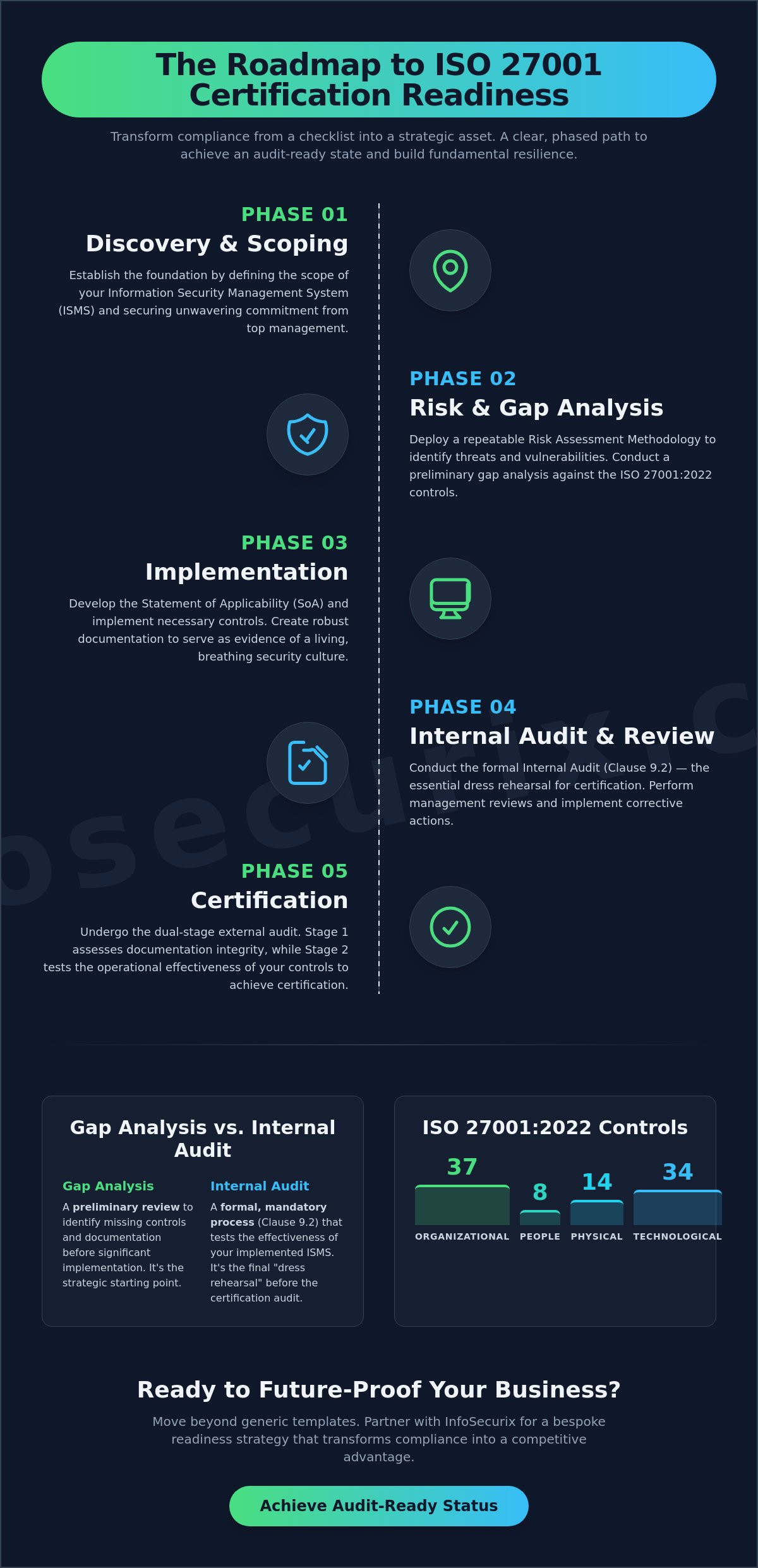
Understanding the distinction between a gap analysis and a formal internal audit is vital for any leadership team pursuing iso 27001 certification readiness. While both assessments evaluate your security posture, they serve entirely different strategic purposes at opposite ends of the implementation timeline. A gap analysis acts as your initial diagnostic: a “where are we now” exploration that uncovers the distance between your current state and the standard’s requirements. In contrast, the internal audit is a mandatory, rigorous “dress rehearsal” designed to prove that your Information Security Management System (ISMS) is not only present but functioning effectively before the external certification body arrives.
Navigating these two phases requires a methodical approach that balances technical precision with business objectives. InfoSecurix acts as your seasoned guide, ensuring that each assessment provides actionable intelligence rather than just a list of failures. By distinguishing between these milestones, you can allocate resources more effectively and avoid the common pitfall of treating the internal audit as a first-time discovery session. This clarity ensures that when the final audit dates arrive, your organization stands on a foundation of verified excellence.
The Role of the Gap Analysis in Early Readiness
Launching your journey with a gap analysis provides the essential blueprint for your entire implementation project. This phase isn’t about passing or failing; it’s about discovery and strategic alignment. A high-level consultant interprets the standard’s technical requirements within your unique business context, ensuring that compliance doesn’t stifle innovation. The primary deliverables include a comprehensive gap report and a prioritized remediation roadmap. For organizations just beginning to formalize their security culture, referencing frameworks like the CISA Cyber Essentials can offer a practical foundation that complements the more rigorous ISO requirements. This early assessment ensures that every subsequent investment of time and capital is directed toward closing the most critical security voids.
The Mandatory Internal Audit: A Requirement for Success
As you approach the final stages of iso 27001 certification readiness, Clause 9.2 of the standard mandates a formal Internal Audit. This is a non-negotiable requirement that must be conducted by impartial, competent personnel who were not involved in the ISMS setup. The internal audit doesn’t just identify non-conformities. It validates that your corrective actions are actually effective in real-world scenarios. To understand how to transform this mandatory process into a strategic diagnostic tool, explore our detailed guide on conducting a information security internal audit as a driver of organizational resilience. The findings from this audit feed directly into the Management Review process, providing leadership with the data-driven confidence needed to authorize the final certification audit. We ensure that your internal audit isn’t just a compliance box to tick, but a strategic validation of your organizational resilience. This process transforms these assessments into opportunities for continuous improvement, positioning your business as a trusted leader in information security.
A Strategic Roadmap: The Phases of Achieving Audit-Ready Status
Achieving a state of audit-ready excellence isn’t a static destination. It’s a methodical progression through specific strategic milestones that transform your security posture from a collection of technical controls into a unified business asset. While previous discussions focused on definitions and diagnostics, this roadmap outlines the momentum required to reach the finish line. Every phase is designed to build upon the last, ensuring that your iso 27001 certification readiness is both thorough and sustainable.
- Phase 1: Discovery and Scoping. Aligning security boundaries with your core business objectives to ensure resource efficiency.
- Phase 2: Risk Assessment and Treatment. Identifying and mitigating core vulnerabilities through a repeatable, documented methodology.
- Phase 3: Remediation and Implementation. The active closure of gaps identified during initial discovery.
- Phase 4: Validation and Internal Audit. Verifying that the system functions as intended before the external registrar arrives.
- Phase 5: Management Review. Securing final executive alignment and authorization to proceed with certification.
Following this structured path allows your organization to maintain a steady pace, avoiding the frantic, last-minute rushes that often lead to audit failures. To gain a deeper understanding of each chronological stage involved, review our comprehensive guide to the iso 27001 certification process and the strategic decisions required at every milestone. Secure your competitive edge by partnering with us for a comprehensive ISO 27001 Certification Readiness engagement that guarantees professional precision at every stage.
Remediation: The Most Critical Phase of Readiness
Transitioning from the discovery of gaps to their active closure represents the most demanding phase of your journey. It’s the point where policies become practices and procedures are backed by tangible evidence logs. This phase isn’t merely about fixing technical issues; it’s about establishing the documentation trail that auditors require to verify compliance. Central to this effort is the implementation of corrective actions. Corrective Action is the systematic elimination of the root cause of a nonconformity. By focusing on root causes rather than symptoms, you ensure that your security ecosystem remains resilient long after the initial certification is granted.
Preparing the Team for the Certification Body Audit
The final hurdle involves the external registrar’s visit, which occurs in two distinct stages. The Stage 1 Audit serves as a documentation review and readiness check: the registrar confirms that your ISMS framework meets the standard’s structural requirements. Once you pass this hurdle, the Stage 2 Audit shifts the focus to operational effectiveness. Preparing your staff for interviews is essential during this phase. They must be able to articulate their security responsibilities with confidence. Building this psychological readiness through mock interviews and awareness sessions ensures that your team remains calm under pressure. When your people believe in the system they’ve built, that confidence translates into a successful, predictable audit outcome.
Partnering for Resilience: The InfoSecurix Approach to ISO 27001
InfoSecurix stands as a seasoned veteran in a field often characterized by high-pressure deadlines and technical jargon. With a legacy spanning over 25 years, we’ve witnessed every iteration of the standard, allowing us to guide organizations through iso 27001 certification readiness with absolute composure. We don’t believe in the distant, adversarial role of a traditional auditor. Instead, we act as a collaborative ally, ensuring that your security framework isn’t just a hurdle to clear but a protective force that enables your company’s growth. Our approach is fundamentally bespoke: we reject generic templates in favor of highly curated strategies that reflect your specific operational realities.
Bridging the gap between granular technical mechanics and high-level strategic value is our core strength. We understand that executive decision-makers need to see how a risk assessment or a specific technological control translates into business resilience and market trust. By positioning compliance as a visionary standard rather than a reactive necessity, we help you transform a perceived liability into a growth-enabling asset. This methodical, top-down perspective ensures that every stakeholder, from the server room to the boardroom, remains aligned with the organization’s security mission. We remain calm under pressure so you can focus on your core business objectives with total peace of mind.
Why 25+ Years of Experience Matters in 2026
The transition from the 2013 standard to the 2022 revision, coupled with the 2024 climate change amendments, has created a complex landscape for even the most diligent firms. Having a deep historical perspective prevents the common errors that arise from a surface-level understanding of these shifts. InfoSecurix stays ahead of the emerging regulatory curve, ensuring our clients are prepared for national compliance requirements before they become bottlenecks. As a leader in high-stakes environments, we provide the steady hand needed to navigate these evolving standards. Our longevity isn’t just a number; it’s a repository of deep-rooted knowledge that future-proofs your business against both current threats and tomorrow’s regulations.
Your Journey to Absolute Confidence
Choosing a proactive security posture over an audit-chasing mindset is the defining characteristic of a mature organization. When you shift your focus from simply passing a test to building a culture of verifiable excellence, the audit itself becomes a predictable formality. We offer the certainty and security required to pursue ambitious growth targets without the fear of public failure or resource exhaustion. Your journey toward iso 27001 certification readiness should result in more than just a certificate; it should provide the absolute confidence that your business is resilient, respected, and ready for the future. Engage InfoSecurix for a Comprehensive Readiness Assessment to begin your transition from compliance to competitive advantage.
Securing Your Competitive Advantage through Strategic Resilience
Mastering iso 27001 certification readiness is a deliberate journey that transforms information security from a technical requirement into a powerful business enabler. By navigating the distinct phases of gap analysis and internal auditing with precision, your organization builds a foundation of trust that resonates with global clients and stakeholders alike. This process isn’t merely about passing an audit. It’s about instilling a culture of continuous improvement that protects your long-term growth and operational integrity. You’ve seen how a structured roadmap and cultural alignment turn compliance into a strategic asset.
With over 25 years of information security excellence, InfoSecurix provides the seasoned guidance and proven methodology necessary for national compliance success. Our expertise spans ISO 27001, SOC2, and ISO 22301, ensuring your readiness strategy is comprehensive, meticulous, and bespoke. We remain the steady partner you need to navigate these complexities without operational friction. We invite you to Secure Your Strategic ISO 27001 Roadmap with InfoSecurix and experience the absolute confidence that comes from expert partnership. Your path to a resilient, audit-ready future is clear; let’s build that legacy of security together.
Frequently Asked Questions
What is the difference between an ISO 27001 readiness assessment and a gap analysis?
A gap analysis identifies missing controls at the start of your journey, serving as an initial “where are we now” diagnostic. In contrast, iso 27001 certification readiness involves a deeper evaluation of your system’s operational maturity. It ensures that your policies aren’t just written, but are actively followed and measurable. This assessment serves as the final validation that your ISMS is resilient enough to withstand a formal registrar’s scrutiny.
How long does it typically take to become ISO 27001 audit-ready?
Most organizations require six to twelve months to reach a state of full audit readiness. This timeline fluctuates based on your current security maturity and the complexity of your business operations. Larger enterprises with multi-site scopes often lean toward the longer end of this range. Smaller, agile firms might move faster if they possess dedicated compliance resources and strong leadership support.
Can we perform an ISO 27001 readiness assessment internally?
You can perform a readiness assessment internally, but doing so often risks a lack of impartiality. External experts bring a “fresh set of eyes” and a historical perspective that internal teams might lack. A seasoned guide identifies subtle non-conformities that internal staff might overlook due to familiarity with existing workflows. This external validation significantly increases your chances of passing the formal audit on the first attempt.
What are the most common reasons organizations fail their ISO 27001 Stage 1 audit?
Failure at Stage 1 often stems from an incomplete Statement of Applicability (SoA) or a poorly defined ISMS scope. Auditors look for structural integrity in your documentation before they ever test your controls. If your risk assessment methodology is inconsistent or your mandatory clauses aren’t addressed, the registrar will likely halt the process. Ensuring these foundational documents are robust is the cornerstone of iso 27001 certification readiness.
How much does ISO 27001 certification readiness cost for a mid-sized enterprise?
The total investment for readiness varies significantly based on the scope of your Information Security Management System. Factors such as the number of employees, the complexity of your technical infrastructure, and your geographic footprint all influence the final figure. While industry averages exist, a bespoke assessment is the only way to determine the specific resource allocation required for your unique business context. For a comprehensive breakdown of every variable that shapes your budget, review our detailed analysis of the cost of iso 27001 certification across the full three-year cycle to build a transparent and defensible financial roadmap.
Is an internal audit mandatory before the certification body arrives?
Yes, a full internal audit is a non-negotiable requirement under Clause 9.2 of the standard. You must complete this “dress rehearsal” and present the findings to management before the external certification body begins their Stage 1 review. The internal audit proves that your system is self-correcting and that you’ve identified any minor non-conformities before they become major hurdles during the formal certification process.
What is the role of top management during the readiness process?
Top management must provide the strategic vision and the necessary resources for the ISMS to thrive. They aren’t just passive sponsors; they’re active participants who ensure security objectives remain aligned with corporate goals. Auditors will interview leadership during Stage 2 to verify their commitment and understanding of the risk landscape. This visible leadership is what transforms a technical project into a sustainable organizational culture.
How does the ISO 27001:2022 update affect our current readiness plan in 2026?
In 2026, all new certifications must adhere strictly to the ISO 27001:2022 standard. This version features a revised set of 93 controls grouped into four modern themes. It also includes the 2024 amendment requiring organizations to evaluate climate change risks within their ISMS context. Your readiness plan must reflect these updated controls and the shift toward a more integrated, risk-based approach to information security internal audit practices and overall security governance.