
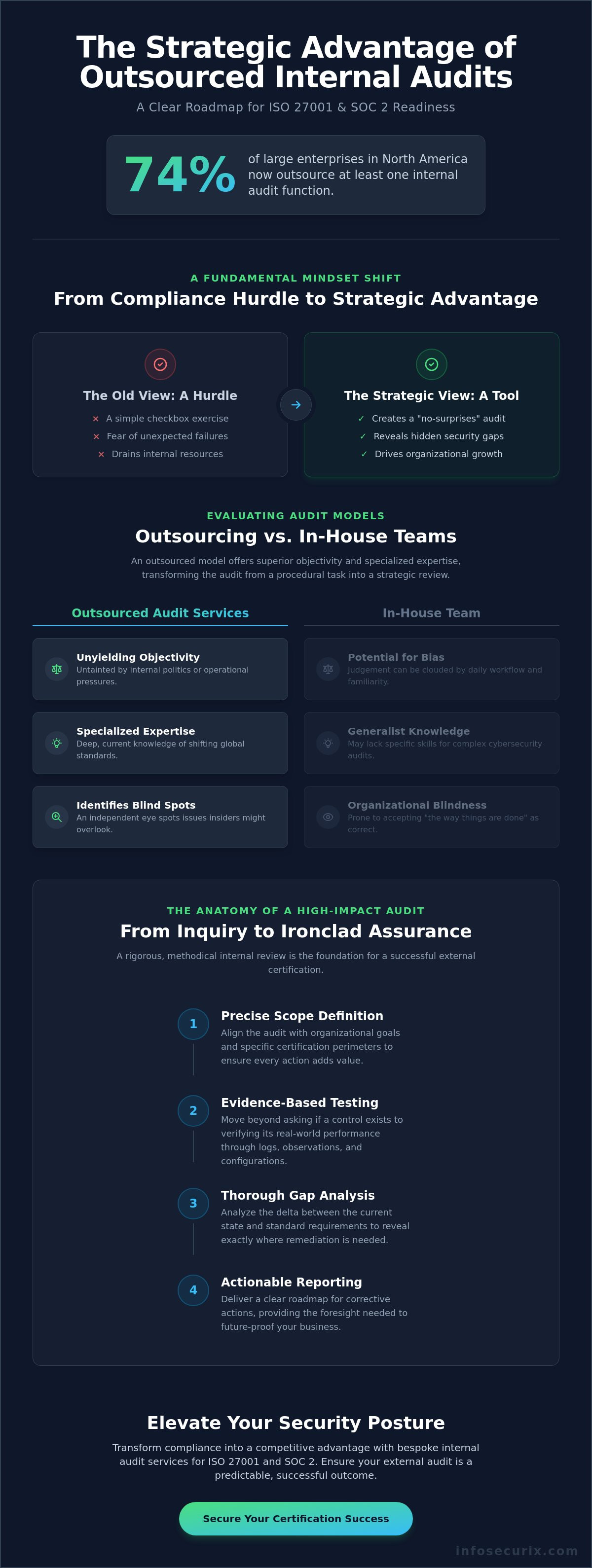
Over 74% of large enterprises in North America now outsource at least one internal audit function to navigate the complexities of modern governance. You’re likely feeling the weight of the new Global Internal Audit Standards and the mandatory 2026 Topical Requirements for Cybersecurity and Organizational Resilience. It’s a daunting task to manage these shifting goalposts when your internal resources are already at capacity; the fear of an unexpected failure during an external certification audit is a legitimate concern for any executive.
Engaging professional internal audit services transforms these regulatory hurdles into a powerful strategic advantage. By moving beyond a simple checkbox exercise, you’ll discover how a methodical internal review creates a “no-surprises” external audit experience and reveals hidden security gaps before they become liabilities. This guide provides a clear roadmap for your ISO 27001 or SOC2 readiness: delivering the foresight and corrective actions needed to future-proof your business in a competitive global market.
Key Takeaways
- Transition from viewing compliance as a mandatory hurdle to utilizing it as a strategic tool for organizational growth.
- Master the shift from simple inquiry to rigorous evidence-based testing to verify the actual effectiveness of your security controls.
- Understand why the outsourced model for internal audit services offers superior objectivity and specialized expertise compared to internal teams.
- Identify the specific documentation and communication protocols required to streamline your audit process and eliminate last-minute friction.
- Discover how bespoke audit programs for ISO 27001 and SOC 2 provide a clear roadmap for long-term security and certification success.
The Strategic Role of Internal Audit Services in Modern Compliance
Professional internal audit services represent much more than a compliance obligation; they’re a sophisticated instrument of corporate governance designed to add value and improve an organization’s operations. Integrating internal auditing into the corporate structure provides an independent, objective assurance activity that helps an organization accomplish its objectives by bringing a systematic, disciplined approach to evaluating risk management. This objective stance is vital, as it ensures that the assessment remains untainted by the daily operational pressures that often cloud internal judgment.
Historically, these functions centered almost exclusively on financial integrity and fraud prevention. That focus has shifted. In the current climate, the scope has expanded significantly to encompass comprehensive information security reviews, reflecting the reality that digital assets are now among a firm’s most critical holdings. This evolution mirrors the rising complexity of the regulatory environment, where data protection and operational continuity are just as important as balance sheet accuracy.
For organizations pursuing ISO 27001 or SOC 2, conducting a formal internal audit isn’t optional. It’s a mandatory clause within the standards themselves. These “first-party” audits act as a rigorous internal pressure test, ensuring that controls are not only documented but are operating effectively before a “third-party” external registrar arrives for a certification assessment. Distinguishing between these functions is key: your internal team or partner prepares the ground, while the external auditor provides the final, public validation of your efforts.
Internal vs. External Audits: Understanding the Synergy
Viewing the internal audit as a mere dry run for the external certification ignores its true potential. While an external auditor focuses on providing a formal opinion for stakeholders, the internal auditor acts as a collaborative partner who identifies process blind spots that those within the daily workflow might overlook. Utilizing an independent eye ensures that the organization isn’t just passing the test but is genuinely secure. Internal readiness serves as the essential catalyst that transforms external validation from a high-stakes gamble into a predictable, successful outcome.
The Business Value of Proactive Information Security Auditing
Adopting a proactive stance toward auditing strengthens operational resilience far beyond the requirements of a certificate. Identifying vulnerabilities early reduces long-term remediation costs; it’s far more efficient to fix a control gap during a scheduled review than to respond to a breach in the middle of a crisis. This level of maturity builds profound trust with stakeholders, including board members and global partners, by providing verified evidence of security control maturity. Organizations that embrace internal audit services find that compliance naturally follows excellence, rather than the other way around.
Key Components of High-Impact Information Security Internal Audits
High-impact audits start with a precise scope definition. This process isn’t merely about drawing boundaries; it’s about aligning the audit with specific organizational goals and certification perimeters. Following the Global Internal Audit Standards provides a rigorous framework for this alignment. It ensures that every resource spent on the audit contributes directly to the organization’s governance and risk management objectives. Without a clearly defined scope, even the most thorough audit risks becoming a fragmented exercise that fails to satisfy external registrars.
Verification is the core of any effective review. We move beyond “asking” if a control exists and focus on “verifying” its actual performance. This evidence-based testing involves examining technical logs, observing operational workflows, and reviewing system configurations. When auditors verify controls, they look for repeatable, documented success. They don’t just check if a policy exists; they look for the technical artifacts that prove the policy is being followed in real-time. It’s the difference between a surface-level survey and a deep-seated assurance activity. By analyzing the delta between the current state and standard requirements, a thorough gap analysis reveals exactly where remediation is needed. This level of precision requires a specialized information security internal audit approach to ensure no technical nuance is missed.
Auditing for ISO 27001 and SOC 2 Standards
Auditing for ISO 27001 requires a dual focus on the Information Security Management System (ISMS) framework and the specific Annex A controls. The goal is to ensure the management system is robust enough to support long-term security. Conversely, SOC 2 audits center on the Trust Services Criteria: security, availability, processing integrity, confidentiality, and privacy. Utilizing a structured ISO 27001 internal audit checklist ensures a systematic review that leaves no stone unturned during the process. This methodical approach transforms the audit into a strategic rehearsal for final certification. Understanding the common ISO 27001 audit failures that derail organizations during Stage 2 assessments is equally critical to ensuring your preparation addresses the right vulnerabilities.
Risk-Based Auditing Methodologies
Modern internal audit services prioritize efforts based on the organization’s unique risk profile. This methodology integrates real-world threat intelligence into the planning phase; it allows auditors to focus on the most critical vulnerabilities first. Risk assessments inform the depth of control testing: ensuring that high-risk areas receive the most rigorous scrutiny. This targeted approach maximizes the strategic impact of the audit while optimizing resource allocation. If you’re ready to refine your approach, consider how our professional internal audit services can support your specific compliance journey.
Evaluating Internal Audit Models: Outsourcing vs. In-House
Deciding between a dedicated in-house team and external internal audit services requires a careful analysis of your organization’s maturity and risk appetite. While an internal department offers deep institutional knowledge, it often struggles with resource constraints and the high cost of maintaining specialized certifications like ISO 27001 or SOC 2 expertise. Many organizations find that the overhead of full-time salaries, benefits, and continuous training for a dedicated team outweighs the flexibility of an engagement-based model. This is particularly true when specialized skills are needed only for specific windows during the certification cycle.
Outsourcing provides immediate access to a seasoned veteran’s perspective and advanced diagnostic tools that entry-level platforms might miss. For those who prefer a hybrid approach, the “co-sourced” model blends internal context with external technical depth. This collaborative structure allows your team to focus on daily operations while experts handle the rigorous testing of complex controls. Adhering to the Internal Audit Standards of Practice ensures that regardless of the model chosen, the quality of the review remains consistent, defensible, and aligned with global governance frameworks.
When to Hire a Specialized Internal Audit Firm
Hiring a cybersecurity internal audit firm becomes essential when your environment includes intricate cloud architectures or strictly regulated data silos. If your internal team feels overextended or lacks the specific technical depth to verify encryption standards and API security, it’s time to bring in a guide. These specialists bring a legacy of success from diverse industries. They ensure your audit is a strategic roadmap rather than just a survival exercise, providing the technical scrutiny required for complex modern environments.
Maintaining Independence and Objectivity
Independence isn’t just a preference; it’s a non-negotiable requirement for compliance excellence. The “auditor cannot audit their own work” rule prevents the internal political bias that can lead to catastrophic surprises during an external assessment. External partners provide the unfiltered truth to executive leadership, acting as a protective force that enables growth through honest, rigorous evaluation. This objective clarity ensures that your audit reports are perceived as trustworthy by both board members and external registrars, free from any internal pressures or conflicts of interest.
Preparing Your Organization for a Successful Internal Audit
Success in a high-stakes compliance environment depends on meticulous preparation. Establishing clear objectives and communication channels ensures that everyone involved understands the specific goals of the engagement. This isn’t just an administrative task; it’s the foundation of a “no-surprises” experience. You should begin by briefing internal stakeholders on the process and their specific roles to eliminate confusion during the active review. When everyone knows what to expect, the audit moves from a source of anxiety to a structured exercise in excellence.
Gathering documentation in advance is a critical step that often determines the pace of the audit. You’ll need to compile policies, procedures, and technical logs into a central repository. This organized approach allows your partner to review evidence efficiently, reducing the time your team spends searching for files during interviews. When you engage professional internal audit services, this level of readiness transforms the audit into a streamlined, strategic exercise rather than a disruptive hurdle. A central repository doesn’t just help the auditor; it provides your leadership with a curated view of your current security posture.
The Internal Audit Lifecycle: From Kickoff to Reporting
The process begins with a formal opening meeting to set expectations and finalize the scope. During the fieldwork phase, expect a series of interviews and technical walkthroughs where the auditor verifies that your documented controls are active in your daily operations. This is the “verify” phase mentioned earlier, where evidence is cross-referenced against your ISMS or SOC 2 criteria. The cycle concludes with a draft report that distinguishes between critical non-conformities and opportunities for improvement. This distinction is vital; it helps you focus your energy on the most significant risks first.
Remediation and Strategic Corrective Actions
Once the findings are delivered, the focus shifts to a Corrective Action Plan (CAP). A well-constructed CAP addresses the root cause of a gap rather than just treating the symptom. You must prioritize findings based on their risk level and their impact on your final certification. Monitoring this progress ensures that your “audit-ready” status is maintained throughout the year, not just in the weeks leading up to an assessment. Awareness of the most common ISO 27001 audit failures and their root causes can sharpen your corrective action priorities and prevent recurring non-conformities. If you’re ready to ensure your organization is fully prepared for its next milestone, schedule your internal audit services to secure your strategic advantage.
Elevating Your Security Posture with InfoSecurix Internal Audit Services
InfoSecurix brings a seasoned veteran’s perspective to every engagement; we’ve spent over 25 years navigating high-stakes compliance environments. Our approach to internal audit services isn’t a one-size-fits-all checklist. We develop bespoke audit programs meticulously designed for ISO 27001, SOC 2, and ISO 22301 standards. This curated methodology ensures that your specific operational nuances are respected while meeting the most rigorous global benchmarks. By positioning ourselves as a partner rather than just a distant auditor, we provide the actionable strategic guidance you need to transform findings into growth opportunities. Our goal is to ensure your organization achieves total ISO 27001 certification readiness, giving you absolute confidence before the external registrars arrive.
The InfoSecurix Advantage: Precision and Longevity
Deep technical expertise is the hallmark of the InfoSecurix advantage. We identify the subtle security gaps that generic auditors often miss, from misconfigured cloud permissions to gaps in business continuity documentation. This precision comes from our longevity in the field. We’ve seen every possible scenario and remain unfazed by complexity. Our commitment to future-proofing your compliance ensures that you don’t just pass your next audit; you build a resilient foundation for the years to come. This steady, authoritative approach has enabled countless organizations to achieve “zero-finding” external audits. They trust our seasoned guides to provide a protective layer that allows their business to scale securely without fear of regulatory setbacks.
Ready to Secure Your Certification Success?
Securing your certification success starts with a professional consultation to define your specific audit scope. We integrate seamlessly with your existing team, working collaboratively to minimize operational disruption while maintaining the necessary objectivity. This methodical approach allows your staff to stay focused on their primary responsibilities while we handle the heavy lifting of control verification. Our seasoned guides are ready to lead you through the intricacies of the 2026 regulatory environment with poise and accuracy. We don’t just point out problems; we offer a strategic roadmap for improvement. If you’re looking for a protective force that enables your growth, the choice is clear. Partner with InfoSecurix for your next internal audit engagement and experience the difference that authoritative expertise makes.
Securing Your Path to Compliance Excellence
Mastering the complexities of the 2026 regulatory landscape requires more than technical proficiency; it demands a visionary approach to corporate governance. By transforming compliance from a mandatory obstacle into a strategic asset, your organization gains the clarity needed to navigate external assessments with absolute confidence. Utilizing professional internal audit services ensures that your security controls are not just documented but are operating with the precision required to withstand rigorous scrutiny. This proactive stance future-proofs your operations and builds a legacy of trust with every stakeholder.
InfoSecurix offers a unique blend of national reach and boutique-level attention to detail, backed by over 25 years of cybersecurity expertise. Our specialized focus on ISO and SOC 2 certification readiness provides the meticulous guidance necessary for a seamless, “no-surprises” audit experience. When you’re ready to elevate your standards and protect your growth, we’re here to serve as your seasoned guide. Secure your compliance future with InfoSecurix internal audit services. Your journey toward excellence is a collaborative endeavor, and we’re committed to your long-term success.
Frequently Asked Questions
What are internal audit services and why are they necessary for compliance?
Internal audit services provide an independent and objective assessment of your organization’s risk management and internal controls. They’re necessary because global standards like ISO 27001 and SOC 2 require a formal internal review to ensure that your security practices align with established frameworks. This process identifies potential weaknesses early, allowing your team to remediate gaps before an external registrar conducts a high-stakes certification assessment.
How often should an organization conduct an information security internal audit?
Most organizations should conduct an information security internal audit at least once every twelve months to maintain compliance with major certification standards. However, it’s best practice to perform a review whenever significant changes occur in your technical environment or business processes. Regular frequency ensures that your controls evolve alongside emerging threats and that your documentation remains accurate for upcoming external surveillance audits.
Can our internal IT team perform the internal audit themselves?
While your IT team possesses deep technical knowledge, they cannot perform the internal audit themselves due to the fundamental requirement for objectivity. A core principle of auditing is that individuals shouldn’t audit their own work or processes they directly manage. Engaging an external partner ensures an unbiased evaluation, which is a critical factor that external certification bodies look for during their final review.
What is the typical duration of a professional internal audit engagement?
The duration of a professional internal audit engagement typically ranges from two to four weeks, depending on the complexity of your environment and the number of controls being tested. This timeframe includes the initial planning phase, active fieldwork, and the final delivery of the audit report. Larger organizations with multiple global locations or complex cloud architectures may require a longer engagement to ensure a thorough and defensible review.
How do internal audit services help with ISO 27001 and SOC 2 certification?
Professional internal audit services act as a strategic dry run that mirrors the rigor of an actual certification assessment. By identifying non-conformities in your ISMS or Trust Services Criteria early, these services provide a clear roadmap for remediation. This preparation significantly reduces the risk of surprises during the external audit, ensuring that your organization is fully prepared to demonstrate compliance excellence to the registrar.
What happens if the internal audit identifies major security gaps?
Identifying major security gaps during an internal audit is a positive outcome, as it allows for correction before a breach or an external audit failure occurs. Your auditor will provide a detailed report outlining these findings, which then informs your Corrective Action Plan. Addressing these root causes proactively strengthens your security posture and demonstrates to stakeholders that your organization is committed to continuous improvement and risk mitigation.
What is the cost difference between in-house and outsourced internal audits?
The cost difference between in-house and outsourced models centers on the distinction between fixed overhead and engagement-based fees. Maintaining an in-house team requires ongoing investment in salaries, benefits, and specialized training to keep pace with evolving standards. Outsourced internal audit services provide access to senior-level expertise and advanced tools without the long-term cost of full-time headcount, often proving more efficient for organizations with specific certification windows.
How do I prepare my team for an upcoming internal audit?
Preparation begins by ensuring all relevant policies, procedures, and technical logs are current and easily accessible in a central repository. You should brief your team on the audit’s scope and objectives to ensure they understand their role during interviews and technical walkthroughs. Clear communication reduces anxiety and allows the auditor to move through the fieldwork phase efficiently, resulting in a more productive and insightful engagement for everyone involved.