
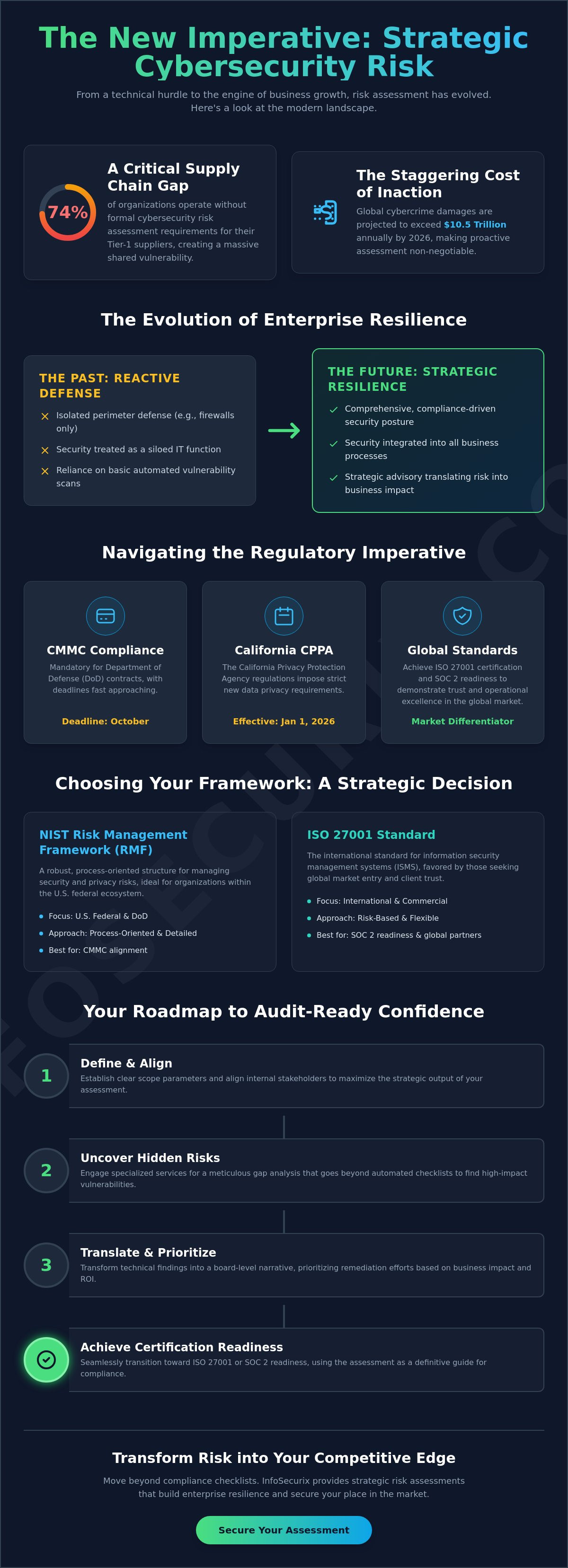
Seventy-four percent of organizations still operate without formal cybersecurity risk assessment requirements for their Tier-1 suppliers: a staggering vulnerability in an era where global cybercrime damages are projected to exceed $10.5 trillion in 2026. While technical teams often view these evaluations as a recurring hurdle, elite leaders recognize that sophisticated cybersecurity risk assessment services are the engine of modern business growth. You’ve likely felt the mounting pressure of the California Privacy Protection Agency regulations that took effect on January 1, 2026, or the looming October deadline for mandatory CMMC compliance in Department of Defense contracts.
It’s understandable to feel overwhelmed by the sheer velocity of regulatory change and the difficulty of translating granular technical threats into a narrative that resonates in the boardroom. This article provides a clear roadmap to bridge that gap. You’ll discover how a structured assessment framework transforms hidden vulnerabilities into a measurable competitive edge and audit-ready posture. We’ll explore the evolution of enterprise resilience through the lens of NIST CSF 2.0, providing you with the strategic depth needed to secure ISO 27001 certification and achieve SOC 2 readiness with absolute confidence.
Key Takeaways
- Recognize how the modern regulatory environment necessitates a shift from simple perimeter defense to a strategic framework focused on demonstrable enterprise resilience.
- Determine the ideal methodology for your organization by evaluating the nuances between NIST and ISO 27001 frameworks to ensure comprehensive risk prioritization.
- Uncover hidden operational risks through specialized cybersecurity risk assessment services that provide the meticulous gap analysis required for audit-ready compliance.
- Prepare your organization for a successful engagement by defining clear scope parameters and aligning internal stakeholders to maximize the strategic output of your assessment.
- Discover a structured roadmap for transforming technical findings into board-level confidence; this facilitates a seamless transition toward ISO 27001 or SOC 2 readiness.
The Evolution of Cybersecurity Risk Assessment Services in a Regulatory-First Era
The era of reactive security has reached its definitive end. In 2026, enterprise resilience is no longer measured by the strength of a firewall alone but by the maturity of an organization’s strategic foresight. Sophisticated cybersecurity risk assessment services have transitioned from technical necessities to vital strategic enablers. They don’t simply identify vulnerabilities; they provide the roadmap for sustained growth in a volatile digital economy where trust is the most valuable currency. This shift reflects a move away from isolated perimeter defense toward a comprehensive, compliance-driven security posture that permeates every level of the corporate structure.
Organizations can’t afford to view security as a siloed IT function when the threat landscape is defined by complex supply chain interdependencies and AI-driven exploits. Instead, resilience is cultivated through deliberate alignment with international standards like ISO 27001. This alignment ensures that security protocols are deeply integrated into business processes, transforming a defensive requirement into a hallmark of operational excellence. By focusing on a “top-down” strategy, leaders can ensure that their security investments are both purposeful and measurable.
From Technical Scans to Strategic Advisory
Automated vulnerability scans offer a useful snapshot, but they lack the nuanced context required for true risk management. A seasoned guide interprets these technical findings through the lens of your specific business objectives, acting as a bridge between the server room and the boardroom. It’s about translating a “critical vulnerability” into a clear statement of potential impact on quarterly revenue or market reputation. By utilizing diverse risk assessment methodologies, expert advisors help prioritize remediation efforts where they’ll yield the highest return on security investment. This bespoke approach ensures that your defense strategy is as unique as your business model.
The Regulatory Imperative for National Enterprises
Navigating the complex web of national security requirements is now a high-stakes strategic effort. With the mandatory CMMC compliance for DoD contracts and the implementation of California’s CPPA regulations in early 2026, the cost of non-compliance has become prohibitive. Professional assessments act as a protective force, ensuring your organization meets these rigorous standards without disrupting core operations. Aligning your internal audits with ISO 22301 for business continuity further future-proofs the enterprise. It ensures that when a disruption occurs, your business doesn’t just survive; it maintains its commitments to stakeholders. This holistic approach transforms a regulatory burden into a demonstrable market advantage that instills absolute confidence in your partners and clients.
Selecting a Methodology: Aligning Business Objectives with Risk Frameworks
Choosing the right methodology is the cornerstone of organizational maturity; it’s a strategic decision that dictates how effectively a business can weather digital storms. While many firms default to generic checklists, the most resilient enterprises align their defense strategies with recognized global standards. For organizations deeply rooted in the U.S. federal ecosystem, the NIST Risk Management Framework (RMF) provides a robust, process-oriented structure for managing security and privacy risks. Conversely, those seeking global market entry often favor the ISO 27001 standard. The choice isn’t binary: it’s about identifying which framework best supports your specific certification goals and long-term business trajectory.
A critical, often overlooked component of this selection process is the integration of internal auditing within the risk lifecycle. Professional cybersecurity risk assessment services shouldn’t exist in a vacuum. Instead, they should inform a repeatable cycle of security improvement where internal audits validate the effectiveness of controls over time. This systematic verification ensures that the risks identified during the initial assessment are actually mitigated. It’s this continuous loop of assessment, implementation, and audit that transforms a static security posture into a living, resilient ecosystem. Adopting a bespoke approach ensures your team prioritizes the vulnerabilities that pose the greatest threat to your unique operational flow.
The ISO 27001 Risk Assessment Methodology
ISO 27001 offers a flexible yet rigorous approach, allowing for both asset-based and scenario-based risk identification. Asset-based models focus on protecting specific hardware and data; scenario-based models anticipate complex threat events. Integrating these assessments into a broader Information Security Management System (ISMS) ensures that risk management becomes a core business function rather than a periodic IT task. For a deeper exploration of these nuances, consider Mastering the ISO 27001 Risk Assessment Methodology to refine your strategic approach.
SOC 2 and the Trust Services Criteria
For service organizations, mapping cybersecurity risk assessment services to the SOC 2 Trust Services Criteria is essential for building client trust. This process involves validating security, availability, and confidentiality through rigorous internal audits. Success in a SOC 2 Type I engagement provides a point-in-time snapshot, while Type II demonstrates sustained operational excellence over a defined period. Establishing a clear roadmap for these milestones allows your organization to move from assessment to certification with absolute precision. If you’re ready to evaluate your current posture, a bespoke risk assessment can serve as the foundational first step toward total compliance.
Beyond the Checklist: Identifying High-Impact Vulnerabilities through Strategic Assessments
Relying on a standardized, “do-it-yourself” checklist is a common pitfall that frequently results in major security audit failures. These generic tools often lack the depth required to satisfy the rigorous standards of ISO 27001 or SOC 2. True resilience is found through meticulous gap analysis: a process that identifies not just where a control is missing, but where it’s failing to support the business objective. Professional cybersecurity risk assessment services transform these findings into a strategic corrective action plan, ensuring that remediation efforts are focused on the vulnerabilities that pose the most significant threat to enterprise longevity. This approach moves beyond the binary “pass or fail” mentality of a checklist to provide a nuanced understanding of your organization’s true security posture.
Prioritizing remediation based on business impact requires a sophisticated understanding of operational dependencies: a minor technical bug in a mission-critical payment gateway is far more critical than a severe vulnerability in an isolated, non-production environment. By translating technical severity into quantifiable business risk, leadership can allocate resources with absolute precision. This ensures that the most dangerous gaps are closed first, effectively future-proofing the organization against the most likely threat vectors. It’s this transition from technical observation to strategic execution that defines a mature security culture.
Uncovering Hidden Operational Vulnerabilities
Technical flaws are only part of the story. Often, the most catastrophic risks stem from human factors or flawed internal processes that a simple scan will never detect. In a modern ecosystem, third-party risk is an inescapable reality; research indicates that 74% of organizations currently lack cybersecurity risk assessment requirements for their Tier-1 suppliers. A “top-down” approach provides the necessary visibility to address these supply chain gaps. By evaluating how data flows between partners and internal systems, you can secure the entire value chain rather than just your own servers. This comprehensive view is essential for maintaining trust in an increasingly interconnected global market.
Developing a Robust IT Risk Assessment Methodology
A scalable methodology is essential for national enterprises that operate across multiple jurisdictions and business units. This requires a consistent scoring system that balances the mathematical likelihood of an event with its documented business impact. Such a framework allows leadership to compare risks across diverse departments and make informed decisions about risk acceptance or mitigation. For those seeking to build this capability internally, our guide on Developing a Robust IT Risk Assessment Methodology provides the technical depth needed for 2026 standards. This structured approach ensures that security maturity remains a repeatable, documented process rather than a one-time achievement.
Preparing for the Engagement: A Roadmap for Organizational Readiness
Success in a high-stakes security engagement is rarely accidental. It’s the result of meticulous preparation and clear organizational alignment. Defining the scope of cybersecurity risk assessment services is the first critical step for any national enterprise. Whether you’re targeting a specific business unit or the entire global infrastructure, establishing clear boundaries ensures that resource allocation is precise and findings are actionable. This phase requires identifying and aligning internal stakeholders from IT, legal, and human resources to ensure that interviews yield maximum strategic value. Setting realistic timelines for the assessment, reporting, and initial remediation allows your team to maintain operational momentum while working toward rigorous certification goals like the CMMC Phase 2 requirements taking effect on November 10, 2026.
Approaching an assessment without a clear roadmap often leads to fragmented results and missed vulnerabilities. A seasoned guide helps you navigate this complexity by establishing a structured cadence for data gathering and stakeholder interviews. This ensures that every participant understands their role in the process: from the C-suite providing strategic context to system administrators detailing technical controls. By fostering this collaborative environment, you transform the assessment from a simple audit into a comprehensive exercise in enterprise resilience. It’s about creating a unified front that is prepared for the scrutiny of both internal stakeholders and external regulators. Organizations looking to deepen their understanding of foundational principles can benefit from The Strategic Guide to Information Security Risk Assessment in 2026, which provides authoritative context for building a resilient security program with the support of an experienced ISO 27001 consultant Pittsburgh.
The Role of Internal Audits in Assessment Success
Conducting an internal audit serves as a vital dry run for high-stakes external certifications. This proactive step allows your organization to identify common audit failures in a controlled environment before they impact your official compliance status. By Mastering Information Security Internal Audits, you create a culture of continuous verification that simplifies the final engagement. It’s a strategic move that builds internal confidence and ensures that your security controls are functioning as intended. These internal reviews often uncover process gaps that automated tools overlook, providing a layer of human-centric scrutiny that is essential for ISO 27001 readiness.
Strategic Documentation Preparation
Organizing your evidence locker is about more than just gathering PDFs. It’s about demonstrating that your policies reflect actual operational reality rather than just optimistic intent. Assessors look for a clear “paper trail” that links your high-level security policies to specific technical logs, incident reports, and meeting minutes. A pre-assessment gap analysis can streamline the entire engagement by highlighting missing documentation early. This preparation ensures that when the formal assessment begins, your team is ready to provide the specific evidence required for audit-ready compliance. If you’re looking to establish a baseline before your next major audit, you can book a professional risk assessment to identify your most critical documentation gaps and secure your path to certification.
InfoSecurix: Transforming Risk Assessments into Certification Readiness
InfoSecurix brings a distinguished 25-year history of high-level security consulting to every engagement. While larger firms may prioritize volume, our boutique consultancy focuses on the surgical precision national enterprises require to navigate the complexities of 2026. We don’t view cybersecurity risk assessment services as a standalone technical event. Instead, we treat them as the vital bridge to achieving ISO 27001 and SOC 2 readiness. This approach ensures that every vulnerability identified is met with a strategic resolution that strengthens your overall operational resilience.
Partnering with a seasoned guide means moving beyond the delivery of a static report. Our experts work as collaborative allies, ensuring that the findings from your assessment are translated into a clear, audit-ready posture. This long-term commitment to your success is what differentiates a standard vendor from a trusted advisor. We focus on future-proofing your business through meticulous current-day standards: allowing you to grow with absolute confidence in your security foundations. By aligning technical processes with strategic business impact, we empower leadership to make informed, risk-based decisions.
The InfoSecurix Advantage in Certification Readiness
Our bespoke action plans are designed to provide executive clarity while maintaining technical depth. This duality ensures that the board understands the strategic impact of security investments while the IT team has a clear roadmap for execution. We’ve established a proven track record in preparing organizations for ISO 20000 implementation and ISO 22301 business continuity. For those beginning this journey, The Strategic Guide to ISO 27001 Certification Readiness offers a foundational look at the requirements for the coming year. These frameworks aren’t just boxes to check; they’re the blueprints for organizational maturity.
Your Journey to Absolute Confidence
True resilience is achieved when an organization moves beyond the assessment to implement strategic corrective actions. The InfoSecurix “Seasoned Guide” approach provides a reassuring partnership through every stage of the audit process. We don’t just point out gaps; we help you close them with precision. This ensures that your organization doesn’t just pass an audit but emerges with a demonstrably stronger security culture. It’s time to transform your technical vulnerabilities into strategic business advantages. Secure your organization’s future with meticulous standards by engaging our comprehensive cybersecurity risk assessment services today.
Securing Your Enterprise Legacy Through Strategic Foresight
Transitioning from a reactive security posture to a state of permanent resilience requires more than just technical tools; it demands a fundamental shift in how your organization perceives and manages risk. By aligning your defense strategies with rigorous international standards, you transform compliance from a seasonal burden into a constant business advantage. Expertly delivered cybersecurity risk assessment services provide the essential clarity needed to navigate the complex regulatory landscapes of 2026 with absolute precision. This strategic foundation ensures that every security investment you make is purposeful, measurable, and directly linked to your long-term growth objectives.
InfoSecurix offers a boutique consultancy approach that prioritizes high-level executive advisory and bespoke security roadmaps. With over 25 years of specialized experience in information security standards, we provide a proven track record in achieving ISO 27001, SOC 2, and ISO 22301 readiness. It’s time to move beyond the checklist and embrace a partnership built on trust and technical excellence. Partner with InfoSecurix for a Meticulous Cybersecurity Risk Assessment and take the definitive step toward audit-ready confidence. Your organization’s future is built on the standards you set today, and we’re here to ensure those standards are world-class.
Frequently Asked Questions
What is the primary difference between a vulnerability scan and a cybersecurity risk assessment?
A vulnerability scan is an automated technical process that identifies known software bugs and configuration errors within your network. In contrast, a risk assessment is a strategic evaluation that interprets those technical findings through the lens of business impact and likelihood. While a scan tells you what is broken, an assessment explains how those weaknesses threaten your specific operational goals and revenue streams.
How often should a national enterprise conduct a professional risk assessment?
National enterprises should conduct a comprehensive assessment at least annually or following any significant change to their technical infrastructure. Given the rapid implementation of regulations like the CMMC and California’s CPPA in 2026, many leaders now opt for quarterly reviews of high-risk business units. This cadence ensures that your security posture remains aligned with the evolving threat landscape and complex compliance requirements.
Can cybersecurity risk assessment services help us achieve ISO 27001 certification faster?
Yes, professional cybersecurity risk assessment services accelerate the certification process by identifying critical gaps before the formal audit begins. This precision prevents your team from wasting resources on non-essential controls and ensures that your Information Security Management System is built on a compliant foundation. Starting with a clear roadmap allows for a more efficient and predictable path to achieving your certification goals.
How long does a typical cybersecurity risk assessment engagement take to complete?
A typical engagement generally spans four to eight weeks, depending on the complexity and geographic scope of your organization. This timeframe encompasses the initial discovery phase, stakeholder interviews, technical analysis, and the final delivery of a strategic remediation roadmap. A methodical pace is essential to ensure that every operational nuance is captured and that the resulting report provides genuine executive-level value.
What internal resources are required to support a specialized risk assessment firm?
Your organization will need to provide access to key stakeholders across IT, legal, and human resources for focused interviews. It’s also vital to have an organized repository of current policies, procedures, and network diagrams ready for review. Providing these resources early allows the assessment team to work efficiently: ensuring a thorough evaluation without causing significant disruption to your daily business operations.
What happens if the assessment identifies critical vulnerabilities we cannot immediately fix?
We help you develop a formal risk treatment plan that includes implementing compensating controls or documenting a justified risk acceptance. Auditors and regulators recognize that not every vulnerability can be remediated instantly due to budget or operational constraints. The goal is to demonstrate that you are aware of the risk and have a structured, time-bound plan to manage it effectively.
Is a SOC 2 readiness assessment the same as a cybersecurity risk assessment?
They are related but serve different strategic purposes. A SOC 2 readiness assessment specifically maps your existing controls against the Trust Services Criteria to identify gaps before an official audit. While a risk assessment is a mandatory component of the SOC 2 framework, the readiness engagement is a broader exercise designed to ensure your entire environment is prepared for the scrutiny of an external auditor.
How do cybersecurity risk assessment services improve our business continuity planning?
Professional cybersecurity risk assessment services identify the specific digital threats that could lead to a total operational halt. By aligning these findings with ISO 22301 standards, we help you prioritize the protection of mission-critical assets. This ensures that your business continuity plans are grounded in realistic threat scenarios, allowing your organization to maintain its core functions even during a major security incident. Complementing this process with a thorough security controls assessment ensures that the safeguards protecting those mission-critical assets are verified to perform effectively under real-world conditions.
What is the primary difference between a vulnerability scan and a cybersecurity risk assessment?
A vulnerability scan is an automated technical process that identifies known software bugs and configuration errors within your network. In contrast, a risk assessment is a strategic evaluation that interprets those technical findings through the lens of business impact and likelihood. While a scan tells you what is broken, an assessment explains how those weaknesses threaten your specific operational goals and revenue streams.
Prioritizing remediation based on business impact requires a sophisticated understanding of operational dependencies: a minor technical bug in a mission-critical payment gateway is far more critical than a severe vulnerability in an isolated, non-production environment. By translating technical severity into quantifiable business risk, leadership can allocate resources with absolute precision. This ensures that the most dangerous gaps are closed first, effectively future-proofing the organization against the most likely threat vectors. It’s this transition from technical observation to strategic execution that defines a mature security culture.