
If your board sees cybersecurity as a cost center rather than a growth catalyst, your current IT risk assessment methodology is likely failing to bridge the gap between technical vulnerabilities and business impact. When the average data breach in the financial sector exceeds $6.08 million, relying on static spreadsheets or inconsistent tracking is no longer just a process flaw; it’s a strategic liability. You’ve likely felt the mounting pressure of the 2026 regulatory landscape, perhaps struggling to translate granular scan results into a narrative that satisfies both skeptical auditors and executive stakeholders.
It’s exhausting to manage the manual effort of risk tracking while fearing that one inconsistent calculation could lead to an audit failure. This guide provides the blueprint to build a defensible, certification-ready framework that transforms risk from a looming threat into a manageable business variable. We’ll explore how to align with ISO 27001:2022 standards, integrate the NIST CSF 2.0 “Govern” function, and move beyond periodic assessments toward a model of continuous exposure management that ensures your organization remains resilient and audit-ready.
Key Takeaways
- Transform technical vulnerabilities into strategic intelligence by establishing a systematic architecture rather than relying on simple risk checklists.
- Navigate framework selection with precision by aligning NIST, ISO, or OCTAVE standards with your organization’s specific maturity level and industry requirements.
- Construct a repeatable it risk assessment methodology that serves as a defensible foundation for both internal governance and external certification audits.
- Streamline implementation by integrating risk evaluation directly into your development lifecycle and leveraging automation to alleviate team fatigue.
- Future-proof your operations by utilizing a robust methodology to accelerate ISO 27001 or SOC2 readiness through meticulous, audit-ready documentation.
Defining the Strategic Role of an IT Risk Assessment Methodology
An it risk assessment methodology represents the systematic architecture an organization employs to evaluate and quantify digital uncertainty. It’s far more than a simple checklist or a collection of vulnerability scans; it’s a sophisticated framework designed to translate technical anomalies into actionable business intelligence. While many firms treat risk as a series of isolated events, a mature methodology provides a repeatable process that ensures consistency across the enterprise. This structured approach is the fundamental prerequisite for achieving ISO 27001 certification readiness and maintaining SOC2 compliance in a demanding regulatory climate.
Effective leaders recognize the distinction between basic risk checks and a formal methodology. Checks are often reactive, focusing on immediate remediation of known flaws. In contrast, a robust methodology is proactive: it establishes the rules of engagement for how every threat is identified, analyzed, and treated. By grounding your security posture in a formal IT risk management strategy, you move away from the exhaustion of constant firefighting toward a state of controlled, risk-informed decision-making.
This transition empowers the board to see security not as a technical burden but as a strategic enabler. When you can demonstrate exactly how a specific vulnerability impacts your “crown jewel” assets, you build a level of trust with stakeholders that a simple spreadsheet can’t provide. A defensible methodology ensures that your security investments are always aligned with your organization’s most critical objectives.
Beyond the Checkbox: Why Methodology Matters in 2026
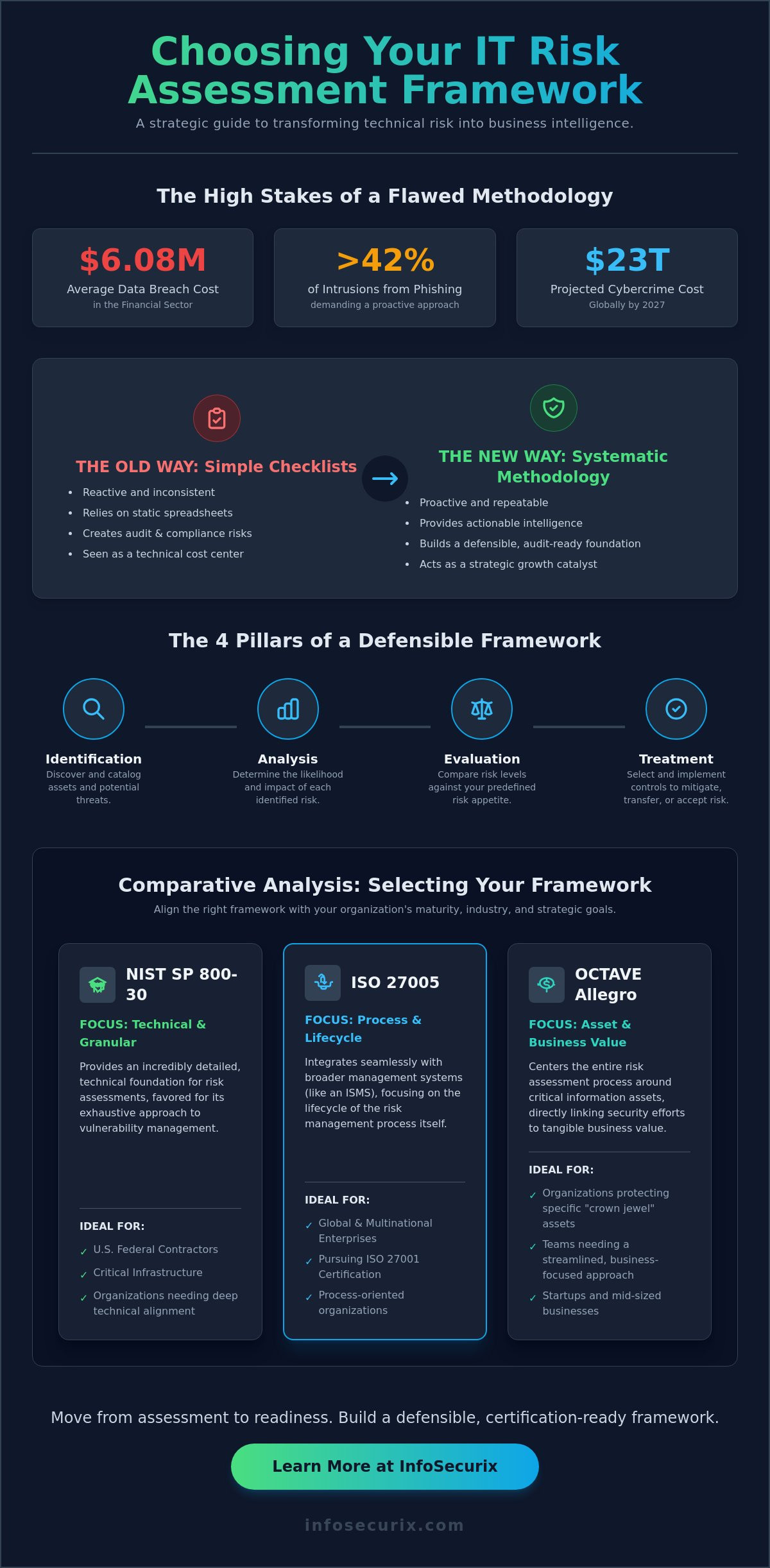
The 2026 threat environment requires more than a defensive posture: it demands strategic foresight. With phishing expected to account for over 42% of successful cyber intrusions this year and the global cost of cybercrime projected to reach $23 trillion by 2027, “compliance-only” thinking has become a liability. A resilience-first strategy focuses on how your systems withstand and recover from AI-driven attacks and supply chain fragility. A formal methodology signals to investors and partners that your organization is built on a foundation of rigorous, future-proofed standards.
Core Components of a Defensible Risk Framework
Building a resilient it risk assessment methodology requires four essential pillars: Identification, Analysis, Evaluation, and Treatment. Each stage must be meticulously documented to ensure reproducibility, which is the hallmark of audit-readiness. At the center of this framework lies your “Risk Appetite”: the North Star that dictates which risks are acceptable and which require immediate mitigation. By defining these parameters clearly, you ensure that your team’s efforts are always focused on the threats that matter most to your long-term growth.
Comparative Analysis: Selecting the Optimal Framework
Selecting the right framework is the most critical pivot point in your security journey. It represents the difference between a system that merely documents risk and one that actively mitigates it. While every organization’s needs are unique, most mature enterprises choose between three industry titans: NIST SP 800-30, ISO 27005, and OCTAVE Allegro. Each offers a distinct lens through which to view your digital landscape. NIST provides an incredibly granular, technical foundation, whereas ISO 27005 focuses on the lifecycle of the risk process itself. OCTAVE Allegro, by contrast, centers the entire assessment around the information assets that drive your business value.
The decision often hinges on your organizational maturity and industry requirements. Federal contractors or those aligned with U.S. standards frequently turn to the NIST Guide for Conducting Risk Assessments because of its exhaustive detail and alignment with federal mandates. However, for organizations seeking global expansion, the process-oriented nature of ISO 27005 is often the superior choice. It integrates seamlessly with broader management systems, making it an essential component for those pursuing ISO 27001 certification readiness.
Modern enterprises are increasingly moving toward a “Hybrid Model.” This bespoke approach combines the technical rigor of threat-based assessments with the business-centric focus of asset-based methodologies. By identifying your “crown jewels” first and then mapping specific, AI-driven threats against them, you create a more resilient and defensible it risk assessment methodology. If you are unsure which path fits your current scale, a formal SOC2 Readiness Assessment can help clarify your requirements.
NIST vs. ISO 27005: Navigating the Standards
Choosing between these standards depends entirely on your compliance destination. NIST is widely regarded for its technical depth, providing a clear roadmap for identifying vulnerabilities within complex infrastructure. ISO 27005 is designed for the international stage. It prioritizes the establishment of a repeatable risk management cycle. If your goal is global certification, mapping your controls to ISO’s process-heavy requirements ensures you meet the high expectations of international auditors.
Quantitative vs. Qualitative: Finding the Middle Ground
The debate between qualitative and quantitative metrics often leaves mid-market firms in a difficult position. Purely qualitative assessments rely on subjective levels like “High” or “Low,” which can feel vague to the Board. Conversely, quantitative methods like Annual Loss Expectancy (ALE) require historical data that many firms simply don’t possess. The “Semi-Quantitative” approach serves as the ideal sweet spot. By using risk scoring to normalize disparate data points, you can provide the executive-level clarity of numbers without the prohibitive complexity of pure financial modeling. This balanced approach ensures your it risk assessment methodology remains both practical and authoritative.
Step-by-Step Guide: Building Your IT Risk Assessment Methodology
Constructing a resilient it risk assessment methodology requires a methodical progression from high-level organizational context to granular control implementation. It’s the difference between guessing where your weaknesses lie and possessing a documented, defensible roadmap for protection. By following a structured five-step process, you ensure that no critical asset is overlooked and every security decision is backed by verifiable data. This systematic approach transforms risk from an abstract threat into a manageable business variable.
Establishing Context and Asset Valuation
Before you can evaluate threats, you must define the precise boundaries of your digital estate. This includes mapping your cloud environments, on-premises servers, and hybrid configurations to ensure there are no blind spots in your perimeter. Assigning value to these assets isn’t a matter of purchase price alone; it’s about the C-I-A triad: Confidentiality, Integrity, and Availability. For instance, a customer database requires high confidentiality, while a public-facing transaction portal demands absolute availability. Auditors will expect a comprehensive Asset Register that documents these valuations, serving as the primary evidence for your scope during a SOC2 Readiness Assessment.
Calculating Inherent vs. Residual Risk
A sophisticated methodology distinguishes between risk in its raw state and risk after safeguards are applied. Inherent risk represents the level of danger your organization faces before any controls are active. Residual risk is the remaining exposure once your security measures are in place. This distinction is vital because auditors focus on the gap between the two to measure the efficacy of your internal controls. If your inherent risk is high but your residual risk remains elevated, your current mitigation strategy is fundamentally failing to protect the business. The NIST Guide for Conducting Risk Assessments provides a foundational blueprint for these calculations, ensuring your scoring remains objective and reproducible.
The Risk Treatment Decision Matrix
Once risks are analyzed, you must decide how to address them through a formal treatment plan. Risk Treatment is the strategic bridge between assessment and action. Your options generally fall into four categories: Avoid, Mitigate, Transfer, or Accept. Avoiding a risk might mean eliminating a specific high-risk activity, while mitigation involves applying technical controls to lower the threat. Transferring risk often involves cyber insurance or third-party partnerships. Justifying “Risk Acceptance” to an auditor requires a documented rationale showing that the cost of mitigation significantly exceeds the potential impact. Mastering this balance is a cornerstone of ISO 27001 certification readiness, as it demonstrates a mature, risk-informed leadership team.
Overcoming Implementation Friction: Aligning Risk with Operations
Translating a theoretical framework into operational reality requires more than technical expertise; it demands a cultural shift that prioritizes security without stifling innovation. Friction often arises when security teams and developers operate in silos, viewing risk management as a hurdle rather than a shared objective. By integrating your it risk assessment methodology directly into the Software Development Life Cycle (SDLC), you ensure that security isn’t an afterthought but a core component of the build process. This “shift-left” approach allows for the early identification of vulnerabilities, reducing the cost and complexity of remediation later in the production cycle.
Operationalizing security shouldn’t lead to “Risk Fatigue” among your technical staff. When teams are overwhelmed by manual data collection and repetitive reporting, the quality of risk analysis inevitably suffers. Automation serves as the essential antidote to this exhaustion. By leveraging tools that automatically aggregate threat data and monitor control efficacy, you allow your experts to focus on high-level strategic analysis. This transition also enables your methodology to account for “Shadow IT,” ensuring that unsanctioned cloud applications are brought under the umbrella of corporate governance before they can manifest as significant liabilities. Organizations looking to operationalize this approach at scale often benefit from engaging professional cybersecurity risk assessment services that provide the structured oversight needed to sustain continuous monitoring across complex environments.
Integrating Risk into the Corporate Culture
A mature organization moves beyond an “Audit-Driven” model, where risk is only considered during annual reviews, toward a “Continuous Monitoring” model. This evolution transforms risk assessments into powerful tools for budget justification. When you can demonstrate a direct link between a specific investment and the reduction of residual risk, securing executive buy-in becomes a data-driven conversation. Establishing a cross-functional Risk Committee further strengthens this alignment, ensuring that “Risk Ownership” is distributed among business unit leaders who are the ultimate stewards of departmental data. Aligning your operations with a rigorous it risk assessment methodology is a prerequisite for achieving ISO 27001 certification readiness, ensuring your growth is built on a foundation of trust.
Avoiding Common Methodology Pitfalls
Even the most well-designed frameworks can succumb to “Analysis Paralysis” if the scoring system becomes overly complex. Your methodology should be sophisticated enough to provide depth but simple enough for stakeholders to understand at a glance. It’s also vital to remain vigilant against “Confirmation Bias,” where teams inadvertently seek data that supports their existing assumptions about security strength. To maintain objectivity, your framework must undergo a formal review at least annually. This ensures your approach remains responsive to new AI-driven threats and regulatory shifts, such as the 2026 updates to the California Privacy Protection Agency (CPPA) regulations. Regular internal audits are the most effective way to validate that your methodology is being applied consistently across all business units.
From Assessment to Readiness: The InfoSecurix Approach
InfoSecurix brings a 25-year legacy of guiding premier organizations through the labyrinth of complex audit environments. We understand that a robust it risk assessment methodology is not merely a static document: it is a strategic engine that powers your path toward global recognition. By partnering with a seasoned guide, you ensure that your risk framework is both defensible and scalable. Our readiness assessments are designed to leverage your existing methodology, identifying critical gaps before they become liabilities during a formal audit for ISO 27001 certification readiness.
Relying solely on internal perspectives can often lead to blind spots in your security posture. A “Third-Party Eye” provides the essential objectivity required to validate your risk framework against current industry benchmarks. This external validation is the bridge between an internal audit and a successful external certification. We don’t just identify what is missing; we provide the authoritative expertise needed to refine your processes until they meet the highest standards of corporate excellence.
Leveraging Risk Data for SOC2 and ISO Success
A sophisticated methodology translates directly into the evidence required for diverse compliance standards. For firms pursuing a SOC2 Readiness Assessment, your risk data maps directly to the Trust Services Criteria, providing a clear narrative of how you protect client data. In the context of ISO 27001, your methodology informs the “Statement of Applicability” (SoA), which is the primary document auditors use to understand your control environment. InfoSecurix specializes in turning these complex risk reports into actionable compliance roadmaps: ensuring your team remains focused on the activities that drive both security and business growth.
Partnering for Resilience: Your Next Steps
Audit success is rarely the result of chance. It is the product of a meticulous, repeatable it risk assessment methodology that withstands the scrutiny of the world’s most demanding examiners. We invite you to engage with our team for a professional consultation to review your current framework and identify opportunities for optimization. As your collaborative ally, InfoSecurix navigates the technical and regulatory complexity so you can focus on scaling your business with absolute confidence. Let us help you future-proof your organization through meticulous standards and a legacy of proven success.
Securing Your Strategic Advantage for 2026
Mastering a robust it risk assessment methodology transforms cybersecurity from a technical obligation into a powerful driver of business resilience. By moving beyond simple checklists and adopting a systematic architecture, your organization gains the clarity needed to satisfy both rigorous auditors and executive stakeholders. You’ve seen how the right framework, whether it’s the technical depth of NIST or the process-driven focus of ISO, creates a defensible foundation that withstands the scrutiny of the modern regulatory landscape.
InfoSecurix offers the seasoned guidance necessary to navigate these complexities with absolute precision. With over 25 years of information security expertise and a proven track record in ISO and SOC2 success, we provide national reach delivered with boutique attention to detail. It’s time to secure your certification future with an InfoSecurix Readiness Assessment. We’re ready to help you validate your framework, close critical gaps, and ensure your organization is prepared for long-term growth. Your path to a secure and certification-ready future starts with a single, strategic step toward excellence.
Frequently Asked Questions
What is the difference between a risk assessment and a vulnerability scan?
A vulnerability scan is a technical, automated tool that identifies specific flaws in software or hardware. In contrast, a comprehensive it risk assessment methodology evaluates the business impact and likelihood of those vulnerabilities being exploited. While scans provide the technical data, assessments provide the necessary context by weighing threats against your organizational goals and asset value.
How often should an IT risk assessment be performed?
Organizations should perform a formal assessment at least annually to maintain compliance with standards like ISO 27001. However, a mature approach requires a new assessment whenever significant changes occur, such as deploying new cloud infrastructure or responding to major regulatory shifts. This ensures your security posture remains resilient as your technical environment and the broader threat landscape evolve.
Can we use a qualitative methodology for ISO 27001 certification?
Yes, qualitative methodologies are widely accepted and frequently utilized for ISO 27001 certification. These approaches use descriptive scales, such as “Low” to “Critical,” to evaluate the impact and likelihood of identified threats. While quantitative data adds precision, a well-documented qualitative it risk assessment methodology is perfectly defensible during an audit, provided the scoring criteria are consistent and clearly defined.
What is the most common mistake when developing a risk methodology?
The most frequent error is over-complicating the scoring system, which often leads to analysis paralysis and inconsistent results. When a methodology is too complex, stakeholders struggle to apply it uniformly across different business units. Focus on creating a repeatable, transparent process that prioritizes clarity over granular mathematical modeling to ensure long-term adoption and executive understanding.
How do we define “Risk Appetite” for a mid-sized organization?
Risk Appetite is the specific amount of risk your organization is prepared to accept in pursuit of its strategic objectives. For mid-sized firms, this is defined by the Board or senior leadership based on financial stability, regulatory requirements, and growth targets. It serves as the essential threshold that determines whether a risk must be mitigated, transferred, or accepted as a cost of doing business.
What role does senior management play in the risk assessment process?
Senior management provides the essential governance and resource allocation that makes the assessment process viable. They are responsible for defining the organization’s risk appetite and ensuring that the results of the assessment inform strategic decision-making. Without active executive involvement, risk management remains a technical exercise rather than a core component of corporate resilience and long-term growth.
Is there a “one-size-fits-all” IT risk assessment template?
No, a truly effective methodology must be tailored to your organization’s specific industry, technical stack, and compliance obligations. While templates provide a helpful starting point, they often fail to account for the unique “crown jewel” assets that drive your business value. A bespoke approach ensures that your security investments are always aligned with your actual exposure and operational reality.
How do we handle risks associated with third-party vendors?
Third-party risks are managed through rigorous due diligence and ongoing monitoring of vendor security practices. This includes reviewing SOC2 reports, conducting specialized assessments for critical partners, and ensuring that contractual obligations align with your internal standards. By integrating external partners into your primary methodology, you protect your supply chain from cascading vulnerabilities and maintain a consistent security posture.