

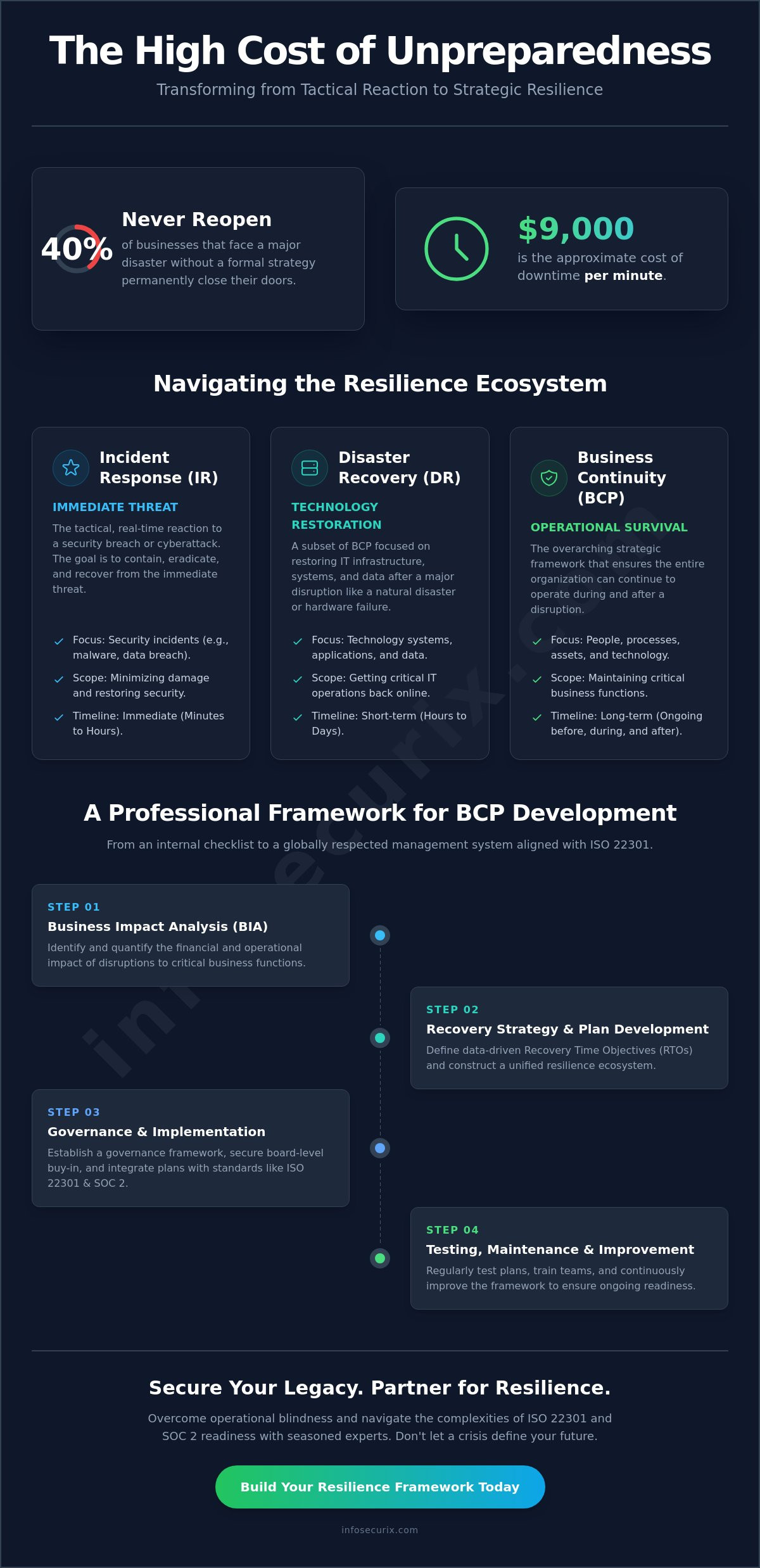
Did you know that 40% of businesses that experience a major disaster without a formal strategy never reopen their doors? When the cost of downtime has climbed to approximately $9,000 per minute in 2026, your approach to business continuity plan development determines whether your organization survives a crisis or becomes a statistic. It’s a reality that weighs heavily on leadership: the pressure to meet the 72-hour restoration requirements of the updated HIPAA Security Rule or the operational mandates of DORA can feel like an insurmountable climb.
You likely recognize that a document in a drawer provides no protection when an actual disruption occurs. We’ve designed this roadmap to help you master the sophisticated process of building a resilient framework that aligns with ISO 22301 standards and secures board-level buy-in. Transitioning from fragmented protocols to a culture of resilience ensures your operations remain steady: your compliance remains absolute, and your growth remains uninterrupted by the unexpected.
Key Takeaways
- Distinguish between tactical emergency reactions and a strategic management system designed for long-term operational resilience.
- Conduct a rigorous Business Impact Analysis to identify critical functions: establishing a data-driven foundation for your recovery priorities.
- Construct a unified resilience ecosystem by aligning Business Continuity, Disaster Recovery, and Incident Response protocols.
- Implement a structured governance framework to simplify business continuity plan development and ensure alignment with international standards.
- Overcome the risks of operational blindness by partnering with seasoned guides to navigate the complexities of ISO 22301 and SOC 2 readiness.
Beyond Emergency Response: Defining Modern Business Continuity Plan Development
Operational survival isn’t a matter of chance; it’s the result of meticulous engineering. While many leaders equate business continuity with immediate disaster recovery, the distinction between tactical reaction and strategic resilience is profound. Tactical emergency response addresses the immediate “what now” of a crisis, such as evacuating a building or restoring a server. In contrast, modern business continuity plan development focuses on the “what next,” ensuring that the core value your organization provides remains uninterrupted regardless of the external environment. It shifts the focus from reactive firefighting to a state of proactive resilience engineering.
The Strategic Imperative of Resilience
Resilience serves as the silent guardian of your brand’s reputation. In an era where stakeholder trust is fragile, the ability to maintain service levels during a disruption is a powerful competitive advantage. When a vendor or client reviews your capabilities, they aren’t looking for a promise to try hard; they’re looking for proof of a system that cannot fail. Beyond mere survival, robust continuity planning fulfills increasingly stringent regulatory and contractual obligations that demand proof of stability. Business continuity is a proactive architecture for organizational survival that ensures critical functions endure through any degree of turbulence. By embedding these principles into your corporate DNA, you transform a potential catastrophe into a demonstration of reliability and steady leadership.
Aligning with International Standards (ISO 22301)
Adopting a recognized framework like ISO 22301 elevates your strategy from an internal checklist to a globally respected management system. Ad-hoc planning often leaves gaps that only become visible during a crisis, whereas a standardized approach provides a comprehensive roadmap for every layer of the enterprise. This disciplined approach to business continuity plan development ensures that your strategy bridges the gap between technical recovery and executive governance. Business continuity planning, when executed through the lens of ISO 22301, ensures that your documentation isn’t just a static file but a “certification-ready” asset that integrates naturally with other standards like ISO 27001 or SOC 2. This alignment provides the board with absolute confidence that the organization’s resilience is built on a foundation of international excellence.
The Foundation of Resilience: Conducting a Business Impact Analysis (BIA)
Precision defines the difference between a functional recovery and a failed attempt. Within the lifecycle of business continuity plan development, the Business Impact Analysis (BIA) serves as the non-negotiable first step. It is the analytical engine that transforms institutional knowledge into actionable data. Without a rigorous BIA, an organization risks misallocating resources toward secondary systems while critical, revenue-generating functions remain vulnerable. This phase demands a shift from general assumptions to a granular understanding of how your organization actually breathes.
The process of Conducting a Business Impact Analysis (BIA) involves more than just listing departments: it requires a deep dive into the financial and operational consequences of downtime. By quantifying the impact of a disruption, leadership can prioritize recovery efforts based on evidence rather than intuition. This ensures that the most time-sensitive processes receive the protection they require to maintain stakeholder trust. Organizations seeking a structured approach to this process can benefit from professional business impact analysis services that transform complex cross-departmental dependencies into a clear, prioritized roadmap for recovery.
Identifying Critical Business Functions
Identifying your core functions requires a methodical look at the dependencies that sustain your mission. It’s not enough to know that a department is “important”; you must understand the specific activities that, if halted, would cause irreparable harm within hours. This mapping must extend beyond your internal walls to include third-party vendors and specific technology stacks. Quantifying the “cost of inaction” for each function allows you to categorize activities by their mission-criticality. For organizations seeking to validate these metrics through professional risk assessments, expert guidance ensures that every recovery target is both achievable and cost-effective.
Setting Data-Driven Recovery Objectives
Once you’ve identified what needs to be saved, you must determine how quickly it needs to return. This is where you define your Recovery Time Objective (RTO) and Recovery Point Objective (RPO). RTO measures the duration of time a business process can be down before the consequences become unacceptable. RPO, conversely, focuses on data: it defines the maximum age of files that must be recovered from backup storage for operations to resume. These metrics are not merely technical settings; they are strategic decisions that dictate your infrastructure requirements. The financial investment required for recovery increases significantly as the desired recovery time approaches zero. Balancing these objectives ensures your resilience strategy is both robust and fiscally responsible.
Navigating the Resilience Ecosystem: BCP vs. DRP vs. Incident Response
Resilience is not a singular achievement but a sophisticated ecosystem of interlocking strategies. While the terms are often used interchangeably, effective business continuity plan development requires a precise understanding of how Business Continuity (BCP), Disaster Recovery (DRP), and Incident Response (IR) function together. A common pitfall for many organizations is the belief that a robust IT disaster recovery plan alone ensures survival. In reality, restoring a database is futile if there’s no operational framework to manage customer communications, supply chain disruptions, or workforce displacement. True organizational endurance relies on a layered defense where each plan triggers specific, coordinated actions.
Auditors and stakeholders look for this integrated approach during compliance reviews. They want to see that your organization doesn’t just react to technical failures but maintains a steady hand across all operational domains. This cohesive structure transforms individual recovery tasks into a unified shield, protecting the enterprise from the multifaceted nature of modern disruptions.
The Technical vs. The Operational
Distinguishing between these pillars ensures that every team member knows their role when a crisis strikes. Incident Response serves as the immediate triage, focusing on containing a specific event, such as a ransomware attack or a data breach. Once the immediate threat is neutralized, Disaster Recovery takes over the technical heavy lifting: it’s the specific subset of the BCP framework dedicated to restoring IT infrastructure and data integrity.
- Incident Response: The rapid-reaction force that identifies and mitigates active threats.
- Disaster Recovery: The technical procedures that restore systems to their pre-incident state.
- Business Continuity: The overarching strategy that keeps the entire mission viable during and after the technical restoration.
Maintaining cross-functional communication during these phases is vital. If the technical team restores a server but the operations team hasn’t been notified to resume client-facing activities, the recovery remains incomplete. A well-constructed BCP bridges this gap, ensuring that the technical and operational gears turn in perfect synchronization.
Synergy with ISO 27001 and SOC 2
Strategic business continuity plan development serves as a core pillar for broader security frameworks. For organizations pursuing ISO 27001 certification readiness, the “Availability” component of the CIA triad (Confidentiality, Integrity, and Availability) is directly satisfied through your continuity protocols. SOC 2 audits also place a heavy emphasis on the availability principle, requiring proof that your services remain accessible to users as promised in your service level agreements.
Auditors look for integrated resilience that transcends simple checklists. They’re seeking evidence that your continuity strategies are woven into your information security management system. By aligning your BCP with these international standards, you demonstrate a level of maturity that reassures partners and regulators alike. It proves that your organization isn’t just checking a box but has engineered a state of permanent readiness that protects data and operations with equal vigor.
A Professional Framework for Business Continuity Plan Development
Adopting a repeatable methodology ensures that your resilience strategy is built on a foundation of logic rather than guesswork. A professional business continuity plan development process follows a structured lifecycle that transforms executive vision into operational reality. This journey begins with high-level governance and concludes with a state of continuous readiness; ensuring that every layer of the organization understands its specific responsibilities during a disruption. Following this five-step architecture provides a clear roadmap for achieving compliance with international standards while future-proofing your business against evolving threats.
Phase 1 & 2: Governance and Data
Securing board-level buy-in is the essential catalyst for any successful resilience program. Without an executive mandate, a BCP often lacks the necessary authority and resources to be effective. Establishing a Business Continuity Steering Committee creates a central hub for decision-making: ensuring that the scope of the plan remains aligned with the organization’s strategic goals. During the data phase, you must integrate comprehensive risk assessments that identify specific threats, including cyberattacks, physical infrastructure failures, and supply chain vulnerabilities. As of the February 2024 amendment to ISO 22301, organizations are now required to explicitly consider the impact of climate change on their operations and stakeholders. This data-driven approach ensures that your recovery strategies are grounded in the actual risks your business faces today.
Phase 3 & 4: Strategy and Documentation
Designing effective mitigation strategies requires a blend of technical innovation and practical work-arounds. During the design phase, teams develop manual procedures to maintain critical functions if primary technology systems fail. These manual protocols are vital for bridge periods before technical recovery is complete. Documentation must be structured for immediate accessibility: utilizing clear checklists, contact trees, and defined roles that eliminate ambiguity during high-pressure events. Ensuring your documentation meets ISO 22301 requirements for clarity and version control is critical for both operational success and audit readiness. For organizations seeking to streamline this process, engaging in professional ISO 22301 business continuity services ensures that your documentation remains both compliant and highly functional.
Phase 5: The Cycle of Improvement
Validating your plan through rigorous testing is the only way to ensure it will perform under actual stress. There is a significant difference between a tabletop exercise, where leadership discusses a hypothetical scenario, and a full-scale simulation that tests the actual technical and operational recovery of systems. Using findings from these exercises, along with results from annual internal audits, allows you to strengthen the plan and address any discovered weaknesses. A robust BCP is a living document that evolves alongside the threat landscape; ensuring your organization remains unfazed by new challenges like the mandatory 72-hour restoration requirements of the 2026 HIPAA Security Rule update.
Securing Your Legacy: Partnering for Professional BCP Development
Legacy isn’t built in a day, but it can be dismantled in minutes if a disruption finds a weakness in your architecture. Internal attempts at business continuity plan development often encounter a specific hurdle: operational blindness. When teams are deeply immersed in daily workflows, they naturally overlook the subtle interdependencies and systemic vulnerabilities that an outside expert identifies instantly. Relying solely on internal perspectives can lead to fragmented documentation that satisfies a checklist but fails during the chaos of a real-world disruption. Partnering with a seasoned guide provides the clarity required to navigate the intricate requirements of ISO 22301 and SOC 2; ensuring your organization is not just compliant, but truly resilient. Conducting a thorough ISO 22301 gap analysis is often the most effective first step in identifying precisely where your current business continuity management system falls short of these demanding standards.
The InfoSecurix Advantage
At InfoSecurix, we bring over 25 years of experience to every engagement: positioning ourselves as a protective force for your organization’s growth. Our bespoke approach to ISO 22301 Business Continuity and SOC2 Readiness Assessments moves beyond generic templates to create a strategy tailored to your unique operational footprint. We act as a collaborative ally. We’ve seen every possible crisis scenario and remain unfazed by the most complex regulatory environments. This steady expertise instills absolute confidence in your leadership and stakeholders; it proves that your legacy is secured by rigorous, international standards. By integrating our internal audits and risk assessments into your core strategy, you transform resilience from a technical requirement into a formidable competitive advantage. Clients who prioritize these standards don’t just survive disruptions: they capture market share while competitors are still struggling to recover.
Your Next Steps Toward Resilience
The journey toward visionary resilience begins with a clear understanding of your current state. Conducting a comprehensive gap analysis is the first step in identifying where your existing protocols may fall short of modern mandates like the 2025 DORA regulations or the 2026 HIPAA updates. Engaging our team for an ISO 22301 readiness assessment allows you to bridge those gaps with precision and longevity. We provide the roadmap; you provide the vision. This partnership ensures that your business continuity plan development is never a “document in a drawer” but a living, breathing component of your corporate excellence. We invite you to move past reactive planning and embrace a future where your organization remains steady through any storm. Let’s work together to build an architecture of resilience that protects your assets, your people, and your future.
Engineering a Future of Uninterrupted Growth
Resilience isn’t a static destination; it’s a state of permanent readiness that defines the modern enterprise. We’ve explored how shifting from reactive emergency response to sophisticated business continuity plan development enables your organization to withstand even the most complex global disruptions. By grounding your strategy in a rigorous Business Impact Analysis and aligning with international standards, you transform potential vulnerabilities into documented operational strengths.
At InfoSecurix, we leverage more than 25 years of strategic security consulting to bridge the gap between basic compliance and true organizational endurance. Our deep expertise in ISO 22301, ISO 27001, and SOC 2 provides a proven methodology for establishing resilience on a national and global scale. We invite you to Secure your operational future with an ISO 22301 readiness assessment today. Together, we can build a protective framework that empowers your organization to lead with absolute confidence, no matter what challenges the future holds.
Frequently Asked Questions
What is the primary goal of business continuity plan development?
The primary goal of business continuity plan development is to ensure that critical organizational functions remain operational during and after a disruption. It seeks to protect the brand’s reputation and stakeholder trust by establishing a state of permanent readiness. This process moves beyond immediate emergency response to create a comprehensive architecture for long-term survival.
How often should a business continuity plan be updated and tested?
Plans should be updated at least annually or whenever a significant change occurs in the organization’s infrastructure, leadership, or vendor landscape. Testing should also occur on an annual basis to validate the technical and operational protocols. Regular intervals of review ensure that the documentation remains a living, relevant asset rather than a static file.
What is the difference between a Business Continuity Plan and a Disaster Recovery Plan?
A Business Continuity Plan (BCP) encompasses the entire organization’s strategy for maintaining operations, while a Disaster Recovery Plan (DRP) is a technical subset focused on restoring IT systems and data. While the DRP handles the technical restoration of servers and databases, the BCP manages the operational framework of business survival. Both are essential components of a unified resilience ecosystem.
Is business continuity plan development required for ISO 27001 certification?
Yes, business continuity plan development is a critical component of achieving ISO 27001 certification. The standard requires organizations to implement controls that ensure the availability of information and information processing facilities. Aligning your continuity efforts with ISO 22301 provides a robust foundation that satisfies these specific information security management requirements.
How do I determine the Recovery Time Objective (RTO) for my business?
Determining your Recovery Time Objective (RTO) requires a rigorous Business Impact Analysis to quantify the financial and operational consequences of downtime. You must identify the maximum tolerable period of disruption for each critical process before the damage to your organization becomes unacceptable. This data-driven approach ensures that your recovery targets are both realistic and strategically sound.
What are the most common failures in business continuity plan development?
The most frequent failures include lack of executive buy-in, insufficient testing of manual work-arounds, and operational blindness from relying solely on internal perspectives. Many organizations struggle with fragmented documentation that proves unusable during a high-pressure event. Engaging a seasoned guide helps eliminate these gaps by providing an objective, expert view of the resilience landscape.
Can a small business achieve ISO 22301 compliance for business continuity?
Small organizations can absolutely achieve ISO 22301 compliance by scaling the framework to fit their specific operational scope and risk profile. The standard is designed to be flexible; it focuses on the effectiveness of the management system rather than the size of the enterprise. This commitment to rigorous standards often serves as a powerful differentiator when competing for contracts with larger partners.
What role does senior management play in the BCP development process?
Senior management provides the essential governance, policy mandate, and resource allocation required for a successful resilience program. Without an executive mandate, the steering committee lacks the authority to drive cross-departmental cooperation. Leadership’s active participation ensures that continuity remains a strategic priority rather than just a technical checklist.