

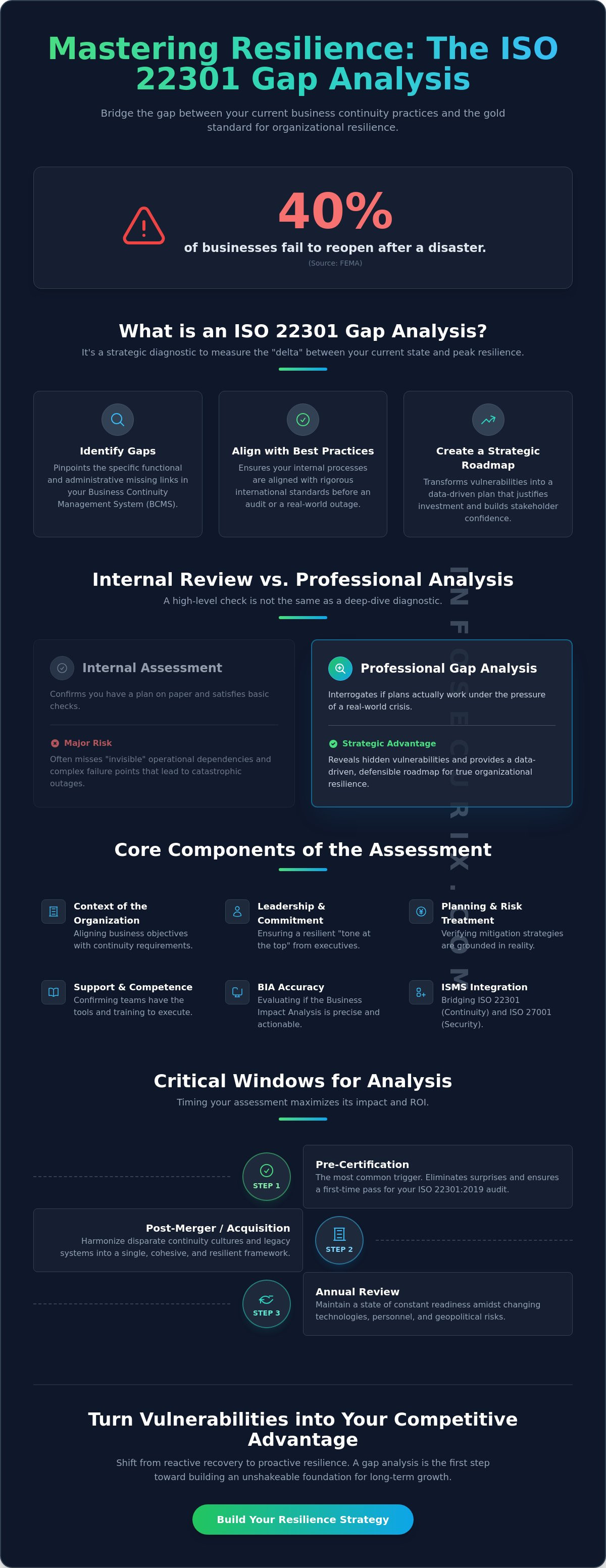
With FEMA reporting that 40% of businesses fail to reopen after a disaster, the difference between enterprise longevity and total collapse often hinges on a single afternoon of rigorous diagnostic scrutiny. Most executive leaders feel the weight of stakeholder pressure and the nagging uncertainty of whether their recovery plans would actually hold up under the pressure of a 2026-scale crisis. An iso 22301 gap analysis serves as the critical bridge between these fragmented efforts and a state of unshakeable resilience. It’s the definitive tool for identifying the missing links in your business continuity management system before they’re exposed by an auditor or a real-world outage.
This strategic roadmap doesn’t just check a compliance box; it transforms your existing vulnerabilities into a calculated strategy that ensures operational continuity regardless of the external climate. We’ll explore how to align your IT recovery with business-wide objectives, prioritize corrective actions, and build the absolute confidence required to pass a formal certification audit. By shifting from reactive recovery to proactive resilience, your organization turns potential downtime into a competitive advantage and a foundation for long-term growth.
Key Takeaways
- Identify the specific “delta” between your current business continuity practices and the rigorous requirements of the ISO 22301:2019 standard.
- Learn why a professional iso 22301 gap analysis reveals “invisible” operational dependencies that internal assessments often don’t catch.
- Evaluate the strength of your leadership’s commitment to resilience; ensure your strategy is a core business priority rather than a siloed IT initiative.
- Follow a structured, phased methodology to clarify your assessment scope and review critical documentation with precision.
- Transition from identifying vulnerabilities to fostering a permanent culture of resilience that simplifies the formal certification process.
Defining the ISO 22301 Gap Analysis: More Than a Compliance Checklist
An iso 22301 gap analysis represents a sophisticated diagnostic that measures the distance between your current operational state and the gold standard of global resilience. It involves a rigorous, systematic evaluation of your Business Continuity Management System (BCMS) against the precise requirements of the ISO 22301 standard. The primary objective is to isolate the “delta,” the specific functional and administrative missing links that could lead to failure during a disruption. While many organizations view this as a hurdle, it’s actually the most efficient way to align your internal processes with international best practices.
Understanding the distinction between a cursory readiness review and a deep-dive technical assessment is vital for executive success. A high-level review might confirm you have a plan on paper; however, a deep-dive iso 22301 gap analysis interrogates whether those plans actually work under the pressure of a 2026-scale crisis. This level of scrutiny is the essential precursor to any business continuity planning services. It ensures that the strategies you implement are grounded in technical reality rather than optimistic assumptions.
The Strategic Purpose of the Gap Assessment
Establishing a baseline for organizational maturity is the first step toward future-proofing your enterprise. In an era where data breaches and supply chain failures are constant, this assessment moves your strategy away from guesswork and toward data-driven precision. It allows leadership to allocate budget and internal resources based on verified risk data rather than perceived needs. By creating a defensible roadmap, you provide executive stakeholders and board members with the transparency they require to authorize significant resilience investments. It transforms business continuity from an insurance expense into a strategic asset.
When to Conduct Your ISO 22301 Analysis
Timing your assessment correctly maximizes its impact on your bottom line. Organizations typically engage in this process during three critical windows:
- Pre-certification: Eliminating surprises to ensure a first-time pass for the ISO 22301:2019 standard.
- Post-merger: Harmonizing disparate continuity cultures and legacy systems into a single, cohesive framework.
- Annual review: Maintaining resilience amidst rapidly changing technological landscapes and shifting geopolitical risks.
Proactively identifying these gaps allows you to maintain a state of constant readiness. It ensures that your recovery protocols evolve alongside your business, protecting your reputation and operational integrity through every cycle of growth.
The Core Components of a Comprehensive BCMS Gap Assessment
A comprehensive iso 22301 gap analysis serves as the diagnostic heart of your resilience strategy. It begins by evaluating the context of the organization; this means scrutinizing how internal and external issues are defined within your specific industry landscape. We look for a clear alignment between your business objectives and your continuity requirements. Equally critical is the assessment of leadership and commitment. A resilient “tone at the top” ensures that business continuity isn’t treated as a peripheral task but as a core executive mandate. Without this high-level buy-in, the most detailed plans often fail during execution.
Planning and risk treatment form the next pillar. We review how objectives are set and whether mitigation strategies are grounded in reality. This leads directly into support and competence. Your teams must possess the tools and training necessary to execute the BCMS under duress. If your staff doesn’t understand their roles during a crisis, the system is fundamentally broken. A sophisticated assessment also bridges the gap between your BCMS and your Information Security Management System (ISMS). In 2026, the integration of ISO 22301 business continuity and ISO 27001 is no longer optional. Cyber resilience and operational continuity are two sides of the same coin.
Evaluating Business Impact Analysis (BIA) Accuracy
The accuracy of your BIA determines the success of your entire recovery effort. Many organizations fall into the trap of setting aspirational Recovery Time Objectives (RTOs) that don’t reflect technical capabilities. A rigorous iso 22301 gap analysis identifies these discrepancies by linking current findings to existing business impact analysis services. Verifying the identification of critical business functions across the entire enterprise ensures that no department is left vulnerable during a wide-scale disruption.
Operational Continuity and Response
Operational continuity requires a deep dive into Clause 8 requirements. We gap-check your incident response structures to ensure they meet the specific criteria for speed and effectiveness. This includes reviewing the adequacy of disaster recovery (DR) sites and redundant infrastructure. According to the FDIC’s Business Continuity Planning guidelines, the maturity of communication protocols is often the deciding factor in crisis management success.
Organizations that harmonize these standards create a more robust defense against modern threats. If you’re ready to move beyond basic checklists, exploring professional risk assessments can provide the clarity needed to secure your enterprise’s future. By shifting from a fragmented approach to a unified resilience framework, you ensure that your response to any disruption is both swift and effective.
Strategic Evaluation: Internal Assessments vs. Professional Gap Analysis
Choosing between internal reviews and an external iso 22301 gap analysis is a pivotal decision for any enterprise seeking 2026-ready resilience. While internal teams possess deep institutional knowledge, they often fall victim to the “blinders” effect. This phenomenon occurs when long-term employees accept systemic risks or inefficient workarounds as “normal” operational quirks. An external perspective shatters these assumptions by applying a fresh set of eyes to established protocols. It’s often the “invisible” cultural gaps, such as a lack of true cross-departmental communication, that represent the greatest threat during a crisis.
Expertise serves as another critical differentiator. Engaging a cybersecurity internal audit firm allows an organization to identify complex dependencies that might escape a generalist review. These specialists understand how a failure in a single cloud microservice can cascade into a business-wide outage; this level of technical depth is central to a comprehensive guide to Business Continuity Management. Balancing the direct cost of a consultant against the internal opportunity cost, specifically the time your best people spend on auditing rather than innovation, often reveals that professional services are the more efficient investment.
The Benefits of a Third-Party Perspective
External advisors bring more than just a fresh set of eyes; they provide access to cross-industry benchmarks and best practices that internal teams simply cannot access. By testing assumptions that internal stakeholders might be hesitant to challenge, third-party experts ensure your BCMS is truly battle-tested. This rigorous approach significantly enhances your credibility with insurers, regulators, and high-value enterprise clients who demand proof of resilience. It moves the conversation from “we think we’re ready” to “we have verified our readiness.”
Decision Matrix: Which Path is Right for You?
Selecting the right path depends on your organizational complexity and the level of regulatory pressure you face. For many, a hybrid approach, performing internal preparation followed by professional validation, offers the best of both worlds. This strategy allows you to clean up obvious issues while ensuring that your final iso 22301 gap analysis is conducted with maximum objectivity. When evaluating the long-term ROI, consider how professional information security internal audit services prevent costly audit failures and reduce potential downtime. It’s a strategic move that transforms compliance from a burden into a competitive advantage.
Executing the ISO 22301 Gap Analysis: A Phased Methodology for 2026
A successful iso 22301 gap analysis requires a disciplined, multi-stage approach that moves beyond superficial checklists. In 2026, the regulatory environment demands more than just proof of existence; it requires proof of efficacy. This methodology begins with Scope Definition; we clarify exactly which business units, physical locations, and digital assets fall under the assessment. Establishing these boundaries prevents “scope creep” and ensures that resources are focused on your most critical operations. Without a defined perimeter, the assessment loses the precision required for executive decision-making.
Phase 1 and 2: Setting the Compliance Foundation
Once the scope is locked, the process moves into Document Review. This involves a meticulous analysis of your existing policies, Business Continuity Plans (BCPs), and Business Impact Analysis (BIA) reports. We look for alignment with the 2019 standard’s high-level structure. If your organization is also pursuing integrated security standards, this stage is ideal for gathering evidence for iso 27001 certification readiness. Identifying “low-hanging fruit” gaps early in this review allows for immediate, high-impact corrections that build momentum for the broader project.
The third and fourth phases involve Stakeholder Interviews and Physical Inspections. Paperwork rarely tells the whole story. By interviewing key personnel, we capture the operational reality of how teams actually respond to disruptions. We then verify these findings through technical inspections; we ensure that the redundant servers and off-site backup facilities mentioned in your BCP actually exist and function as described. This “boots-on-the-ground” approach is what separates a strategic iso 22301 gap analysis from a simple compliance exercise. It ensures that your resilience strategy is rooted in physical reality rather than theoretical assumptions.
Phase 5: Turning Findings into a Strategic Action Plan
The final phase is the delivery of the Final Reporting and Remediation Planning. We categorize every identified gap into specific tiers: Critical, Major, Minor, or Opportunities for Improvement. This prioritization allows leadership to tackle the most significant risks first. Assigning clear ownership and realistic deadlines for each corrective action ensures accountability throughout the organization. Using these findings, you can begin a data-driven business continuity plan development roadmap that addresses your specific vulnerabilities.
A structured methodology provides the clarity needed to navigate complex enterprise environments. If you want to ensure your organization is prepared for the unforeseen, engaging in professional internal audits will provide the objective validation your stakeholders demand. By transforming these findings into a prioritized action plan, you create a resilient framework that supports long-term enterprise growth.
Beyond the Report: Transitioning from Gap Analysis to ISO 22301 Certification
The final report of your iso 22301 gap analysis is not the conclusion of your journey; it’s the catalyst for a fundamental organizational evolution. Moving from the diagnostic phase to active implementation requires a shift in executive mindset. You’ve identified the “delta” between your current state and international excellence; now, you must use those findings to fuel a cycle of continuous improvement. Closing these loops ensures that your Business Continuity Management System (BCMS) remains a living framework rather than a stagnant document on a shelf. Preparing your workforce is the next critical step. Transitioning from a “compliance” mindset to a genuine “culture of resilience” ensures that every employee, from the front line to the C-suite, understands their personal role in maintaining operational integrity during a crisis.
Implementing Corrective Actions with Precision
Remediation must be handled with surgical precision to maximize resource efficiency. We recommend prioritizing your corrective actions based on the specific Business Impact Analysis results identified during the earlier stages of the assessment. Focus first on the critical business functions that sustain your revenue and reputation. Integrating continuity controls into daily business operations is the only way to ensure longevity; these protocols shouldn’t feel like an added burden but a natural part of how your organization functions. To maintain this high standard, conduct follow-up “mini-audits” periodically. These targeted reviews verify that identified gaps remain closed and that new vulnerabilities haven’t emerged as your technology stack evolves.
The InfoSecurix Advantage in Business Continuity
InfoSecurix acts as your seasoned guide through the complexities of the 2026 regulatory landscape. We leverage over 25 years of deep-rooted expertise to transform your audit findings into a strategic advantage. Our approach is intentionally bespoke; we focus on the strategic impact of your technical processes rather than getting lost in granular mechanics. We don’t just point out errors. We provide a collaborative partnership that empowers your organization to achieve ISO 22301 business continuity excellence. Our visionary yet grounded methodology ensures that your certification journey is smooth, professional, and ultimately successful.
Future-proofing your enterprise requires a BCMS that evolves alongside the 2026 threat landscape. As AI-driven risks and global supply chain dependencies become more complex, your resilience strategy must remain agile. By treating your iso 22301 gap analysis as a strategic roadmap rather than a one-time checklist, you position your business to withstand any disruption. This proactive stance does more than protect your assets; it builds unshakeable trust with your stakeholders and secures your path for long-term growth. True resilience is a continuous commitment to excellence that begins today.
Securing Your Organizational Legacy through Strategic Resilience
Navigating the complexities of the 2026 risk landscape requires more than reactive planning; it demands a proactive commitment to international standards. You’ve seen how a rigorous iso 22301 gap analysis transforms systemic vulnerabilities into a prioritized roadmap for long-term growth. By identifying the critical “delta” between your current operations and global best practices, you ensure your business remains steady under pressure. This process moves beyond basic compliance to foster a genuine culture of resilience that protects both your reputation and your bottom line.
InfoSecurix brings over 25 years of information security excellence to your certification journey. Our deep expertise in ISO 27001, SOC2, and ISO 22301 standards allows us to provide strategic corrective action plans tailored to your unique organizational scope. We act as your seasoned guide, ensuring every identified gap is addressed with precision and foresight. It’s this level of meticulous detail that turns potential downtime into a foundation for future success.
Secure your enterprise resilience with a professional ISO 22301 gap analysis from InfoSecurix.
Embrace the future with the absolute confidence that your enterprise is built to last.
Frequently Asked Questions
What is the difference between an ISO 22301 gap analysis and an internal audit?
A gap analysis is a diagnostic tool used to identify missing elements before you implement or certify a management system. It’s a forward-looking exercise that determines what you need to build. In contrast, an internal audit is a formal verification process designed to ensure that an existing, documented system is operating as intended. While the gap analysis finds what’s missing, the audit confirms that what’s already there is working correctly.
How long does a typical ISO 22301 gap analysis take to complete?
A typical assessment usually takes between two and four weeks from initial scope definition to the delivery of the final report. This timeline fluctuates based on the size of your organization and the number of physical locations included in the review. Smaller, single-site firms may conclude the process in a few days; however, complex global enterprises require a more measured pace to ensure every critical dependency is interrogated.
Can we perform an ISO 22301 gap analysis ourselves using a template?
You can certainly use a template for an initial self-assessment, but this approach often lacks the objective depth required for true resilience. Internal teams frequently overlook systemic “blind spots” or cultural workarounds that an external expert would immediately flag. A professional assessment provides a level of scrutiny that templates cannot replicate, ensuring your organization is truly prepared for a formal certification audit without the risk of overlooked non-conformities.
What documentation do I need to prepare for a professional gap assessment?
You should gather your current Business Continuity Plans, Business Impact Analysis reports, and existing risk assessment registries. It’s also helpful to provide incident response protocols, evidence of previous testing or exercises, and any relevant organizational charts. Having these documents ready at the start of the engagement allows the assessors to move quickly into the deep-dive analysis of your operational maturity.
How much does an ISO 22301 gap analysis cost for a national enterprise?
The investment for a professional iso 22301 gap analysis depends on the complexity of your business units and the technical depth of the review. National enterprises with multiple data centers or complex supply chains will naturally require a more extensive engagement than smaller firms. Most executive leaders view this cost as a strategic investment that reduces the far greater financial risk of significant operational downtime or audit failure.
Is an ISO 22301 gap analysis mandatory for certification?
No, performing a gap analysis isn’t a mandatory requirement for achieving formal certification. It is, however, widely considered a critical best practice for any organization that wants to ensure a first-time pass. By identifying and remediating non-conformities early, you avoid the high costs and reputational damage associated with failing a formal audit by an accredited certification body.
What happens if the gap analysis reveals significant non-conformities?
Identifying significant non-conformities is the primary objective of the assessment and provides the baseline for your remediation strategy. Once these gaps are uncovered, they are categorized by their potential impact on your business continuity. You then use these findings to assign ownership and set realistic deadlines for corrective actions, ensuring every vulnerability is addressed before your official certification audit begins.
How often should we update our gap analysis in a changing threat environment?
You should update your iso 22301 gap analysis whenever your organization undergoes a major structural change or if the external threat landscape shifts significantly. This includes events like mergers, major cloud migrations, or entering new international markets. At a minimum, performing an annual review ensures that your resilience strategy remains aligned with your current operational reality and protects against emerging 2026-scale disruptions.