
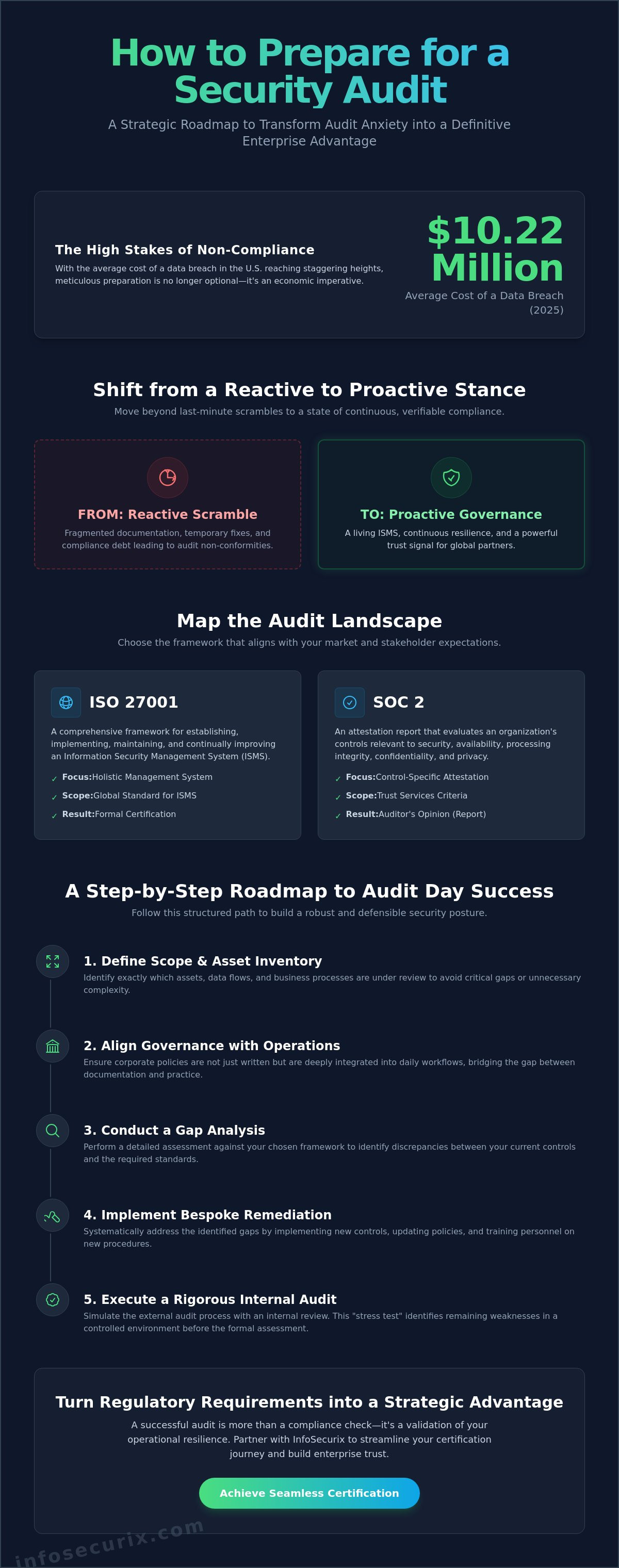
With the average cost of a data breach in the United States reaching $10.22 million in 2025, a security audit is no longer a simple check-box exercise: it’s a high-stakes validation of your organization’s right to operate in an increasingly scrutinized marketplace. You likely feel the weight of this responsibility as you face an overwhelming volume of documentation and the persistent fear that a single overlooked control could compromise enterprise trust. It’s natural to feel uncertain about which requirements are truly mandatory versus merely recommended. Mastering how to prepare for a security audit shouldn’t be a reactive scramble for evidence; instead, it’s an opportunity to fortify your operational resilience.
We’ve designed this guide to transform that audit-day anxiety into a definitive strategic advantage by providing a professional-grade framework for readiness. We’ll provide a clear, actionable roadmap to compliance that validates your current security posture and streamlines the path to successful certification. From ISO 27001 to SOC 2, this framework ensures you meet the rigorous standards of the modern enterprise while future-proofing your business growth through meticulous preparation.
Key Takeaways
- Discover how to prepare for a security audit by shifting your focus from reactive documentation gathering to a proactive state of continuous compliance.
- Understand the critical nuances between ISO 27001 and SOC 2 frameworks to ensure your internal audits effectively simulate the external evaluation process.
- Identify the core pillars of readiness: establishing a definitive asset inventory and aligning your corporate governance with daily operational practices.
- Implement a structured roadmap that utilizes gap analysis and bespoke remediation to close security vulnerabilities before the formal audit begins.
- Learn how professional readiness assessments can streamline your certification journey while turning regulatory requirements into a strategic enterprise advantage.
Understanding the Strategic Importance of Security Audit Readiness
Security audit readiness is not a seasonal event; it is a permanent state of operational excellence. Understanding how to prepare for a security audit requires a shift in perspective from reactive panic to proactive governance. Organizations that treat an Information security audit as a hurdle to clear often suffer from compliance debt: a buildup of temporary fixes that eventually fail under professional scrutiny. Instead, viewing readiness as a continuous cycle ensures that your security posture remains resilient against evolving threats while serving as a powerful trust signal to global partners.
Scrambling at the last minute leads to fragmented documentation and inconsistent control implementation. These lapses are the primary drivers of audit non-conformities. By establishing a robust Information Security Management System (ISMS), you create a living framework that evolves with your business. This systematic approach transforms the audit from a source of anxiety into a strategic validation of your resilience. Preparation builds confidence.
The Difference Between Compliance and Security
Meeting a specific regulatory standard represents the floor of your protection, not the ceiling. True security requires a bespoke approach that bridges technical controls with executive oversight. This alignment ensures that your ISMS reflects your organization’s specific risk appetite rather than a generic checklist. By defining the scope based on your unique operational footprint, you move beyond mere box-ticking toward a culture of verifiable safety. Achieving ISO 27001 certification readiness, for example, demands that policies are not just written but deeply integrated into daily workflows.
The ROI of a Meticulous Preparation Strategy
Investing in readiness pays dividends by identifying critical gaps before an external auditor discovers them. This foresight significantly reduces remediation costs: it’s far more efficient to fix a process internally than to react to a formal finding. With the average cost of a data breach reaching $10.22 million in 2025, the financial incentive for precision is undeniable. Mastering how to prepare for a security audit also shortens sales cycles by providing immediate assurance to enterprise clients who demand rigorous standards. Demonstrating this level of maturity positions your organization as a reliable partner in the global supply chain. Audit readiness is the intersection of documented policy and verified practice.
Mapping the Audit Landscape: Frameworks and Objectives
Understanding the complex landscape of regulatory requirements requires a clear understanding of which framework aligns best with your organizational goals. When considering how to prepare for a security audit, you must first distinguish between the comprehensive management approach of ISO 27001 certification readiness and the control-specific attestation required for SOC 2. While ISO 27001 establishes a global standard for an Information Security Management System (ISMS), SOC 2 focuses on the Trust Services Criteria: security, availability, processing integrity, confidentiality, and privacy. Deciding which path to take depends on your market expansion plans and the specific expectations of your enterprise stakeholders. Determining the correct scope is a vital first step; you need to identify exactly which assets, data flows, and business processes are under the microscope to avoid unnecessary complexity during the formal assessment. A misplaced boundary can lead to either critical gaps in your defense or an unnecessarily bloated audit process that drains resources.
External vs. Internal Audits: A Collaborative Approach
Executing a rigorous information security internal audit serves as the ultimate stress test for your defenses. This independent review mirrors the scrutiny of external certification bodies, allowing you to identify and remediate vulnerabilities in a controlled environment before they become official non-conformities. Think of the internal audit as a high-stakes rehearsal that ensures a “no-surprises” experience during the final engagement. By conducting a professional gap analysis early, you bridge the distance between your current state and the required standard. This collaborative preparation phase transforms the external auditor from a perceived adversary into a partner who simply validates your established excellence. It’s about building a narrative of maturity that is backed by undeniable evidence.
Framework Alignment: ISO 27001, SOC 2, and Beyond
Strategic alignment between different frameworks can significantly reduce the administrative burden on your team. For many organizations, the journey begins with SOC 2 for small business growth, providing the necessary assurance to close larger contracts. However, as you scale, you may find that the controls implemented for one standard satisfy the requirements of another. Adopting Cybersecurity Program Best Practices ensures that your foundational security is robust regardless of the specific badge you seek. This “comply once, satisfy many” philosophy allows you to leverage commonalities between ISO and SOC 2, streamlining your path to multiple certifications. Organizations seeking to further mature their IT service delivery should also consider how ISO 20000 vs ITIL frameworks intersect with their broader compliance strategy. If you’re wondering how to prepare for a security audit across multiple frameworks, the answer lies in unified control mapping. A professional readiness assessment can provide the clarity needed to move forward with absolute confidence.
The Core Pillars of Audit Readiness: A Comprehensive Checklist
Achieving a state of readiness requires a systematic decomposition of your security environment into five core pillars. When organizations ask how to prepare for a security audit, the answer begins with meticulous asset management. You must maintain a definitive, real-time inventory of all hardware, software, and sensitive data repositories. Without this visibility, your security controls are merely theoretical. Your policy documentation must also align corporate governance with operational reality; generic templates will fail to withstand a seasoned auditor’s scrutiny. Active control implementation ensures that these policies are supported by functional technical and administrative safeguards. For example, implementing a unified omni-channel payment platform like Strictly ensures that your transaction data is managed through a secure, audit-ready channel. Finally, evidence collection remains the most critical hurdle. In the professional auditing world, if an action isn’t documented, it effectively never happened. This “Golden Rule” dictates that your success depends on your ability to produce verifiable proof of compliance on demand.
To ensure your workforce remains an asset rather than a liability, employee awareness must be prioritized. Regular training ensures that every team member understands their specific role in maintaining the security perimeter. A robust readiness strategy includes:
- Asset Management: Creating a comprehensive inventory that tracks every endpoint and data silo.
- Policy Documentation: Developing bespoke policies that reflect actual business practices.
- Control Implementation: Verifying that encryption, access controls, and firewalls are active.
- Evidence Collection: Gathering logs, screenshots, and sign-off sheets as proof of performance.
- Employee Awareness: Testing staff knowledge through phishing simulations and security briefings.
Documentation: The Auditor’s Primary Lens
Establishing a version-controlled repository for all security policies is essential for demonstrating maturity. Auditors prioritize this documentation to understand your strategic intent and the longevity of your program. You should map every specific control directly to a policy statement to show a clear line of reasoning. Organizing these evidence folders into a logical structure, mirroring the audit framework’s own sections, facilitates a smooth walkthrough and instills confidence in your examiner. This level of organization is a key component of Responding to IT Security Audits effectively. It’s about presenting a narrative of competence that leaves no room for ambiguity.
Technical Control Validation
Validation involves a deep dive into your technical infrastructure to ensure that your “floor” of protection is solid. You must verify access logs, encryption standards, and network configurations to ensure they meet the rigorous requirements of your chosen framework. It is necessary to conduct a recent information security risk assessment to justify why specific controls were selected and how they mitigate identified threats. Proactively conducting vulnerability scans allows you to identify and remediate technical findings before the external engagement begins. This methodical approach ensures that when you determine how to prepare for a security audit, your technical environment is as polished as your paperwork.
A Step-by-Step Roadmap to Audit Day Success
Execution is the bridge between strategic intent and successful certification. While previous sections established the foundational pillars, this roadmap details the systematic progression required to achieve an impeccable result. Understanding how to prepare for a security audit involves moving through five distinct phases: each designed to build upon the last until your organization reaches a state of total readiness. This process ensures that when the external auditor arrives, your team isn’t reacting to requests but rather leading a guided tour of a mature security environment.
- Phase 1: Initial Gap Analysis. This phase identifies the precise distance between your current operational state and the requirements of the chosen standard.
- Phase 2: Remediation and Control Design. Here, you close identified gaps with bespoke security solutions that fit your unique business context.
- Phase 3: The Internal Audit Dry Run. Simulating the pressure of a live audit environment allows you to test your response times and the accessibility of your evidence.
- Phase 4: Final Documentation Review. This quality control step ensures the “paper trail” is impeccable and that every policy has a corresponding record of activity.
- Phase 5: Auditor Engagement. The final phase involves managing the relationship and the onsite visit with transparency and professional confidence.
The Power of the Readiness Assessment
Utilizing professional soc2 readiness assessment services functions as the ultimate insurance policy for your certification journey. These assessments translate complex gap analysis findings into a prioritized action plan, allowing you to allocate resources where they’ll have the greatest impact. Engaging stakeholders across the organization is vital during this stage; compliance is a cross-departmental responsibility that requires buy-in from HR, Legal, and Operations. A successful assessment ensures that everyone understands their specific role in the upcoming engagement. Secure your path to compliance by scheduling a comprehensive readiness assessment today.
Managing the Auditor Relationship
Establishing a single point of contact (SPOC) for the audit engagement is a hallmark of a well-prepared organization. This individual acts as the primary liaison, ensuring that communication remains consistent and that the auditor’s requests are handled efficiently. When answering questions, your team should be transparent yet concise: provide exactly what is asked for without volunteering extraneous information that could lead to unnecessary follow-up inquiries. If the auditor identifies a minor non-conformity, it’s helpful to view it as an opportunity for improvement rather than a failure. Handling findings with a solution-oriented mindset demonstrates a commitment to the continuous improvement of your security posture. Mastering how to prepare for a security audit means being ready for the questions you expect and the ones you don’t.
Partnering for Perfection: How InfoSecurix Facilitates Seamless Audits
Leveraging over 25 years of specialized expertise: InfoSecurix serves as a seasoned guide through the labyrinth of modern compliance. We understand that learning how to prepare for a security audit is about more than avoiding a failing grade; it’s about establishing a foundation for long-term enterprise growth. Our bespoke framework begins with a rigorous initial risk assessment and concludes with comprehensive support through the final certification process. This meticulous attention to detail ensures that your organization doesn’t just meet the standard but exceeds it, positioning your business as a visionary leader in data protection and operational resilience.
With the global cost of cybercrime projected to reach $10.5 trillion in 2026: the stakes for maintaining a verified security posture have never been higher. We help you move beyond a purely preventative mindset to one that emphasizes total resilience and the ability to recover swiftly from sophisticated incidents. By partnering with us, you gain access to a legacy of success and deep-rooted knowledge that remains unfazed by regulatory complexity. We don’t just help you pass an audit; we help you future-proof your business against the AI-driven threats and geopolitical instabilities that define the current landscape. Professionalism is our baseline; excellence is our standard.
Beyond the Checklist: Strategic Security Partnership
Our boutique consultancy approach offers a level of precision that “big firm” automated tools simply cannot replicate. We focus on the strategic impact of technical processes: translating granular requirements into business outcomes that resonate with board-level decision-makers. This alignment ensures that your security program is viewed as a growth enabler rather than a cost center. By choosing a partner that prioritizes precision over high-volume automation, you ensure that every control is optimized for your specific operational footprint. Join the ranks of globally secure enterprises today. Contact InfoSecurix for a Readiness Assessment to begin your transformation.
Your Next Steps Toward Certification
The journey toward a successful certification begins with a single, deliberate action. To understand the specific requirements for your organization, download our SOC 2 readiness checklist, which provides a definitive roadmap to enterprise trust. Once you’ve reviewed the framework, scheduling a professional consultation is the most effective way to define your audit scope and timeline. We provide the clarity needed to master how to prepare for a security audit while ensuring your current-day standards are robust enough to secure your legacy of trust. Let us provide the calm, authoritative guidance your organization needs to navigate its next successful certification with absolute confidence.
Securing Your Legacy of Operational Excellence
Achieving a successful certification is a definitive milestone that signals your commitment to the highest standards of data protection. By shifting from a reactive posture to a proactive framework, you ensure that every control and policy serves as a verifiable pillar of your organization’s resilience. Mastering how to prepare for a security audit is ultimately about more than passing an assessment; it’s about building a culture of transparency that attracts enterprise partners and facilitates global growth.
With over 25 years of information security expertise, InfoSecurix provides the seasoned guidance necessary to navigate the complexities of ISO and SOC 2 certifications. We combine national reach with the boutique precision required for bespoke security solutions, ensuring your readiness is absolute. Our proven track record across diverse regulatory landscapes allows you to approach your next audit with total confidence. It’s time to transform your compliance requirements into a definitive competitive advantage.
Secure your enterprise trust with an InfoSecurix Readiness Assessment.
Your path to a validated security posture is within reach.
Frequently Asked Questions
How long does it typically take to prepare for a security audit?
It typically takes between three and twelve months to adequately prepare, depending on your organization’s current security maturity and the specific framework. Smaller firms with existing controls might move faster; however, larger enterprises often require a full year to align diverse departments with new standards. This timeline allows for a thorough gap analysis, remediation, and the collection of several months of operational evidence to prove control effectiveness.
What is the most common reason organizations fail their first security audit?
The most common reason for failure is a lack of verifiable evidence to support established controls. Even if a control is technically active, an auditor cannot certify its existence without a clear document trail. Organizations often struggle with inconsistent logging or outdated policy versions that don’t reflect actual daily operations. Ensuring your documentation is both current and comprehensive is a cornerstone of how to prepare for a security audit successfully.
Can we conduct our own internal audit, or do we need a third party?
While you can conduct an internal audit using in-house resources, engaging a third-party expert provides a higher degree of objectivity and rigor. Internal teams may overlook familiar process gaps or lack the specific experience needed to simulate an auditor’s scrutiny. A professional partner acts as a seasoned guide, identifying subtle vulnerabilities that could lead to non-conformities during the formal certification engagement.
What documentation is absolutely essential for an ISO 27001 audit?
Essential documentation includes the ISMS scope statement, the Statement of Applicability (SoA), and the Risk Treatment Plan. You must also produce evidence of management reviews, internal audit results, and proof of corrective actions taken. These documents serve as the primary lens through which an auditor evaluates your strategic intent and the maturity of your security governance, proving that your policies are active and effective.
How often should a security audit be performed to maintain compliance?
Most frameworks require an annual audit to maintain active certification and demonstrate ongoing due diligence. While the initial certification is a significant milestone, surveillance audits occur in the subsequent two years to ensure the management system remains effective. This recurring cycle ensures that your security posture evolves alongside emerging threats and organizational changes, maintaining a state of continuous compliance and enterprise trust.
What happens if the auditor identifies a major non-conformity?
If an auditor identifies a major non-conformity, certification is typically withheld until the issue is resolved and re-verified. You’ll receive a formal report detailing the gap, and you must design a remediation plan to address the root cause. A follow-up assessment is then required to verify that the new controls are effective and that the organization now meets the standard’s rigorous requirements.
Is a SOC 2 readiness assessment mandatory before the actual audit?
A SOC 2 readiness assessment isn’t strictly mandatory by regulation, but it serves as a strategic necessity for any organization seeking a successful outcome. Attempting a SOC 2 audit without a preliminary assessment often leads to costly delays and avoidable findings. This phase helps you understand how to prepare for a security audit by identifying control gaps early, allowing you to remediate them before the high-stakes external engagement begins.
How do we prepare our employees for auditor interviews?
Preparing employees involves conducting mock interviews to build confidence and clarify expectations regarding the audit process. Staff should be encouraged to answer questions honestly and concisely, focusing only on their specific roles and responsibilities. The goal isn’t to memorize policies but to ensure they know where to locate documentation and understand how their daily actions support the broader security framework. For organizations that also manage IT service delivery under structured frameworks, understanding the distinction between ISO 20000 vs ITIL can further clarify employee responsibilities and process ownership across departments.