

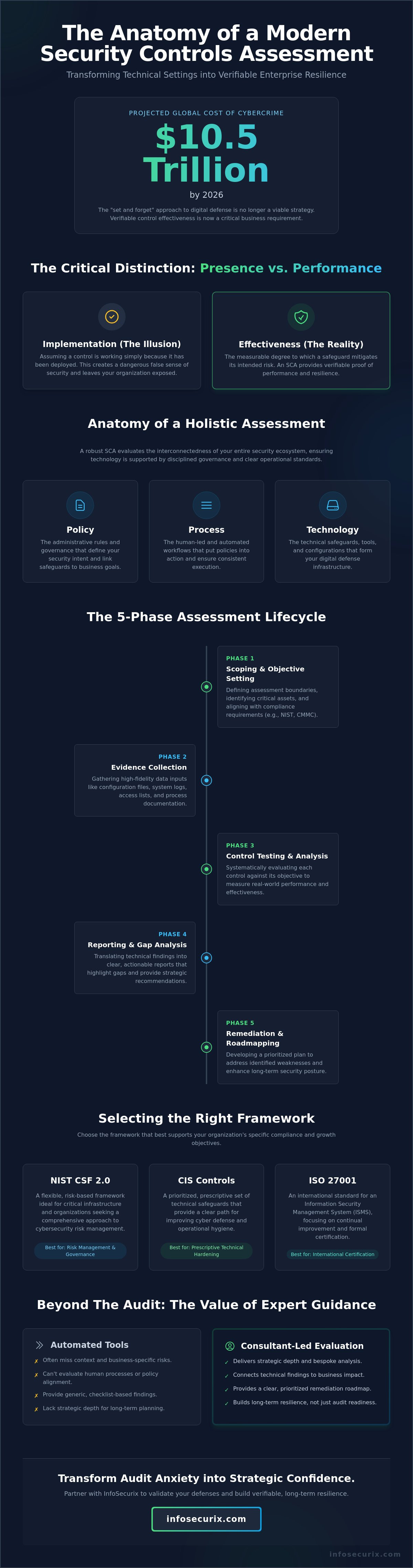
With the global cost of cybercrime projected to reach $10.5 trillion in 2026, the traditional “set and forget” approach to digital defense has become a significant liability. You’ve likely invested heavily in sophisticated technical safeguards, yet a persistent sense of uncertainty often remains regarding their actual performance under pressure. It’s a common challenge for leaders who need to prove control effectiveness to stakeholders or fear that overlooked technical gaps might compromise a formal certification audit. Executing a meticulous security controls assessment is no longer a periodic checkbox exercise. Instead, it’s the definitive method for transforming abstract technical settings into verifiable enterprise resilience and strategic clarity.
We’re here to help you bridge the divide between complex technical implementation and high-level corporate excellence. This guide provides a clear roadmap for testing your safeguards against modern benchmarks like NIST CSF 2.0 and the finalized CMMC 2.0 requirements. You’ll gain the insights needed to align your technical security with evolving regulatory expectations, replacing audit anxiety with the steady confidence of a seasoned veteran. We’ll explore the systematic steps to validate your defenses, ensuring your organization remains both protected and prepared for the rigorous external audits of the coming year.
Key Takeaways
- Learn why a formal security controls assessment is the essential foundation for any resilient cybersecurity strategy: it bridges the gap between technical settings and executive-level confidence.
- Explore the methodology of using CIS Controls and verifiable data inputs to measure the real-world performance of your technical and administrative safeguards.
- Compare the nuances of NIST, CIS, and ISO 27001 Annex A to determine which framework best supports your organization’s specific compliance and growth objectives.
- Follow a methodical five-phase roadmap designed to streamline the assessment process; this journey starts with precise scoping and moves through comprehensive evidence collection.
- Understand why a bespoke, consultant-led evaluation provides a level of strategic depth and long-term security that automated, generic tools cannot replicate.
Defining the Security Controls Assessment (SCA) in a Modern Risk Landscape
Establishing a resilient enterprise begins with a precise evaluation of its defenses. A Security controls assessment is a systematic, high-level evaluation of the technical, administrative, and physical safeguards that shield your organizational assets. It serves as the foundational layer of a robust cybersecurity posture, providing a level of scrutiny that basic tools simply cannot reach. While many teams rely on automated vulnerability scans to find technical holes, these snapshots often ignore the human and physical layers of defense. The assessment focuses on the critical gap between intent and reality. It ensures that your security ecosystem isn’t just a collection of tools, but a cohesive strategy that provides the absolute confidence modern stakeholders and board members require in 2026.
The Strategic Distinction: Implementation vs. Effectiveness
Presence is not performance. It’s a common pitfall to assume that because a control has been deployed, it’s actually doing its job. In many cases, a safeguard can be present within a network but remain fundamentally ineffective because of poor configuration, lack of maintenance, or shifting threat patterns. We define control effectiveness as the measurable degree to which a safeguard mitigates its intended risk. Relying on unverified implementation creates a dangerous false sense of security; it’s an illusion of safety that leaves you exposed to sophisticated threats. A professional security controls assessment validates these defenses under pressure, transforming a passive checklist into a verified, high-performance barrier against operational disruption.
Core Components: Policy, Process, and Technology
A sophisticated assessment must look far beyond software to analyze the human processes and administrative policies that sustain your defense. Every technical setting should be tied to a specific Control Objective, which is a clear statement that links a security activity to a vital business goal. In the current landscape, these three pillars are inseparable. If your policies are robust but your human processes are fragmented, your technology will eventually fail. We examine the interconnectedness of these elements to ensure your organization is future-proofed against emerging risks. This holistic approach ensures that your technical implementations are backed by disciplined governance and clear operational standards, creating a culture of security that extends from the server room to the boardroom.
Measuring Success: The Metrics and Methodology of Control Evaluation
Precision in measurement is the hallmark of a mature security program. To move beyond subjective claims of safety, sophisticated organizations utilize the CIS Controls Assessment Specification as a rigorous benchmark for measurement. This specification provides a structured, repeatable way to verify whether safeguards are performing as intended. A successful security controls assessment relies on two primary pillars: Inputs and Operations. Inputs represent the raw data required for verification, while Operations are the specific actions taken to analyze that data. When combined, these measures form the metrics that translate granular technical activity into the strategic insight required for executive reporting.
Identifying Inputs and Safeguard Measurements
Selecting high-fidelity data sources is critical to ensuring the integrity of your assessment results. We focus on collecting evidence that provides an objective view of your environment. Common inputs include:
- Configuration files from firewalls, servers, and cloud environments.
- System logs and event data that track historical performance.
- Role-based access lists and permission structures.
- Interview evidence and documented artifacts from key process owners.
Every measurement involves specific assumptions, such as the belief that a log source is capturing all relevant traffic or that a configuration file is current. Documenting these assumptions is a vital step in the security controls assessment process; it ensures accuracy and prevents skewed results that could lead to a false sense of security. By identifying these variables early, we maintain the precision necessary for a reliable evaluation.
Quantitative vs. Qualitative Assessment Metrics
Effective reporting requires a balance between the precision of hard data and the nuance of professional expert judgment. Quantitative metrics, such as the percentage of systems meeting a specific patch threshold, provide a clear baseline of performance. However, qualitative analysis is equally important; it explains the context behind the numbers and identifies why certain gaps exist. When presenting these findings to a Board of Directors, it’s essential to justify security spend by showing how these metrics impact the organization’s risk profile. This methodology is deeply integrated with a broader IT risk assessment methodology, ensuring that every control is evaluated based on its contribution to enterprise resilience. If you’re preparing for a high-stakes external review, conducting a thorough internal audit can help you uncover these metrics and address vulnerabilities before they become liabilities.
Selecting the Right Framework: NIST, CIS, and ISO 27001 Requirements
Framework selection is not merely a technical preference; it’s a strategic decision that dictates how your organization communicates risk to the global market. While the NIST Cybersecurity Framework (CSF) 2.0 offers unparalleled flexibility for outcome-based security, the CIS Controls v8.1 provide a highly prioritized, technical roadmap for immediate risk reduction. For organizations seeking international recognition, the ISO 27001:2022 standard remains the gold standard for information security management systems, especially after the transition period for previous versions ended in October 2025. Choosing the right framework requires an honest appraisal of your industry requirements, geographic footprint, and long-term growth objectives. Many leaders ask why a bespoke security controls assessment is necessary when generic checklists are readily available. The answer lies in the depth of verification. A generic checklist confirms that a tool is installed; a professional assessment confirms that the tool is configured correctly to withstand a sophisticated breach.
For those managing multiple regulatory burdens, adopting a Unified Controls Framework (UCF) is a sophisticated way to streamline efforts. Mapping a single security controls assessment across several standards allows you to “test once and comply many times,” reducing the operational fatigue often associated with large-scale audits. This methodical approach ensures that your technical implementations satisfy the requirements of NIST, ISO, and CMMC 2.0 simultaneously, creating a sense of thoroughness and interconnectedness across your entire compliance program.
Aligning SCA with Certification Readiness
Executing a rigorous assessment serves as a vital rehearsal for formal audits. It functions as an essential “pre-audit” for ISO 27001 certification readiness, allowing your team to identify and remediate gaps in a low-stakes environment. This is particularly critical for meeting the SOC 2 Trust Services Criteria, where auditors look for specific evidence of control performance over time rather than just a snapshot of implementation. Professional assessments are designed to uncover “silent failures,” which are those subtle technical or procedural breakdowns that remain invisible to your internal teams but are immediately apparent to an external auditor during a certification review.
The Role of Continuous Monitoring in 2026
The era of the “point-in-time” audit has passed. In 2026, the focus has shifted toward continuous control verification to maintain alignment with benchmarks like NIST and CIS. While automated tooling is indispensable for detecting configuration drift in real-time, it cannot replace the nuanced judgment of an expert assessor who understands the strategic context of your business. We define continuous monitoring as a strategic necessity for maintaining enterprise trust and ensuring that your resilience remains unbroken between formal assessment cycles. Relying on a mix of automated precision and human expertise creates a steady, reliable defense that evolves alongside the threat landscape.
The 5-Phase Lifecycle of a Professional Security Controls Assessment
Executing a professional security controls assessment is a methodical journey that transforms raw technical data into strategic foresight. It’s not a chaotic hunt for errors but a disciplined 5-phase process designed to provide a comprehensive view of your defense. This lifecycle ensures that your assessment is repeatable, defensible, and deeply aligned with your organizational goals. By following this structured path, you move from the uncertainty of unverified implementation to the absolute confidence of a validated security posture.
Scoping and Evidence Collection
A successful assessment begins with a criticality-based approach to scoping. This ensures your resources aren’t wasted on low-risk systems but are focused on the high-impact assets that drive your business value. Defining exactly what’s “in-bounds” prevents scope creep and allows for a deeper dive into the most sensitive environments. During the information gathering phase, we collect a curated set of essential artifacts: policies, network diagrams, and detailed system configurations. Incorporating a formal information security internal audit at this stage is a sophisticated way to verify evidence integrity. It ensures that the documentation we analyze truly reflects the current state of your operations, providing a reliable foundation for the testing to follow.
Control Testing and Vulnerability Mapping
Control testing is the engine of the assessment; it’s where we verify if your safeguards actually perform under pressure. It’s vital to execute these operations with precision to avoid disrupting production environments. We often employ “Negative Testing,” which involves deliberately attempting to bypass a safeguard to see if it holds firm. When a control doesn’t meet the required standard, we move into Vulnerability Mapping. This process links a failed control to a specific threat actor capability, providing the context necessary for executive decision-makers to understand the real-world stakes. It’s the difference between flagging a technical setting and explaining how that setting allows an adversary to move laterally through your financial systems.
Strategic Reporting and Corrective Actions
The final phase is reporting and remediation, where we create the strategic roadmap for improvement. A professional report must include a prioritized Risk Treatment Plan that translates technical failures into a compelling business case for security investment. It provides a clear path forward, ensuring that every remediation effort directly reduces your most critical exposures. This phase naturally integrates with comprehensive cybersecurity risk assessment services, which provide the holistic strategy required to close gaps permanently. If you’re ready to move beyond basic checklists and build true enterprise resilience, our team can guide you through a bespoke Risk Assessment that secures your organization’s future.
Beyond the Audit: Partnering with InfoSecurix for Long-Term Resilience
Compliance shouldn’t be viewed as a static hurdle or a one-time event. Instead, it serves as a powerful catalyst for organizational growth and market differentiation. While automated tools offer a surface-level glance at your environment, they often miss the nuanced risks that only a seasoned veteran can identify. Choosing a professional security controls assessment with InfoSecurix means moving beyond “cookie-cutter” results to embrace a bespoke strategy tailored to your unique operational footprint. With over 25 years of experience navigating the most complex regulatory landscapes, we provide the absolute confidence required to thrive in a volatile digital economy. Our approach is steady and measured: we focus on the strategic impact of technical processes to ensure your growth is never hindered by unforeseen vulnerabilities.
The Value of a Seasoned Guide in Compliance
Bridging the gap between granular technical mechanics and high-level executive strategy requires a partner who has seen every possible scenario. InfoSecurix acts as a Seasoned Guide: we don’t just identify gaps; we invest in your long-term certification success. Our expertise across ISO 27001, SOC 2, and NIST frameworks ensures that your organization isn’t just checking boxes but building a legacy of trust with your clients. This collaborative relationship transforms the assessment process into a strategic rehearsal. It prepares your team for the scrutiny of external auditors while reinforcing your competitive advantage in the marketplace. We work as a collaborative ally, remaining calm under pressure and providing the clarity needed to navigate evolving global standards.
Future-Proofing Your Posture with Strategic Corrective Actions
Moving from a reactive state of “putting out fires” to a proactive posture of resilience is the ultimate goal of a professionally led security controls assessment. The long-term ROI of a rigorous evaluation is found in the prevention of costly breaches and the streamlining of future compliance cycles. By implementing strategic corrective actions today, you future-proof your business against the threats of 2026 and beyond. A well-constructed assessment provides more than just a list of failures: it offers a vision for a more secure and efficient future. We invite you to secure your enterprise’s future through meticulous standards and a commitment to excellence that goes far beyond a simple audit. It’s time to transform your security posture from a cost center into a foundational pillar of your corporate success.
Securing Your Strategic Advantage in a Volatile Landscape
Building enterprise resilience in 2026 requires more than just modern software; it demands a disciplined validation of every safeguard within your ecosystem. We’ve explored how a rigorous security controls assessment transforms technical implementation into a defensible strategy that satisfies both board members and external auditors. By aligning your defenses with frameworks like NIST CSF 2.0 or ISO 27001, you ensure that your organization remains steady under pressure. Professional evaluation isn’t just about finding gaps; it’s about future-proofing your growth through meticulous standards and expert insight.
InfoSecurix brings over 25 years of experience in information security compliance to every engagement. Whether you’re navigating the complexities of SOC 2 or seeking ISO 27001 certification, our seasoned team provides the expert guidance necessary for success. We invite you to Partner with InfoSecurix for a Comprehensive Security Controls Assessment and move beyond reactive defense. Transforming your compliance journey into a catalyst for excellence is the most reliable way to protect your legacy. Your path to absolute confidence starts with a partner who understands the high stakes of your industry.
Frequently Asked Questions
What is the difference between a security controls assessment and a risk assessment?
A risk assessment identifies potential threats and vulnerabilities to determine an organization’s overall risk level. In contrast, a security controls assessment focuses on evaluating the specific technical, physical, and administrative safeguards designed to mitigate those risks. While the risk assessment defines the “what” and “why” of your strategy, the assessment verifies the “how well” by testing the actual performance of your barriers.
How often should an organization perform a security controls assessment?
Organizations should conduct a comprehensive evaluation at least annually or immediately following significant changes to their network architecture. In the 2026 landscape, many sophisticated firms are supplementing these periodic reviews with continuous monitoring. This proactive approach ensures that your defenses remain aligned with benchmarks like NIST CSF 2.0 and prevents configuration drift from creating unaddressed gaps in your information security management system.
Is a security controls assessment mandatory for ISO 27001 certification?
Yes, validating the performance of your safeguards is a core requirement for achieving and maintaining ISO 27001:2022 certification. The standard explicitly requires organizations to monitor, measure, and evaluate their security performance. A formal security controls assessment provides the objective evidence that external auditors require to confirm your Annex A controls are functioning as intended and effectively protecting organizational assets.
Can we use automated tools to perform a security controls assessment?
Automated tools are indispensable for gathering technical data and identifying misconfigurations, but they cannot replace the nuanced judgment of a seasoned assessor. We utilize automation to provide high-fidelity inputs and real-time visibility while relying on human expertise to evaluate policy alignment and human processes. This hybrid methodology ensures a level of thoroughness and strategic insight that automated software alone simply cannot replicate.
How long does a typical security controls assessment take to complete?
A typical engagement usually spans three to six weeks depending on the complexity of your environment and the defined scope. This timeline includes the initial scoping and evidence gathering phases followed by deep-dive testing and strategic reporting. Global enterprises with multiple regulatory burdens or extensive cloud footprints may require a longer duration to ensure every critical asset is evaluated with the necessary precision.
What are the most common control failures identified during an SCA?
We frequently uncover “silent failures” in identity and access management, such as over-privileged accounts and inadequate multi-factor authentication coverage. Misconfigured cloud storage and inconsistent patch management are also prevalent technical gaps. These failures often stem from a lack of disciplined administrative oversight, proving that even the most advanced technology requires robust human processes and clear policies to remain effective under pressure.
Who should be involved in the security controls assessment process?
Success requires a collaborative effort that includes IT leadership, security operations teams, and business process owners. Engaging executive stakeholders early ensures that the assessment objectives align with your broader corporate strategy and growth goals. By involving a cross-functional team, you create a sense of shared responsibility and ensure that the final remediation roadmap is operationally feasible for the entire enterprise.
How do we prioritize remediation after the assessment is complete?
Remediation should follow a criticality-based approach that focuses on failures linked to high-impact, exploitable risks. We help you rank corrective actions using a prioritized Risk Treatment Plan that translates technical vulnerabilities into clear business stakes. This methodical strategy ensures that your security investment is directed toward the most vital gaps, maximizing your ROI and strengthening your overall posture against modern threats.