

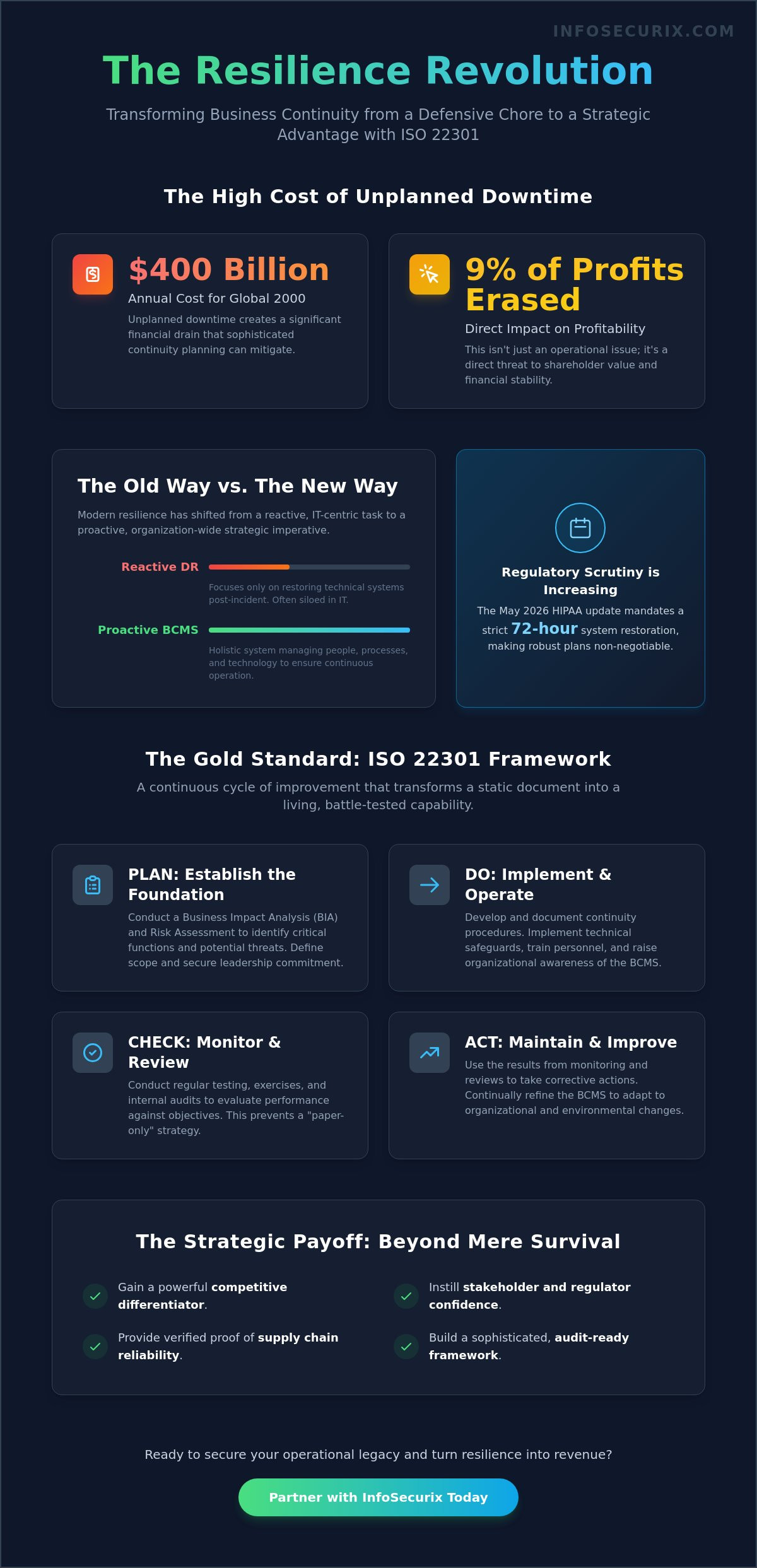
Did you know that unplanned downtime costs the Global 2000 approximately $400 billion annually, effectively erasing 9% of their total profits? While many executives view resilience as a defensive necessity, the most sophisticated organizations recognize it as a catalyst for sustainable growth. Engaging professional business continuity planning services isn’t just about surviving a crisis: it’s about building a foundation of operational precision that both stakeholders and regulators trust. You likely feel the weight of increasing scrutiny, especially with the May 2026 HIPAA Security Rule overhaul mandating a strict 72-hour system restoration requirement for critical data.
We recognize that the technical complexity of ISO standards can feel overwhelming, particularly when you’re tasked with quantifying the ROI of a plan you hope to never use. This article demonstrates how to transform organizational vulnerability into a strategic advantage through the rigorous ISO 22301 framework. You’ll discover the essential components of a battle-tested continuity plan, the systematic path toward successful certification, and the technical safeguards required to eliminate downtime during unforeseen events.
Key Takeaways
- Shift from reactive disaster recovery to a proactive Business Continuity Management System (BCMS) that safeguards your organization’s long-term operational legacy.
- Discover how professional business continuity planning services leverage the ISO 22301 framework to transform organizational vulnerability into a verified strategic advantage.
- Identify and prioritize critical functions through a rigorous Business Impact Analysis (BIA), ensuring technical recovery efforts align perfectly with executive priorities.
- Prevent the risks of a “paper-only” strategy by implementing non-negotiable testing and multi-year exercise programs that build authentic organizational readiness.
- Adopt a bespoke approach to resilience that moves beyond generic templates to deliver a sophisticated, audit-ready framework tailored to your specific risk profile.
The Evolution of Resilience: Why Modern Business Continuity Planning Services are Essential
The concept of organizational survival has undergone a radical transformation. Historically, leaders treated resilience as a binary state: you either had backups or you didn’t. In the high-stakes environment of 2026, this reactive posture is no longer sufficient. Modern business continuity planning services have transitioned from a simple recovery manual to a sophisticated Business Continuity Management System (BCMS). This shift is driven by a stark reality: unplanned downtime now costs Global 2000 companies $400 billion annually, which represents approximately 9% of their total profits. Relying on informal, “best effort” planning creates a level of risk that today’s stakeholders and regulators won’t tolerate.
Regulatory bodies are moving toward more prescriptive mandates, making standardized frameworks essential. For example, the U.S. Department of Health and Human Services is finalizing a major HIPAA Security Rule overhaul in May 2026. This update eliminates addressable safeguards and mandates specific technical controls, including a 72-hour system restoration requirement. Professional services ensure your organization isn’t just checking boxes; they help you build a resilient architecture capable of meeting these rigorous new benchmarks. Moving from an informal plan to a professional BCMS ensures your response is measured, tested, and audit-ready.
Distinguishing Business Continuity from Disaster Recovery
Many executives conflate Disaster Recovery (DR) with Business Continuity (BC), yet they serve distinct roles in an enterprise protection strategy. Business continuity planning focuses on the people and processes: it ensures that the essential functions of the business remain operational during a disruption. Disaster Recovery is a subset of this broader strategy, focusing specifically on the technical systems: the restoration of hardware, data, and infrastructure. Total enterprise protection requires a synergy between these two disciplines. Without BCP, you might have recovered data but no staff to process it. Without DR, your staff is ready, but your systems are dark.
The Strategic Value of a Certified BCMS
Adopting a certified BCMS, specifically through the ISO 22301 framework, moves an organization beyond mere compliance. It creates a powerful competitive differentiator. In an era of heightened supply chain scrutiny, partners and vendors increasingly require proof of resilience before signing contracts. By utilizing professional business continuity planning services, you provide stakeholders with a verified assurance of your reliability. This structured approach transforms resilience from a cost center into a strategic asset. It protects your operational legacy while instilling absolute confidence in your market position and future-proofing your growth against unforeseen volatility.
Aligning with the Gold Standard: The ISO 22301 Framework for Business Continuity
ISO 22301:2019 represents the definitive international benchmark for organizational resilience. While many frameworks offer general guidance, this standard provides a rigorous, certifiable structure that demands more than just a recovery plan. It requires a comprehensive management system. Professional business continuity planning services play a vital role here, translating the standard’s technical requirements into a functional operational reality. At its heart lies the Plan-Do-Check-Act (PDCA) cycle: a methodical rhythm of establishing the system, implementing it, monitoring its performance, and refining it based on actual results. This cycle ensures your resilience isn’t a static document but a living, evolving capability.
Achieving this level of readiness starts with understanding the organization’s context and securing unwavering leadership commitment. ISO 22301 isn’t a project that lives solely within the IT department; it’s a strategic initiative that requires executive oversight to allocate resources and set measurable objectives. For those beginning this journey, resources like Ready.gov business preparedness offer a foundational starting point, but the path to full certification requires a deeper, more specialized engagement. Expert guidance streamlines this process, ensuring that the transition from current state to certified excellence is both efficient and thorough.
Key Components of an ISO-Compliant BCMS
A certifiable BCMS is built on three pillars: policy, resources, and documentation. The policy serves as the high-level vision, defining the scope and objectives that the organization intends to achieve. Without clear, measurable goals, resilience remains an abstract concept. Resource allocation is equally critical. You must ensure the right individuals are trained and empowered to act when a crisis occurs. Auditors look for specific documentation that proves the system is active and effective, including:
- Business Continuity Policy: A formal statement of management’s commitment to resilience.
- Resource Requirements: A detailed map of the personnel, facilities, and technology needed for recovery.
- Performance Metrics: Evidence that the plan is regularly reviewed, tested, and updated.
The Role of Gap Analysis in Certification Readiness
A gap analysis serves as a vital diagnostic tool for resilience, revealing the specific distance between your current operational state and full ISO 22301 compliance. It’s the first step in any professional engagement, allowing you to prioritize remediation efforts where they’ll have the most significant impact on risk reduction. Instead of a scattergun approach, you focus on the vulnerabilities that actually threaten your critical functions. If you’re ready to move beyond generic templates, exploring ISO 22301 business continuity readiness can provide the clarity needed to secure your organization’s future.
The Architecture of Readiness: Business Impact Analysis and Risk Assessment
The strength of any resilience strategy depends on the precision of its underlying data. While the ISO framework provides the necessary structure, the Business Impact Analysis (BIA) and Risk Assessment (RA) provide the operational intelligence. Engaging expert business continuity planning services ensures these assessments aren’t merely academic exercises but serve as the “brain” of your organizational defense. By systematically evaluating how specific disruptions affect your bottom line, you move from guesswork to data-driven decision-making. This process identifies exactly which functions are non-negotiable for survival and which can be temporarily suspended.
A formal Risk Assessment identifies external and internal threats: cyberattacks, equipment failure, or supply chain volatility. When you pair this with a BIA, the result is a clear roadmap for recovery. You aren’t just planning for a vague disaster; you’re planning for specific impacts on your most vital assets. This level of granularity is what distinguishes audit-ready business continuity planning services from generic, off-the-shelf templates. It allows your leadership team to move with absolute confidence during a disruption, knowing exactly which systems must be prioritized to maintain the integrity of the organization. This methodology aligns with the high standards seen in regulated sectors, such as FINRA business continuity planning guidelines, where precision is a mandate rather than a suggestion.
Defining Recovery Objectives: RTO and RPO
Determining the maximum allowable downtime, or Recovery Time Objective (RTO), is a critical business decision. It defines how quickly a function must be restored before the damage becomes irreparable. Parallel to this is the Recovery Point Objective (RPO), which calculates acceptable data loss thresholds. Setting these objectives requires a delicate balance: faster recovery times typically demand higher investment. Professional services help you navigate this trade-off by aligning technical capabilities with actual business needs, ensuring your targets are both ambitious and achievable.
Identifying Critical Business Functions
Not all processes carry the same weight during a crisis. Mapping dependencies involves tracing the intricate links between suppliers, technology, and human capital. This process reveals hidden vulnerabilities: perhaps a secondary vendor lacks their own resilience plan, or a critical process relies on a single individual. Functions are typically categorized as “Mission Critical,” “Vital,” or “Support” to ensure resources flow to the most urgent areas first. Consider the impact of downtime on your reputation or legal standing. For instance, failing to restore systems within the 72-hour window required by the May 2026 HIPAA update could lead to devastating financial and reputational consequences. A structured approach to business continuity plan development ensures these critical functions are identified, prioritized, and protected before a disruption occurs.
From Documentation to Execution: Testing, Training, and Refining the Plan
A business continuity plan that exists only as a digital file on a secure server is a liability in disguise. It creates a dangerous sense of security while offering no guarantee of performance during a high-pressure event. Professional business continuity planning services emphasize that validation is non-negotiable. You cannot afford to wait for a crisis to discover that your recovery procedures are outdated or that your staff is unprepared to execute their designated roles. Transitioning from a theoretical document to a verified operational capability requires a commitment to rigorous testing and a structured, multi-year exercise program.
Training the workforce is the cornerstone of this transition. Every individual within the continuity arc must understand their specific responsibilities, from the executive team making high-level decisions to the operational staff maintaining critical functions. For organizations looking to empower their personnel through accredited security industry education, insightsecurity.ie offers specialized training and consultancy. This collective knowledge transforms the plan from a static set of instructions into a dynamic response culture. As business environments evolve and technology stacks change, the plan must follow suit. Continuous improvement is achieved by capturing lessons learned during every drill and refining the BCMS to reflect the current reality of the organization, ensuring it remains a living asset.
Types of Continuity Exercises and Drills
Validating a BCMS involves a progression of complexity to build confidence and skill. Tabletop exercises serve as an ideal starting point, allowing leadership teams to walk through specific scenarios in a low-stress environment to identify logical gaps. Simulation testing takes this a step further by conducting live-action drills for specific departments, such as testing the 72-hour restoration requirement mandated by recent regulations. Finally, full-scale rehearsals validate the entire system under realistic conditions. These rehearsals provide the ultimate proof that the organization can operate through a disruption without compromising its mission or reputation.
Maintaining Audit-Ready Documentation
Documentation is the bridge between operational readiness and regulatory compliance. Auditors for ISO 22301 look for a comprehensive “paper trail” that proves the system is actively managed rather than merely archived. This includes strict version control and ensuring that the plan remains accessible even when primary systems are down. Evidence of testing, including post-exercise reports and remediation logs, is essential for a successful certification journey. Regular internal audits serve as a vital health check, identifying areas for refinement before an external auditor arrives. This methodical approach ensures your documentation is as robust as your operational response.
Securing Your Operational Legacy: The InfoSecurix Approach to Continuity
Leveraging over 25 years of specialized expertise in high-stakes compliance and information security, InfoSecurix provides a level of precision that generic templates simply cannot match. Our business continuity planning services are built on a foundation of deep-rooted knowledge and a legacy of navigating the most complex regulatory environments. We don’t believe in a one-size-fits-all strategy; instead, we offer a bespoke methodology designed to align with your unique operational footprint and risk tolerance. This curated approach ensures that your resilience framework is not just a compliance checkbox but a robust engine for long-term stability and growth.
Integrating your BCMS with other critical standards like ISO 27001 and SOC2 creates a unified security posture that protects every facet of your organization. By bridging the gap between information security and operational continuity, we help you build a comprehensive defense that satisfies both technical IT requirements and high-level executive mandates. This interconnectedness is essential for modern enterprises that must prove their reliability to a global network of partners and stakeholders. Acting as your Trusted Advisor, we guide you through the intricacies of the ISO 22301 standard, ensuring that every element of your plan is audit-ready and operationally sound.
Our Certification Readiness Philosophy
Achieving certification is a journey of refinement rather than a single event. Our philosophy centers on strategic corrective actions that address the root causes of vulnerability rather than just the symptoms. We utilize independent internal audits to uncover hidden weaknesses that might be overlooked by internal teams. This objective perspective is vital for maintaining the ongoing health of your BCMS. By providing clear, actionable insights, we empower your executive leadership to lead through disruptions with absolute confidence, knowing that their decisions are backed by a battle-tested and verified framework.
Partnering for National Excellence
Future-proofing your organization against the evolving threat landscape of 2026 requires a partner who understands both the big-picture trends and the granular mechanics of resilience. InfoSecurix offers national-scale expertise combined with the personal, attentive service of a boutique firm. We remain unfazed by the increasing complexity of global standards, providing the steady hand you need to secure your operational legacy. Your success depends on the ability to operate through uncertainty, and we’re committed to ensuring your business remains a protective force for your clients and employees alike. Secure your organization’s future with InfoSecurix’s ISO 22301 readiness services.
Securing Your Operational Legacy Through Strategic Resilience
Building a resilient organization is a continuous journey of refinement. It requires moving beyond basic backups to embrace a comprehensive management system that protects your operational legacy. By aligning with the ISO 22301 framework, you transform vulnerability into a verified strategic advantage. This process demands a methodical approach to risk assessment and business impact analysis; it ensures your recovery objectives are both ambitious and achievable. Utilizing professional business continuity planning services is the most effective way to navigate this complexity with absolute confidence.
InfoSecurix brings over 25 years of information security expertise to every engagement. We specialize in ISO 22301, ISO 27001, and SOC2 readiness, providing bespoke consultancy tailored to complex regulatory landscapes. Our seasoned advisors work as collaborative allies to ensure your documentation is audit-ready and your staff is prepared for any scenario. It’s time to future-proof your business through meticulous standards that drive enterprise value. Partner with InfoSecurix for Expert Business Continuity Planning. Your commitment to these rigorous standards today secures your organization’s growth and reliability for years to come.
Frequently Asked Questions
What are business continuity planning services?
Business continuity planning services provide the professional expertise required to establish a resilient Business Continuity Management System (BCMS). These services encompass the systematic identification of critical functions, the execution of rigorous risk assessments, and the development of actionable recovery strategies. By partnering with a seasoned guide, your organization transforms theoretical readiness into a verified capability that aligns with the international ISO 22301 standard.
How much do business continuity planning services cost?
The investment required for professional resilience planning depends entirely on the complexity of your organizational structure and the specific regulatory landscape of your industry. Factors such as the number of operational sites, the volume of critical business functions, and the desired level of certification readiness will influence the scope of the engagement. A bespoke approach ensures that resources are allocated precisely where they provide the most significant strategic protection.
What is the difference between ISO 22301 and a standard BCP?
While a standard business continuity plan (BCP) is often a static document focusing on immediate recovery, ISO 22301 is a comprehensive management system. It demands a holistic approach that includes leadership commitment, continuous performance evaluation, and a structured rhythm of improvement. Professional business continuity planning services ensure your resilience strategy moves beyond a simple manual to become a certifiable framework that meets the highest international benchmarks.
How long does it take to develop a comprehensive business continuity plan?
Developing a sophisticated, audit-ready plan typically requires a timeframe of three to six months for most mid-to-large enterprises. This duration allows for a thorough Business Impact Analysis, the identification of dependencies, and the implementation of necessary technical safeguards. The exact timeline is determined by the maturity of your existing processes and the speed at which your internal teams can validate recovery procedures.
Is a business impact analysis (BIA) required for ISO 22301?
Yes; a formal Business Impact Analysis is a non-negotiable requirement under Clause 8.2 of the ISO 22301 standard. The BIA serves as the intellectual foundation of your BCMS by determining the maximum allowable downtime for every critical function. Without the data provided by a BIA, it’s impossible to set accurate Recovery Time Objectives (RTOs) or prioritize the restoration of essential services during a disruption. Engaging professional business impact analysis services ensures this foundational assessment is conducted with the rigor and precision required to satisfy both auditors and executive stakeholders.
What happens if our organization fails an ISO 22301 audit?
If an auditor identifies gaps, they will issue non-conformities classified as either “minor” or “major.” This result is not a final failure but rather a structured opportunity for corrective action. Your organization is given a specific period to remediate these findings through targeted improvements. Engaging in regular internal audits before the official certification assessment is the most effective way to identify and resolve these vulnerabilities early.
How often should a business continuity plan be tested?
Organizational resilience should be validated through testing at least once per year or whenever a significant change occurs in your operational environment. Testing frequencies may increase for high-risk sectors or those facing new regulatory mandates, such as the May 2026 HIPAA system restoration requirements. A multi-year exercise program ensures that different scenarios, from tabletop walkthroughs to full-scale simulations, are used to maintain authentic readiness.
Can business continuity planning help with cyber insurance premiums?
Professional business continuity planning services frequently assist in securing more favorable terms from cyber insurance underwriters. Insurers prioritize organizations that can demonstrate a disciplined approach to risk management and a proven ability to restore critical systems within strict timeframes. By presenting a certified ISO 22301 framework, you provide tangible evidence of a lower risk profile, which can lead to enhanced coverage options and premium stability.