

The most significant risk to your enterprise isn’t the initial audit; it’s the quiet degradation of security practices once the certificate is on the wall. While achieving certification is a commendable feat, maintaining ISO 27001 compliance in 2026 requires a transition from a project-based mindset to a permanent operational rhythm. You likely understand the pressure of compliance drift, where manual documentation becomes a burden and the anxiety of a Year 2 surveillance audit begins to loom. With the global average cost of a data breach reaching $4.44 million, the stakes for your Information Security Management System (ISMS) have never been higher.
We’ll show you how to move beyond “checking boxes” to build a sustainable posture that satisfies auditors and protects your growth. This roadmap details how to integrate the 93 controls of the ISO/IEC 27001:2022 standard into your daily workflow: creating a predictable, low-stress audit cycle. By establishing clear risk ownership and leveraging the recent ISO/IEC 27000:2026 vocabulary updates, you can provide senior leadership with the transparent reporting they require to view security as a strategic asset rather than a technical hurdle.
Key Takeaways
- Understand the mechanics of compliance drift and how to transition from a project-based mindset to a permanent operational rhythm.
- Distinguish between surveillance and recertification audits to focus your resources on the high-impact areas auditors prioritize in 2026.
- Implement a dynamic risk management strategy that evolves with your business: ensuring that maintaining ISO 27001 compliance remains a byproduct of genuine security.
- Establish a structured compliance calendar featuring monthly reviews and quarterly internal audits to prevent the stress of year-end scrambling.
- Discover why a veteran-led consultancy model provides the objective oversight necessary to future-proof your ISMS against sophisticated threats.
The ISO 27001 Maintenance Lifecycle: Beyond Initial Certification
Transitioning from a project-based implementation to an operational rhythm defines the essence of the ISO/IEC 27001 standard. Maintaining ISO 27001 compliance isn’t merely about retaining a certificate; it’s the disciplined, ongoing operation of your Information Security Management System (ISMS) to ensure it remains effective against an evolving threat landscape. This phase requires a shift in perspective. You aren’t just protecting data. You’re future-proofing the enterprise’s reputation through a commitment to excellence that persists long after the auditor leaves the room.
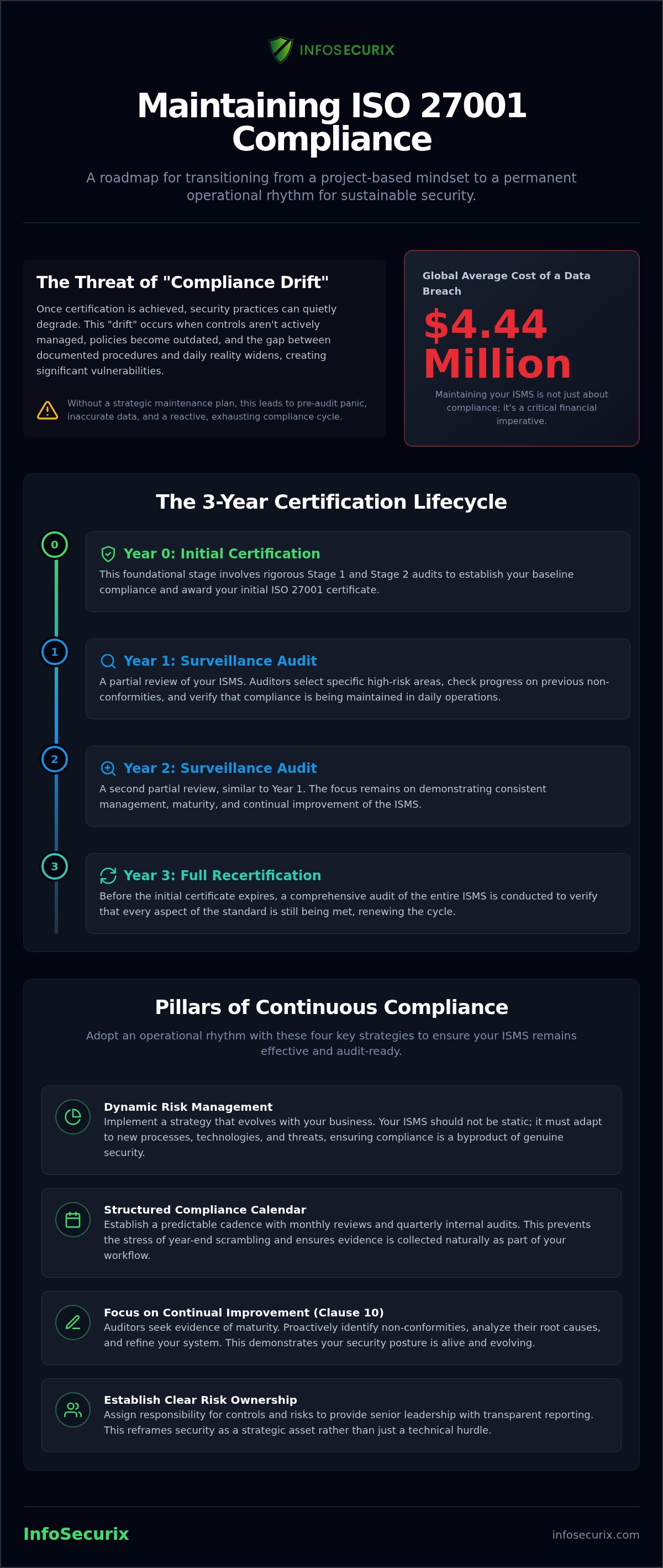
Organizations often fall victim to “Compliance Drift.” This phenomenon occurs when security controls, once perfectly aligned with the standard, begin to degrade because they aren’t actively managed. Policies become outdated as business processes shift. Access logs go unreviewed because teams are busy. Risk assessments gather dust. Without a strategic roadmap, the gap between your documented procedures and your daily reality widens; this creates significant vulnerabilities that auditors will inevitably find during your next visit.
Viewing the three-year certification cycle as a journey of maturity rather than a recurring hurdle transforms the process from a burden into a strategic advantage. Auditors in 2026 place immense weight on Clause 10, which focuses on Continual Improvement. They aren’t just looking for proof that your controls exist. They’re looking for evidence that you’ve identified non-conformities, analyzed their root causes, and refined your system accordingly. Demonstrating this maturity proves that your security posture is alive and evolving.
The 3-Year Certification Cycle Explained
- Year 0: Initial Certification. This stage involves the rigorous Stage 1 and Stage 2 audits that establish your baseline compliance and award your initial certificate.
- Years 1 and 2: Surveillance Audits. These are partial reviews of your ISMS. The registrar focuses on specific elements, your progress on previous non-conformities, and how well you’re maintaining ISO 27001 compliance in daily operations.
- Year 3: Full Recertification. Before your certificate expires, a comprehensive audit of the entire system is conducted to verify that every aspect of the standard is still being met.
Why Maintenance Fails: Avoiding the Scramble
The “Pre-Audit Panic” syndrome is a common symptom of a broken maintenance strategy. When teams spend three months frantically updating spreadsheets and fabricating evidence of meetings that happened months ago, data accuracy suffers. This reactive approach is exhausting and transparent to seasoned auditors. Moving away from manual, siloed documentation toward a structured internal audit cadence ensures that evidence is collected naturally as part of your business workflow.
Establishing a robust ISO 27001 certification readiness framework sets a foundation that makes this ongoing maintenance significantly more manageable. When your initial implementation is built for longevity, the transition to maintenance mode feels like a natural progression rather than an abrupt change in direction. It’s about building a system that works for you, not one that you work for only when an audit is near.
Surveillance Audits vs. Recertification: Understanding the Requirements
Maintaining ISO 27001 compliance is not a monolithic task; it’s a nuanced progression that shifts in intensity as you move through the certification cycle. While the initial audit establishes your baseline, the subsequent years demand a demonstration of maturity and consistency. Understanding the technical and qualitative differences between a surveillance audit and a recertification audit is essential for any leadership team. One is a targeted pulse check, while the other is a comprehensive validation of your entire security architecture.
Surveillance audits, occurring in years one and two, involve a partial review of your Information Security Management System (ISMS). Rather than testing every control, the auditor selects specific high-risk areas and focuses heavily on your internal audit results and management reviews. A critical focus during these visits is your treatment of previous non-conformities. Auditors expect to see that corrective actions have been integrated into your daily operations rather than treated as one-time fixes. The Statement of Applicability (SoA) remains a focal point; it must be a living document that reflects your current environment. It’s a common misconception that surveillance audits are “easier.” In reality, a failed surveillance audit can lead to certificate suspension just as swiftly as a failed recertification, potentially triggering contractual issues with your global partners. Navigating the benefits and challenges of ISO 27001 requires recognizing that the standard demands constant vigilance, not just periodic effort.
Key Focus Areas for Surveillance Audits
- System Performance: Reviewing management review minutes and internal audit findings to ensure the ISMS is functioning as intended.
- Corrective Action Effectiveness: Providing evidence that past gaps were closed with sustainable, long-term solutions.
- Contextual Evolution: Documenting how your risk landscape has changed due to new technologies, market shifts, or organizational restructuring.
Preparing for Year 3: The Recertification Milestone
Year three represents a full-scope recertification. This is a “fresh start” where the registrar evaluates every single clause of the standard and all 93 Annex A controls. It is a rigorous process that validates the longevity and suitability of your security posture. To succeed, you must ensure that every control has been tested at least once during the preceding three-year cycle. Many organizations find that performing a bespoke information security internal audit several months before the milestone is the most effective way to identify hidden gaps. This proactive measure ensures that your recertification is a celebration of your security culture rather than a stressful scramble for evidence. For enterprises seeking to solidify their market position, engaging a seasoned guide to oversee these milestones ensures that your ISMS remains a robust asset for years to come.
The Four Pillars of Continuous ISO 27001 Compliance
Establishing a resilient Information Security Management System (ISMS) requires more than a reactive response to upcoming audit dates. It demands a structural foundation built on four strategic pillars. These pillars ensure that maintaining ISO 27001 compliance is an effortless byproduct of your daily operations rather than a seasonal burden. By focusing on these core areas, your enterprise can transition from a state of “audit readiness” to one of “continuous security.”
- Dynamic Risk Management: Transitioning from static annual reviews to event-driven assessments that respond to organizational changes.
- Strategic Internal Audit Cadence: Utilizing audits as sophisticated tools for discovery and improvement, moving beyond simple checkbox exercises.
- Evidence and Documentation Hygiene: Maintaining audit-ready records in real-time to eliminate the need for historical reconstruction.
- Security Awareness and Culture: Strengthening the “People” controls to match the rigor of your technical architecture.
Evolving Your Risk Assessment Methodology
The threat landscape of 2026 demands a strategic information security risk assessment that accounts for sophisticated, modern challenges. Traditional risk models often fail to capture the nuances of AI-driven social engineering or complex supply chain vulnerabilities. Your methodology must evolve to link risk outcomes directly to corporate budget and resource allocation. This alignment ensures that security investments are prioritized based on actual business impact. An evolved risk methodology prevents compliance drift by identifying new vulnerabilities before they become audit failures. By integrating risk management into your project lifecycles, you ensure that every new initiative is secure by design from its inception.
Cultivating a Culture of Compliance
True resilience is found in the collective behavior of your workforce. Organizations that successfully maintain ISO 27001 certification understand that security is a shared responsibility across every department. This requires moving beyond generic, once-a-year training videos toward continuous, role-based awareness programs. Leadership plays a pivotal role here; Clause 5 of the standard mandates a visible commitment from top management to the ISMS. You can measure this culture for audit evidence through engagement metrics, phishing simulation results, and the frequency of self-reported security incidents. When security becomes a core cultural value, the administrative burden of compliance naturally diminishes as employees proactively follow established protocols.
Actionable Steps: Building an Operational Compliance Calendar
Transitioning from a reactive state to a disciplined, calendar-driven rhythm is the hallmark of a mature security organization. Maintaining ISO 27001 compliance requires more than good intentions; it demands a structured schedule that ensures every component of your Information Security Management System (ISMS) receives regular attention. By establishing a predictable cadence, you eliminate the “pre-audit panic” and transform compliance into a steady, manageable business process. This operational roadmap provides the clarity your team needs to stay ahead of the curve.
- Step 1: Establish a Monthly ISMS Review. Conduct short, focused meetings to track key performance indicators (KPIs). Focus on incident response metrics, system uptime, and the status of outstanding corrective actions.
- Step 2: Schedule Quarterly Internal Audits. Break the ISMS into manageable segments rather than attempting one massive annual review. This approach ensures deeper scrutiny of specific controls without overwhelming your staff.
- Step 3: Conduct Bi-Annual Risk Reviews. Assess your risk landscape every six months. Specifically look for changes in business processes, new technology deployments, or emerging threats like AI-driven social engineering.
- Step 4: Execute an Annual Management Review. Formalize the “Improvement” phase of the Plan-Do-Check-Act cycle. This high-level session ensures the ISMS remains suitable and effective for the organization’s strategic goals.
- Step 5: Perform Continuous Documentation Updates. Update policies as changes occur. Ensuring documentation reflects your current reality prevents the dangerous gap between what is written and what is actually happening on the ground.
Quarterly vs. Annual Internal Audits
Adopting a “Rolling Audit” approach significantly reduces organizational stress while improving the quality of your findings. When you audit specific departments or control sets quarterly, you can engage deeply with process owners and identify subtle gaps that a rushed annual audit might miss. It’s essential to select internal auditors who are both competent and independent of the area being audited. This objectivity is vital for identifying non-conformities that could otherwise lead to certificate suspension. Mapping these findings directly to your corrective action process ensures that every discovery leads to a measurable improvement in your security posture. For enterprises seeking absolute precision, engaging a professional internal audit service provides the veteran oversight needed to secure your long-term success.
The Management Review: Your Strategic Compliance Tool
The annual management review is not a mere formality; it is a mandatory requirement under Clause 9.3 of the standard. This session must include specific inputs: audit results, feedback from interested parties, and the status of risk assessments. By presenting these data points to executive leadership, you turn the review into a roadmap for the following year. It is the most effective way to secure buy-in for necessary security investments. When leadership sees the direct correlation between compliance health and business resilience, security shifts from a cost center to a strategic enabler.
The InfoSecurix Advantage: Strategic Partnership for Longevity
In an era where many vendors promise “compliance on autopilot” through software alone, the reality remains that an automated platform cannot navigate the complexities of a changing business environment. Maintaining ISO 27001 compliance is a human-centric endeavor that requires the nuanced judgment of a seasoned guide. InfoSecurix provides a sophisticated alternative to generic checklists: a veteran-led consultancy model that prioritizes strategic longevity over temporary fixes. We don’t just provide a tool; we provide a partnership that scales with your ambition and protects your enterprise from the quiet degradation of security standards.
Our internal audit services serve as an essential, objective “second set of eyes” that identifies vulnerabilities before the registrar arrives. We ensure your Information Security Management System (ISMS) is not just audit-ready but genuinely resilient. With over 25 years of experience navigating complex regulatory landscapes, we act as a collaborative ally invested in your growth. We understand that the discipline required for maintaining ISO 27001 compliance is significant, but it becomes a source of organizational strength when managed with precision and foresight.
Beyond Checklists: Strategic Corrective Actions
Fixing a symptom might satisfy a checkbox, but curing the root cause is what protects your enterprise long-term. InfoSecurix helps organizations develop strategic corrective actions that prevent reoccurring non-conformities. For instance, we recently assisted a global technology firm that faced a systemic failure in their access control reviews. Instead of simply updating the log, we redesigned their entire identity management workflow: a move that eliminated the risk and impressed the external auditor during their recertification. This bespoke guidance is the difference between a fragile system and a future-proofed security posture. We replace generic templates with precision-engineered solutions that reflect your unique operational reality and corporate culture.
Ready for Your Next Audit?
The peace of mind that comes from a professionally managed ISMS is invaluable. You can enter your surveillance audit with absolute confidence, knowing that your controls are effective and your documentation is current. Whether you require a comprehensive readiness assessment or a targeted internal audit engagement, we’re here to ensure your success. Don’t leave your certification to chance or the limitations of a software-only approach. Engage with a seasoned guide who has seen every possible audit scenario and can provide the steady hand your organization needs to thrive in 2026. We invite you to reach out for a consultation and discover how a strategic partnership can transform your compliance journey from a burden into a competitive advantage.
Securing Your Legacy of Continuous Compliance
Achieving your initial certificate was a significant milestone; however, the true value of an Information Security Management System lies in its ongoing maturity. By integrating a disciplined compliance calendar and focusing on the four pillars of resilience, you transform security from a technical requirement into a strategic asset. We’ve detailed how to navigate the nuances of surveillance audits and why a proactive internal audit rhythm is essential for long-term success. Maintaining ISO 27001 compliance ensures that your organization remains protected against modern threats while providing the transparent reporting your leadership demands.
InfoSecurix offers a sophisticated partnership built on 25 years of information security expertise. We provide national reach through a boutique, high-touch consultancy approach that addresses the specific needs of your business. Our team possesses comprehensive knowledge across ISO 27001, SOC2, and ISO 22301; this positions us as a trusted guide for your most complex challenges. Secure your certification longevity with InfoSecurix readiness services. Your enterprise deserves the confidence that comes from a steady, expert hand.
Frequently Asked Questions
How often do we need to perform internal audits to remain ISO 27001 compliant?
Internal audits must be conducted at planned intervals to ensure the system remains effective. While the standard doesn’t mandate a specific frequency, performing a full audit at least once per year is the industry norm. Many sophisticated enterprises adopt a rolling quarterly approach. This ensures that maintaining ISO 27001 compliance becomes a continuous habit rather than an annual scramble, allowing your team to address smaller gaps before they escalate.
Can our ISO 27001 certification be revoked during a surveillance audit?
Yes, your certification can be suspended or revoked if a major non-conformity is identified and not remediated within the registrar’s specific timeframe. Surveillance audits carry the same weight as the initial assessment regarding your certificate’s validity. If an auditor finds a total breakdown in a mandatory requirement, they’re obligated to take action. This underscores the necessity of a steady, professionally managed Information Security Management System (ISMS).
What is the most common reason organizations fail their recertification audit?
The most frequent cause of failure is compliance drift, where security practices degrade significantly after the initial audit. Organizations often fail to provide traceable evidence of Clause 10, which governs continual improvement. Auditors in 2026 expect to see a mature system that evolves based on incident data and risk reviews. If your ISMS appears static or neglected, it signals a lack of commitment to the standard’s core principles.
Do we need to update our Statement of Applicability (SoA) every year?
You must review and update your Statement of Applicability whenever your risk landscape or business environment changes. While a full rewrite isn’t always necessary, the SoA must remain an accurate reflection of which controls you’ve implemented and why. An outdated SoA is a common trigger for a non-conformity. It suggests that your risk management process is disconnected from your daily operational reality and current threat environment.
What is the difference between a minor and a major non-conformity in ISO 27001?
A major non-conformity represents a total failure to meet a requirement of the standard or a situation that puts your entire ISMS at risk. A minor non-conformity is typically an isolated incident or a small lapse in a documented process. While a minor finding won’t immediately jeopardize your certificate, failing to address it can lead to a major non-conformity during the next surveillance visit from your registrar.
How much does it cost to maintain ISO 27001 compliance compared to initial certification?
Maintenance costs are typically lower than the initial certification investment, yet they require a dedicated, recurring budget. You must account for annual registrar fees, internal audit resources, and ongoing staff training. While setup involves heavy lifting in policy creation and control implementation, maintaining ISO 27001 compliance focuses on operational consistency. Investing in a seasoned consultant can often reduce these long-term costs by streamlining your internal documentation processes.
Can we switch our certification body (registrar) during the 3-year cycle?
You can switch your certification body at any point, though it’s most common to do so before a new 3-year cycle begins. The process involves a transfer audit where the new registrar reviews your existing documentation and audit history. This is a strategic move if your current provider doesn’t offer the industry-specific expertise or the collaborative partnership your growing enterprise requires to thrive.
Is automated compliance software enough to satisfy an ISO 27001 auditor?
No, automated software is a tool for evidence collection, not a replacement for a functioning ISMS. Auditors look for human oversight, risk-based decision-making, and evidence that leadership is actively involved. While software can streamline documentation, it cannot demonstrate the security culture or the nuanced reasoning behind your risk treatment decisions. A successful audit requires a balance of technical tools and expert, human-led governance.