What if your next major competitive advantage had nothing to do with your product and everything to do with how you protect your clients’ data? For B2B organizations operating in an environment where cybersecurity threats are intensifying and enterprise procurement teams are scrutinizing vendor security posture more rigorously than ever, that question deserves a serious answer. The benefits of ISO 27001 certification for B2B extend well beyond a compliance checkbox; they represent a strategic investment in trust, operational resilience, and long-term commercial credibility.
You already know the pressure. Justifying certification costs to leadership, deciphering complex compliance requirements, and demonstrating to prospective clients that your information security practices are genuinely robust, not just promised, are challenges that define the modern B2B landscape. These concerns are legitimate, and they deserve a measured, expert-informed response.
This article delivers exactly that. Drawing on over 25 years of information security expertise, it walks you through the most compelling strategic, operational, and commercial advantages that ISO 27001 certification unlocks for B2B organizations, so you can make a confident, well-informed decision about your path forward.
Key Takeaways
- The benefits of ISO 27001 certification for B2B extend far beyond compliance – discover how certification accelerates enterprise procurement cycles and positions your organization as a preferred, trusted vendor.
- ISO 27001 establishes a systematic, internationally recognized framework for managing sensitive data, giving B2B organizations a structured foundation for long-term information security resilience.
- Certification delivers measurable financial returns: organizations that achieve ISO 27001 consistently experience lower breach-related costs, making the initial investment a strategically sound business decision.
- Implementing an ISO 27001-aligned Information Security Management System (ISMS) transforms compliance from a one-time exercise into an ongoing operational discipline – one that continuously identifies and mitigates emerging vulnerabilities.
- With over 25 years of information security expertise, InfoSecurix provides tailored certification readiness services designed to guide B2B organizations through every stage of the ISO 27001 journey with precision and confidence.
Understanding ISO 27001: A Key to B2B Success
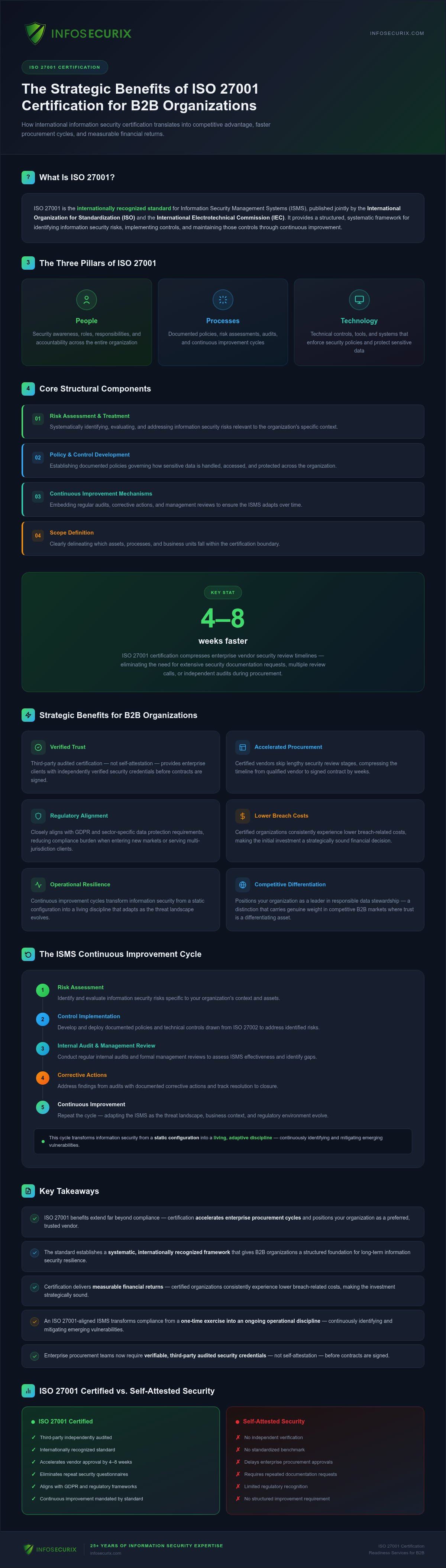
ISO 27001 is the internationally recognized standard for information security management systems, published jointly by the International Organization for Standardization (ISO) and the International Electrotechnical Commission (IEC). At its core, it provides organizations with a structured, systematic framework for identifying information security risks, implementing controls to address them, and maintaining those controls through continuous improvement. For B2B organizations specifically, this isn’t simply an operational consideration; it’s a foundational business decision that shapes how clients, partners, and procurement teams perceive your credibility.
Understanding what the standard actually requires, and why those requirements exist, is the essential first step toward leveraging its full strategic value.
The Core Components of ISO 27001
ISO 27001 is built around three interconnected pillars: people, processes, and technology. No single element is sufficient on its own. The standard requires organizations to conduct formal risk assessments to identify vulnerabilities, develop clearly documented security policies, and implement a defined set of controls drawn from its companion document, ISO 27002. Critically, it mandates regular internal audits and management reviews to ensure the Information Security Management System (ISMS) remains effective as the threat landscape evolves. This cycle of assessment, implementation, and review transforms information security from a static configuration into a living discipline.
Key structural components include:
- Risk assessment and treatment: Systematically identifying, evaluating, and addressing information security risks relevant to the organization’s specific context.
- Policy and control development: Establishing documented policies that govern how sensitive data is handled, accessed, and protected across the organization.
- Continuous improvement mechanisms: Embedding regular audits, corrective actions, and management reviews to ensure the ISMS adapts over time.
- Scope definition: Clearly delineating which assets, processes, and business units fall within the certification boundary.
Why ISO 27001 Matters for B2B Organizations
The benefits of ISO 27001 certification for B2B are most visible at the intersection of client trust and commercial opportunity. Enterprise procurement teams increasingly require vendors to demonstrate verifiable security credentials before contracts are signed. ISO 27001 certification provides exactly that verification, backed by independent third-party audit rather than self-attestation.
The standard also aligns closely with a range of regulatory frameworks, including GDPR and sector-specific data protection requirements, which reduces the compliance burden organizations face when entering new markets or serving clients across multiple jurisdictions. Businesses that achieve certification don’t just satisfy a procurement requirement; they position themselves as leaders in responsible data stewardship, a distinction that carries genuine weight in competitive B2B markets where trust is a differentiating asset.
Achieving this level of recognized credibility requires expert guidance through a rigorous process. That’s precisely where a specialized partner like InfoSecurix, with over 25 years of information security experience, provides organizations with a decisive advantage from the outset.
Building Trust and Competitive Advantage through Certification
Certification doesn’t just signal competence; it actively removes friction from your most commercially sensitive relationships. One of the most immediately measurable benefits of ISO 27001 certification for B2B is its ability to compress vendor security review timelines by four to eight weeks. Enterprise procurement teams conducting third-party risk assessments no longer need to request extensive security documentation, schedule multiple review calls, or commission independent audits when a certified vendor is already on the table. The certification does that work for you, accelerating the path from qualified vendor to signed contract.
That acceleration matters enormously in competitive bidding situations. When two organizations offer comparable capabilities at comparable price points, the vendor with ISO 27001 certification carries a verifiable, independently audited security credential that the uncertified competitor simply cannot replicate through marketing claims or security questionnaires alone. Risk-averse procurement teams, particularly in financial services, healthcare technology, and enterprise SaaS, consistently favor the lower-risk option. Certification makes you that option.
The Impact of Trust in B2B Relationships
Trust in B2B contexts isn’t abstract; it’s built through demonstrated, repeatable behavior. ISO 27001 certification provides exactly that demonstration, backed by a rigorous third-party audit rather than a self-completed security questionnaire. Clients who engage certified vendors report greater confidence in long-term data handling, which translates directly into stronger retention, expanded contract scopes, and more candid strategic partnerships. Organizations that can point to a certified ISMS aren’t just promising security; they’re proving it, and that distinction compounds in value over time as client relationships deepen.
Leveraging Certification for Market Differentiation
Certification deserves a prominent place in your commercial positioning, not as a footnote in a compliance section but as a front-line differentiator in proposals, pitch decks, and marketing materials. Organizations that position ISO 27001 as evidence of their operational discipline consistently attract clients who treat security as a primary vendor selection criterion, precisely the clients whose contracts tend to be larger, longer, and more strategically valuable.
Consider the full spectrum of advantages that certification unlocks:
- Accelerated procurement cycles: Certified organizations move through vendor onboarding significantly faster, reducing sales cycle length and improving revenue predictability.
- Preferential positioning in RFPs: Many enterprise and public sector tenders now explicitly require or award additional scoring to ISO 27001-certified vendors.
- Expanded addressable markets: Certification opens doors to regulated industries and international clients where security credentialing is a non-negotiable prerequisite.
- Stronger partner relationships: Technology partners and channel resellers increasingly prefer to align with certified organizations to protect their own client commitments.
The full strategic value of these advantages is most effectively realized when the certification journey is structured correctly from the outset. Organizations pursuing this credential benefit from working with specialists who understand both the standard’s technical requirements and its commercial implications; exploring ISO 27001 certification readiness services is a practical starting point for B2B organizations ready to convert compliance into competitive leverage.
Ultimately, the benefits of ISO 27001 certification for B2B extend well beyond a credential on a website. Certification reshapes how the market perceives your organization, how quickly clients engage with you, and how confidently they remain with you over time.
Cost-Benefit Analysis of ISO 27001 Certification
Leadership teams frequently approach ISO 27001 certification as a cost center rather than a value driver. That framing deserves to be challenged directly. When you examine the full financial picture, including incident costs avoided, procurement cycles compressed, and revenue opportunities unlocked, the economics of certification consistently favor investment over inaction.
Quantifying the ROI of Certification
The most immediate financial return comes from breach cost reduction. According to IBM’s Cost of a Data Breach Report, organizations with mature security programs and established controls consistently experience lower per-incident costs than those without. ISO 27001’s structured risk treatment framework directly supports that maturity, reducing both the likelihood and severity of security incidents by ensuring vulnerabilities are identified and addressed systematically rather than reactively.
Beyond incident avoidance, consider the hours your team currently spends responding to client security questionnaires, vendor assessments, and third-party audit requests. Certified organizations routinely report that these processes become dramatically more efficient post-certification; a single audit certificate replaces dozens of bespoke documentation requests. That operational time saving compounds across every client relationship and every sales cycle over a three-to-five year period.
The commercial dimension is equally significant. One of the measurable benefits of ISO 27001 certification for B2B is preferential positioning in competitive bids, particularly in regulated sectors where certification carries explicit scoring weight. Winning a single enterprise contract that would otherwise have been lost to an uncertified competitor can return the entire cost of certification many times over.
Comparison of Costs vs. Benefits
Understanding the investment requires an honest look at both sides of the ledger. Initial certification costs typically encompass gap assessments, ISMS implementation work, staff training, and the external audit itself. Ongoing costs include annual surveillance audits and the internal resource commitment required to maintain the ISMS. These are real expenditures that vary based on organizational size and complexity.
Set against those costs, the financial benefits over a three-to-five year horizon include:
- Reduced breach-related expenditure: Lower incident response costs, reduced regulatory exposure, and minimized reputational damage from security events.
- Operational efficiency gains: Streamlined vendor assessment processes, reduced duplication of compliance effort across frameworks, and faster client onboarding.
- New revenue from previously inaccessible markets: Regulated industries and international enterprise clients that require certification as a non-negotiable procurement criterion.
- Improved client retention: Certified organizations demonstrate ongoing security discipline, which strengthens long-term contract renewals and reduces churn risk.
The benefits of ISO 27001 certification for B2B don’t materialize from the certificate alone; they emerge from implementing the standard correctly and maintaining it with discipline. Organizations that treat certification as a strategic program rather than a one-time project consistently realize stronger returns. Structuring that program effectively from the outset, with expert guidance through every phase, is what separates organizations that extract maximum value from those that simply clear a compliance threshold.
Implementing ISO 27001: A Path to Compliance and Beyond
Achieving certification is one thing. Building an information security management system that genuinely strengthens your organization and sustains its value over time is another matter entirely. The distinction separates organizations that treat ISO 27001 as a documentation exercise from those that extract its full strategic potential. Approached correctly, implementation becomes a transformative operational discipline rather than a compliance burden.
Establishing a comprehensive ISMS requires deliberate architectural thinking from the outset. Every policy, control, and procedure must be anchored to your organization’s specific risk profile, not imported wholesale from a generic template. That contextual precision is what makes the difference between a system that passes an audit and one that actively protects your business.
Steps to Achieve ISO 27001 Certification
A structured implementation follows a clear progression, and each phase builds directly on the one before it:
- Gap analysis: Begin by mapping your current security posture against the standard’s requirements. This assessment surfaces the specific controls, policies, and processes that need to be developed, strengthened, or formalized before certification is viable.
- Policy and procedure development: Using gap analysis findings as your blueprint, develop the documentation that governs how information assets are classified, accessed, and protected. These documents must be practical and enforceable, not aspirational statements that staff ignore in practice.
- Staff training and awareness: Technical controls alone don’t secure an organization. Embedding security awareness across every level of the business ensures that people understand their responsibilities and can recognize threats before they escalate. This cultural dimension is one of the most consistently underestimated benefits of ISO 27001 certification for B2B organizations pursuing long-term resilience.
- Internal audit and management review: Before inviting an external auditor, conduct a rigorous internal audit to identify residual gaps and demonstrate that your ISMS functions as designed under operational conditions.
Engaging a specialized consultancy at the gap analysis stage significantly sharpens this process. InfoSecurix brings over 25 years of information security expertise to every engagement, providing the tailored support that generic compliance roadmaps simply can’t replicate.
Ongoing Maintenance and Surveillance
Certification isn’t a finish line; it’s the beginning of a continuous improvement cycle. Annual surveillance audits require organizations to demonstrate that their ISMS remains effective as threats evolve and business contexts shift. Continuous monitoring, proactive risk reassessment, and documented corrective actions are what keep the system credible and commercially valuable long after the initial certificate is issued.
Organizations that embed these disciplines consistently find that their ISMS becomes a genuine operational asset, one that reduces incident frequency, supports regulatory alignment across multiple frameworks, and reinforces the client trust that drives long-term B2B commercial relationships.
Ready to structure your implementation journey with precision? Explore InfoSecurix’s ISO 27001 certification readiness services and take the first step toward certification that delivers lasting strategic value.
Why Choose InfoSecurix for Your ISO 27001 Journey?
Selecting the right partner for ISO 27001 certification isn’t a minor operational decision. It’s a strategic commitment that shapes the quality of your ISMS, the efficiency of your certification timeline, and the long-term value you extract from the process. InfoSecurix brings over 25 years of information security expertise to every engagement, combining deep technical knowledge with a clear understanding of the commercial pressures B2B organizations navigate daily.
That depth of experience matters in practice. Certification journeys encounter friction at predictable points: scope definition ambiguities, risk treatment disagreements, control implementation gaps that only surface during internal audits. Organizations working with a seasoned consultancy move through those friction points with precision rather than improvisation. InfoSecurix’s team has guided organizations across sectors through each of these challenges, and that accumulated knowledge translates directly into faster, more confident progress for every new client engagement.
The services InfoSecurix provides are deliberately tailored rather than templated. ISO 27001 Certification Readiness, Risk Assessments, and Internal Audits are each structured around your organization’s specific risk landscape, operational context, and commercial objectives. A financial technology firm and a professional services organization face fundamentally different threat profiles; a generic compliance roadmap serves neither well. Bespoke guidance, grounded in your actual environment, is what produces an ISMS that functions under real operational conditions.
A Trusted Partner in Security Compliance
InfoSecurix’s approach is collaborative from the first engagement. Rather than arriving with a fixed methodology and applying it uniformly, the team invests time in understanding your security posture, your client commitments, and the regulatory environments you operate within. That understanding informs every recommendation, ensuring that the controls you implement address genuine risks rather than satisfying audit requirements in isolation. Long-term relationships, not transactional engagements, define how InfoSecurix works with its clients; ongoing support through surveillance audits and continuous improvement cycles is built into the partnership from the outset.
Join the Ranks of Successful Clients
Organizations that have completed their ISO 27001 journey with InfoSecurix consistently report two outcomes: a certification process that proceeded with greater clarity and efficiency than anticipated, and an ISMS that continues to deliver operational value well beyond the initial audit. The benefits of ISO 27001 certification for B2B are most fully realized when implementation is structured correctly from day one, and that’s precisely what expert partnership enables.
Realizing the full benefits of ISO 27001 certification for B2B starts with a single, well-informed conversation. Connect with InfoSecurix to discuss your certification readiness and take the first step toward a credential that delivers measurable, lasting strategic value.
Turn Certification Into Your Next Commercial Advantage
The benefits of ISO 27001 certification for B2B are both immediate and compounding: faster procurement cycles, stronger client retention, measurable reductions in breach-related costs, and access to regulated markets that simply won’t engage with uncertified vendors. Certification doesn’t just protect your organization; it actively positions it for growth in environments where trust is the deciding factor.
What separates organizations that extract lasting value from this credential and those that merely clear a compliance threshold is the quality of guidance they receive throughout the journey. With over 25 years of information security experience and a proven track record of guiding organizations through every stage of the certification process, InfoSecurix brings the specialized expertise your ISMS implementation deserves.
Your path to certification starts with a single, well-informed step. Discover how InfoSecurix can guide you to ISO 27001 certification success and build the security foundation that your most valuable clients are already looking for.
Frequently Asked Questions About ISO 27001 Certification for B2B
What is ISO 27001 certification and why is it important for B2B companies?
ISO 27001 is the internationally recognized standard for establishing, implementing, and maintaining an Information Security Management System. For B2B companies specifically, it provides independently verified proof that your organization manages sensitive client data responsibly. Enterprise procurement teams increasingly treat this credential as a prerequisite rather than a preference, making certification a direct commercial enabler rather than simply a compliance exercise.
How does ISO 27001 certification improve data security?
Certification improves data security by replacing reactive, ad-hoc practices with a structured, risk-driven framework. Organizations are required to formally identify their information assets, assess the threats and vulnerabilities relevant to each, and implement documented controls to address them. Critically, the standard mandates regular review cycles, so your security posture adapts as your business environment and the broader threat landscape evolve, rather than remaining static after an initial configuration.
What are the costs associated with obtaining ISO 27001 certification?
Certification costs vary considerably depending on your organization’s size, complexity, and current security maturity. Typical expenditure encompasses a gap assessment, ISMS documentation development, staff training, and the external certification audit itself. Ongoing costs include annual surveillance audits and the internal resource commitment required to maintain your ISMS. Rather than quoting figures that won’t reflect your specific context, we’d recommend consulting directly with a specialist to understand the investment relevant to your organization.
How long does it take to achieve ISO 27001 certification?
Most organizations complete their initial certification within six to twelve months, though this timeline depends heavily on the maturity of existing security controls and the complexity of the defined ISMS scope. Organizations with well-documented processes and established security practices often move more quickly. Working with an experienced consultancy from the outset compresses this timeline by identifying gaps early and avoiding the rework that commonly delays organizations navigating the process independently.
What ongoing maintenance is required after achieving certification?
Certification requires annual surveillance audits conducted by your accredited certification body, along with a full recertification audit every three years. Beyond those formal checkpoints, maintaining a credible ISMS means conducting regular internal audits, completing management reviews, and documenting corrective actions when issues arise. Organizations that treat these disciplines as operational habits rather than audit preparation consistently find their ISMS delivers stronger security outcomes and greater commercial value over time.
Can ISO 27001 help meet other compliance requirements?
Yes, and this is one of the more practical benefits of ISO 27001 certification for B2B organizations operating across multiple regulatory environments. The standard’s control framework aligns closely with GDPR data protection obligations, and its risk management principles map well to requirements found in sector-specific frameworks. Implementing a certified ISMS reduces duplicated compliance effort, since many controls and documented processes satisfy multiple frameworks simultaneously rather than requiring separate workstreams for each.
What are the common challenges businesses face during certification?
The most consistent challenges include defining an appropriate ISMS scope, building genuine staff engagement with security policies, and translating risk assessment findings into practical, enforceable controls. Organizations also frequently underestimate the documentation discipline required to satisfy audit requirements. These aren’t insurmountable obstacles, but they do benefit significantly from experienced guidance. A specialized partner who has navigated these friction points across multiple engagements helps organizations resolve them efficiently rather than discovering them mid-audit.