
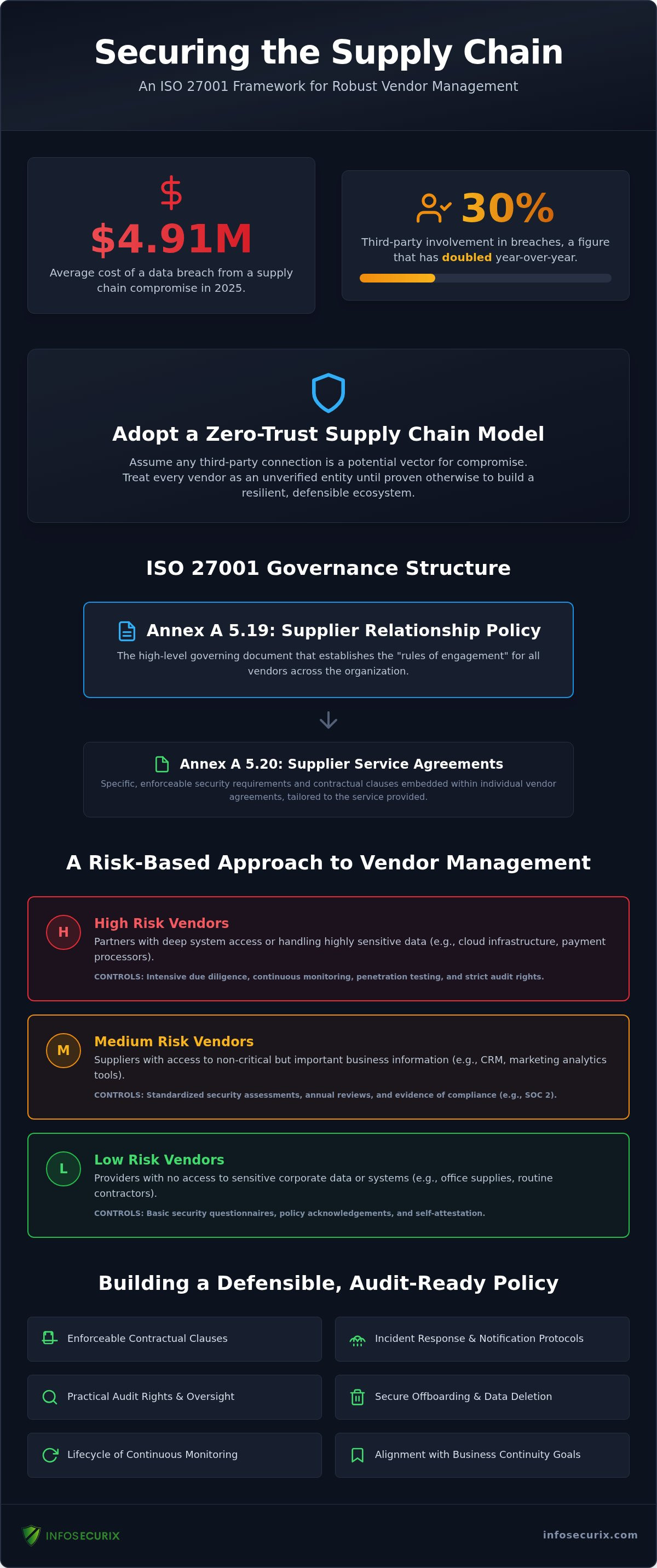
In 2025, the average cost of a data breach stemming from a supply chain compromise climbed to $4.91 million. This figure highlights a stark reality for modern enterprises: your security is only as robust as your least compliant vendor. Establishing a sophisticated ISO 27001 supplier relationship policy is no longer just a checkbox for your next audit. It’s a critical strategic defense against an increasingly interconnected threat landscape where third-party involvement in breaches has doubled to 30%.
Managing the security requirements of massive cloud providers or opaque third-party partners often feels like an uphill battle. We understand the unease that accompanies an Annex A 5.19 assessment, especially when documentation feels reactive rather than proactive. This guide transforms that anxiety into a position of strength. We’ll provide a clear framework to secure your supply chain and achieve absolute compliance using a risk-based approach. You’ll learn how to categorize vendors effectively, align procurement with security objectives, and build a defensible policy that satisfies even the most meticulous auditors.
Key Takeaways
- Adopt a zero-trust supply chain model to fortify your organization’s perimeter against sophisticated third-party vulnerabilities.
- Master the structural nuances between your high-level ISO 27001 supplier relationship policy and individual service agreements to ensure seamless governance.
- Utilize a proportionate response strategy to categorize vendors by data sensitivity, optimizing your security resources for the highest-risk partnerships.
- Translate policy requirements into enforceable contractual clauses, including practical audit rights that provide genuine oversight of vendor controls.
- Establish a lifecycle of continuous monitoring and tiered review cycles to maintain a defensible, audit-ready posture throughout 2026.
Beyond the Perimeter: Why Supplier Security is the Modern Enterprise’s Greatest Vulnerability
The modern enterprise no longer exists within four walls. It’s a sprawling network of SaaS providers, infrastructure partners, and specialized contractors. While this interconnectedness drives innovation, it also creates a surface area that attackers are exploiting with surgical precision. Viewing your ISO 27001 supplier relationship policy as a mere compliance hurdle is a mistake that could cost millions. In 2026, this policy serves as the bedrock of your information security management system (ISMS); it defines how you protect your assets when they leave your direct control.
Leading organizations are abandoning the outdated “trust but verify” model. They’re adopting zero-trust principles within their supply chains instead. This shift assumes that any third-party connection is a potential vector for compromise. By treating every vendor as an unverified entity until proven otherwise, you build a resilient ecosystem that doesn’t crumble when a single partner fails. Establishing this framework early ensures that security is baked into the procurement process rather than being added as an afterthought.
The Evolving Threat Landscape of the Supply Chain
The scale of modern supply chain attacks is staggering. According to the 2025 Verizon Data Breach Investigations Report, third-party involvement in breaches doubled to 30% in just one year. This represents the largest year-over-year shift ever recorded. A single vulnerability in a shared software library or a niche service provider creates a multiplier effect: it allows attackers to compromise hundreds of downstream clients simultaneously. Because of these stakes, auditors conducting assessments against the ISO 27001:2022 standard now place Annex A 5.19 under intense scrutiny. They aren’t looking for a signed paper. They’re looking for evidence of active risk management and a policy that reflects the complexities of the current year.
The Business Value of Robust Supplier Governance
Robust governance offers rewards that extend far beyond audit day. A mature ISO 27001 supplier relationship policy accelerates enterprise sales cycles by providing immediate assurance to prospective clients. It removes the friction often found between procurement, legal, and security teams by establishing clear, pre-approved security requirements for every tier of vendor. This proactive stance ensures that your supply chain strategy aligns perfectly with your ISO 22301 business continuity goals. When you secure your suppliers, you aren’t just protecting data; you’re ensuring the long-term resilience of your entire operation. Leveraging an independent internal audit to verify these supplier controls before your certification audit can be the difference between a minor observation and a major non-conformity.
Deciphering Annex A 5.19: The Structural Requirements for Robust Supplier Governance
Annex A 5.19 of the ISO 27001:2022 standard serves as the blueprint for managing external risks. It mandates that organizations define and implement a consistent set of processes to protect their information assets when shared with third parties. This requirement isn’t merely about having a signed document; it’s about establishing a living lifecycle that spans the entire duration of a partnership. An effective ISO 27001 supplier relationship policy acts as the governing authority that dictates how your organization identifies, assesses, and mitigates risks before they manifest into security incidents.
Confusion often arises when distinguishing between Annex A 5.19 and Annex A 5.20. To maintain clarity, view A 5.19 as the high-level policy that establishes the “rules of engagement” for all vendors. Conversely, A 5.20 focuses on the specific security requirements embedded within individual supplier agreements. While a generic template might provide a starting point, it often fails to account for the unique operational nuances of your business. A tailored policy is essential. It ensures that security controls are proportionate to the level of access granted, preventing unnecessary administrative burdens on low-risk vendors while enforcing rigorous standards on critical partners.
Core Components of an Audit-Ready Policy
To withstand the scrutiny of a certification audit, your policy must be comprehensive. It should clearly outline the mandatory elements of your vendor management process. These include:
- Risk Assessment and Due Diligence: The specific criteria used to evaluate a supplier’s security posture before onboarding.
- Acceptable Use: Explicit rules for how suppliers may access, process, or store your organization’s data.
- Ongoing Monitoring: The frequency and method of reviewing supplier performance against agreed security metrics.
- Termination Procedures: A structured “offboarding” process that ensures all access is revoked and data is securely returned or destroyed when the relationship ends.
Integrating with the Broader ISMS Framework
Your supplier policy doesn’t exist in a vacuum. It must be deeply integrated with your information security risk assessment process. This integration ensures that every third-party risk is identified and treated with the same rigor as internal vulnerabilities. These findings then feed directly into your Statement of Applicability (SoA), providing a clear map of which controls are relevant to your supply chain. For organizations heavily reliant on SaaS or IaaS, Annex A 5.23 (Cloud Services) becomes a specialized subset of this policy, requiring even more granular controls around data residency and shared responsibility models.
Establishing these structures can be complex, but you don’t have to navigate it alone. Engaging a seasoned expert for an ISO 27001 readiness assessment can help identify gaps in your current supplier governance before they are flagged by an auditor.
The Risk-Based Approach: Categorizing Suppliers for Proportionate Security Controls
Applying a uniform security standard to every vendor is a recipe for operational paralysis. A sophisticated ISO 27001 supplier relationship policy must champion a “Proportionate Response” strategy to ensure that your most rigorous controls are reserved for partners with the greatest potential impact on your security posture. This approach prevents resource drain by focusing your team’s energy where the risk is highest. It begins with a comprehensive Supplier Inventory. This register functions as an extension of your asset register; it documents exactly what information each vendor accesses and the sensitivity of that data, providing a clear map of your external dependencies.
Assigning risk scores requires a methodical evaluation of both access levels and business impact. We evaluate vendors based on whether they possess direct network access, physical access to facilities, or simply handle encrypted data. High-access, high-impact vendors receive the most intense scrutiny during the onboarding phase. This tiering allows you to scale your due diligence efforts, ensuring that a niche marketing consultant doesn’t face the same audit requirements as your primary data center provider.
Developing a Tiering Methodology
Establishing clear tiers is essential for consistent governance. Tier 1 vendors are strategic partners with deep access to sensitive systems or proprietary data. Tier 3 vendors are commodity suppliers with negligible security impact. Your policy should also address the challenge of “Shadow IT” by defining clear procedures for identifying and risk-scoring unsanctioned suppliers that departments might adopt independently. Categorizing these vendors based on network, physical, or data-only access levels ensures that security remains a central component of every business relationship.
Handling Enterprise Cloud Providers
Managing global giants like AWS, Google, or Microsoft requires a different tactical approach because custom security terms are rarely an option. In these scenarios, your ISO 27001 supplier relationship policy should permit the use of “proxy evidence” to establish trust. We rely on their SOC 2 Type II reports or existing ISO 27001 certifications to verify their control environments. When a vendor’s standard terms cannot be modified to meet every internal requirement, it’s vital to document the “residual risk” within your risk register. This transparency allows your leadership to make informed, risk-based decisions while maintaining a defensible audit trail. Our team often assists clients in interpreting these third-party reports during ISO 27001 readiness engagements to ensure no hidden vulnerabilities remain unaddressed.
Drafting a Defensible Policy: Critical Clauses and Security Requirements for Supplier Agreements
Translating a high-level ISO 27001 supplier relationship policy into enforceable contractual language is where strategic vision meets operational reality. A policy alone won’t compel a vendor to adhere to your standards; only a legally binding agreement provides the necessary leverage to ensure compliance. This process requires a meticulous bridge between your security requirements and your procurement contracts: it ensures that every obligation outlined in Annex A is mirrored in the fine print of your vendor agreements. By embedding these requirements directly into the contract, you transform a theoretical guideline into a mandatory performance standard.
Inclusion of a “Right to Audit” clause is non-negotiable for high-risk partnerships, yet its practical application requires careful negotiation. While you must reserve the right to verify a supplier’s controls as per Annex A 5.22, you should also define reasonable notice periods and frequency limits to remain pragmatic. Similarly, Annex A 5.21 mandates that you address the “ICT Supply Chain.” This means your contracts must require your suppliers to cascade your security requirements down to their own sub-contractors. This fourth-party oversight is essential for maintaining visibility across the entire data processing chain, ensuring that your security posture doesn’t erode as data moves further from your perimeter.
Essential Security Clauses for 2026
Modern agreements must include specific, time-bound incident notification requirements. For instance, a clause might state that the supplier shall notify the customer of any suspected or actual information security incident within 24 hours of discovery. This precision is vital for regulatory compliance and rapid response. Additionally, “Data Return and Destruction” clauses must be explicit: they should detail the methods of secure erasure and the requirement for a formal certificate of destruction upon contract termination. Finally, change management clauses should require suppliers to notify you before making significant infrastructure changes that could alter their risk profile or the security of the services provided.
The Role of the Supplier Security Addendum
Utilizing a standardized Supplier Security Addendum (SSA) is a sophisticated way to streamline the legal review process. Rather than renegotiating security terms for every contract, an SSA allows you to attach a curated set of requirements to any master service agreement. This consistency maps directly to your ISO 27001 certification readiness goals by ensuring that no vendor falls through the cracks. When a vendor refuses specific terms, your policy should dictate a formal exception-handling process. This process documents the deviation and ensures that the resulting residual risk is reviewed and accepted by the appropriate stakeholder. To ensure your contracts are truly audit-ready, consider scheduling an ISO 27001 internal audit to verify that your theoretical policy matches your actual contractual commitments.
Ensuring Resilience: Continuous Monitoring and the Path to ISO 27001 Certification
Establishing an ISO 27001 supplier relationship policy is a significant milestone, yet the true measure of its effectiveness lies in its enforcement. A policy that remains a static document on a server is a liability during a certification audit. Resilience is built through continuous monitoring: it’s the active process of ensuring that the security promises made in a contract are actually being kept in the field. This ongoing vigilance transforms your supplier management from a reactive exercise into a proactive defense mechanism that adapts as vendor risks evolve.
Review cycles must be strictly aligned with the risk tiers identified earlier in your governance framework. Tier 1 strategic partners require intense, frequent scrutiny, often involving quarterly performance reviews or biannual deep-dive assessments. Conversely, Tier 3 commodity vendors may only require an annual review of their updated certifications or a self-assessment questionnaire. This tiered approach ensures that your security team remains focused on high-impact vulnerabilities without becoming overwhelmed by administrative noise. When a supplier’s security posture degrades, your policy should dictate a clear path for remediation: it should outline the steps for corrective action or, if necessary, the structured termination of the partnership.
Conducting regular information security internal audits on your supplier management process is the most effective way to identify gaps before an external auditor arrives. These internal reviews verify that your team is following the documented policy, from the initial risk assessment through to the latest monitoring logs. InfoSecurix brings over 25 years of industry experience to this process; we act as the seasoned guide that helps you navigate the complexities of Annex A compliance, ensuring your framework is both defensible and scalable.
Strategies for Ongoing Supplier Performance Review
Effective monitoring relies on measurable data. We recommend identifying specific key performance indicators (KPIs) such as patch latency for critical vulnerabilities or incident response times during tabletop exercises. While automated security ratings tools provide valuable real-time telemetry, they should be used to supplement, not replace, manual questionnaires that capture the human and process elements of a vendor’s security culture. If a vendor’s performance slips, having these metrics allows for objective, data-driven conversations about necessary improvements.
Preparing for the Certification Audit
Auditors in 2026 expect to see a clear “chain of evidence” for Annex A 5.19. They will look for traceability: a direct line from the initial vendor risk assessment to the security clauses in the contract and finally to the evidence of ongoing monitoring. Missing any link in this chain can jeopardize your certification. To ensure your organization is fully prepared, we invite you to engage for a comprehensive compliance readiness assessment. This strategic review identifies any remaining gaps in your supplier governance, providing you with the absolute confidence that your supply chain is secure and audit-ready.
Future-Proofing Your Enterprise Through Strategic Supplier Governance
Securing the modern supply chain requires a transition from passive oversight to a dynamic, risk-based discipline. By categorizing vendors through a lens of data sensitivity and embedding rigorous security requirements into every agreement, you transform your ISO 27001 supplier relationship policy from a static requirement into a genuine competitive advantage. This sophisticated framework ensures that your organization remains resilient, even as third-party threats grow more complex and auditors become more discerning in 2026.
Navigating the nuances of Annex A compliance doesn’t have to be a source of organizational friction. InfoSecurix provides the seasoned guidance you need to orchestrate a bespoke compliance journey. With over 25 years of specialized experience, we deliver absolute predictability through milestone-based, fixed-fee engagements. Whether you require a comprehensive gap analysis or a rigorous internal audit to verify your controls before the certification body arrives, our team is invested in your long-term success. Secure Your Supply Chain with InfoSecurix Expert ISO 27001 Guidance and take the next step toward an audit-ready future with absolute confidence.
Frequently Asked Questions
What is the primary difference between ISO 27001:2013 and 2022 regarding supplier relationships?
The 2022 update transitioned from a few broad controls to a more granular, five part structure: A.5.19 through A.5.23. This version places a significantly higher emphasis on the entire lifecycle of the relationship. It introduces specific mandates for managing the ICT supply chain and cloud services, requiring organizations to move beyond simple contract signing toward active, continuous monitoring of vendor performance.
Do I need a separate policy for cloud service providers under Annex A 5.23?
You don’t necessarily need a standalone document, but your ISO 27001 supplier relationship policy must explicitly address the unique risks of cloud environments. Your framework should define the shared responsibility model and verify data residency requirements. For many enterprises, including these as a dedicated subsection within the master policy provides the necessary clarity for auditors while maintaining a single source of truth.
How often should I perform a risk assessment on my existing suppliers?
Annual assessments serve as the baseline for most vendors, but high risk Tier 1 partners often require quarterly reviews. The frequency should be dictated by the vendor’s risk score and specific triggers: significant infrastructure changes, reported security incidents, or updates to regulatory requirements. A risk based approach ensures your team’s energy is focused on the partners with the greatest potential impact on your security.
Can I rely solely on a supplier’s ISO 27001 certificate as proof of their security?
A certificate is excellent proxy evidence, but it isn’t a substitute for specific due diligence. You must verify that the certificate’s scope actually covers the services and locations relevant to your organization. Many businesses make the mistake of accepting a certificate only to discover later that the vendor’s primary data center or the specific SaaS product they use was excluded from the audit scope.
What should I do if a critical supplier refuses to sign our security addendum?
You must document the refusal as a residual risk within your risk register and obtain formal sign off from senior management. If the vendor is too critical to replace, you should implement compensating controls: these might include enhanced encryption, stricter access logging, or more frequent third party report reviews. This transparency ensures that the risk is managed rather than ignored, which is vital for maintaining a defensible audit posture.
Is a “Right to Audit” clause mandatory for ISO 27001 compliance?
While the standard doesn’t use the word mandatory for every contract, Annex A.5.22 requires you to monitor, review, and manage changes in supplier services. A “Right to Audit” clause is the most robust way to satisfy this requirement. For global cloud providers where an on site audit is impossible, auditors typically accept a SOC 2 Type II report or a bridge letter as a valid alternative for verifying their control environment.
How do I manage security for small vendors who lack formal security certifications?
Apply a proportionate response by using a simplified security questionnaire tailored to their specific access level. If a vendor handles non sensitive data, focus on their basic security hygiene: password policies, device encryption, and incident notification procedures. This approach allows you to maintain compliance without placing an undue administrative burden on small partners who lack the resources for major certifications.
What role does procurement play in the ISO 27001 supplier relationship policy?
Procurement serves as the strategic gatekeeper that ensures your ISO 27001 supplier relationship policy is applied at the point of entry. They are responsible for integrating security assessments into the initial RFP process and ensuring that no contract is executed without the approved security addendums. This alignment between security and procurement prevents the common issue of vendors being onboarded before their risk profile has been properly evaluated.