
A SOC 2 report is no longer a luxury for growing firms; it’s the primary currency of enterprise trust in a digital-first economy. You understand the immense pressure of proving your security posture to sophisticated clients who demand nothing less than excellence. The risk of an audit failure or the discovery of significant control gaps can feel like a shadow over your sales pipeline, threatening to derail months of hard-earned momentum.
Mastering this process requires more than a simple set of checkboxes. It demands a professional interpretation of the AICPA standards that aligns with your specific operational goals. By following this strategic SOC 2 readiness checklist, you’ll gain the clarity needed to navigate the complexities of the Trust Services Criteria with absolute confidence. We’ve designed this roadmap to help you identify critical gaps, implement resilient internal controls, and ultimately secure a successful SOC 2 Type 2 report that drives long-term business growth. We’ll walk through every phase of preparation, from initial scoping to final documentation, ensuring your team is ready for the rigors of a formal audit.
Key Takeaways
- Understand that audit success depends on a comprehensive evaluation of your internal controls long before the formal examination begins.
- Learn how to map your control environment against the relevant Trust Services Criteria to meet specific enterprise security demands.
- Prioritize remediation efforts by performing a rigorous gap analysis to pinpoint and resolve critical security deficiencies early.
- Utilize a professional SOC 2 readiness checklist to establish clear organizational boundaries and a structured path toward your Type 2 report.
- Transform compliance from a technical hurdle into a strategic asset that fosters long-term operational resilience and drives enterprise sales.
Defining SOC 2 Readiness: The Foundation of Audit Success
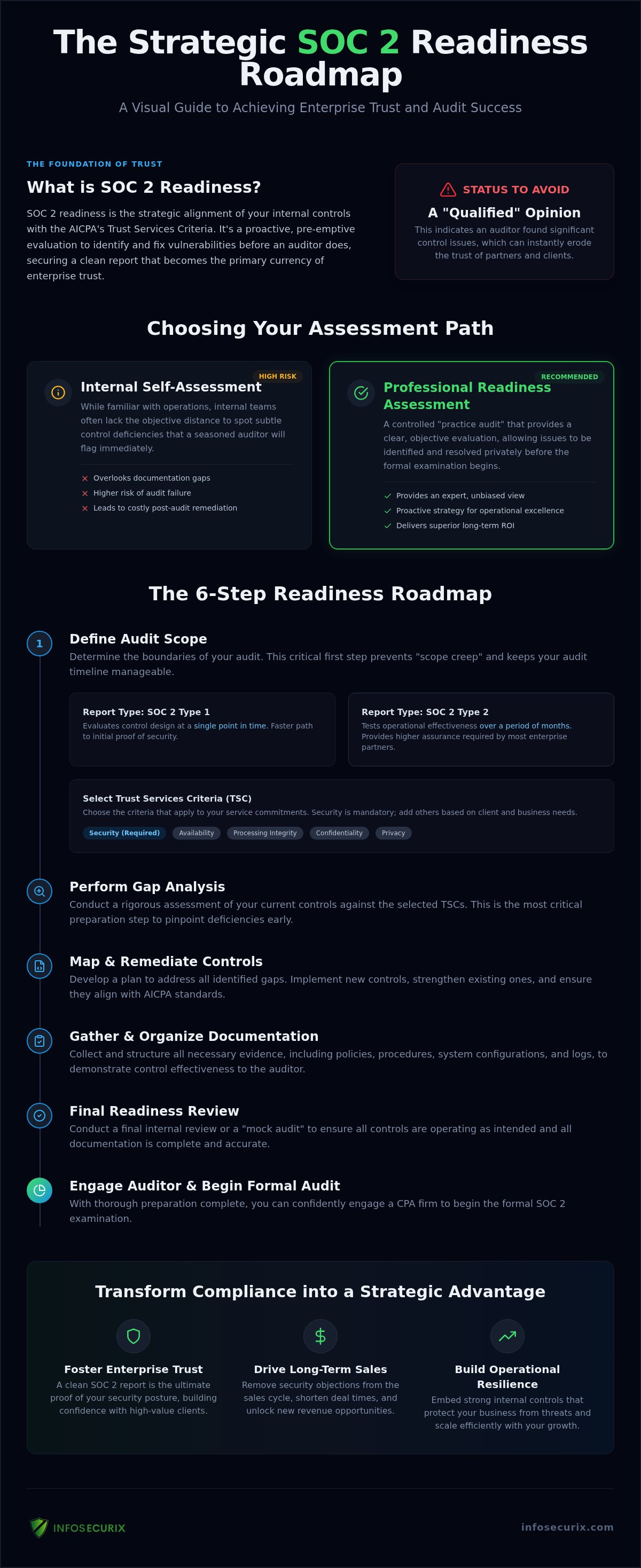
Achieving a successful audit requires more than just good intentions; it demands a rigorous, pre-emptive evaluation of your entire security infrastructure. SOC 2 readiness is the strategic alignment of internal controls with the AICPA’s Trust Services Criteria. By utilizing a comprehensive SOC 2 readiness checklist, organizations can identify vulnerabilities before they become public liabilities in a final report. The AICPA specifically recommends these preliminary assessments to prevent the dreaded “qualified” opinion. This status indicates that an auditor found significant issues with your controls, which can instantly erode the trust you’ve worked to build with enterprise partners.
Self-Assessment vs. Professional Readiness Assessments
While internal teams possess deep knowledge of daily operations, they often lack the objective distance required to spot subtle control deficiencies. Internal staff may inadvertently overlook documentation gaps or process inconsistencies that a seasoned auditor will flag immediately. Relying solely on internal intuition creates a significant risk of remediation costs that far exceed the price of early preparation. A professional readiness assessment provides a controlled “practice test” environment where these issues can be resolved privately. Investing in expert-led guidance offers a superior long-term ROI compared to the catastrophic costs of a failed audit or the extensive remediation expenses required after a public report goes wrong. It’s a matter of moving from a reactive posture to a proactive strategy of operational excellence.
Determining Your SOC 2 Report Scope
Defining the audit boundary is a critical step that dictates the focus of your entire compliance journey. You must first decide which of the five Trust Services Criteria (TSC) apply to your specific service commitments. While Security remains the mandatory “Common Criteria” for every engagement, your enterprise clients might also demand Proof of Availability, Confidentiality, Processing Integrity, or Privacy based on the nature of your data handling.
Once the criteria are selected, you’ll need to decide between a SOC 2 Type 1 and a Type 2 report. A Type 1 report evaluates your controls at a specific point in time, offering a faster path to initial proof of security. Conversely, a Type 2 report tests the operational effectiveness of those controls over a period of months, providing the high-level assurance that enterprise partners typically require. This scoping process ensures your SOC 2 readiness checklist remains focused on the specific systems and data that drive your business value. Aligning your system requirements with these service commitments prevents “scope creep” and keeps your audit timeline manageable and predictable.
The Five Trust Services Criteria: Mapping Your Control Environment
Selecting the right criteria for your audit isn’t merely a technical requirement; it’s a strategic decision that signals your organization’s maturity to the market. The AICPA defines five Trust Services Criteria (TSC) that serve as the benchmarks for your security posture. While the Security criterion is the non-negotiable foundation, the addition of Availability, Processing Integrity, Confidentiality, or Privacy allows you to tailor your report to your specific service commitments. Integrating these choices into your SOC 2 readiness checklist ensures that your internal controls aren’t just present, but are actively protecting the value you deliver to your clients.
The Common Criteria (Security) Framework
The Security criterion, often called the Common Criteria, consists of nine distinct sub-categories ranging from CC1.1 to CC9.2. These standards address the fundamental ways your organization manages its security culture and operational risks. At the bedrock of this framework is the Control Environment; it establishes the tone at the top and dictates the integrity and ethical values of your security practices. Beyond culture, the framework requires rigorous risk assessment and monitoring activities. These aren’t passive tasks. They involve identifying potential threats to your system and establishing continuous oversight to ensure controls remain effective as your business scales. A well-constructed strategic SOC 2 readiness checklist provides the necessary structure to map these complex requirements to your daily operations.
Selecting Additional Criteria for Competitive Advantage
Expanding your audit scope beyond the Common Criteria can provide a significant competitive edge during enterprise procurement. For SaaS providers, the Availability criterion is often essential; it validates that your systems remain operational and meet your promised service level agreements (SLAs). If your platform handles financial transactions or complex data transformations, Processing Integrity ensures that data processing is complete, valid, accurate, and authorized. This level of transparency builds immense confidence with stakeholders who rely on your data’s precision.
Confidentiality and Privacy criteria are equally vital for firms handling sensitive intellectual property or personal information. While Confidentiality focuses on protecting data restricted to a specific set of people or organizations, the Privacy criteria specifically address personal data collection and use. Selecting the Privacy TSC can be a powerful way to demonstrate alignment with global regulations like GDPR or CCPA. However, it’s easy to over-complicate your audit by including unnecessary criteria. Engaging with compliance readiness services allows you to right-size your scope, ensuring you meet enterprise demands without incurring the overhead of redundant controls. This balanced approach protects your resources while future-proofing your growth.
The Gap Analysis: Identifying and Remediating Vulnerabilities
Performing a thorough gap analysis allows you to measure your existing operations against the rigorous standards of the Trust Services Criteria. It’s the most critical phase of your SOC 2 readiness checklist because it transforms abstract requirements into a concrete to-do list. Rather than viewing a gap as a failure, you should treat it as a strategic opportunity for operational hardening. Identifying these vulnerabilities early ensures that your security posture is resilient enough to withstand the scrutiny of a formal examination and the complex demands of enterprise clients.
Once deficiencies are identified, you must prioritize remediation efforts based on the criticality of each security flaw. High-risk areas, such as unsecured data storage or a lack of multi-factor authentication, require immediate attention to prevent audit disqualification. Developing a formal Corrective Action Plan (CAP) is essential for maintaining momentum. This document must assign clear ownership and establish firm deadlines for every remediation task, ensuring that no vulnerability remains unaddressed as you approach your audit window. This structured approach provides the transparency needed to manage internal resources effectively while building a legacy of security excellence.
Common Security Control Deficiencies in 2026
Frequent failures often occur within logical access controls and user lifecycle management. It’s common to find active accounts belonging to former employees or over-privileged users who don’t require access to sensitive production environments. Additionally, insufficient change management documentation remains a significant hurdle for many organizations. Even if your technical changes are sound, failing to record the approval and testing process can lead to a qualified audit opinion. We also frequently observe a documentation gap where robust controls exist in practice but aren’t formally recorded in a policy manual, leaving the auditor with no evidence to verify.
Strategic Remediation and Control Implementation
Remediation involves a dual approach of technical and administrative improvements. On the technical side, you’ll need to implement robust controls such as multi-factor authentication (MFA), end-to-end encryption, and centralized logging to provide a clear audit trail. These tools don’t just satisfy an auditor; they protect your business from evolving cyber threats. Administratively, you must draft and formalize policies for Incident Response and Disaster Recovery to guide your team during a crisis. Establishing information security internal audit processes early in the cycle allows you to test these new controls in a real-world setting. This practice ensures your systems function as intended before the official auditor arrives, providing a final layer of confidence in your compliance journey.
The 2026 SOC 2 Readiness Roadmap: A Step-by-Step Checklist
Moving from initial preparation to a successful audit requires a disciplined, chronological approach. This 2026 SOC 2 readiness checklist serves as your definitive guide to navigating the transition from a Type 1 assessment to a comprehensive Type 2 report. By following these steps, you ensure that your security posture isn’t just a point-in-time achievement but a sustainable operational standard that enterprise clients can trust.
- Step 1: Define Organizational Boundaries. Clearly identify the systems, people, and data that fall within the audit scope; select the specific Trust Services Criteria that align with your service commitments.
- Step 2: Conduct a Formal Readiness Assessment. Engage a seasoned guide to perform a deep-dive evaluation of your current controls; this identifies the specific gaps that could lead to a qualified audit opinion.
- Step 3: Execute Remediation. Close identified gaps by implementing technical controls and formalizing all administrative security policies and procedures.
- Step 4: Select an AICPA-Accredited CPA Firm. Identify an independent auditor who understands your technology stack and industry-specific challenges.
- Step 5: Enter the Observation Period. Begin the multi-month window where you gather evidence to prove your controls operate effectively over time.
Preparing for the Observation Period
The transition to a Type 2 report introduces a fundamental shift in requirements: you must prove that your controls work consistently over a 3 to 12-month window. This period demands a “continuous monitoring” cadence to ensure that security practices don’t lapse after the initial implementation. You should prepare your internal teams for the Evidence Request List (ERL) provided by the auditor. This list is a meticulous catalog of logs, screenshots, and signed approvals that serve as the primary proof of your compliance. Establishing a systematic way to collect this data in real-time prevents the last-minute scramble that often leads to audit fatigue.
Selecting the Right Audit Partner
Choosing the right CPA firm is a strategic decision that impacts the credibility of your final report. It’s essential to evaluate firms based on their specific experience with your technology stack and their adherence to the latest SSAE 18 standards. You must also distinguish between your consultant and your auditor. While InfoSecurix acts as your collaborative ally and seasoned guide during the readiness phase, the CPA firm must remain an independent third party to maintain the integrity of the audit. This separation of duties ensures that your SOC 2 readiness checklist is validated by an objective authority. If you’re ready to move beyond automated checkboxes and build a bespoke security framework, consider how our specialized SOC 2 readiness assessment services can bridge the gap between your current state and enterprise-grade compliance.
The Strategic Advantage of Professional Readiness Consulting
Navigating the complexities of a modern audit requires more than a standard SOC 2 readiness checklist; it demands the seasoned perspective of a partner who has managed hundreds of successful engagements. Leveraging InfoSecurix’s 25+ years of industry experience allows your organization to move beyond simple “checkbox compliance” and build a truly robust security posture. This elevated approach does more than satisfy an auditor; it creates a protective force that enables your firm to attract and retain high-value enterprise clients. By identifying and remediating gaps before the formal audit begins, you significantly reduce the total cost of ownership by avoiding the expensive re-audit fees and remediation delays associated with initial failures. Ultimately, a clean SOC 2 report becomes a powerful sales enablement tool that differentiates your brand in a competitive national market.
Why Software Alone Isn’t Enough for SOC 2
Automated compliance platforms offer efficiency, yet they frequently miss the qualitative nuances of the “Control Environment.” These tools are designed for technical verification, but they cannot evaluate the strength of your organizational security culture or the ethical values that underpin your operations. Professional interpretation remains vital when mapping custom, bespoke controls to the Trust Services Criteria to ensure they meet the specific intent of the standards. Partnering with a specialized cybersecurity internal audit firm provides a strategic layer of scrutiny that software simply cannot replicate. We ensure your documentation and processes reflect the actual maturity of your organization, providing the context and authority required to satisfy a discerning CPA firm.
The InfoSecurix Engagement Model: Accuracy and Authority
Our engagement model is built on a foundation of methodical, milestone-based progress. We act as a “Seasoned Guide” throughout your entire compliance journey, providing a collaborative environment where your team feels empowered rather than overwhelmed. Starting with a high-level vision and moving into systematic gap remediation, we ensure every technical process is aligned with your broader business objectives. This deliberate pace reflects our commitment to accuracy and long-term operational resilience. We invite you to move beyond the uncertainty of self-assessment and secure your organization’s future. Reach out today to schedule a SOC 2 readiness consultation and begin your roadmap to enterprise trust.
Future-Proofing Your Security Standards for 2026 and Beyond
Navigating the path to a successful SOC 2 report requires more than technical diligence; it demands a strategic commitment to operational excellence. By following a professional SOC 2 readiness checklist, you’ve established a foundation that moves beyond simple compliance to build authentic enterprise trust. You’ve learned how to map your control environment effectively, prioritize critical remediation, and select the right partners to guide your journey. This proactive approach ensures your organization is resilient against evolving threats and ready for the scrutiny of the world’s most demanding clients.
InfoSecurix brings 25+ years of information security excellence to your side. Our fixed-fee compliance engagements and expert-led gap analysis provide the clarity needed to succeed without the risk of audit failure. Don’t leave your reputation to chance or automated software alone. We’re here to serve as your seasoned guide, ensuring every control is meticulously documented and every gap is strategically closed. It’s time to transform your security posture into your greatest competitive advantage. Secure Your Enterprise Trust with a Professional SOC 2 Readiness Assessment today. Your roadmap to long-term growth starts with a partner you can trust.
Frequently Asked Questions
How long does a SOC 2 readiness assessment typically take?
A professional SOC 2 readiness assessment typically spans four to eight weeks. This timeframe allows our consultants to conduct deep-dive interviews, review existing documentation, and observe current control activities. Larger organizations with complex, multi-cloud environments may require additional time to ensure every system boundary is accurately mapped before the formal audit begins.
What is the difference between a SOC 2 Type 1 and a SOC 2 Type 2 readiness assessment?
A Type 1 readiness assessment evaluates whether your controls are designed appropriately at a specific point in time. In contrast, a Type 2 assessment focuses on proving that those controls operate effectively over an observation period of three to twelve months. Preparing for Type 2 requires a more rigorous SOC 2 readiness checklist that includes continuous monitoring and evidence collection strategies to satisfy the auditor’s long-term scrutiny.
Can we use our ISO 27001 readiness to satisfy SOC 2 requirements?
You can certainly leverage your ISO 27001 framework to satisfy a significant portion of SOC 2 requirements. While the two standards have different reporting structures, the underlying security controls often overlap significantly. We help you identify the specific delta between the ISO Annex A controls and the AICPA Trust Services Criteria to ensure a seamless transition between these prestigious certifications.
How much does a professional SOC 2 readiness assessment cost?
The investment for a professional readiness assessment depends on the number of Trust Services Criteria selected and the complexity of your technology stack. Organizations should consider the scope of their service commitments and the number of physical or cloud locations involved. While we utilize fixed-fee engagement models to provide financial predictability, the total cost reflects the depth of the strategic gap analysis and remediation planning required for your specific business.
What happens if the readiness assessment identifies major control gaps?
Identifying major control gaps is the primary goal of a readiness engagement and should be viewed as a strategic advantage. When gaps are found, we work with you to develop a formal Corrective Action Plan that assigns ownership and sets realistic deadlines for remediation. This proactive approach ensures you resolve vulnerabilities privately before they can result in a qualified opinion on your public audit report.
Do we need a readiness assessment if we use compliance automation software?
Compliance automation software is a valuable tool for evidence collection, but it doesn’t replace the need for professional interpretation. Automated platforms often miss the qualitative nuances of the “Control Environment” or the specific intent behind custom security policies. A professional assessment provides the human expertise needed to map your unique operations to the AICPA standards, ensuring your SOC 2 readiness checklist is both accurate and authoritative.
Who should be involved in the SOC 2 readiness process within our organization?
Successful readiness requires a cross-functional team that includes executive leadership, IT security, Human Resources, and Legal counsel. While the technical teams manage the implementation of security controls, HR and Legal are essential for formalizing policies and ensuring compliance with employment standards. Appointing a dedicated project owner ensures consistent communication between these departments and our consulting team throughout the preparation process.
Is a SOC 2 readiness assessment mandatory before the official audit?
While a readiness assessment isn’t a regulatory requirement, it’s a strategic necessity for organizations aiming for a clean audit report. The AICPA recommends these preliminary evaluations to identify potential failures that could derail the formal examination. Most enterprise-level firms view the readiness phase as the most critical step in their roadmap; it provides the absolute confidence needed to present their security posture to the market.