

With 81% of organizations actively pursuing or maintaining certification as of 2025, the global shift toward standardized security is no longer a choice; it’s a fundamental requirement for enterprise growth. You likely recognize that a robust ISO 27001 project plan is the only way to move beyond reactive security and into a state of resilient, strategic governance. Yet, the path to compliance often feels obscured by overwhelming documentation requirements and the technical weight of 93 distinct controls. It’s common to feel the pressure of defining a precise ISMS scope while lacking the internal specialized expertise to conduct formal risk assessments without disrupting daily operations.
We’ve designed this guide to bridge that gap by offering a sophisticated, phase-based roadmap tailored for executive-level execution. You’ll gain a clear understanding of the mandatory requirements of the ISO/IEC 27001:2022 standard and the 2024 climate amendments. We’ll preview the essential milestones from initial gap analysis to the final certification audit: providing you with a predictable path that minimizes operational friction and secures your organization’s future in an increasingly complex regulatory environment.
Key Takeaways
- Shift your organizational mindset from reactive IT fixes to a proactive Information Security Management System (ISMS) that enables sustainable growth.
- Establish a definitive roadmap by utilizing a phase-based ISO 27001 project plan to coordinate resources and conduct a thorough gap analysis.
- Deploy a risk assessment methodology that identifies threats through a business-impact lens, ensuring your controls are both precise and effective.
- Secure your certification readiness by conducting formal internal audits to gather the objective evidence required for a successful external review.
- Master the two-stage certification process to future-proof your enterprise against evolving regulatory landscapes and sophisticated cyber threats.
The Strategic Architecture of an ISO 27001 Project Plan
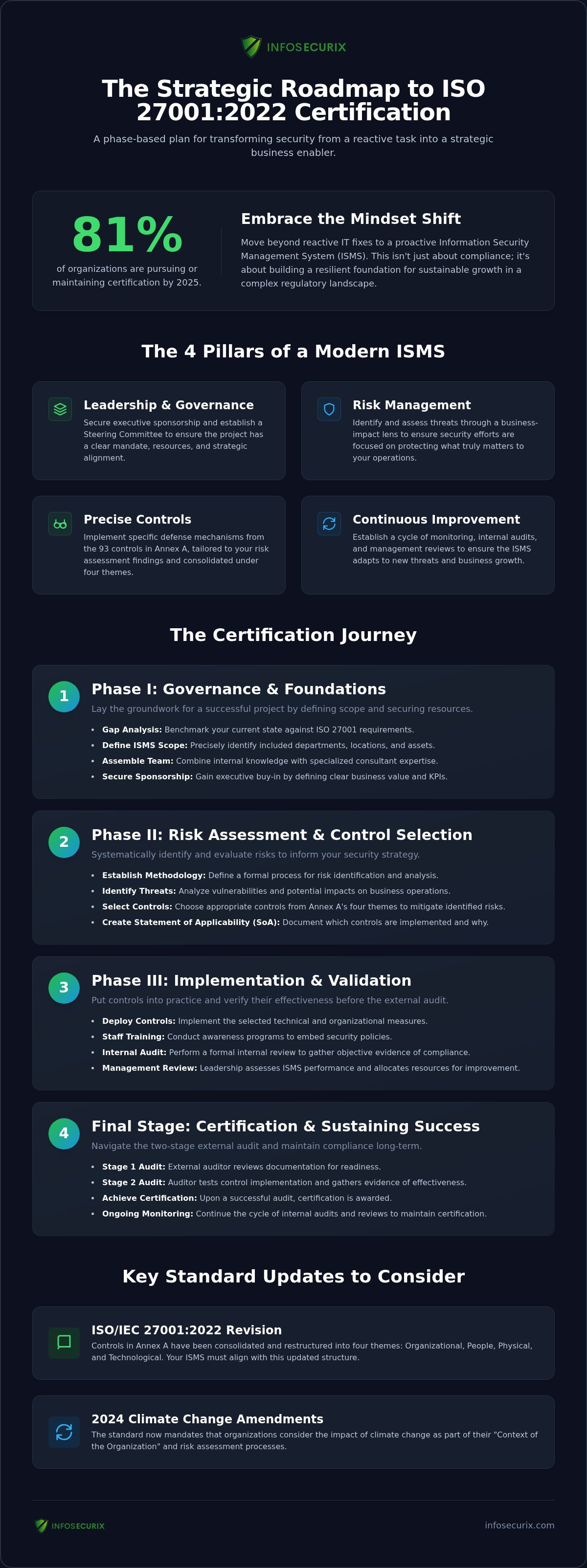
A successful ISO 27001 project plan is not a mere sequence of technical tasks. It’s a high level roadmap that guides an organization through a fundamental security transformation. By 2026, the global threat landscape has shifted. AI driven attacks and stricter international regulations mean that reactive IT patches are no longer sufficient. You need a proactive Information Security Management System (ISMS) that integrates with your business goals. This strategic architecture rests on four critical pillars. First, Leadership ensures the project has the mandate it needs. Second, Risk management identifies what truly matters to your operations. Third, Controls provide the specific defense mechanisms. Finally, Continuous Improvement ensures the system adapts as your business grows. Following the 2022 revision, which consolidated controls into four themes, your plan must be more integrated than ever. The 2026 update to the ISO/IEC 27000 vocabulary standard further clarifies these governance principles: emphasizing that ownership of the ISMS belongs at the highest levels of the organization.
Securing Executive Alignment and Sponsorship
Securing sponsorship is about more than just a signature on a budget. It’s about translating the technical requirements of the ISO/IEC 27001 standard into tangible business value. We recommend establishing a Steering Committee. This group oversees project milestones and ensures resource allocation remains consistent. It serves as the bridge between technical execution and corporate strategy. Beyond audit readiness, you should define clear KPIs: such as the percentage of staff trained or the reduction in high risk vulnerabilities. This approach turns compliance into a competitive advantage that builds trust with enterprise partners. When leadership views security as a growth enabler, the entire organization adopts a more resilient posture.
Defining the ISMS Scope with Precision
Precision in the ISMS scope is the difference between a successful certification and a project that never ends. You must identify exactly which departments, locations, and digital assets are included. If you don’t define these boundaries early, you’ll face scope creep. This can easily derail your 2026 timeline and inflate costs. Documenting the Context of the Organization is a foundational requirement. It forces you to look at external and internal factors: including the 2024 climate change considerations now mandated by the standard. A well defined scope allows for a bespoke implementation that protects your most critical assets without unnecessary operational disruption. It ensures your ISO 27001 project plan remains focused, predictable, and achievable.
Phase I: Establishing Governance and Resource Foundations
Phase I marks the transition from conceptual planning to active mobilization. It begins with a comprehensive gap analysis to determine the precise delta between your current operational state and the rigorous requirements of the standard. This diagnostic phase identifies where existing controls are sufficient and where new investments are necessary. Without this baseline, your ISO 27001 project plan risks becoming a series of aimless activities. Once the gaps are identified, you must assemble an implementation team that balances internal operational knowledge with specialized compliance expertise. This team serves as the engine of the project: maintaining a steady communication rhythm to prevent the loss of momentum that often plagues long term enterprise initiatives.
The Role of a Specialized ISO 27001 Consultant
A strategic ISO 27001 certification readiness partner acts as a seasoned guide through the complexities of the initial foundation. Leveraging 25 years of experience allows an organization to sidestep common pitfalls: such as misinterpreting the four themes of Annex A or failing to align documentation with actual practice. While internal leads understand the business nuances, an external partner provides the objective perspective needed to ensure audit readiness. This collaboration balances internal resource constraints with a proven methodology, accelerating your timeline toward a successful Stage 1 audit. If you find your internal team stretched thin, engaging in professional ISO 27001 certification readiness support can clarify your roadmap immediately.
Drafting the Core ISMS Policy Framework
Establishing a documentation hierarchy is the next critical milestone. At the summit sits the high level Information Security Policy: a document that reflects executive intent and defines the organization’s commitment to security. Beneath this, you develop specific processes and work instructions that detail how controls are executed. For organizations already managing multiple frameworks, it’s vital to align these policies with existing NIST security and privacy controls or SOC2 requirements. This alignment prevents redundancy and creates a unified governance structure. Policies should never be static PDF files. They must be living documents that evolve alongside your business. By creating a clear, accessible framework, you ensure that security becomes a shared responsibility rather than an isolated IT function.
Phase II: Mastering Risk Assessment and Control Selection
After establishing governance foundations, your focus must shift to the analytical core of the Information Security Management System. Selecting a robust information security risk assessment methodology is the most critical decision in this phase. It’s not just a compliance requirement. It is the mechanism that identifies which assets require the most protection based on actual business impact. This stage of the ISO 27001 project plan requires you to look beyond technical vulnerabilities. You must identify threats through a lens of operational resilience. Once risks are identified, they are addressed through a formal Risk Treatment Plan (RTP). This strategic document outlines whether you will treat, avoid, transfer, or accept specific risks: reinforcing the business case for ISO 27001 by ensuring security investments are proportional to the threats you face.
The Intellectual Heart: The Statement of Applicability
The Statement of Applicability (SoA) is often the most scrutinized document during an external audit. It serves as a comprehensive map: linking the 93 controls from Annex A of the 2022 standard directly to your identified risks. You must provide clear, defensible justifications for every control you choose to exclude. This creates a cohesive narrative for the auditor. It proves that your security posture is a deliberate choice rather than a generic application of rules. A well constructed SoA demonstrates that you have considered the organizational, people, physical, and technological themes of the modern standard with absolute precision.
Designing Bespoke Security Controls
Generic templates often fail because they don’t account for your unique operational flow. Your controls must be bespoke. They should integrate seamlessly with existing business processes to minimize friction. A balanced approach is essential. Technical controls like multi factor authentication are only effective when supported by organizational policies and physical security measures. If your organization requires specialized physical protection to complement its digital strategy, you can discover TOTAL SÉCURITÉ for professional security solutions. When you design controls that reflect how your team actually works, you increase adoption and reduce the likelihood of “shadow IT” workarounds. This phase ensures that your ISO 27001 project plan results in a security framework that is both rigorous and practical: enabling growth while maintaining a defensive shield.
Phase III: Implementation, Internal Audit, and Validation
Phase III is the pivotal stage where your strategic vision meets the daily operational flow of your enterprise. This stage of the ISO 27001 project plan focuses on the physical and technical execution of the controls identified in your Statement of Applicability. It’s the moment when policies move off the page and into the hands of your workforce. Successful execution requires a dual approach: deploying sophisticated technical safeguards while simultaneously fostering a culture of security through employee awareness training. You can’t rely on technology alone. Your team must understand their role in protecting the organization’s information assets.
During this phase, gathering objective evidence becomes your primary objective. External auditors don’t take your word for it; they require concrete proof. You must maintain meticulous records: including incident response logs, access control reviews, and evidence of periodic risk assessments. These artifacts form the backbone of your audit trail. Once implementation is complete, you must conduct a formal Management Review. This is a critical governance milestone where leadership evaluates the performance of the ISMS and ensures it remains suitable, adequate, and effective for the business’s goals.
The Internal Audit Milestone
An independent internal audit serves as the ultimate diagnostic for your implementation efforts. It’s vital to recognize the strategic importance of the internal audit as the most effective way to identify hidden non-conformities. Unlike the final certification audit, this is an opportunity for internal refinement. It allows you to implement strategic corrective actions in a controlled environment. A professional internal audit provides an objective perspective that internal teams often lack. It bridges the gap between “thinking” you are ready and “knowing” you are ready for the external certification body.
Corrective Action and Continuous Improvement
The discovery of a non-conformity isn’t a failure; it’s an opportunity for improvement. You must develop a systematic approach to remediating findings by utilizing the Plan-Do-Check-Act (PDCA) cycle. This cycle should become a permanent operational rhythm within your organization. It ensures that your ISO 27001 project plan doesn’t end at certification but evolves into a model of continuous resilience. By the time you prepare your final documentation package for the Stage 1 audit, your ISMS should be a polished, high-performing system. If you want to ensure your framework is truly audit-ready, consider engaging our team for a comprehensive Internal Audit to validate your compliance before the official review.
Navigating the Certification Audit and Sustaining Success
Certification is often viewed as the final destination of a long journey. In reality, it marks the beginning of a more mature phase in your organization’s security lifecycle. Successfully executing your ISO 27001 project plan culminates in the formal audit process: where your hard work is validated by an accredited Certification Body (CB). Managing this relationship requires a balance of transparency and professional poise. You aren’t merely defending your ISMS; you’re demonstrating its effectiveness as a living, breathing system. Transitioning from a high intensity project into a sustainable, business as usual culture is essential for long term resilience. It ensures that security remains a core value rather than a seasonal checklist. This shift requires ongoing leadership commitment to keep the momentum alive long after the initial certificate is framed.
What to Expect During the Certification Audit
The certification process is divided into two distinct stages: each serving a specific purpose in the validation of your framework. Stage 1 is the Readiness Review. During this phase, the auditor examines your documentation, scope, and Statement of Applicability to ensure the foundations are sound. They’re looking for evidence that the ISMS is designed correctly. Stage 2 is the deep dive. This involves extensive staff interviews and a rigorous review of operational evidence to prove that your controls work in practice. You should prepare your team to handle auditor questions with confidence and transparency. Auditors value organizations that demonstrate a clear understanding of their own risks and show a proactive approach to continuous improvement.
- Stage 1 Focus: Documented policies, ISMS scope, and the Risk Treatment Plan.
- Stage 2 Focus: Operational logs, physical security checks, and employee interviews.
- Auditor Interaction: Direct, honest communication that reflects your internal audit findings.
Future-Proofing Your Compliance Journey
Maintaining your status requires more than passing the initial test. Annual surveillance audits ensure your ISMS evolves alongside the threat landscape. A robust ISMS also serves as a sophisticated foundation for other excellence standards. Many organizations leverage their security framework to streamline ISO 20000 implementation for IT service excellence. Continuous risk monitoring is mandatory in an era of rapid technological shifts. InfoSecurix remains your long term Trusted Advisor throughout this journey. We provide the seasoned guidance needed to navigate recertification cycles and complex regulatory updates. We ensure your security posture remains a protective force that enables your business to scale with absolute confidence. By integrating your ISO 27001 project plan into the fabric of your operations, you create a legacy of trust and reliability that fuels sustainable growth.
Securing Your Enterprise Legacy through Strategic Compliance
Mastering the 2022 standard is a transformative process that shifts your organization from reactive security to a state of proactive governance. By establishing a clear architecture and prioritizing risk based control selection, you’ve built more than a checklist; you’ve created a resilient foundation for sustainable growth. A successful ISO 27001 project plan requires this steady, methodical approach to ensure that security becomes a core cultural value rather than a temporary initiative. As you move toward certification, remember that the internal audit remains your most vital stress test to validate your operational readiness and demonstrate maturity to external bodies.
InfoSecurix stands ready to guide you through these complexities as your seasoned partner. We bring 25+ years of strategic compliance leadership and specialized internal audit methodologies to every engagement. Our national reach ensures we can support your organization’s scale while maintaining a boutique, high touch approach that respects your unique operational needs. Secure your organization’s future with a bespoke ISO 27001 project plan from InfoSecurix and turn your compliance journey into a definitive competitive advantage. Your path to resilience is clear, and the rewards of rigorous standards are within your reach.
Strategic Insights: Frequently Asked Questions
How long does a typical ISO 27001 project plan take to execute?
Most organizations require between six and twelve months to move from the initial gap analysis to final certification. While a smaller firm with a narrow scope might achieve readiness in four months, a complex enterprise often requires eighteen months to fully integrate the ISMS into its operational fabric. The timeline depends heavily on your current maturity level and the availability of internal resources dedicated to the project.
What are the most common reasons an ISO 27001 project plan fails?
A lack of executive sponsorship and an incorrectly defined scope are the primary drivers of project failure. When leadership doesn’t actively champion the initiative, resource allocation stalls and the security culture fails to take root. Similarly, a scope that is too broad becomes unmanageable, while one that is too narrow fails to protect critical business assets, leading to a breakdown in the certification process.
Can we achieve ISO 27001 certification without external consulting?
It is possible to achieve certification using only internal resources, though this path often increases the risk of significant audit non-conformities. Organizations that choose this route must possess deep internal expertise in the 2022 standard and the capacity to conduct objective internal audits. Many find that the time lost to trial and error exceeds the investment required for a seasoned guide who can streamline the process.
What is the difference between a project plan and a risk treatment plan?
An ISO 27001 project plan serves as the high level roadmap for the entire implementation lifecycle: including timelines, resource management, and governance milestones. In contrast, the Risk Treatment Plan (RTP) is a technical document that specifies how you will address each identified risk through treatment, avoidance, transfer, or acceptance. The project plan manages the execution of the project, while the RTP manages the effectiveness of your security posture.
How much does it cost to implement an ISO 27001 project plan in 2026?
Total costs in 2026 are determined by the complexity of your digital environment and the size of your workforce. Small businesses typically see first year investments ranging from $8,000 to $10,800, while mid sized companies often spend between $20,000 and $50,000. These figures account for implementation efforts, mandatory internal audits, and the external fees charged by the Certification Body for the two stage audit process.
Is the 2022 version of ISO 27001 significantly different in terms of planning?
The 2022 revision streamlines the planning process by consolidating 114 controls into 93 across four intuitive themes: Organizational, People, Physical, and Technological. This structure requires a more integrated planning approach that reflects modern cloud environments and AI driven threats. It also mandates that you consider climate change impacts within your organizational context: a requirement introduced in the 2024 amendment.
How many resources are required to manage the ISMS project internally?
A successful implementation typically requires a dedicated Lead Implementer, a Project Manager, and a Steering Committee composed of departmental heads. For a mid sized organization, the Lead Implementer often spends 15% to 20% of their time on project activities over the course of a year. This internal team must have the authority to drive change across departments to ensure the ISMS is truly effective.
What documents are mandatory for a successful ISO 27001 project plan?
You must produce several critical documents to satisfy the requirements of the standard: including the ISMS Scope, the Information Security Policy, and the Statement of Applicability. Additionally, you are required to maintain records of your risk assessment methodology, the Risk Treatment Plan, and evidence of management reviews. These documents provide the objective evidence auditors need to verify that your system is operating as intended.