

Your internal audit report is not a post-mortem document. It’s the single most powerful instrument you have for securing ISO 27001 certification, and most organizations are using it wrong. They treat it as a filing exercise, a record of what went wrong, rather than the strategic roadmap it’s designed to be. The result? Certification bodies arrive at Stage 2 audits and find documentation that raises more questions than it answers.
If you’ve felt the pressure of ensuring every Clause 9.2 requirement is captured, or struggled to translate a technical vulnerability into language that resonates with your executive leadership, you’re not alone. Structuring a professional ISO 27001 internal audit report template is genuinely complex work, and the cost of getting it wrong extends far beyond a failed audit cycle.
This guide changes that. Drawing on the disciplines that separate compliant, certification-ready documentation from generic compliance paperwork, you’ll find a precise, structured approach to building an internal audit report that satisfies certification bodies, empowers remediation teams, and gives your leadership team the clarity they need to act. Here’s exactly what a rigorous, professionally constructed report looks like from cover page to corrective action plan.
Key Takeaways
- A professionally structured ISO 27001 internal audit report template is not a compliance formality — it is the strategic instrument that bridges your ISMS assessment and successful certification body approval.
- Clause 9.2 imposes precise documented evidence requirements, and understanding exactly what certification bodies expect to see is the difference between a confident Stage 2 audit and a costly remediation cycle.
- Categorizing findings with a rigorous grading system — distinguishing Major Non-Conformities from Observations and Opportunities for Improvement — determines whether your corrective actions are targeted or merely reactive.
- A step-by-step reporting framework, built on consolidated evidence and mapped directly to specific ISMS controls, transforms raw audit data into a credible, certification-ready narrative that executive leadership can act on immediately.
- Expert-led internal audits uncover the “hidden” risks that self-assessments consistently miss — a distinction that 25+ years of ISO 27001 specialization makes measurably clear at the certification stage.
Mastering Clause 9.2: The Internal Audit Report as a Strategic Asset
Clause 9.2 of the ISO/IEC 27001 information security management standard does something deceptively simple: it mandates that organizations plan, establish, implement, and maintain an audit programme, and retain documented information as evidence. Most compliance guides stop there. What they fail to articulate is why that documented evidence carries such decisive weight, and how the structure of your ISO 27001 internal audit report template determines whether a certification body reads your ISMS as credible or merely performative.
Think of the internal audit as the final dress rehearsal before your certification body takes the stage. Every finding you surface, every control gap you document, and every corrective action you assign is rehearsing the exact narrative your Stage 2 auditor will interrogate. Organizations that approach this rehearsal with strategic intent arrive at certification confident. Those that treat it as a paperwork obligation arrive with gaps they can’t explain.
The Role of Documented Evidence in Certification
Certification auditors don’t simply verify that an internal audit occurred; they examine the audit report to assess the quality of management review engagement, the traceability of findings back to specific ISMS controls, and whether the auditor operated with genuine independence and objectivity. A well-constructed report demonstrates a direct, traceable relationship between audit findings and your Statement of Applicability, confirming that every applicable control has been assessed and that any exclusions are defensible. Without that traceability, even a technically sound ISMS can fail to satisfy the evidentiary standard a certification body requires.
Strategic Benefits for Executive Stakeholders
The internal audit report’s value extends well beyond the certification cycle. Translated effectively, technical non-conformities become business risk profiles that resonate with executive decision-makers: a gap in access control policy isn’t an IT problem, it’s a quantifiable exposure to data breach liability and reputational harm. That reframing transforms audit data into a compelling case for security budget allocation and resource prioritisation.
Building this discipline consistently, audit cycle after audit cycle, also cultivates something more durable: a culture of transparency where security accountability sits at the leadership level rather than being delegated downward. With 25+ years of experience translating complex ISMS findings into actionable executive intelligence, InfoSecurix understands that the most strategically valuable internal audit reports don’t just record what happened; they shape what leadership decides to do next.
That’s the distinction between compliance documentation and a genuine strategic asset.
The Anatomy of an Executive-Grade Internal Audit Report
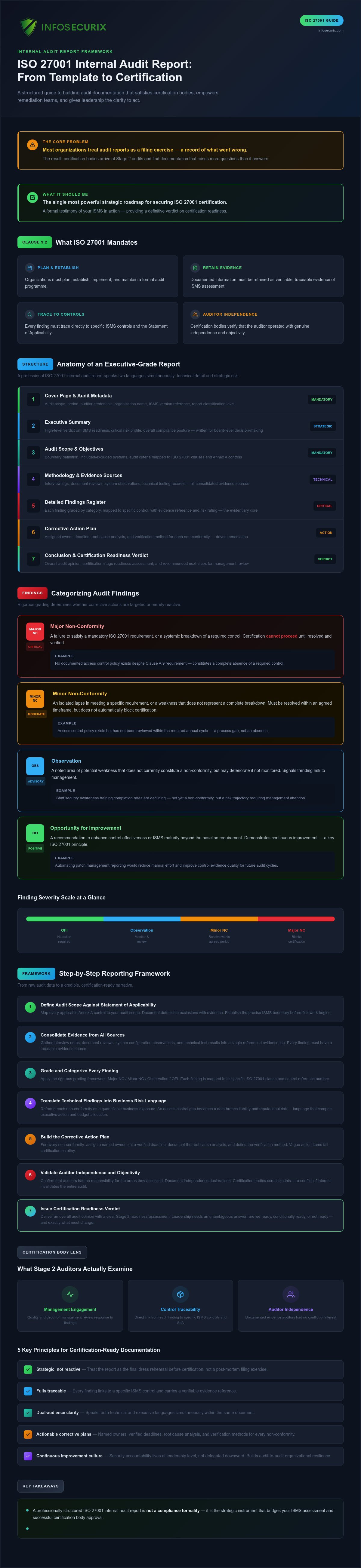
Constructing a report that survives the scrutiny of a certification body requires more than just filling in blanks on a page. It demands a structure that speaks two languages simultaneously: the granular, technical language of the systems administrator and the strategic, risk-oriented language of the board. A professional ISO 27001 internal audit report template serves as the blueprint for this dual-purpose communication, ensuring that no mandatory evidence is overlooked while maintaining a narrative of organizational resilience.
The report must be viewed as a formal testimony of your Information Security Management System (ISMS) in action. It isn’t merely a list of observations; it’s a curated document that provides a definitive verdict on your readiness for the high-stakes environment of a Stage 2 certification audit. If your current documentation feels disjointed, engaging a specialist for ISO 27001 Certification Readiness can provide the professional polish required for certification excellence.
Crafting the Executive Summary
The executive summary is the most critical component for leadership engagement. It should distill weeks of assessment data into a single-page overview that highlights the overall maturity of the ISMS. Rather than burying the lead, start with a definitive “Pass/Fail” readiness statement. This section must clearly summarize any major non-conformities that require immediate resource allocation, allowing stakeholders to understand the business risk without getting lost in technical minutiae. It’s about providing a clear, high-level maturity score that reflects the organization’s commitment to security.
Documenting Audit Scope and Methodology
Transparency is the foundation of a credible audit. This section must explicitly define the boundaries of the assessment, including specific departments, physical sites, and digital systems reviewed. To ensure the findings are beyond reproach, auditors employ a “triangulation” method of evidence collection: a rigorous process of combining personnel interviews, direct observation of practices, and meticulous document review. While the primary focus remains on the ISO 27001:2022 clauses and Annex A controls, professional auditors often reference the NIST Cybersecurity Framework to provide additional context on control maturity and alignment with global best practices.
A sophisticated ISO 27001 internal audit report template should include a dedicated section for detailed findings that bridge the gap between raw observations and specific ISO requirements. Each finding must be traced back to a requirement, ensuring that the remediation team knows exactly which control failed and why. This level of precision doesn’t just satisfy an auditor; it builds a culture of accountability where security is treated as a measurable business discipline.
Categorizing Findings: Non-Conformities vs. Opportunities for Improvement
A finding without a grade is just an observation. The discipline that separates a professionally constructed ISO 27001 internal audit report template from a generic compliance document is a rigorous, consistently applied grading system that assigns each finding its precise weight. Certification bodies don’t simply want to know what you found; they want to understand how you’ve judged its severity, and whether that judgment reflects a genuine understanding of risk. Without that framework, your corrective action plan becomes reactive rather than strategic, and your remediation team wastes resources addressing symptoms rather than root causes.
Identifying Major vs. Minor Non-Conformities
The distinction between a major and minor non-conformity is not a matter of opinion; it’s a determination rooted in systemic impact. A major non-conformity exists when a control has either completely failed or was never implemented, when a clause requirement is entirely absent from documented evidence, or when a pattern of related minor failures collectively undermines a core ISMS process. A missing risk treatment plan, for instance, isn’t a paperwork oversight; it’s a systemic failure that signals to a certification body that risk management exists in name only.
Minor non-conformities, by contrast, represent isolated lapses in an otherwise functioning control. Common examples surfacing in 2026 audits include:
- Access review logs completed outside the documented review cycle frequency
- Supplier agreements that reference outdated security clauses not aligned with ISO 27001:2022 Annex A
- Awareness training records missing for a small cohort of recently onboarded staff
- Asset inventory entries that are incomplete but structurally present
Each of these is correctable without halting certification progress. The key is documenting the isolated nature of the lapse with precision, demonstrating that the surrounding control architecture remains intact.
The Value of Opportunities for Improvement (OFI)
Opportunities for Improvement occupy a category that many organizations underestimate. An OFI is not a requirement failure; it’s a professional observation that a control, while compliant, could be strengthened to deliver greater resilience or efficiency. Documenting OFIs demonstrates something a certification body finds genuinely compelling: that your ISMS is not merely meeting the minimum bar but actively pursuing maturity.
This distinction matters strategically. A report populated exclusively with non-conformities signals a reactive security culture. One that balances corrective findings with thoughtful improvement recommendations signals an organization that has internalized the continuous improvement ethos that ISO 27001 is built upon. Referencing supplementary frameworks such as the NIST Cybersecurity Framework when articulating OFIs adds further credibility, grounding your improvement suggestions in globally recognized best practice rather than internal preference.
For a deeper understanding of how this grading discipline integrates into a complete audit methodology, Mastering Information Security Internal Audits provides an authoritative strategic framework that builds directly on these principles. Applying that level of rigor to your ISO 27001 internal audit report template is precisely what transforms a compliance document into a certification asset.
From Template to Testimony: A Step-by-Step Reporting Framework
Collecting audit evidence is only half the work. The discipline that transforms raw observations into a certification-ready document lies in the five-step finalization process that separates a professional ISO 27001 internal audit report template from a collection of unstructured notes. Each step serves a distinct purpose, and skipping any one of them creates a gap that certification bodies are trained to identify.
The process moves in a deliberate sequence. Begin by consolidating all evidence and verifying it against your Accountability Matrix, confirming that every control owner, every documented responsibility, and every piece of supporting evidence aligns with what was actually observed. This verification step catches the discrepancies that self-assessments routinely miss: a policy that exists on paper but has no corresponding implementation record, or an ownership assignment that hasn’t been updated following an organizational restructure.
With evidence consolidated, draft your initial findings and map each one directly to its corresponding ISO 27001 clause or Annex A control. Precision here is non-negotiable. A finding described as “access controls need improvement” is useless to a remediation team; a finding that states “access review logs for the finance system were last completed 94 days beyond the documented 30-day cycle, in non-conformance with Annex A 8.3” is actionable. That specificity is what a certification body expects to trace through your documentation.
Validating Findings with Process Owners
The closing meeting is where professional auditors apply the “no surprises” rule: every finding presented to process owners should have already been informally discussed during fieldwork. Surprises breed defensiveness, and defensiveness slows remediation. Inviting process owners to review draft findings for factual accuracy before the report is finalized doesn’t weaken the audit’s authority; it strengthens it. A finding that a process owner has validated is one they’re already psychologically invested in resolving. That rapport, built deliberately during the audit cycle, is what accelerates corrective action timelines when it matters most.
Developing the Corrective Action Plan (CAP)
The Corrective Action Plan is where your audit findings acquire teeth. Each non-conformity must be assigned a named owner, a realistic resolution deadline calibrated to the severity of the finding, and a mandatory root cause analysis for any major failure. Root cause analysis is not optional for major non-conformities; it’s the mechanism that prevents the same finding from reappearing in your next audit cycle. Treating the symptom without diagnosing the cause is a pattern certification bodies recognize immediately, and it signals an ISMS that reacts rather than learns.
Securing formal management sign-off on the completed CAP is the final step that activates the remediation phase. This signature isn’t a formality; it’s the documented evidence that leadership has reviewed, accepted, and committed resources to addressing every finding surfaced. For organizations navigating this process for the first time, The Strategic Guide to ISO 27001 Certification Readiness provides an authoritative roadmap for aligning your CAP with the broader certification timeline. If you want expert guidance building a CAP that satisfies certification body scrutiny from day one, explore InfoSecurix’s Internal Audit services to understand how structured expertise accelerates your path to certification.
Beyond the Template: How InfoSecurix Transforms Audit Data into Readiness
A template is a framework. It defines the structure, the sequence, the categories of evidence required. What it cannot supply is the judgment to recognize when a technically compliant control is concealing a systemic vulnerability, or the experience to know which gaps a certification body will scrutinize most intensely in your specific industry context. That judgment is the product of accumulated expertise, and it’s precisely what separates a self-administered audit from a professionally led one.
Organizations that rely solely on an ISO 27001 internal audit report template without the expertise to interpret what the evidence reveals consistently arrive at Stage 2 audits with blind spots they don’t know they have. Hidden risks don’t announce themselves in checklists. They surface in the nuanced patterns that only become visible after decades of comparative assessment work across diverse ISMS environments.
The InfoSecurix Advantage: Senior-Level Insight
Bringing 25+ years of specialization to every engagement, InfoSecurix approaches internal audits as a strategic exercise rather than a compliance obligation. The distinction is tangible: where a box-checking approach confirms that documentation exists, a senior-led assessment interrogates whether that documentation reflects operational reality. Those two things are often not the same. Our audit methodology is calibrated to your industry’s specific risk profile, meaning the reporting framework adapts to the controls and threat vectors most relevant to your sector rather than applying a generic standard uniformly. When your process owners sit across from a certification body examiner, they’re prepared because they’ve already experienced that level of scrutiny from our team.
Your Roadmap to Certification
Every internal audit InfoSecurix conducts is structured to feed directly into a successful Stage 2 outcome. Findings are documented with the precision and traceability that certification bodies expect, corrective actions are assigned with realistic timelines calibrated to severity, and the final report provides leadership with a clear, prioritized picture of residual risk. The goal isn’t minimal compliance; it’s an ISMS that is operationally resilient and credible under external examination.
That resilience is built audit cycle by audit cycle, through the kind of consistent, expert-led assessment that transforms an ISMS from a certification artefact into a genuine organizational asset.
If your next certification milestone is approaching and you want the confidence that comes from a professionally structured audit process, schedule an ISO 27001 Readiness Assessment with InfoSecurix and take the first step toward certification with complete strategic clarity.
Your Certification Journey Starts With the Right Foundation
A professionally constructed ISO 27001 internal audit report template isn’t a compliance formality; it’s the document that determines whether your certification body sees a credible, operationally resilient ISMS or a collection of well-intentioned paperwork. The difference between those two outcomes comes down to structure, evidence traceability, and the judgment to know which gaps carry real certification risk.
Three principles define the path forward: treat every audit cycle as a strategic rehearsal, grade your findings with the precision that drives targeted remediation, and ensure your corrective action plan reflects genuine root cause resolution rather than surface-level fixes.
Applying those principles consistently is where expert guidance earns its value. With 25+ years of specialization, milestone-based engagements designed for predictable outcomes, and senior-level consultants who have navigated every audit scenario imaginable, InfoSecurix brings the depth of experience that self-assessments simply can’t replicate.
Your next certification milestone deserves that level of rigor. Elevate your compliance with professional Internal Audit Services from InfoSecurix and approach your Stage 2 audit with complete confidence.
Frequently Asked Questions About ISO 27001 Internal Audit Reports
What is the most critical section of an ISO 27001 internal audit report?
The Corrective Action Plan is the section that carries the most weight with certification bodies, because it demonstrates that your organization doesn’t just identify gaps but actively resolves them. That said, the findings section runs a close second: without precise, control-mapped findings, your CAP has no credible foundation to build on. Both sections must work together to tell a coherent story of accountability and continuous improvement.
How long should an internal audit report be for a mid-sized organization?
There’s no mandated page count, but a well-structured report for a mid-sized organization typically spans 20 to 40 pages, covering scope documentation, detailed findings, evidence references, and the corrective action plan. Length should be driven by completeness, not volume. A concise, precisely written 25-page report that traces every finding to a specific control will always outperform a sprawling 60-page document that buries its conclusions in unnecessary narrative.
Can I use the same template for ISO 27001 and SOC 2 audits?
The structural elements, such as scope definition, evidence documentation, and finding categorization, do overlap meaningfully. However, the control frameworks are distinct: ISO 27001 maps findings to Annex A controls and clauses, while SOC 2 organizes findings around Trust Services Criteria. Using a single template without adapting the control-mapping sections creates traceability gaps that auditors notice immediately. The safer approach is a core template with framework-specific modules for each standard.
Is it mandatory to include a Corrective Action Plan in the report?
ISO 27001 Clause 10.1 requires documented evidence that non-conformities have been addressed and corrective actions taken, so while the CAP doesn’t have to be physically embedded within the audit report itself, it must exist as traceable documented evidence. In practice, integrating the CAP directly into your ISO 27001 internal audit report template is the most efficient approach; it keeps findings and remediation commitments in a single, auditor-ready document rather than scattered across separate files.
How often should the internal audit report be updated?
The report itself is a point-in-time document, not a living file. What should be updated regularly is your audit programme and the associated corrective action tracking. ISO 27001 requires at least one complete internal audit cycle per certification period, but many organizations conduct targeted interim audits when significant changes occur, such as a system migration, a restructure, or a new supplier relationship. Each audit cycle produces its own report, creating a traceable history of ISMS maturity over time.
Who is responsible for signing off on the final internal audit report?
The lead auditor signs off on the findings and methodology, confirming the report’s factual accuracy. Senior management or the designated ISMS owner then provides a separate sign-off on the Corrective Action Plan, which constitutes documented evidence of leadership commitment under Clause 5.1. That management signature isn’t a formality; it’s the formal trigger that activates the remediation phase and demonstrates to a certification body that leadership is genuinely engaged with the ISMS, not just delegating it downward.
What happens if we identify a major non-conformity in the report?
A major non-conformity doesn’t automatically disqualify you from certification, but it does require documented root cause analysis and a credible remediation plan before your Stage 2 audit proceeds. Certification bodies expect to see evidence that the underlying systemic failure, not just its surface symptom, has been addressed. Identifying a major non-conformity during an internal audit is precisely the outcome the process is designed to produce; discovering it for the first time during a Stage 2 audit is the scenario worth avoiding at all costs.
Can an internal employee write the audit report, or does it require a consultant?
ISO 27001 permits internal employees to conduct and document audits, provided they demonstrate independence from the areas being assessed. The practical challenge is objectivity: self-assessments consistently miss the systemic patterns and control gaps that experienced external auditors recognize from comparative work across multiple ISMS environments. An internal employee can satisfy the compliance requirement; a specialist with 25+ years of audit experience is far more likely to surface the hidden risks that a certification body will scrutinize, making the investment in expert-led audits measurably worthwhile.