
Choosing the wrong cybersecurity framework is a multi-million dollar gamble that few executives can afford to lose. With the average cost of a data breach in the United States reaching a record $10.22 million in 2026, the stakes for your organization have never been higher. You’ve likely felt the mounting pressure from international partners to achieve ISO 27001 certification while simultaneously attempting to decode the technical nuances of NIST CSF 2.0. Understanding the fundamental difference between ISO 27001 and NIST is no longer just a task for the IT department: it’s a critical decision for the boardroom that dictates your global market access and operational resilience.
We recognize the frustration of managing overlapping audits and the confusion that arises when trying to align NIST 800-53 with international standards. Our goal is to provide you with a definitive roadmap for framework selection that maximizes your return on investment. This guide explores how to harmonize these standards to create a bespoke security posture, ensuring your long-term compliance strategy remains both visionary and grounded. By the end of this article, you’ll have the confidence to select the path that safeguards your legacy and enables sustainable corporate growth.
Key Takeaways
- Understanding the fundamental difference between ISO 27001 and NIST allows leaders to align security investments with specific market requirements and contractual obligations.
- Identify whether your organization requires the globally recognized certification of ISO 27001 or the flexible, risk-based framework of NIST CSF 2.0 to drive operational excellence.
- Discover how framework selection directly impacts your ability to secure international contracts and manage rising insurance premiums in a vendor-heavy economy.
- Learn the “Map Once, Comply Many” approach to streamline audits and save hundreds of hours by leveraging structural overlaps between international and domestic standards.
- Assess your organizational maturity and target markets to determine which standard provides the most robust return on investment for your long-term compliance roadmap.
The Framework Dilemma: Why the ISO vs. NIST Debate Matters in 2026
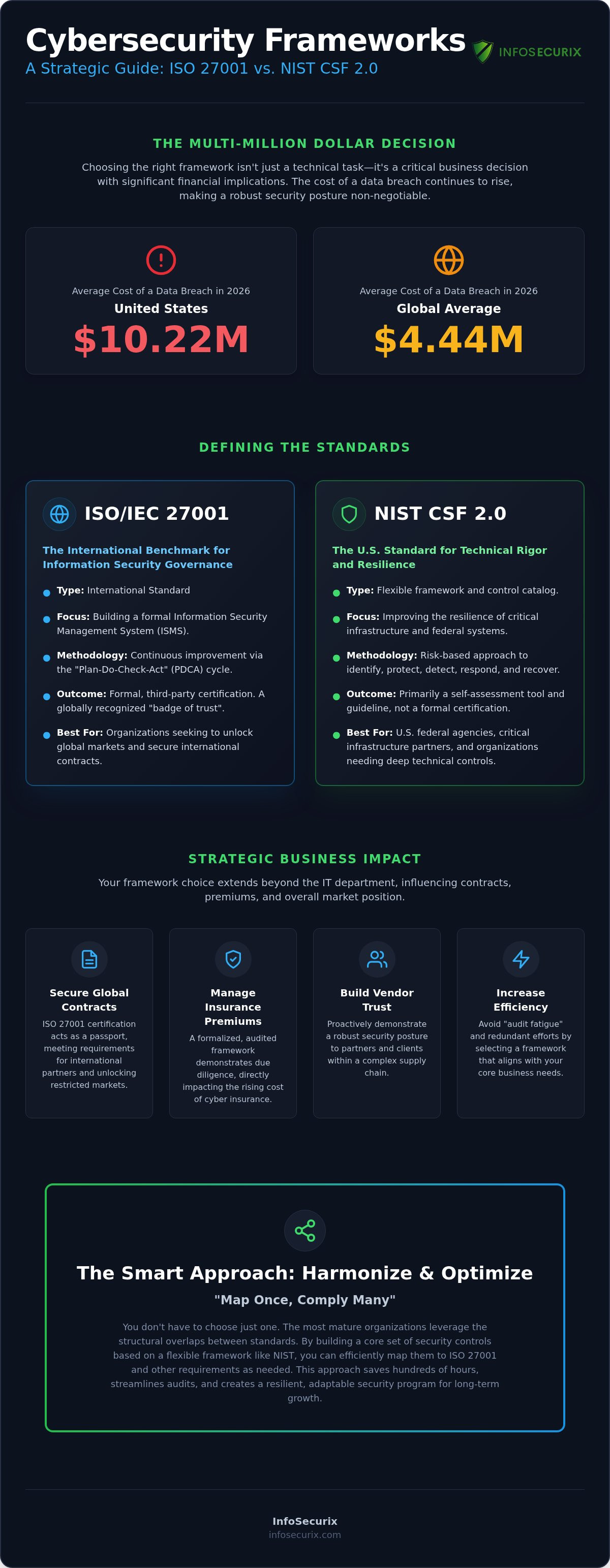
Security is no longer a silent operational function. It’s a primary driver of market trust. In 2026, the global average cost of a data breach has reached $4.44 million, while the United States average has surged to $10.22 million. These figures represent more than just financial loss; they signify a breakdown in the vendor-client relationship. As organizations lean more heavily on complex supply chains, the pressure to demonstrate a robust security posture has reached a fever pitch. Boards now view cybersecurity frameworks as strategic assets that influence everything from contract wins to the cost of cyber insurance premiums.
Moving beyond “checkbox compliance” is essential for modern enterprises. The choice between frameworks isn’t merely a technical preference; it defines your organization’s competitive edge. Understanding the difference between ISO 27001 and NIST is the first step toward building a resilient architecture that doesn’t just survive an audit but thrives in a volatile digital economy. This year requires a more nuanced approach to information security governance than ever before, as regulators and partners demand transparency that goes deeper than a simple certificate.
The Cost of Compliance Uncertainty
Selecting a framework without a clear strategic vision often leads to “audit fatigue.” This occurs when teams spend more time documenting controls than actually securing data. This redundancy drains resources and stalls innovation. When an organization pursues a standard that its primary market doesn’t recognize, the financial impact is immediate and severe. Compliance uncertainty is the gap between regulatory requirements and operational reality. By resolving this gap, firms can transform security from a cost center into a value-add that reassures stakeholders and protects long-term growth.
Global Reach vs. Domestic Rigor
The tension between domestic requirements and international expansion is a common hurdle for growing firms. While the ISO/IEC 27001 standard provides a universally recognized certificate for global business, NIST frameworks offer the technical rigor often demanded by US federal agencies and critical infrastructure partners. This distinction creates a need for framework portability. This is a concept where a business can pivot between standards without rebuilding its entire security program. A seasoned guide helps you navigate this complexity, ensuring you don’t commit to a path that limits your future reach. The goal is to build a foundation that is both flexible enough for US domestic needs and authoritative enough for the global stage.
Defining the Standards: ISO 27001 and the NIST Ecosystem
Misunderstanding the difference between ISO 27001 and NIST often stems from treating them as identical checklists. They aren’t. ISO 27001 is an international standard that dictates how to build an Information Security Management System (ISMS). It’s a structural blueprint for governance. In contrast, the NIST ecosystem is a collection of frameworks and control catalogs designed to improve the resilience of critical infrastructure and federal systems. While ISO 27001 leads to a formal, third-party certification, NIST is traditionally a self-assessment tool. This distinction is vital for executives who must choose between a “badge of trust” for global partners or a deep technical roadmap for domestic operations.
ISO 27001: The International Benchmark
The ISO philosophy centers on the “Plan-Do-Check-Act” cycle. This approach ensures that security isn’t a static achievement but a process of continuous refinement. By establishing a formal ISMS, your organization proves it has the governance in place to identify risks and implement corrective actions. This is why an accredited certification carries so much weight in global enterprise circles; it’s a verified statement of maturity. For many, achieving ISO 27001 certification readiness is the first step toward unlocking restricted markets and securing high-value international contracts. It transforms abstract security claims into a tangible, audited reality.
The NIST Spectrum: CSF 2.0 and SP 800-53
The NIST landscape is divided into strategic guidance and technical depth. The NIST Cybersecurity Framework (CSF 2.0) focuses on six core functions: Govern, Identify, Protect, Detect, Respond, and Recover. It’s designed to facilitate communication between technical teams and executive leadership. However, when an organization needs granular, “how-to” instructions for federal-grade security, they turn to NIST SP 800-53. This is a massive catalog of controls that provides the technical depth missing in higher-level frameworks. While NIST doesn’t offer a formal “certification” in the same way ISO does, its technical rigor is considered the gold standard for organizations operating within the United States or working with federal agencies.
Navigating these two worlds requires a seasoned guide who understands how to bridge the gap between management systems and technical controls. If you’re unsure which path aligns with your 2026 growth targets, starting with a professional readiness assessment can provide the clarity needed to avoid redundant efforts. Choosing the right standard today ensures your compliance strategy remains a powerful asset for years to come.
Structural Architecture: Mapping the Key Differences
Analyzing the structural difference between ISO 27001 and NIST reveals two distinct philosophies regarding organizational maturity. ISO 27001 operates on a binary model: your organization is either certified or it isn’t. This pass/fail nature provides a clear, authoritative signal to the market. In contrast, the NIST Cybersecurity Framework utilizes a tiered approach. These tiers (Partial, Risk Informed, Repeatable, and Adaptive) allow a business to measure its progress along a spectrum of sophistication. This flexibility is ideal for internal benchmarking, yet it lacks the immediate contractual weight that a formal ISO certificate carries in international negotiations.
Choosing between these architectures depends on your primary objective. If your goal is to satisfy a specific legal requirement for a US federal contract, the granular rigor of NIST is often non-negotiable. However, if you’re seeking a universal language of trust to facilitate global trade, the management-heavy structure of ISO is superior. Understanding these nuances ensures you don’t over-engineer your security program for the wrong audience.
Certification and External Validation
The presence of a third-party Registrar is the defining feature of the ISO ecosystem. This independent auditor validates that your Information Security Management System (ISMS) meets every requirement of the standard. Conversely, there is no official “NIST Certified” badge. While organizations can claim alignment with NIST, they lack the external stamp of approval that boards and insurers often demand. To address this, many firms utilize SOC 2 readiness assessments to provide a comparable level of independent validation for their NIST-aligned controls. This third-party scrutiny is essential for building the “psychology of trust” with stakeholders who require more than just self-attestation.
Control Depth and Customization
The sheer volume of technical requirements varies significantly between the two standards. ISO 27001:2022 features 93 controls organized into four themes, providing a high-level management framework. NIST Special Publication 800-53 is far more exhaustive, containing over 1,000 individual control enhancements. ISO allows for a “Statement of Applicability” (SoA), which gives you the freedom to exclude controls that aren’t relevant to your specific risk profile. NIST is generally more prescriptive, demanding a higher level of technical granularity from the outset. ISO focuses on the “system,” while NIST focuses on the “controls.” This fundamental distinction dictates whether your team spends their time perfecting management processes or fine-tuning technical configurations.
Strategic Selection: Which Framework Aligns with Your Business Goals?
Choosing a cybersecurity framework is a strategic pivot that defines your organization’s trajectory for years to come. It’s not merely a technical decision: it’s a commitment of resources that must align with your primary business objectives. The strategic difference between ISO 27001 and NIST lies in their ultimate objective: market access versus operational depth. While one standard acts as a passport for global trade, the other serves as a technical manual for domestic resilience. Executives must weigh the cost of third-party certification against the labor-intensive requirements of deep control implementation to ensure they aren’t over-investing in the wrong areas.
Regulatory drivers also play a decisive role in this selection process. Organizations heavily focused on European markets often find that ISO 27001 provides a more natural alignment with GDPR requirements due to its emphasis on management systems and documentation. Conversely, firms targeting the US federal sector or critical infrastructure are frequently pushed toward NIST standards to satisfy FISMA or CMMC obligations. Balancing these competing demands requires a clear-eyed assessment of where your revenue originates and which regulatory landscape poses the greatest risk to your continuity.
Market Drivers and Contractual Requirements
Global enterprise RFPs frequently list ISO 27001 as a non-negotiable prerequisite for doing business. If your growth strategy involves chasing international contracts, the absence of an ISO certificate can disqualify you before the technical evaluation even begins. On the other hand, the NIST ecosystem is foundational for the Cybersecurity Maturity Model Certification (CMMC), which is essential for the US Department of Defense supply chain. A practical tip for any decision-maker: analyze the security requirements of your top five clients before committing to a path. Their expectations often dictate your most efficient route to compliance.
Internal Resources and Culture
Implementing a framework requires more than just budget; it requires cultural alignment. ISO 27001 demands a high level of documentation rigor and executive involvement that some nascent teams find overwhelming. Technical teams often prefer the prescriptive guidance of NIST because it provides specific, granular instructions for securing systems. If you’re unsure where your team’s strengths lie, performing an information security internal audit can reveal existing gaps and help you identify the best fit for your current maturity level. This proactive step ensures your chosen framework supports, rather than stifles, your operational momentum.
Securing your organization’s future requires a roadmap tailored to your specific market demands and internal capabilities. To move forward with absolute confidence, you should request a strategic readiness assessment from a seasoned guide who can help you navigate these complex choices without redundant effort.
Harmonizing Standards: The InfoSecurix Approach to Compliance
While the fundamental difference between ISO 27001 and NIST involves certification versus technical depth, forward-thinking executives don’t view these frameworks as mutually exclusive. We employ a “Map Once, Comply Many” philosophy. This methodology leverages the significant overlaps between international and domestic standards to save your team hundreds of hours of redundant labor. By using ISO 27001 as your foundational management structure, you create a robust governance container. You can then populate this container with the granular technical controls found in the NIST ecosystem, satisfying global partners and domestic regulators simultaneously.
This unified approach begins with a comprehensive risk assessment. This serves as the single source of truth for your entire security posture. It aligns your specific business objectives with technical requirements, ensuring that every control serves a dual purpose. This strategy future-proofs your organization against the evolving regulations of 2026. It allows your management system to adapt to new threats without requiring a total architectural overhaul whenever a new standard emerges.
The Readiness Advantage
A professional readiness assessment is the most critical phase of any compliance journey. It identifies hidden gaps before they manifest as costly audit failures or contract losses. We prioritize absolute budget predictability for our partners by utilizing fixed-fee milestone engagements. This approach ensures your investment is directed toward strategic corrective actions rather than open-ended consulting hours. By resolving complexities early, we instill a sense of absolute confidence in your long-term compliance roadmap.
Building Operational Resilience
True security extends far beyond the successful completion of an audit. It must support long-term business continuity and enable sustainable growth. We often link framework success directly to ISO 22301 business continuity strategies. This ensures your organization remains steady and productive even under extreme pressure. Meticulous standards today protect your legacy tomorrow. We invite you to partner with a seasoned guide who has navigated the information security landscape for 25+ years. Together, we can transform your compliance requirements into a powerful, protective force that empowers your organization’s future.
Securing Your Global Competitive Edge
Choosing a cybersecurity framework is a defining moment for your organization’s global standing and operational integrity. While the fundamental difference between ISO 27001 and NIST dictates whether you prioritize international certification or domestic technical depth, the most successful leaders recognize that these paths can be harmonized. By implementing a management system that bridges both standards, you ensure your business remains agile, compliant, and ready for the shifting regulatory demands of 2026. This strategic alignment transforms security from a reactive obligation into a proactive competitive advantage that resonates with stakeholders and partners alike.
Navigating this complex landscape requires a partner who translates technical rigor into tangible executive value. With over 25 years of specialized information security expertise, InfoSecurix provides the seasoned guidance necessary to secure your market position. We offer fixed-fee readiness assessments to ensure your compliance budgeting remains predictable and transparent from the outset. It’s time to take the first step toward a more resilient and future-proofed business.
Secure Your Strategic Advantage: Schedule an ISO 27001 Readiness Assessment with InfoSecurix. Your commitment to these meticulous standards today provides the absolute confidence needed for your organization’s growth tomorrow.
Frequently Asked Questions
What is the primary difference between ISO 27001 and NIST CSF?
The primary difference between ISO 27001 and NIST lies in their ultimate objective and validation method. ISO 27001 is an internationally recognized standard that requires a formal audit by an accredited registrar to achieve certification. In contrast, the NIST Cybersecurity Framework is a voluntary set of guidelines designed for flexible risk management. While ISO focuses on establishing a governed management system, NIST provides a strategic roadmap for improving overall cybersecurity maturity without a binary pass or fail result.
Can an organization be NIST certified?
No, an organization cannot receive an official NIST certification because the National Institute of Standards and Technology does not provide a certification program. While you can claim to be “NIST compliant” or “NIST aligned” through self-assessment or third-party validation, there is no accredited certificate equivalent to ISO 27001. Many firms use SOC 2 reports to provide the independent verification that NIST alignment lacks, offering stakeholders the assurance they require for contractual trust.
Is ISO 27001 harder to achieve than NIST compliance?
The perceived difficulty of each standard depends entirely on your organizational goals and technical maturity. ISO 27001 is often considered more rigorous regarding documentation and management oversight because of the mandatory external audit process. However, achieving compliance with the technical controls in NIST 800-53 can be far more complex due to its massive catalog of over 1,000 individual security enhancements. The difference between ISO 27001 and NIST is often a choice between management rigor and technical depth.
Which framework is better for GDPR compliance?
ISO 27001 is generally considered the superior choice for organizations seeking alignment with GDPR. Because ISO 27001 is an international standard, its management system approach directly addresses the organizational and technical security requirements mandated by European regulators. Its focus on risk-based governance and continuous improvement mirrors the GDPR’s accountability principle. This makes it a natural fit for firms operating within the European Union or handling the data of EU citizens who require demonstrable security proof.
Do I need both ISO 27001 and NIST for my business?
You do not necessarily need both, but harmonizing the two can provide a significant strategic advantage. Many global enterprises adopt ISO 27001 to satisfy international contract requirements while utilizing NIST controls to meet the specific technical demands of US-based clients or federal agencies. This “Map Once, Comply Many” approach allows you to build a single, resilient security posture that satisfies multiple stakeholders without duplicating your team’s efforts or doubling your internal compliance budget.
How long does it take to prepare for an ISO 27001 audit versus NIST implementation?
Preparation timelines vary based on your current security maturity, but most organizations spend six to twelve months preparing for an initial ISO 27001 certification audit. NIST implementation timelines are more fluid because the framework is designed for continuous improvement rather than a single audit deadline. While a basic NIST CSF alignment might take four to six months, implementing the full technical depth of NIST 800-53 for a federal contract can often exceed a year of dedicated effort.
What are the costs associated with ISO 27001 vs. NIST?
The cost structures differ significantly between the two frameworks. ISO 27001 involves direct expenses for accredited registrar fees and mandatory surveillance audits to maintain the certificate. While the NIST framework documents themselves are free to download, the internal costs for technical implementation and control remediation can be substantial. Organizations should evaluate the long-term ROI of each path, considering that the global market access granted by an ISO certificate often outweighs the initial investment in readiness assessments.
How does NIST 800-53 differ from the NIST Cybersecurity Framework (CSF)?
The NIST Cybersecurity Framework (CSF) provides a high-level strategic overview of security functions, while NIST 800-53 is a granular catalog of technical controls. Think of the CSF as the executive summary that identifies what needs to be protected and why. NIST 800-53 is the technical manual that explains exactly how to implement those protections at the system level. Most organizations use the CSF for board-level reporting and 800-53 for engineering-level implementation to ensure comprehensive coverage.