

The most comprehensive risk assessment is merely a catalog of vulnerabilities until it’s transformed into a decisive, actionable response. Many enterprise leaders find themselves paralyzed by a mountain of identified threats, feeling the weight of uncertainty when they must justify risk acceptance to auditors or assign ownership for remediation. Developing a risk treatment plan shouldn’t feel like a bureaucratic exercise in box-ticking. Instead, it’s the strategic bridge between identifying a threat and securing your organization’s future through precision and foresight.
You can master the methodology of crafting a robust framework that aligns with the latest international standards and satisfies the rigorous demands of ISO 27001 Clause 6.1.3. We’ll provide a clear roadmap for remediation that empowers you to present a defensible strategy to executive leadership. By moving beyond the granular mechanics of security theory, you’ll learn to build a resilient ecosystem that thrives amidst the complexities of the 2026 regulatory landscape. This guide explores the systematic steps to transition from assessment to operational excellence, ensuring your security posture is both resilient and audit-ready.
Key Takeaways
- Understand how a Risk Treatment Plan acts as the essential bridge between theoretical risk identification and actual security posture, fulfilling mandatory requirements for ISO 27001 and SOC 2.
- Master the four strategic pillars of risk response: avoidance, mitigation, transfer, and acceptance. This ensures every decision aligns with your organization’s unique risk appetite.
- Learn a methodical approach to developing a risk treatment plan by prioritizing assessment findings and selecting precise controls from frameworks like Annex A.
- Discover how to operationalize your strategy through a centralized Risk Register, clearly defining remediation ownership and justifying residual risk to executive leadership.
- Identify the critical blind spots in your remediation strategy by leveraging professional readiness assessments to ensure your plan stands up to the most rigorous audits.
The Strategic Role of a Risk Treatment Plan in Modern Compliance
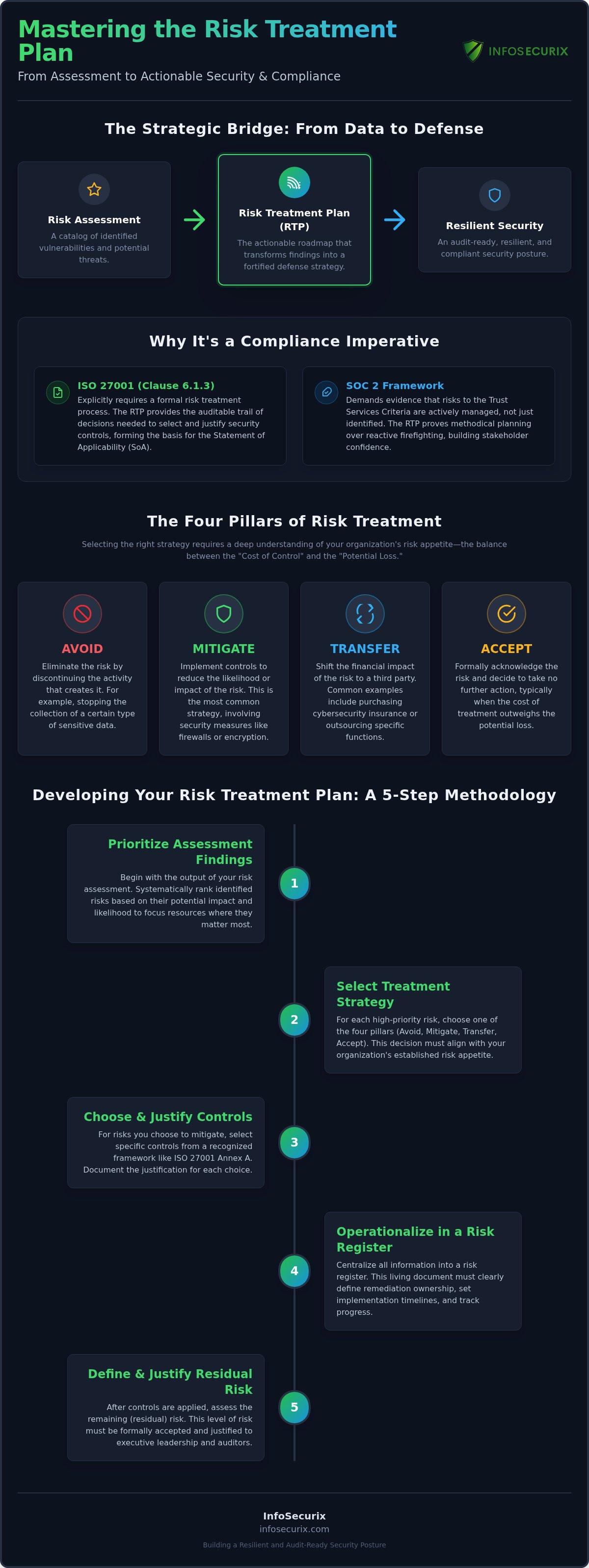
Identifying a vulnerability is only the first step in a much larger journey toward resilience. While a risk assessment serves to catalog potential failures by identifying what could go wrong, it’s the act of developing a risk treatment plan that transforms these observations into a fortified defense by deciding exactly what to do about them. For those in industrial sectors, OT Sec UK, US, AE and IN provides the specialized OT cyber security consultancy needed to ensure this operational bridge effectively protects critical infrastructure, providing a clear, auditable trail of decisions that satisfy both internal stakeholders and external regulators.
A comprehensive risk management plan provides the foundational structure for this process, ensuring that every identified threat receives a deliberate and documented response. Without this vital layer of strategy, organizations often find themselves trapped in a cycle of perpetual assessment without ever achieving true remediation. The treatment plan is the mechanism that converts data into action, ensuring that no identified risk is left unaddressed or unmanaged.
For organizations pursuing ISO 27001 certification, Clause 6.1.3 explicitly requires a formal risk treatment process. Similarly, SOC 2 frameworks demand evidence that risks to the Trust Services Criteria are not just identified, but actively managed. Developing a risk treatment plan demonstrates to auditors that your security posture is the result of methodical planning rather than reactive fire-fighting. This builds profound confidence among executive leadership. It shows that every security control is a calculated investment in the organization’s longevity.
Beyond the Checkbox: RTP as a Business Enabler
Modern risk management is no longer about simple compliance; it’s about ensuring that security spending aligns perfectly with core business priorities. In 2026, organizations face sophisticated threats like AI-driven social engineering and deepfake-based corporate espionage, where the investigative capabilities of International Investigative Group provide a critical layer of defense. An effective RTP allows leadership to prioritize resources where they matter most, future-proofing the company against these emerging vectors. The risk treatment plan is a strategic roadmap for resource allocation that ensures maximum protection for the most critical assets.
Alignment with Global Standards
The interconnectedness of global standards like ISO 27001, ISO 22301, and SOC 2 creates a complex environment for compliance. A central component of this alignment is the Statement of Applicability (SoA), which mirrors the decisions made within your treatment plan. By synchronizing these documents, you create a cohesive narrative of resilience. For those beginning this journey, understanding The Strategic Guide to ISO 27001 Certification Readiness in 2026 is a vital prerequisite for success. This integrated approach ensures that your risk management strategy supports broader corporate excellence.
Evaluating the Four Pillars of Risk Treatment: Selecting Your Strategy
Once you’ve identified vulnerabilities, the next phase in developing a risk treatment plan is selecting the most appropriate response for each threat. This selection isn’t arbitrary. It requires a sophisticated understanding of your organization’s risk appetite: the specific level of risk the board is willing to tolerate in pursuit of its objectives. Choosing a strategy involves a meticulous trade-off between the “Cost of Control” and the “Potential Loss.” In many cases, the price of absolute security exceeds the value of the asset being protected. A seasoned advisor recognizes that the objective isn’t to eliminate every threat but to manage them with precision.
This strategic balance is particularly critical in specialized industrial sectors. For example, in the large-scale energy solutions and fuel delivery operations managed by Secure Supplies Group, developing a risk treatment plan involves weighing the cost of security controls against the operational risks inherent in global supply chains.
The NIST Guide for Conducting Risk Assessments provides a rigorous framework for evaluating these threats before they enter the treatment phase. By following such standards, you ensure that your treatment choices are defensible and grounded in industry best practices. This methodical approach transforms risk management from a reactive exercise into a strategic advantage.
Risk Mitigation and Transfer Strategies
Mitigation remains the most common path for high-priority risks. It involves implementing technical controls, such as multi-factor authentication and advanced encryption, alongside administrative measures like employee awareness training. However, when the technical burden is too great, organizations often look toward transfer strategies. This involves shifting the financial impact to a third party. While cloud providers assume some operational risk, cyber insurance is the primary vehicle for financial transfer. In 2026, the landscape for insurance has shifted significantly. Premiums are increasingly tied to demonstrated maturity. Insurers now demand proof of rigorous standards like ISO 27001 before providing coverage. If you’re unsure where your current strategy stands, a professional Risk Assessment can clarify your path forward.
Risk Avoidance and Formal Acceptance
Sometimes, the most prudent course is to remove the risk entirely through avoidance. This might involve discontinuing a specific high-risk service or exiting a market where regulatory complexity makes operations too hazardous. Conversely, risk acceptance is a necessary reality for items that fall within the defined appetite or where remediation is disproportionately expensive. This is not a passive choice. It requires formal executive sign-off and a documented justification. Auditors during a certification review will often scrutinize accepted risks first. They want to ensure that acceptance isn’t merely a euphemism for neglect. A well-documented acceptance strategy demonstrates that leadership is fully aware of the residual landscape and has made a conscious, strategic decision.
A Step-by-Step Methodology for Developing a Risk Treatment Plan
Constructing a resilient security posture demands more than just identifying threats. It requires a systematic translation of those threats into a structured, actionable response. The process of developing a risk treatment plan begins with a rigorous prioritization of your findings. You can’t treat every vulnerability with the same level of intensity. By referencing the Strategic Guide to Information Security Risk Assessment, you ensure your treatment efforts are focused on the risks that pose the greatest threat to your mission-critical assets. Once prioritized, you must select specific controls from recognized frameworks. This typically involves mapping risks to the 93 controls in ISO 27001 Annex A or the Trust Services Criteria within SOC 2, ensuring your defense is both comprehensive and compliant.
Identifying and Mapping Controls
Effective risk treatment relies on the principle of “Defense in Depth.” Rather than relying on a single safeguard, a sophisticated plan layers multiple treatments to protect a single high-impact asset. For instance, protecting sensitive data might involve a combination of encryption, strict access controls, and regular monitoring. It’s not enough to simply list these controls. You must validate their efficacy through technical assessments. For organizations requiring high-assurance validation, Exploit Labs provides specialized penetration testing and TIBER-DE assessments to ensure controls stand up to the sophisticated attack scenarios of 2026. The SOC 2 framework provides an excellent mechanism to validate control effectiveness through the collection of rigorous evidence and continuous testing. This mapping ensures that every theoretical risk is met with a tangible, verified technical or administrative barrier.
Assigning Accountability and Timelines
Vague ownership is the silent killer of enterprise resilience. For a risk treatment plan to be effective, every action item must have a designated owner and a realistic remediation deadline. Accountability ensures that tasks don’t get lost in the shuffle of daily operations. We recommend setting these timelines based on risk severity: critical risks should be addressed within 30 days, while high-priority items might have a 60-day window. Internal audits play a vital role here. They verify that owners are meeting their commitments and that the implemented controls are performing as expected. This structured oversight transforms a static document into a living, breathing security strategy.
The final step in developing a risk treatment plan is the calculation of residual risk. This is the level of risk that remains after your selected controls have been applied. It’s a fundamental concept because no system is ever 100% secure. Documenting this residual landscape is essential for executive transparency. It allows leadership to understand exactly what risks they are still carrying and provides a defensible basis for formal risk acceptance. By following this methodical approach, you move beyond mere documentation and into the realm of strategic resilience.
Operationalizing the Plan: Documentation, Ownership, and Residual Risk
Operationalizing your security strategy requires a centralized Risk Register that serves as the single source of truth for your organization. This document is more than a simple list; it’s a sophisticated management tool that houses the results of developing a risk treatment plan and ensures every vulnerability has a tracked, accountable response. Similar to how Computer Market Research provides SaaS solutions to automate and streamline channel management for global enterprises, a robust Risk Register brings efficiency to complex security workflows. By replacing static spreadsheets with a living database that connects threats to specific owners, you transform compliance from a periodic hurdle into a continuous state of readiness.
The effectiveness of your plan depends on the clarity of its documentation. Every entry in your register should bridge the gap between technical vulnerability and business impact. By maintaining this meticulous record, you provide a clear audit trail that satisfies regulators and instills confidence in your internal teams. It’s the difference between reactive troubleshooting and a deliberate, strategic defense. To ensure your documentation stands up to the highest standards, consider partnering with InfoSecurix for a Readiness Assessment that identifies gaps in your operational workflow.
Calculating and Communicating Residual Risk
Understanding the distinction between inherent and residual risk is fundamental to executive decision-making. Inherent risk represents the raw threat level before any safeguards are applied. Residual risk is the exposure that remains after your selected controls are implemented. The logic is straightforward: Inherent Risk minus Control Effectiveness equals Residual Risk. When you’re developing a risk treatment plan, your goal is to reduce this residual level until it sits comfortably within the organization’s defined risk appetite. When presenting these findings to a Board of Directors, avoid getting lost in granular technical data. Focus on the strategic landscape. Show them how your chosen treatments have shifted the organization’s risk profile from a state of vulnerability to one of calculated, manageable exposure.
Monitoring, Reviewing, and Updating
The threat landscape of 2026 is fluid, so your plan must be equally dynamic. Establish a quarterly cadence for formal reviews, or trigger an immediate update following significant organizational changes like mergers or the adoption of new AI technologies. These reviews aren’t just administrative; they’re an opportunity to validate that your treatments are still effective. Information Security Internal Audits provide the necessary friction to test your controls in real-world scenarios. If a treatment fails to mitigate a risk as expected, don’t hide the result. Document the lessons learned. This transparency builds a resilient culture that values continuous improvement over the mere appearance of security.
Beyond Documentation: Partnering for Certification Readiness
A perfectly formatted document is only as strong as the strategy it represents. While developing a risk treatment plan is a critical internal milestone, the true test occurs when that plan is subjected to the scrutiny of an external auditor. Many organizations create robust-looking registers only to find that their logic for risk acceptance or their choice of controls fails to meet the specific expectations of frameworks like ISO 27001 or SOC 2. Partnering with a seasoned guide ensures that your strategy isn’t just compliant on paper but resilient in practice.
InfoSecurix brings over 25 years of industry experience to the table, offering a perspective that looks beyond the immediate remediation task to the broader horizon of certification. We specialize in identifying the subtle “blind spots” that internal teams often overlook: the gaps in ownership, the insufficiently justified residual risks, and the controls that lack verifiable evidence. By predicting how an auditor will interpret your risk decisions, we help you refine your approach before the stakes are at their highest. This foresight transforms your compliance burden into a competitive advantage, signaling to partners and clients that your security posture is fortified by precision.
The InfoSecurix Advantage in Risk Management
Our approach to consultancy is fundamentally bespoke. We reject the “one-size-fits-all” templates that often lead to generic, ineffective security postures. Instead, we act as a collaborative partner, working alongside your team to build a framework that reflects your organization’s unique operational reality. Our expertise spans the most rigorous global standards, including ISO 27001, SOC 2, ISO 22301, and ISO 20000. This comprehensive scope allows us to harmonize your risk management efforts across multiple certifications, reducing duplication and maximizing efficiency. We don’t just provide a service; we deliver a partnership rooted in trust and longevity.
Next Steps for Your Compliance Journey
Moving from a state of vulnerability to one of strategic resilience requires a clear roadmap and expert execution. A professionally vetted risk treatment plan does more than satisfy an auditor; it provides your leadership with the absolute confidence that the organization is protected against the most sophisticated threats of 2026. This peace of mind is the ultimate ROI of a rigorous readiness assessment. It allows you to focus on growth and innovation, knowing that your security foundation is steady and your risk landscape is fully mastered.
The path to resilience is a journey best taken with an expert who has navigated every possible scenario. Whether you are in the early stages of developing a risk treatment plan or are preparing for a final certification audit, our team is ready to guide you through the complexity. Secure your organization’s future with an InfoSecurix Readiness Assessment.
Securing Your Competitive Edge Through Strategic Resilience
Mastering the methodology of developing a risk treatment plan is the definitive transition from passive observation to active defense. By prioritizing findings, selecting precise controls, and documenting residual risk with absolute transparency, you build a security posture that withstands the most rigorous audits. This strategic framework does more than satisfy compliance requirements. It provides a clear roadmap for resource allocation and instills profound confidence in your executive leadership.
InfoSecurix offers over 25 years of information security expertise to guide you through this complex landscape. We combine a national reach with a boutique, high-touch consultancy approach, ensuring your remediation strategy is as unique as your business. Our proven track record in ISO 27001 and SOC 2 success means you aren’t just preparing for an audit. You’re future-proofing your organization against the emerging threats of 2026.
Partner with InfoSecurix for Expert Risk Treatment Planning and Certification Readiness. Your commitment to these standards today ensures a secure, prosperous future for your enterprise.
Frequently Asked Questions
What is the difference between a risk assessment and a risk treatment plan?
A risk assessment is the methodical process of identifying and analyzing vulnerabilities; however, a risk treatment plan is the strategic roadmap for addressing them. Think of the assessment as the diagnostic phase and the treatment plan as the prescribed cure. While the assessment highlights what could go wrong, the act of developing a risk treatment plan ensures that every threat is met with a deliberate, documented response.
Is a risk treatment plan mandatory for ISO 27001 certification?
Yes, a risk treatment plan is a mandatory requirement for ISO 27001:2022 certification under Clause 6.1.3. Auditors specifically look for this document to verify that the organization has a structured approach to managing the risks identified during the assessment phase. It serves as the primary evidence that your Information Security Management System (ISMS) is active and effective rather than just a collection of static policies.
How often should a risk treatment plan be updated?
Your plan should be reviewed at least annually or whenever significant organizational changes occur. Major shifts such as mergers, the adoption of new technologies like generative AI, or changes in regulatory requirements should trigger an immediate review. Maintaining a steady cadence ensures that your security posture remains aligned with the evolving threat landscape of 2026 and reflects the current operational reality of your enterprise.
Can an organization accept a high-level risk without mitigation?
An organization can choose to accept a high-level risk without mitigation if it falls within the predefined risk appetite and receives formal executive sign-off. This decision must be documented with a clear justification explaining why the cost of treatment outweighs the potential loss. Auditors will scrutinize these accepted risks closely to ensure they aren’t simply ignored vulnerabilities but are instead calculated business decisions made by informed leadership.
What should be included in a standard risk treatment plan document?
A standard risk treatment plan must include the identified risk, the chosen treatment strategy, and the specific controls being applied. It’s equally critical to document the assigned owner, the remediation deadline, and the calculated residual risk. This level of detail ensures that developing a risk treatment plan results in a defensible strategy that stands up to the most rigorous professional audits and provides clear direction for your team.
Who is responsible for owning the risk treatment plan?
Responsibility for the risk treatment plan is shared between the designated Risk Owners and the security leadership team. While the CISO or Compliance Officer provides the framework and oversight, the individual business unit leaders typically own the specific risks and the remediation actions. This shared accountability ensures that security is integrated into the core business processes rather than being treated as a siloed IT function that lacks operational support.
How does residual risk affect my SOC 2 report?
Residual risk directly impacts your SOC 2 report by demonstrating how effectively your controls address the Trust Services Criteria. Auditors examine whether your residual risk levels are acceptable and if they’ve been properly communicated to stakeholders. If residual risks remain high in critical areas like data confidentiality or system availability, it may lead to exceptions in your final report. Clear documentation and management of these risks are essential for a clean audit.
What happens if we fail to meet the remediation deadlines in our plan?
Failing to meet remediation deadlines can compromise your compliance status and increase your organization’s exposure to active threats. From an audit perspective, missed deadlines suggest a lack of management commitment or inadequate resource allocation. It’s vital to document the reasons for any delays and update the plan with revised timelines. This maintains a transparent and auditable record of your resilience efforts even when challenges arise during the remediation process.