
A data classification policy ISO 27001 is far more than a clerical requirement; it’s the strategic foundation of a risk-based Information Security Management System. You likely recognize the tension between maintaining rigorous security standards and ensuring your staff can actually follow complex data handling rules. It’s frustrating to face the ambiguity of classification levels while the pressure of an upcoming external audit looms, especially as 2026 regulations like the EU AI Act introduce additional layers of complexity to your data environment.
Achieving compliance doesn’t have to mean sacrificing operational agility. This guide provides a definitive roadmap for implementing a scalable classification scheme that satisfies the requirements of Annex A.5.12 while remaining practical for daily use. By following this strategic approach, you’ll gain a clear understanding of labeling protocols and the confidence to demonstrate a mature, future-proof security posture during your next audit. We’ve distilled 25 years of industry expertise into this framework to help you turn compliance into a genuine strategic advantage.
Key Takeaways
- Master the alignment between Clause 8.2 and your Statement of Applicability so it’s clear your security controls are both relevant and defensible.
- Design a scalable, four-tier labeling scheme that embeds your data classification policy ISO 27001 into the fabric of your daily operations.
- Analyze the performance benefits of automated discovery versus manual oversight to select a classification method that scales with your growth.
- Implement a methodical roadmap for asset inventory and criteria definition, providing the clarity your team needs to handle data with precision.
- Leverage 25 years of industry insights to navigate the ISO 27001:2022 transition with absolute confidence and executive-level clarity.
The Strategic Foundation: Understanding Data Classification in ISO 27001
A robust Information Security Management System (ISMS) operates on the principle of precision. You can’t apply universal protection to every byte of data without drowning in operational costs and friction. Precision is key. A data classification policy ISO 27001 establishes a systematic framework for identifying the true value of your information assets. This process allows your organization to focus its resources where they matter most. Within the ISO/IEC 27001 standard, data classification acts as the bridge between high-level governance and granular security controls.
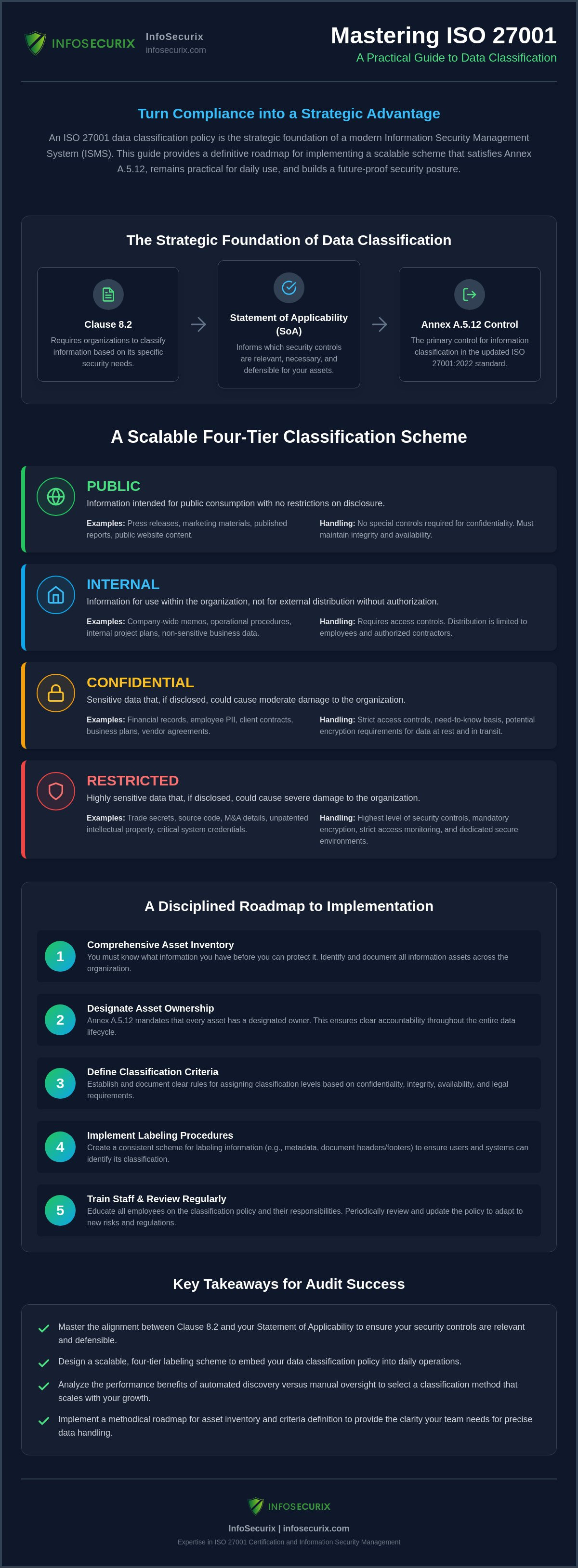
Clause 8.2 requires organizations to classify information based on its specific security needs. This isn’t a standalone exercise. It directly informs your Statement of Applicability (SoA) by determining which controls are necessary and which are redundant. If you haven’t properly categorized your data, your risk treatment plan is essentially guesswork. The transition to the ISO 27001:2022 version has streamlined this through Annex A.5.12; this update replaces the more fragmented approach of the 2013 standard with a cohesive focus on information classification as a primary control theme.
The Core Requirements of Annex A.5.12
Effective implementation begins with a comprehensive inventory of information assets. You must know what you have before you can decide how to protect it. Annex A.5.12 mandates that every asset has a designated owner. This ownership ensures accountability throughout the entire data lifecycle, from creation to disposal. The classification scheme you adopt must accurately reflect the information’s value to the business and its sensitivity to unauthorized disclosure or loss. Without this foundation, the rest of your security architecture lacks a clear objective.
The Interplay Between Confidentiality, Integrity, and Availability
While many leaders fixate on confidentiality, a mature data classification policy ISO 27001 equally prioritizes integrity and availability. A loss of availability for a critical production database can be just as damaging as a confidentiality breach. Your classification levels should reflect the impact of a failure in any of these three pillars. Organizations must explicitly map each classification level to a specific set of technical and organizational security controls to ensure consistent protection across the enterprise. This balance ensures that security remains a business enabler rather than a roadblock.
Architecting the Scheme: Defining Classification Levels and Information Labels
Designing a data classification policy ISO 27001 requires a sophisticated balance between granular security and user adoption. If a scheme is too complex, employees will bypass it; if it’s too simple, it fails to provide the nuanced protection required for high-value assets. Most successful organizations adopt a four-tier model that provides clear boundaries for data handling. This structure typically includes Public, Internal, Confidential, and Restricted levels. By establishing these tiers, you’re creating a common language for risk that resonates from the server room to the boardroom.
Your policy must transform these abstract tiers into tangible actions. This is achieved through meticulous labeling and metadata integration. Digital assets should carry persistent markers that inform both human users and automated security systems how the data must be treated. Refining these definitions through a professional risk assessment ensures your policy remains functional rather than just a theoretical exercise.
Selecting Your Classification Tiers
While a three-tier system offers simplicity, it often lacks the precision needed to distinguish between standard business operations and highly sensitive intellectual property. Conversely, a five-tier system can lead to “classification fatigue,” where users struggle to choose the correct label. A four-tier approach is usually the most effective for aligning with regulations like GDPR or HIPAA. It’s vital to define “Internal Use Only” with absolute clarity. This prevents the common pitfall where employees treat non-sensitive data with excessive secrecy, which inevitably slows down collaborative workflows.
Labels and Visual Markers
Standardizing visual markers is a fundamental step in making security visible. Digital documents should utilize headers, footers, or watermarks that clearly state the classification level. However, the modern enterprise faces the unique challenge of unstructured data within emails, chats, and collaborative platforms. Your policy should mandate the use of metadata tags that follow the file regardless of where it’s stored. Achieving a state of ISO 27001 certification readiness depends heavily on the consistency of these markers across all platforms. When every email and chat message is governed by a clear labeling protocol, you eliminate the ambiguity that often leads to accidental data exposure.
Strategic Comparison: Balancing Security Granularity with Operational Efficiency
A sophisticated data classification policy ISO 27001 does not exist to impede progress; rather, it functions as a strategic filter that separates critical signals from background noise. When organizations attempt to treat all data with equal weight, they inevitably create a bottleneck that stifles innovation. Precision is the antidote to friction. The goal is to achieve a level of granularity that protects high-value assets without burying the workforce under administrative overhead. By refining the scope of your security controls through accurate classification, you effectively reduce the “attack surface” that requires the most expensive monitoring and defense mechanisms.
One of the most significant advantages of a well-structured policy is the reduction in audit complexity. When an auditor sees a clearly defined and enforced classification scheme, they can quickly verify that the most sensitive data is handled correctly. This targeted approach often leads to shorter audit cycles and lower certification costs. Instead of auditing every system in the enterprise, the focus shifts to the specific environments where Restricted or Confidential data resides. Efficiency in compliance is born from this type of intentional organization.
Manual vs. Automated Classification
Choosing between manual and automated classification requires a nuanced understanding of your organizational culture. Manual, user-driven classification remains a powerful tool for building a security-first mindset; it forces employees to consider the value of the information they create. However, relying solely on human intervention becomes impossible when dealing with petabytes of legacy data. A hybrid approach often yields the best results. Automated tools can perform the heavy lifting of data discovery and initial tagging, while humans provide the contextual oversight for complex or ambiguous cases. This balanced strategy ensures that your data classification policy ISO 27001 remains scalable as your business grows.
Impact on Risk Assessment
Classification is the primary engine that drives a meaningful information security risk assessment. By identifying your most sensitive assets, you can allocate your security budget with surgical precision. It’s much more effective to implement multi-factor authentication and rigorous encryption on a small subset of high-value data than to struggle with a broad, shallow defense across the entire network. When you over-classify low-risk information, you inadvertently trigger security fatigue, which leads employees to ignore or circumvent the very policies designed to protect the organization. Maintaining this balance is essential for long-term policy adherence and operational health.
A Disciplined Roadmap: Implementing Your Data Classification Policy Step-by-Step
Execution is the true test of any security framework. A data classification policy ISO 27001 must be implemented with a rhythmic precision that respects existing workflows while closing security gaps. This roadmap provides a systematic approach to embedding these standards into your corporate DNA, moving your organization from theoretical compliance to operational resilience. Success depends on a disciplined sequence of actions that ensure every stakeholder understands their role in the data lifecycle.
- Step 1: Conduct a comprehensive information asset inventory. You cannot protect what you haven’t identified. This inventory should capture all data repositories, from cloud storage to physical archives.
- Step 2: Define and document your classification criteria and levels. Establish objective rules for why data is labeled as Public, Internal, Confidential, or Restricted.
- Step 3: Assign asset owners and train them on their responsibilities. Accountability is the glue of the ISMS. Owners must be empowered to make classification decisions based on the established criteria.
- Step 4: Develop and distribute data handling guidelines for each level. Provide clear instructions on how to store, share, and destroy data according to its classification.
- Step 5: Monitor, audit, and refine the policy through internal reviews. Security is a process of continuous improvement. Regular evaluations ensure the policy evolves alongside new threats and business needs.
Developing Data Handling Guidelines
A handling matrix serves as the primary operational manual for your staff. It should explicitly state the requirements for storage, transmission, and disposal for each tier. For “Restricted” data, the controls must be uncompromising; this includes mandatory encryption at rest and in transit, multi-factor authentication for access, and detailed audit logging to track every interaction. Secure disposal is equally critical. Following Annex A.7.14 requirements ensures that classified assets are destroyed in a manner that prevents recovery, protecting the organization from post-lifecycle data breaches.
Training and Awareness
True security is rooted in behavioral change rather than simple checklist completion. Training programs should move beyond passive slides to active engagement. Simulating classification errors or conducting “spot checks” allows you to test employee readiness and identify areas where the policy might be too ambiguous. This proactive approach builds a culture of vigilance. To ensure your implementation meets the highest standards of the 2022 transition, InfoSecurix provides professional Internal Audits that validate your controls and prepare your team for a successful external certification audit.
Partnering for Excellence: How InfoSecurix Secures Your Certification Readiness
Translating a complex regulatory requirement into a functional business asset requires more than a checklist: it demands the insight of a veteran who has navigated every variation of the ISO landscape. InfoSecurix brings over 25 years of industry experience to your organization, helping you transform a static data classification policy ISO 27001 into a dynamic engine for risk management. We focus on strategic corrective actions that go beyond mere documentation, ensuring your controls are deeply embedded in your operational reality. This approach doesn’t just prepare you for an audit; it future-proofs your enterprise against the evolving threat landscape of 2026.
Our “Seasoned Guide” methodology is designed to instill absolute confidence in your leadership team. We bridge the gap between technical standards and executive-level strategy, ensuring that your security posture enables growth rather than restricting it. By focusing on fixed-fee engagements, we provide the transparency and predictability your budget requires while delivering the sophisticated expertise your data deserves.
Bespoke Compliance Consulting
Generic templates often collapse under the scrutiny of a rigorous external audit because they fail to account for the unique complexities of your data environment. Our consultants specialize in designing a curated approach: aligning your classification scheme with other critical frameworks like SOC2 Readiness Assessments or ISO 20000 Implementation. By conducting a meticulous gap analysis before your certification audit, we identify and resolve vulnerabilities in your labeling and handling protocols. This precision ensures that your Information Security Management System (ISMS) remains a cohesive, authoritative structure rather than a collection of siloed policies.
Achieving Long-Term Operational Resilience
Choosing InfoSecurix means gaining a collaborative ally invested in your long-term success. We don’t view a data classification policy ISO 27001 as an isolated clerical task; instead, we position it as a prerequisite for a mature, executive-level security strategy. A well-executed framework provides the clarity needed to allocate resources effectively, protecting your most valuable assets while maintaining the agility required for 2026 market demands. Our methodology ensures that your transition to ISO 27001:2022 is seamless, steady, and entirely defensible.
Securing your digital future starts with a foundation of trust and technical excellence. We invite you to experience the confidence that comes from professional partnership. Contact InfoSecurix today to schedule your ISO 27001 Certification Readiness assessment and turn your compliance journey into a genuine strategic advantage.
Future-Proofing Your Information Security Architecture
Establishing a sophisticated data classification policy ISO 27001 represents a fundamental shift from reactive defense to proactive governance. By architecting a scheme that balances security granularity with operational efficiency, your organization transforms a compliance requirement into a distinct competitive advantage. This strategic clarity ensures that your most vital information assets receive the highest level of protection while maintaining the agility necessary for 2026 and beyond. Success in this arena is defined by precision: knowing exactly what to protect and how to do it without disrupting the rhythm of your daily operations.
Guiding your team through the nuances of the ISO 27001:2022 transition requires a partner who’s seen every possible scenario and remains unfazed by complexity. InfoSecurix provides 25+ years of expert compliance guidance to help you secure your certification with absolute certainty. From specialized transition support to authoritative internal audits and risk assessments, we offer the seasoned perspective your enterprise deserves. Secure your ISO 27001 certification readiness with InfoSecurix and position your business for a legacy of security and growth. Your journey toward excellence is well within reach.
Frequently Asked Questions
What is the minimum number of classification levels required for ISO 27001?
ISO 27001:2022 does not specify a mandatory minimum number of classification levels. Organizations are empowered to design a scheme that reflects their specific operational complexity and risk profile. While a three-tier model is common, a four-tier structure often provides the necessary precision for balancing internal transparency with the protection of highly sensitive intellectual property. This flexibility allows your policy to scale alongside your business growth.
How does ISO 27001:2022 change the requirements for data classification?
The ISO 27001:2022 update consolidated previous controls into a more streamlined framework, specifically Annex A.5.12. This control requires that information be classified based on confidentiality, integrity, availability, and the requirements of interested parties. It shifts the focus toward a more integrated, risk-based approach within the broader Information Security Management System, ensuring that protection is proportional to the actual value of the data.
Is it mandatory to label every single document in our organization?
It’s not mandatory to manually label every individual document, but you must have documented procedures for labeling information in accordance with your data classification policy ISO 27001. High-value or sensitive assets require explicit markers to ensure they are handled correctly. For lower-risk data, organizations often implement “default” handling rules to maintain efficiency while ensuring basic security standards are met across the entire enterprise.
Who is responsible for classifying information according to the standard?
The responsibility for classifying information rests primarily with the designated information owners. These individuals possess the necessary context to evaluate the value and sensitivity of the data under their care. While the security team provides the framework and tools, the information owner ensures that each asset is categorized accurately throughout its lifecycle. This accountability is a cornerstone of a mature and defensible Information Security Management System.
Can we use automated tools to satisfy ISO 27001 classification requirements?
Automated discovery and classification tools are highly effective for managing large volumes of data, especially unstructured files. These technologies can satisfy ISO 27001 requirements if they are correctly calibrated to your organization’s specific criteria. A hybrid approach often yields the best results: combining automated speed for legacy data with human contextual oversight for complex or highly sensitive data sets that require nuanced judgment.
How often should our data classification policy be reviewed and updated?
Your data classification policy ISO 27001 should be reviewed at planned intervals, typically annually, or whenever significant changes occur within your business environment. Regular reviews ensure that your classification criteria remain relevant as new regulations, such as the EU AI Act, come into effect. This iterative process is a core component of the “Plan-Do-Check-Act” cycle, ensuring your security measures keep pace with emerging threats.
What happens if we fail to classify an asset during an ISO 27001 audit?
Failing to classify an asset during an external audit can result in a non-conformity report. This indicates a gap in your implementation and suggests that sensitive information may not be receiving adequate protection. Auditors look for consistency: a single missing label is a minor issue, but a systemic failure to categorize assets suggests a fundamental weakness in your security governance that could jeopardize your certification status.
How does data classification relate to GDPR compliance?
Data classification is a vital prerequisite for GDPR compliance because it identifies where personal and sensitive data resides within your network. By tagging data according to its privacy implications, you can apply the specific technical and organizational measures required by law. This alignment ensures that your security controls protect not just corporate secrets, but the fundamental rights of data subjects, simplifying your broader regulatory obligations.