
With internal audit budgets dropping from 34% to 23% according to recent IIA data, your existing compliance spreadsheet isn’t just outdated; it’s a potential liability. You likely feel the weight of an overwhelming number of controls to monitor, especially when limited resources make it difficult to align with complex, multi-framework requirements like ISO 27001 and SOC 2. Creating an internal audit schedule shouldn’t feel like a desperate race against the clock. It should be a meticulous, strategic asset that empowers your organization to scale with absolute security and poise.
We recognize the challenge of maintaining a steady hand when high-stakes certification deadlines loom. This article provides a clear, step-by-step process for designing a defensible, risk-based roadmap that ensures continuous compliance and operational resilience. We’ll explore how to prioritize your most critical controls and incorporate the latest ISO 19011:2026 guidelines. By the end, you’ll have the confidence that your schedule will stand up to any external certification audit while future-proofing your business through seasoned, expert standards.
Key Takeaways
- Master the foundational steps for creating an internal audit schedule that transforms a static checklist into a dynamic, risk-calibrated roadmap for your organization.
- Learn how to define your audit universe by mapping specific technical controls to rigorous standards like ISO 27001 and SOC 2.
- Discover a methodology for prioritizing high-risk areas. This includes addressing emerging 2026 threats such as AI governance and advanced supply chain vulnerabilities.
- Gain a clear, multi-year framework for consolidating compliance requirements and assigning audit frequencies based on operational impact.
- Understand the strategic importance of maintaining auditor independence to build unwavering confidence with external certification bodies.
The Strategic Importance of a Risk-Based Internal Audit Schedule
Establishing a robust Information Security Management System (ISMS) requires more than just policy documentation; it demands a living, breathing mechanism for oversight. Creating an internal audit schedule serves as this foundational element. It provides the structure necessary to verify that controls are functioning as intended throughout the year. Rather than viewing the audit as a seasonal hurdle, visionary leaders treat it as a continuous feedback loop that reinforces the organization’s security posture. This methodical approach ensures that compliance remains steady, even as the regulatory environment shifts.
The 2026 IIA Global Internal Audit Standards have redefined modern expectations by shifting the focus toward strategic alignment and value creation. These updated guidelines require that audit planning reflects the organization’s unique risk profile and long-term objectives. Adopting this risk-based methodology moves your team beyond simple “box-ticking” exercises. It creates a defensible framework that satisfies both internal stakeholders and external certification bodies by demonstrating a proactive approach to governance and risk management.
Distributing the audit workload across the calendar year is essential for maintaining operational resilience. Concentrating all reviews into a single quarter often leads to “audit fatigue,” where internal resources are stretched thin and the quality of findings diminishes. A well-constructed schedule ensures that each department has the time and focus required to participate meaningfully. This balanced distribution fosters a culture of accountability and precision, preventing the rushed, surface-level evaluations that often miss critical vulnerabilities.
Compliance vs. Strategic Assurance
Achieving the minimum requirements for ISO 27001 or SOC 2 is a baseline, not the finish line. A sophisticated audit schedule uses these frameworks as a springboard for identifying operational efficiencies and hidden security gaps. By treating the schedule as a strategic tool, you provide executive leadership with a clear window into how risk is managed across the enterprise. This visibility transforms the audit function from a cost center into a partner in growth, ensuring that security measures enable rather than hinder business objectives.
The Consequences of an Ad-Hoc Audit Approach
Relying on an ad-hoc approach creates a cycle of reactive “cramming” in the weeks leading up to an external certification visit. This frantic activity often results in control drift and significant documentation gaps that are difficult to remediate under pressure. Such inconsistency undermines the credibility of your compliance program and leaves the organization vulnerable to unaddressed risks. Defensible auditing is the ability to justify every audit date and focus area based on a documented risk assessment.
Defining the Audit Universe and Scope
Defining the audit universe is the first step toward precision in your compliance journey. It represents the comprehensive map of every department, technical control, and business process that influences your security posture. When creating an internal audit schedule, clarity regarding these boundaries is paramount. You must distinguish between in-scope assets that handle sensitive data and out-of-scope systems that pose negligible risk. This distinction prevents the dilution of resources. It ensures that your most critical vulnerabilities receive the scrutiny they deserve. Setting these boundaries requires a firm understanding of your organization’s risk appetite and operational complexity.
Integrating third-party vendors and cloud service providers into this scope is no longer optional. As organizations increasingly rely on external infrastructure, the internal audit must verify that these partners adhere to your established security standards. This process includes reviewing SOC 2 Type II reports or conducting targeted assessments of high-risk suppliers to maintain a seamless chain of trust. A bespoke approach to vendor auditing ensures that your “extended enterprise” doesn’t become a backdoor for security breaches. If your team is struggling to define these boundaries, partnering with a seasoned guide for Internal Audits can provide the necessary clarity.
Mapping Controls Across Multiple Frameworks
Modern organizations often face the challenge of satisfying multiple standards simultaneously. A “test once, satisfy many” strategy is the most efficient way to reduce organizational disruption. By identifying common controls between SOC 2 and ISO 27001, you can streamline your efforts significantly. Documenting this mapping logic is essential for ISO 27001 certification readiness; it demonstrates to external assessors that your program is both thorough and integrated. This methodical alignment reduces the burden on process owners while maintaining a high standard of assurance.
Inventorying Critical Assets and Processes
The foundation of your audit universe is a direct reflection of your information security risk assessment. You must prioritize high-value data repositories and critical business functions that would cause the most damage if compromised. Your schedule should cover the full lifecycle of data: from initial ingestion and storage to final destruction. Meticulous inventorying ensures that no dark data or legacy systems fall through the cracks. This systematic approach future-proofs your business by aligning current-day standards with long-term strategic resilience.
Risk-Ranking and Resource Allocation for 2026
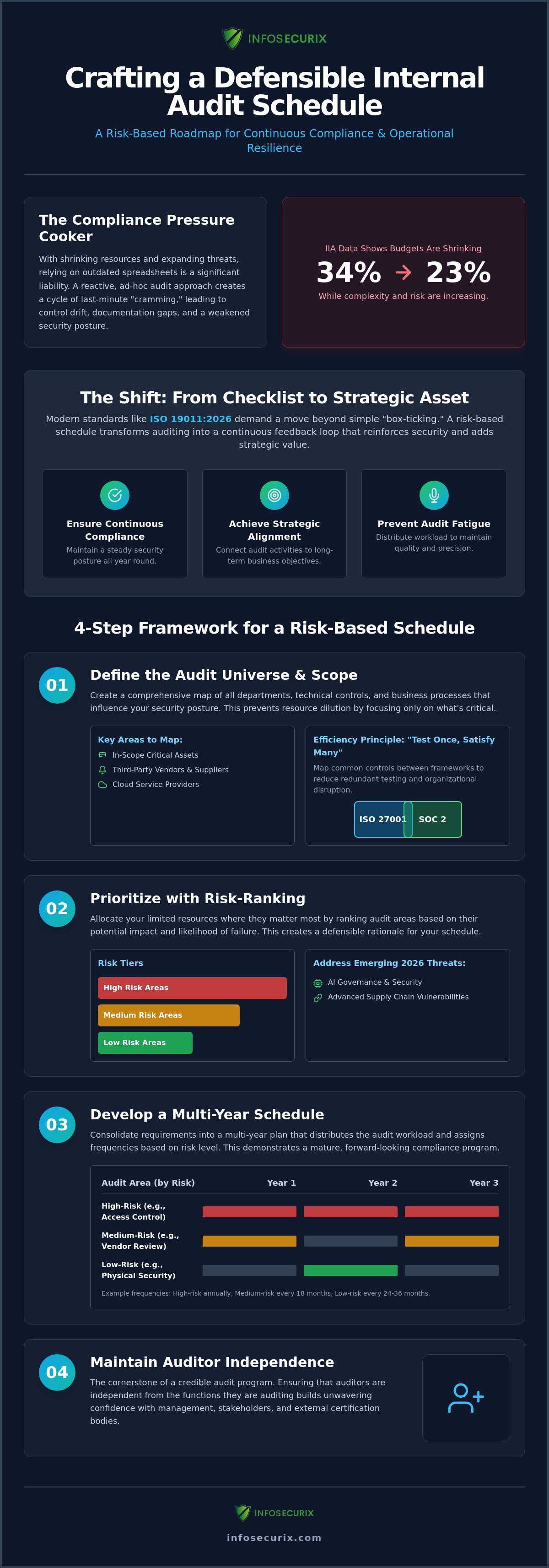
Prioritizing your efforts requires a sophisticated understanding of the current threat environment. Creating an internal audit schedule for 2026 necessitates a shift from traditional cycles to a risk-calibrated approach. This methodology categorizes your audit universe into High, Medium, and Low tiers; it ensures that your most vulnerable controls receive the scrutiny they require. A seasoned guide understands that not all processes are created equal. By ranking them based on impact and likelihood, you transform a generic checklist into a strategic roadmap that safeguards your organization’s most valuable assets.
Balancing the “Audit Budget” is a critical exercise in resource management. You must evaluate whether your team possesses the internal expertise to audit complex technical controls, such as quantum-resistant encryption or automated CI/CD pipelines. This assessment goes beyond simple headcounts: it considers the time, personnel, and technical tools required for each engagement. If your internal resources are stretched, leveraging a partner for independent Internal Audits can provide the specialized knowledge needed to maintain a defensible compliance posture without overwhelming your staff.
Developing a Risk-Based Frequency Model
High-risk areas, such as identity management and access control, typically require quarterly reviews to prevent control drift. Conversely, stable processes with a low impact on the security perimeter might only necessitate biennial oversight. Triggers for “Out-of-Cycle” audits must also be established: these include major system migrations, significant security incidents, or sudden regulatory shifts. Numerical risk scores directly translate into specific audit intervals on the master calendar to ensure that the highest threats receive the most frequent oversight.
Addressing the 2026 Mandatory Topical Requirements
Integrating the latest requirements is essential for maintaining a visionary compliance program. The February 23, 2026, COSO guidance on “Achieving Effective Internal Control Over Generative AI” provides a roadmap for managing the unique risks associated with machine learning models. Your schedule must now account for these AI governance reviews to satisfy modern stakeholder expectations. There is also an increasing emphasis on auditing third-party risk management (TPRM) programs to address advanced supply chain vulnerabilities. Finally, ensure that your business continuity plans are rigorously evaluated for ISO 22301 business continuity compliance to guarantee operational resilience during unforeseen disruptions.
In specialized industrial contexts, these supply chain audits often include verifying the quality and certification of critical hardware components—such as those available at compasswire.com—to ensure that production processes remain compliant with rigorous ISO quality standards.
Step-by-Step: Creating Your Multi-Year Internal Audit Schedule
Transforming a risk assessment into a functional calendar requires a methodical approach that balances regulatory rigor with resource availability. When creating an internal audit schedule, you’re building a multi-year roadmap that serves as a protective force for your organization’s growth. This process begins by consolidating every compliance requirement into a single master list to ensure nothing is overlooked. From there, you must assign a risk-based frequency to each control group, ensuring that high-impact areas receive the attention they deserve. Plotting these audits across a 12-to-36-month horizon prevents resource bottlenecks and provides a clear vision for the future. Once finalized, obtaining executive or audit committee approval formalizes the schedule as an organizational mandate. Finally, establish a quarterly review cycle to update the plan as new threats or system changes emerge.
Executing this roadmap with precision requires a deep-rooted knowledge of how various controls interact within a complex ecosystem. It isn’t just about marking dates on a calendar; it’s about ensuring each audit provides proactive insights that help navigate a shifting landscape. If your internal team is stretched thin by the complexity of these requirements, partnering with a Trusted Advisor for Internal Audits can provide the seasoned expertise needed to refine your schedule and ensure it remains defensible under pressure.
The 12-Month vs. 36-Month Perspective
A rolling 3-year perspective is essential for standards like ISO 27001 that demand a comprehensive review of all controls within a certification cycle. Your first year should prioritize high-risk gaps identified in recent information security internal audits to remediate vulnerabilities immediately. While the 36-month view provides stability, the schedule must remain flexible enough to accommodate emergency “special request” audits triggered by unexpected system changes. This balance between long-term planning and short-term agility is the hallmark of a mature compliance program.
Visualizing the Schedule for Stakeholders
Presenting the schedule to department heads is as much about communication as it is about data. Utilizing Gantt charts or heat maps helps stakeholders visualize the timing and resource requirements of each engagement. Clearly communicating the “why” behind the schedule ensures cooperation from process owners who might otherwise view audits as a disruption. Tracking progress is equally vital. Use a standardized system to document the status of each audit, whether it’s Planned, In-Progress, Completed, or Deferred. This level of transparency builds trust and demonstrates a commitment to meticulous standards across the enterprise.
Executing and Sustaining the Audit Lifecycle
Transitioning from the strategic planning phase to active execution requires a shift in focus from the calendar to the control room. While creating an internal audit schedule provides the necessary structure, the “Audit Kickoff” meeting serves as the catalyst for success. This initial gathering aligns the auditor, process owners, and executive sponsors on the objectives, scope, and timeline of the specific engagement. It establishes an atmosphere of transparency and collaboration: a critical factor in uncovering genuine insights rather than just checking boxes. By clarifying expectations early, you ensure that the audit process is viewed as a value-added exercise rather than a bureaucratic hurdle.
Maintaining absolute auditor independence is the cornerstone of a defensible compliance program. The “Conflict of Interest” trap often ensnares organizations that attempt to audit their own internal processes using the same staff who designed or manage them. This proximity can lead to blind spots and a lack of objectivity that external certification bodies will quickly identify. Leveraging InfoSecurix ensures that your audits are conducted with a seasoned, impartial perspective. Our team brings 25+ years of experience to every engagement, providing the specialized expertise required to execute complex reviews when your internal resources are limited or better utilized elsewhere.
Ensuring Auditor Independence and Competence
Organizations must remain vigilant against the compromise of objectivity. You simply cannot audit your own work and expect the results to hold weight during a high-stakes certification review. Training internal teams on the latest 2026 auditing standards and technical tools is a noble pursuit, yet it often falls short of the depth provided by a dedicated partner. Engaging a cybersecurity internal audit firm provides an impartial, expert-level review that builds unwavering confidence with external assessors. This independent lens is vital for identifying subtle control failures that internal teams might overlook due to familiarity.
Continuous Improvement of the Audit Function
Closing the loop on findings through robust corrective action plans is the final, essential step in the lifecycle. These plans shouldn’t merely address the symptom of a failure; they must target the root cause to prevent recurrence. Post-audit reviews allow your team to evaluate the effectiveness of the audit process itself, identifying areas where the methodology can be refined. Use these insights to update your Risk Assessments and refine next year’s schedule. A resilient organization is one that treats auditing as a continuous journey of improvement, not a static destination.
Elevating Your Organization Through Strategic Oversight
Mastering the intricacies of creating an internal audit schedule is more than a regulatory requirement; it’s a commitment to organizational excellence and long-term resilience. By transitioning from a reactive approach to a risk-calibrated, multi-year roadmap, you ensure that your most critical controls receive consistent and expert scrutiny. This strategic foresight allows your team to navigate the complexities of 2026 requirements, such as AI governance and advanced supply chain security, with absolute poise. A well-constructed schedule doesn’t just satisfy external assessors; it serves as a visionary tool for executive decision-makers to manage risk proactively.
When internal resources are stretched or the technical landscape becomes unfazed by complexity, a seasoned guide can provide the necessary clarity. InfoSecurix brings over 25 years of compliance expertise and a proven record of success in ISO and SOC 2 certifications. We offer a specialized focus on risk-based assurance that empowers your business to grow securely. Partner with InfoSecurix for a Strategic Internal Audit Review to refine your roadmap and future-proof your standards. Your path toward compliance excellence is a journey we are ready to navigate alongside you.
Frequently Asked Questions
How often should an internal audit schedule be updated?
Update your schedule at least once per year or whenever a significant change occurs in your organization’s risk profile. Triggers for a mid-year update include major system migrations, security incidents, or the introduction of new regulatory requirements. This ensures your planning remains aligned with the actual threats facing the enterprise; it prevents the audit function from becoming a static exercise that misses emerging vulnerabilities.
Can one internal audit satisfy both ISO 27001 and SOC 2 requirements?
Yes, you can satisfy both requirements through a single, integrated audit by mapping common controls across both frameworks. This “test once, satisfy many” approach significantly reduces organizational disruption and saves valuable staff time. Creating an internal audit schedule that accounts for these overlaps requires meticulous documentation of the mapping logic to ensure external assessors from both standards accept the evidence provided.
What is the difference between an internal audit plan and an internal audit schedule?
An internal audit plan defines the strategic scope and objectives of the audit function, while the schedule specifies the exact timing and resource allocation for those engagements. Think of the plan as the high-level roadmap and the schedule as the actionable calendar. The schedule transforms the theoretical goals of the plan into a functional timeline that prevents resource bottlenecks and ensures consistent oversight.
Is it mandatory to audit every control every year for ISO 27001?
No, ISO 27001 does not require an annual audit of every single control, provided you cover the entire scope within a full certification cycle. You should prioritize high-risk areas for more frequent review, such as quarterly or bi-annually. Low-risk controls might only appear on your schedule once every two or three years, as long as this frequency is justified by your documented risk assessment.
How do I handle audits if our internal team lacks technical expertise in certain areas?
You should engage a specialized external firm to conduct reviews in areas where your internal team lacks specific technical competence. Auditor competence is a formal requirement under the ISO 19011:2026 guidelines. Bringing in a seasoned partner ensures that complex technical controls, such as AI governance or advanced encryption, receive the expert scrutiny required to maintain a defensible compliance posture.
What should I do if we fall behind on our internal audit schedule?
If you fall behind, prioritize the remaining audits based on their risk level and document the justification for any deferrals. Transparency is essential when facing external certification bodies. Rather than rushing through every task and sacrificing quality, focus on high-impact areas and establish a clear, documented timeline for completing the deferred items in the subsequent cycle.
Who is responsible for approving the internal audit schedule?
Senior management or the audit committee is responsible for the formal approval of the internal audit schedule. This endorsement ensures that the audit function has the necessary mandate and resources to operate effectively across the organization. It also demonstrates a top-down commitment to rigorous standards, which is a key element that external auditors look for during certification visits.
How does the 2026 IIA standard change how we schedule cybersecurity audits?
The 2026 IIA Global Internal Audit Standards demand a more agile, risk-based approach that specifically incorporates mandatory topical requirements like AI governance. Creating an internal audit schedule under these new standards means moving away from rigid, multi-year cycles toward a more dynamic model. Your scheduling must now reflect the rapid pace of technological change and the specific risks associated with generative AI and advanced supply chain vulnerabilities.