

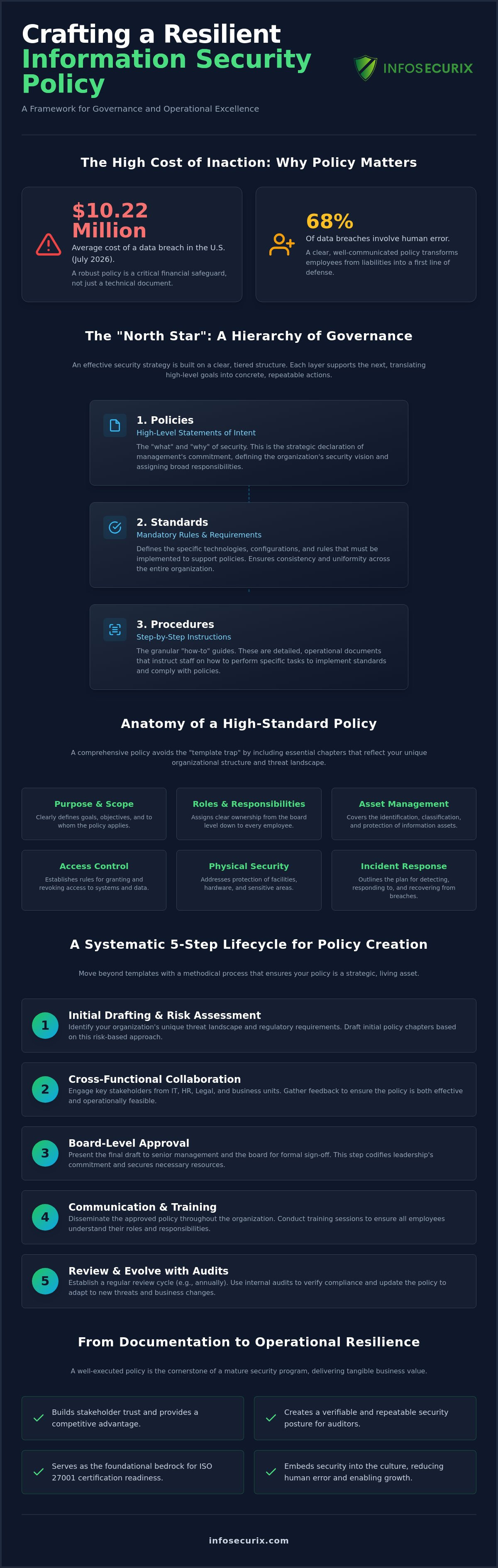
In July 2026, the average cost of a data breach in the United States reached a record $10.22 million. This staggering figure confirms that security isn’t just a technical necessity; it’s a critical component of your organization’s financial health. You likely understand that protecting your enterprise requires a structured approach, yet the process of creating an information security policy often feels overwhelming. It’s common to fear producing “shelfware” that satisfies a checkbox but fails to protect your assets or engage your employees. You need a document that serves as a functional roadmap rather than a bureaucratic hurdle.
This guide provides a sophisticated framework for developing a policy that aligns with international standards like ISO 27001:2022 while enabling business growth. You’ll learn how to move beyond basic documentation to build a resilient security culture that remains steady under pressure. By examining the latest NIST CSF 2.0 “Govern” function and addressing the 68% of breaches that involve human error, we’ll outline a systematic path toward total certification readiness and long-term operational excellence.
Key Takeaways
- Establish your Information Security Policy as a foundational governance document that serves as the “North Star” for all technical controls and corporate behaviors.
- Identify the essential chapters required for creating an information security policy that avoids the “template trap” by reflecting your organization’s unique threat landscape.
- Adopt a methodical 5-step lifecycle to move from initial drafting to board-level approval through structured, cross-functional collaboration.
- Ensure your documentation remains a strategic asset by utilizing professional internal audits to verify compliance and evolve with the shifting global threat landscape.
Understanding the Strategic Role of an Information Security Policy
An Information Security Policy (ISP) serves as the primary governance document that dictates how an organization protects its intellectual property and client data. It isn’t merely a list of rules for the IT department; it’s a strategic declaration of management’s commitment to security. By creating an information security policy, leadership establishes a clear vision that permeates every level of the company. This document functions as a “North Star,” providing a consistent reference point for all technical controls and employee behaviors. It bridges the gap between high-level business objectives and the granular technical realities of the server room. Without this high-level guidance, security efforts remain fragmented and vulnerable to the inconsistencies of individual judgment, which often leads to costly operational gaps.
Modern enterprises are moving away from reactive security models that focus solely on breach response. Instead, they’re embracing proactive, policy-driven resilience. This transition ensures that security is baked into the organizational culture rather than bolted on as an afterthought. A well-defined policy also acts as a powerful trust-builder with external stakeholders. When partners and clients see a comprehensive Information security policy overview within your governance structure, they gain confidence in your ability to safeguard their interests. It signals that you’ve moved beyond basic survival to a state of disciplined excellence. This level of transparency is often the deciding factor in securing high-value contracts and maintaining long-term partnerships in a competitive market.
The Distinction Between Policies, Standards, and Procedures
Clarity in documentation requires understanding the hierarchy of governance. Policies are high-level statements of intent, outlining “what” must be protected and “who” is responsible. Standards serve as the mandatory rules or specific technologies that support those policies; they ensure uniformity across different departments. Finally, procedures provide the granular, step-by-step instructions for implementing those standards. This structured approach prevents confusion and ensures that every team member, from the front desk to the executive suite, understands their specific role in the broader security narrative. It transforms abstract goals into actionable daily habits.
Why Documentation is the Bedrock of Compliance
Auditors view documentation as the primary evidence of management’s intent and oversight. A lack of formal policy often results in inconsistent practices that fail under scrutiny. When organizations pursue ISO 27001 certification readiness, the policy document becomes the cornerstone of the entire management system. It provides the framework for risk management and continuous improvement. Successfully creating an information security policy ensures that your security posture is verifiable, repeatable, and aligned with international best practices. This meticulous approach to documentation doesn’t just satisfy an auditor; it builds a resilient foundation that supports sustainable business growth and protects your most valuable assets from evolving threats.
The Anatomy of a High-Standard Information Security Policy
A high-standard policy is far more than a collection of restrictive rules; it is a curated architectural framework that defines how your organization lives and breathes security. When creating an information security policy, you must ensure that each chapter is constructed with meticulous precision. The document should begin with a clear statement of purpose, followed by sections on asset management, physical security, and incident response. Using sophisticated yet accessible language is vital. If your staff cannot comprehend the requirements, they cannot be expected to follow them. This clarity transforms the policy from a static file into a functional guide that empowers every individual within the enterprise to act as a guardian of the company’s integrity.
Establishing clear roles and responsibilities is the next critical layer of this architecture. The CEO and board members provide the strategic mandate and necessary resources, while the Chief Information Security Officer (CISO) oversees the daily execution. However, the responsibility does not stop at the executive suite. Every entry-level employee must understand their obligation to report suspicious activity and adhere to acceptable use standards. To maintain the integrity of these rules during unusual business requirements, a formal “Exceptions” clause is necessary. This ensures that any deviation from standard protocol is documented, risk-assessed, and approved by the appropriate authority, preventing the policy from becoming an obstacle to innovation. For organizations seeking a tailored approach, engaging with experts for a SOC2 Readiness Assessment can provide the necessary clarity to align these chapters with global standards.
Governance and Scope Definition
Defining the scope is a fundamental step that determines the boundaries of your security influence. You must explicitly state which personnel, networks, and physical locations are governed by the document. This includes addressing modern complexities such as remote work environments and third-party cloud services. By establishing who owns the policy and who has the power to enforce it, you create a chain of accountability that remains steady under pressure. This governance ensures that the policy covers 100% of your critical assets without leaving dangerous blind spots.
Core Security Domains: Access Control and Data Classification
The strength of your internal defense relies heavily on two core domains: access control and data classification. A robust access control policy utilizes the principle of least privilege, ensuring employees only have the specific permissions required for their roles. This limits the potential damage from human error or compromised credentials. Simultaneously, data classification categorizes information into levels such as Public, Internal, or Confidential. This allows you to apply the most rigorous protections to your most sensitive assets. Successfully creating an information security policy requires integrating these digital controls with physical security measures; for instance, partnering with a professional service like 11 Bravo Security can help ensure that badge access and on-site guard protocols are consistently maintained to create a truly comprehensive protective shield.
Risk-Based Policy Development vs. Generic Templates
Many organizations succumb to the “Template Trap,” believing that a downloaded document satisfies their governance needs. This approach often leads to catastrophic audit failures because generic templates cannot account for your specific operational nuances. When creating an information security policy, you must move beyond copy-pasted clauses to build a framework that reflects your actual environment. A bespoke policy doesn’t just check a box; it identifies the specific threats facing your industry and crafts a defense tailored to those realities. It ensures that your security posture is a true reflection of your organizational identity rather than a hollow administrative exercise.
True governance begins with a deep understanding of your vulnerabilities. A strategic information security risk assessment should be the primary driver of your policy requirements. By quantifying your risks, you can prioritize controls that offer the highest protection without imposing unnecessary friction on your team. This balance between rigorous security and operational efficiency is the hallmark of a mature organization. It ensures that your protective measures are proportional to the threats you face, rather than being a blanket of restrictive rules that stifle productivity. This methodical approach instills confidence in both internal teams and external auditors.
Identifying Your Organization’s Unique Threat Profile
Industry-specific regulations like HIPAA, PCI-DSS, or GDPR demand specialized language and specific control sets that a generic template will likely overlook. Tax and accounting professionals, for example, can discover Apex Tech 4 Tax Pros to help create a Written Information Security Plan (WISP) that meets their unique regulatory obligations. You must also analyze your data lifecycle, tracing information from the moment of ingestion through its storage, transmission, and eventual destruction. This granular view ensures that every touchpoint is secured against unauthorized access or accidental disclosure. Each phase of the lifecycle presents unique risks that require targeted policy statements. Risk appetite represents the specific threshold of acceptable loss an organization is willing to tolerate while pursuing its strategic objectives.
Aligning Policy with Business Objectives
A high-level policy should serve as an enabler for growth and innovation, not a barrier. Executive leadership plays a vital role here by establishing the “tone at the top,” signaling that security is a shared value rather than a technical burden. This alignment ensures that security initiatives receive the necessary backing and resources to succeed. When creating an information security policy with this strategic alignment, you transform it into a competitive differentiator. This maturity becomes a powerful asset during rigorous RFP processes, proving to potential clients that your organization is a reliable partner committed to meticulous standards and long-term data integrity.
A Systematic 5-Step Lifecycle for Policy Creation
Establishing a robust governance framework begins with a clear, systematic approach that moves your organization from a blank page to a board-approved mandate. This isn’t a task for the IT department alone; it’s a cross-functional endeavor that requires input from legal, human resources, and operations. By creating an information security policy through a structured lifecycle, you ensure the final document is both legally sound and operationally viable. This process transforms a technical requirement into a foundational pillar of organizational integrity. A policy that lacks executive backing or legal vetting often fails when tested by an auditor or a real-world security incident, making this methodical journey essential for long-term success.
Legal and HR implications are central to the enforcement of any security standard. If a policy is not clearly communicated or lacks a formal approval process, it becomes difficult to hold individuals accountable for violations. You must ensure that the document aligns with existing employment contracts and local labor laws to prevent administrative friction. Successfully creating an information security policy requires a commitment to transparency and a documented trail of acceptance from every member of the team. This disciplined approach instills confidence in stakeholders and provides a steady hand during times of organizational growth or complexity.
Step 1 & 2: Assessment and Drafting
Conducting a rigorous gap analysis against established frameworks like ISO 27001 or SOC 2 provides the necessary baseline for your documentation. This assessment reveals the distance between your current state and the desired level of maturity. Engaging stakeholders from diverse departments ensures the policy is realistic and achievable. Legal counsel must review the language to mitigate liability, while HR ensures the document aligns with corporate culture. Precision is paramount during the drafting phase. You should avoid ambiguous language like “should” or “periodically” because they create loopholes that auditors will exploit. Instead, use definitive directives that establish clear, measurable expectations for everyone.
Step 3, 4 & 5: Review, Approval, and Communication
Stress-testing the draft against real-world scenarios during a peer review phase identifies potential friction points before the policy goes live. Once refined, the document requires formal approval from the executive leadership team. Obtaining these signatures secures the strategic mandate required for organization-wide enforcement. The rollout strategy is the final, critical step. It’s not enough to simply post the document on an internal portal. Every employee must read and formally acknowledge the policy to create a documented trail of accountability. If you’re ready to move from planning to execution, our experts can facilitate your SOC2 Readiness Assessment to ensure your policy meets every technical and administrative requirement.
Transforming Policy from Documentation to Operational Resilience
The journey of creating an information security policy concludes with its integration into daily operations. A policy that exists only as a static file offers no protection; it must become a “living document” that evolves alongside the shifting threat landscape. Maintaining this vitality requires a shift in perspective from administrative compliance to operational resilience. By treating your security documentation as a dynamic framework, you ensure that your protective measures remain relevant as new vulnerabilities emerge. This proactive stance instills a sense of absolute confidence in your stakeholders, demonstrating that your organization is not merely checking boxes but is actively committed to a culture of security awareness. It turns a formal requirement into a strategic asset that enables long-term business growth.
Verifying the effectiveness of these policies is the next essential step in the lifecycle. You cannot manage what you do not measure. This is where the critical role of information security internal audits becomes apparent. These assessments provide the objective evidence needed to confirm that technical controls and employee behaviors align with your stated intent. When violations do occur, they must be handled through a fair and consistent disciplinary process. This ensures that the policy remains credible and respected by all staff members. Partnering with a seasoned guide provides the necessary catalyst for maintaining high standards year-over-year, ensuring your documentation remains a protective force for your enterprise.
The Annual Review and Revision Cycle
Technological advancements, such as the rapid adoption of AI, or updates to standards like ISO 27001:2022 act as immediate triggers for policy updates. You must maintain meticulous version control and historical documentation to provide a clear audit trail for regulators and internal stakeholders. This transparency proves that your security posture is steady and well-constructed. The review cycle is a mandatory cadence, typically performed on an annual basis, to ensure policy relevance and operational accuracy.
Measuring Policy Effectiveness Through Internal Audits
Tracking key performance indicators, such as training completion rates or the frequency of unauthorized access attempts, allows you to quantify policy adherence across the organization. Engaging an independent internal audit firm is often the most effective way to identify hidden blind spots in your implementation. These experts bring a level of precision and comprehensive scope that internal teams may overlook. Closing the loop is the final objective; you must turn audit findings into strategic corrective actions that strengthen your defenses. Successfully creating an information security policy is a continuous cycle of improvement that future-proofs your business against the complexities of the modern digital world.
Future-Proofing Your Enterprise Through Disciplined Governance
Transitioning from a static document to a resilient security culture requires a shift in strategic vision. We’ve explored how moving beyond generic templates toward a risk-based methodology ensures your controls are both proportional and effective. By creating an information security policy that reflects your unique threat profile, you establish a foundation for operational excellence that satisfies auditors and builds deep trust with stakeholders. This commitment to meticulous documentation serves as the bedrock for your organization’s future growth and stability.
Achieving this level of sophistication doesn’t have to be a solitary endeavor. With over 25 years of strategic security guidance, InfoSecurix provides the national expertise required to navigate complex internal audits and risk management. We specialize in developing bespoke compliance roadmaps for ISO 27001 and SOC 2 that align with your specific business objectives. Elevate your security posture with a bespoke InfoSecurix Readiness Assessment today. Secure your legacy by transforming your standards into a powerful competitive advantage. We look forward to partnering with you on this journey toward excellence.
Frequently Asked Questions
What is the primary purpose of an information security policy?
The primary purpose is to provide a high-level governance framework that protects an organization’s information assets and establishes management’s security intent. It serves as the definitive reference for acceptable use, risk management, and data protection standards. By clearly defining these expectations, the document ensures that all technical controls and human behaviors align with the overarching business objectives and regulatory obligations.
How long should an information security policy be?
A security policy should be long enough to cover all critical domains without becoming an unreadable burden. Most effective policies range from 15 to 30 pages, depending on the complexity of the organization’s infrastructure and regulatory landscape. The focus should always remain on clarity and precision rather than page count. A concise, well-structured document is far more likely to be read and followed than an overly granular manual.
Who is responsible for writing the information security policy?
The Chief Information Security Officer (CISO) typically leads the process of creating an information security policy, but it requires a cross-functional effort. Stakeholders from legal, human resources, IT, and operations must contribute to ensure the document is realistic and legally enforceable. Ultimately, executive leadership must review and sign off on the final version to provide the necessary strategic mandate for organization-wide adoption.
How often should a security policy be updated?
You should review and update your security policy at least once a year or whenever significant changes occur within your technological or regulatory environment. Triggers for more frequent updates include the adoption of new tools like generative AI, major shifts in remote work protocols, or the discovery of new industry vulnerabilities. Maintaining this annual cadence ensures that your governance remains relevant and resilient against an ever-evolving threat landscape.
What is the difference between a policy and a procedure?
A policy is a high-level statement of intent that defines “what” must be done and “why,” whereas a procedure provides the step-by-step instructions for “how” to achieve it. Policies establish the rules and responsibilities for the entire organization. Procedures are often department-specific documents that guide technical staff through the actual implementation of those rules. Both are necessary to bridge the gap between strategic vision and daily operational reality.
Can a small business use a security policy template?
Small businesses can use templates as a starting point, but they must customize the content to reflect their specific risk profile and operational needs. Relying solely on a generic template often leads to “shelfware” that fails to address unique vulnerabilities or satisfy rigorous audits. Creating an information security policy that is bespoke to your industry ensures that your protective measures are proportional to the actual threats your business faces.
How do you ensure employees actually follow the security policy?
Ensuring compliance requires a combination of formal training, clear communication, and consistent enforcement. Every employee should be required to read and sign the policy during the onboarding process and again during annual reviews. Utilizing internal audits to track key performance indicators, such as training completion rates, allows management to identify and address gaps in awareness before they lead to a security incident.
Is an information security policy legally required?
While not every business is under a single universal law, most organizations are subject to industry-specific regulations that mandate a formal security policy. Frameworks such as HIPAA for healthcare, PCI-DSS for payment processing, and GDPR for data privacy explicitly require documented security governance. Even without a direct legal mandate, a comprehensive policy is often a prerequisite for obtaining cyber insurance or securing contracts with high-value enterprise clients.