

Your IT department isn’t a cost center; it’s the untapped engine of your enterprise’s competitive advantage. When leadership views service management through the narrow lens of overhead, they miss the transformative benefits of ISO 20000 certification that stabilize operations and fuel growth. Achieving this standard isn’t merely about passing an audit: it’s about establishing a sophisticated framework where IT performance aligns directly with corporate financial objectives.
It’s common to feel the weight of quantifying service management’s intangible gains while navigating the perceived complexity of a formal audit. We’ll bridge that gap by showing you how to build a bulletproof business case that resonates in the boardroom. Drawing on decades of implementation expertise, we’ll provide a clear roadmap for ISO 20000-1:2018, the specific metrics that capture stakeholder attention, and a systematic approach to eliminating the service friction that erodes your bottom line. By the end of this guide, the path from technical compliance to strategic enterprise growth will be unmistakable.
Key Takeaways
- Learn to transition from reactive troubleshooting to a proactive service delivery model that positions IT as a core driver of enterprise growth.
- Unlock the strategic benefits of ISO 20000 certification to reduce operational downtime and eliminate the redundant processes that drain your resources.
- Quantify the financial impact of unmanaged IT services by calculating the hidden costs of service friction and inconsistent delivery.
- Utilize a structured framework to pitch certification to leadership, ensuring your IT initiatives align perfectly with current corporate strategic objectives.
- Discover how a focus on strategic corrective actions, backed by 25 years of veteran expertise, transforms the audit process into a catalyst for business improvement.
Understanding the ISO 20000 Standard: More Than an IT Checklist
Precision defines the modern enterprise. At its core, ISO/IEC 20000 represents the international pinnacle of IT Service Management (ITSM), providing a robust blueprint for organizations to deliver high-quality services consistently. It’s a fundamental shift in philosophy. Rather than operating in a state of perpetual firefighting, certified organizations adopt a proactive stance where service delivery is predictable, measurable, and aligned with business goals. This transition ensures that IT isn’t just reacting to failures but is actively engineering success.
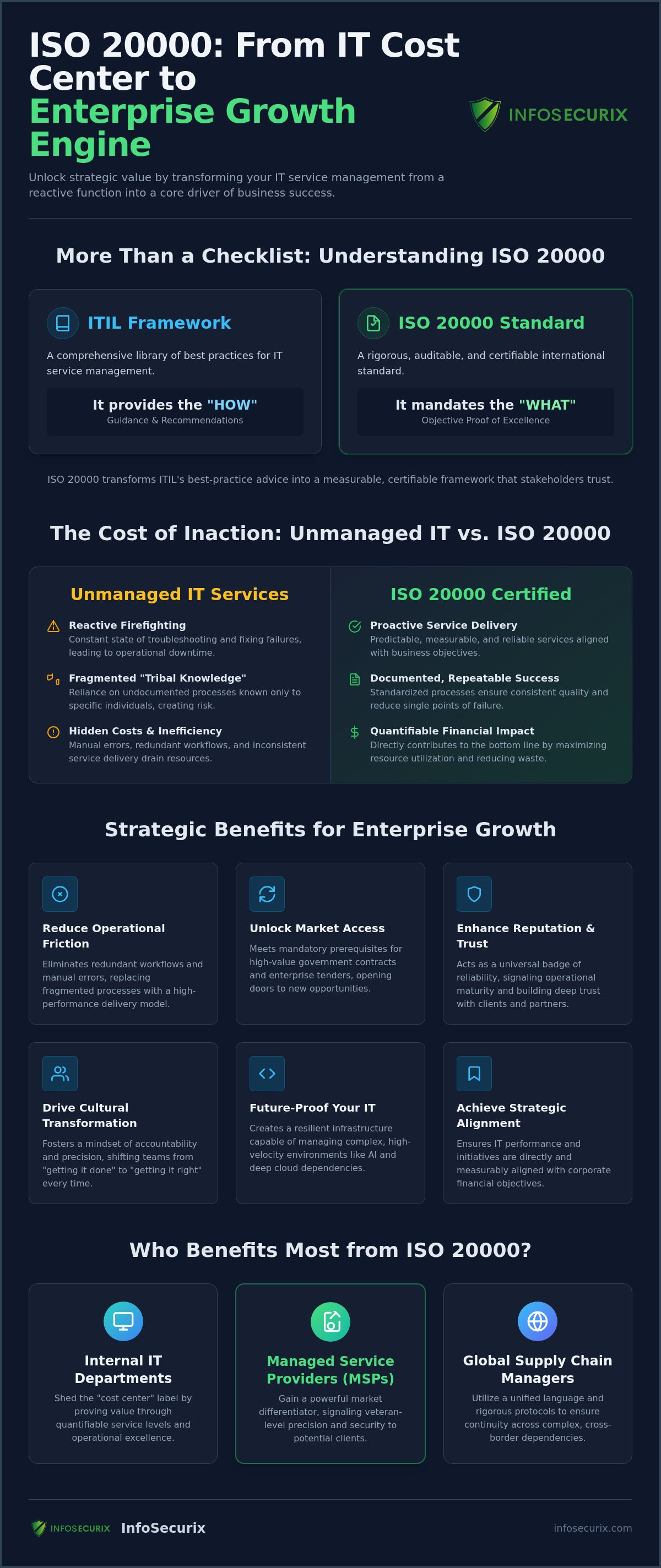
Many leaders confuse this standard with ITIL, but the distinction is vital for your business case. ITIL serves as a comprehensive library of best practices; it provides the “how” for service management. In contrast, ISO 20000 is the rigorous, certifiable standard that mandates the “what.” It provides the objective proof of excellence that stakeholders demand. As we move through 2026, the stakes have never been higher. With the rapid integration of AI and deep cloud dependencies, one of the primary benefits of ISO 20000 certification is the creation of a resilient infrastructure capable of managing these complex, high-velocity environments without sacrificing reliability.
The Core Components of the Standard
The standard is anchored by the Service Management System (SMS). This framework requires deep leadership commitment. It’s not a project for the IT basement but a mandate from the boardroom. It encompasses the entire lifecycle of a service: from initial design and build through to the transition into live environments. A critical pillar here is Continual Service Improvement (CSI). In an environment where technology evolves weekly, CSI ensures your processes don’t just stay compliant; they stay competitive and lean.
Who Needs ISO 20000 Certification?
While any organization can adopt these principles, certain sectors find the benefits of ISO 20000 certification particularly transformative:
- Internal IT Departments: These teams use the standard to shed the cost center label, proving their value through quantifiable service levels and operational excellence.
- Managed Service Providers (MSPs): For these firms, such as ManagePoint, certification is a powerful market differentiator. It signals to potential clients that their data and services are managed with veteran-level precision.
- Global Supply Chain Managers: Companies managing intricate, cross-border dependencies require the unified language and rigorous protocols that ISO 20000 provides to ensure continuity.
This isn’t a simple checklist. It’s a strategic commitment to quality that future-proofs your organization against the complexities of the digital age. By adopting a systematic approach, you replace tribal knowledge with documented, repeatable success.
The Strategic Benefits of ISO 20000 Certification for Enterprise Growth
Enterprise growth relies on the seamless orchestration of IT services. When processes are uncoordinated, the organization pays a hidden tax in the form of manual errors and redundant workflows. One of the primary benefits of ISO 20000 certification is the immediate reduction in this operational friction: it replaces fragmented “tribal knowledge” with a standardized, high-performance delivery model. This precision ensures that every IT resource is utilized to its maximum potential, directly contributing to the bottom line rather than merely supporting it.
Global market dynamics in 2026 have made certification a non-negotiable asset for business development. High-value government contracts and enterprise tenders now frequently list this standard as a mandatory prerequisite. The official ISO 20000 standard acts as a universal badge of reliability, signaling to potential partners that your organization possesses the maturity to manage complex service dependencies. This level of transparency builds deep trust, facilitating faster procurement cycles and opening doors to international markets that remain closed to uncertified competitors.
Cultural transformation is perhaps the most enduring outcome of this journey. Implementing the standard fosters a mindset of accountability and precision within IT teams. Staff move away from a culture of “getting it done” toward a culture of “getting it right” through documented, repeatable success. This shift elevates the internal perception of IT from a troubleshooting department to a strategic partner that leadership can rely on for predictable results. Achieving this level of maturity requires a clear understanding of your current baseline; a professional readiness assessment can often reveal the most direct path to these improvements.
Financial and Operational ROI
ROI in 2026 is defined by the radical reduction of downtime costs and the optimization of existing infrastructure. Standardized processes minimize the cost of quality by preventing the service failures that lead to expensive remediation and lost productivity. By doing more with your current IT assets, you maximize resource optimization and ensure that growth doesn’t require a linear increase in overhead.
Risk Mitigation and Compliance Synergy
Aligning these service protocols with ISO 27001 certification readiness creates a unified posture that protects both service availability and data integrity. This synergy strengthens supply chain resilience by establishing rigorous vendor management standards and clear communication lines. The benefits of ISO 20000 certification also include a significant reduction in the likelihood of Service Level Agreement (SLA) breaches, protecting the organization from the financial penalties and reputational damage associated with inconsistent delivery.
ISO 20000 vs. Unmanaged IT Services: Analyzing the Cost of Inaction
Operating without a centralized Service Management System (SMS) imposes a silent, compounding drain on corporate resources. This “Hidden Tax” of inefficiency manifests through uncoordinated IT changes, where a lack of visibility leads to repeated errors and wasted billable hours. In an unmanaged environment, every minor update carries the risk of a cascade failure. By institutionalizing best practices, one of the most significant benefits of ISO 20000 certification is the transition from individual-dependent results to process-driven reliability. Modern IT service management (ITSM) requires this level of structured control to prevent the fragmentation that occurs when teams operate in silos.
The absence of a formal standard often fosters a “Hero Culture.” In this scenario, the organization relies on the extraordinary efforts of specific individuals to maintain service uptime. While admirable, this model is inherently fragile; it leaves the enterprise vulnerable to “Shadow IT” and knowledge loss when key personnel depart. Transitioning to a “Process Culture” through ISO 20000 ensures that service delivery remains consistent regardless of staffing changes. This stability is essential for maintaining enterprise trust, as inconsistent service delivery rapidly erodes the reputation of the IT department and the broader business it supports. To mitigate this risk, many organizations leverage StatusPulse to provide transparent, real-time status updates that keep stakeholders informed even during service disruptions.
The Cost of Service Downtime in 2026
In a digital-first economy, service outages are no longer technical inconveniences; they are direct hits to revenue and brand equity. ISO 20000 incident management protocols provide the rigorous structure needed to prevent minor glitches from escalating into full-scale crises. While the standard ensures high-quality daily operations, aligning it with ISO 22301 business continuity protocols provides the ultimate safety net for catastrophic service failure. This integrated approach ensures that even during unexpected disruptions, the path to recovery is documented and tested.
Competitive Disadvantage in Tendering
Procurement teams in 2026 have become increasingly sophisticated, using international standards as a primary filter to eliminate vendors who lack formal certification. Organizations that remain “compliance-lite” are often disqualified before the technical evaluation even begins. This creates a measurable gap in win-rates, where certified providers demonstrate a level of maturity that unmanaged services simply cannot match. Beyond lost revenue, failing to meet these international service standards can lead to complex legal and contractual liabilities if service failures impact a client’s critical operations.
How to Pitch ISO 20000 to Leadership: A Step-by-Step Framework
Securing executive buy-in for a major service management initiative requires more than a technical presentation; it demands a clear translation of IT excellence into business value. One of the core benefits of ISO 20000 certification is its ability to bridge the gap between technical operations and executive vision. To succeed, you must move beyond the “how” of the standard and focus entirely on the “why” that resonates in the boardroom. This structured framework helps you build a narrative of resilience and growth.
- Step 1: Align with Strategic Objectives. Connect the implementation directly to this year’s corporate goals, such as market expansion or digital transformation, proving that IT is an enabler, not a bottleneck.
- Step 2: Quantify the ‘As-Is’ State. Use hard data from recent service failures or operational inefficiencies to illustrate the current “friction tax” the company is paying.
- Step 3: Present a Multi-Phased Roadmap. Reduce the perceived risk by breaking the journey into manageable stages, showing that certification is a controlled evolution rather than a disruptive event.
- Step 4: Highlight Compliance Synergy. Demonstrate how this framework strengthens other existing commitments, such as SOC 2 or ISO 27001, creating a unified and efficient compliance posture.
- Step 5: Propose a Low-Risk First Step. Suggest a readiness assessment to identify specific gaps and remediation costs before committing to the full certification audit.
Speaking the Language of the C-Suite
Each executive has a different priority, and your pitch must adapt accordingly. When speaking to the CFO, translate “SLA uptime” into “Revenue Protection” by showing the financial impact of avoided outages. For the COO, frame “Process Standardization” as “Operational Scalability,” explaining how a mature Service Management System (SMS) allows the business to grow without a linear increase in IT headcount. Finally, pitch “Continuous Improvement” to the CEO as “Innovation Readiness.” A stable, well-managed IT environment provides the foundation necessary to adopt emerging technologies like AI with confidence and speed.
Anticipating and Overcoming Objections
Leadership often fears that international standards bring excessive bureaucracy. Address the “Too Much Documentation” myth by emphasizing lean implementation strategies that focus on strategic corrective actions rather than paperwork for its own sake. When cost becomes a hurdle, justify the investment by comparing it to the potential loss from a single major service breach or a failed tender. Using data from a recent information security internal audit can be a powerful way to prove that existing gaps are already costing the company money through inefficiency and risk exposure.
Positioning your organization for success starts with an expert evaluation of your current maturity. You can begin this transformation today by engaging with a seasoned ISO 20000 implementation partner to refine your business case and identify your most critical path to certification.
Strategic Readiness: Partnering with InfoSecurix for ISO 20000 Success
Navigating the complexities of international standards requires a partner who brings both technical proficiency and strategic foresight. InfoSecurix leverages over 25 years of experience in compliance and security to guide organizations through the intricacies of ISO 20000 implementation. We’ve seen nearly every possible service scenario and remain unfazed by the complexity of modern IT environments. Our approach moves beyond the simple mechanics of an audit to focus on strategic corrective actions that drive tangible business value.
When you partner with us, you aren’t just seeking a badge. You’re investing in the long-term benefits of ISO 20000 certification that protect your reputation and operational continuity. Every organization possesses a unique service landscape, so we provide bespoke strategies that respect your specific scope and complexity. Our Readiness Assessment serves as a critical first step, identifying high-risk areas and process gaps before you face a formal audit. This proactive analysis often saves thousands in potential remediation costs by ensuring your framework is robust from the start.
Our Methodical Approach to Implementation
- Phase 1: Comprehensive Gap Analysis and Risk Assessment. We establish your current maturity baseline and identify the most direct path to compliance.
- Phase 2: Documentation Development and Process Alignment. We build a lean, effective Service Management System (SMS) that mirrors your unique business requirements.
- Phase 3: Internal Audit and Final Readiness Verification. We perform a rigorous final check to instill absolute confidence before your formal certification audit.
Future-Proofing Your IT Service Management
Service reliability in 2026 requires a management system that remains unfazed by technical complexity and rapid scaling. The long-term value of a partnership with a cybersecurity internal audit firm lies in our ability to anticipate shifts in the regulatory and technological environment. We ensure your SMS isn’t just compliant today but is engineered to handle tomorrow’s volatility.
By securing the benefits of ISO 20000 certification through a structured, veteran-led process, you transform your IT services into a permanent engine for enterprise growth. Secure your organization’s future today by engaging with a partner committed to your long-term achievement.
Future-Proof Your Enterprise with Service Excellence
Transitioning from unmanaged IT services to a certifiable standard is a strategic pivot that future-proofs your organization. By aligning technical performance with corporate objectives, you replace operational friction with a scalable engine for growth. The core benefits of ISO 20000 certification extend far beyond a successful audit; they manifest in reduced downtime, enhanced stakeholder trust, and a culture of documented precision.
InfoSecurix provides the seasoned guidance necessary to navigate this transformation. With over 25 years of compliance expertise, our boutique, high-touch approach ensures your roadmap is bespoke to your organization’s unique needs. We go beyond simple checklists by delivering strategic corrective action plans that actually improve your business operations across our national network. Take the first step toward operational excellence and schedule your ISO 20000 Readiness Assessment with InfoSecurix today. Your path to a resilient, value-driven IT service management system starts with a single, expert evaluation.
Frequently Asked Questions
What is the primary difference between ISO 20000 and ITIL?
ISO 20000 is the formal, certifiable standard that mandates specific requirements, whereas ITIL is a best-practice framework offering guidance on how to manage services. You can be certified against ISO 20000, but you cannot be certified as an organization against ITIL. Many enterprises use ITIL processes as the vehicle to meet the rigorous benchmarks required for certification success.
How long does the ISO 20000 certification process typically take?
The journey typically ranges from six to eighteen months depending on your current process maturity. This timeline accounts for the initial gap analysis, documentation development, and the mandatory period of operating the system to generate evidence for the auditor. Organizations with existing ITIL-aligned processes often find they can navigate this path toward the lower end of that range.
Can a small business achieve ISO 20000 certification efficiently?
Small businesses can achieve certification efficiently by defining a narrow, high-value service scope. Focusing on a specific client project or a single core service prevents the implementation from becoming an administrative burden. This targeted approach allows smaller teams to realize the benefits of ISO 20000 certification without overextending their internal resources or sacrificing operational agility.
Is ISO 20000 certification mandatory for IT service providers in 2026?
Certification is not a legal mandate for IT service providers in 2026. However, it has become a de facto requirement for participating in global procurement and high-stakes government tenders. Without this badge of reliability, service providers often find themselves filtered out of lucrative contracts during the initial pre-qualification phases where maturity is a primary selection criterion.
What are the hidden costs of failing an ISO 20000 audit?
Failing an audit incurs significant hidden costs beyond the immediate re-examination fees. The most damaging impact is often the delay in securing new contracts that require proof of certification. Internal teams also face the “emergency tax” of rapid remediation, which pulls key personnel away from revenue-generating projects to fix process gaps under high-pressure deadlines.
How does ISO 20000 integrate with ISO 27001 for information security?
Both standards share the Annex SL high-level structure, making integration seamless and efficient. While ISO 27001 secures the confidentiality and integrity of your data, ISO 20000 ensures the availability and performance of the services that deliver that data. Combining these frameworks creates a unified management system that protects the organization from both security breaches and service failures.
What is the role of a readiness assessment in the certification journey?
A readiness assessment serves as a strategic diagnostic tool that identifies critical gaps before the formal certification body arrives. It provides a clear, prioritized roadmap for corrective actions, ensuring that your resources are focused on the most impactful improvements. This preliminary step is essential for reducing the risk of audit failure and saving thousands in potential remediation costs.
How often does an organization need to undergo re-certification for ISO 20000?
Certification follows a three-year cycle. After the initial successful audit, your organization will undergo annual surveillance audits to verify that the service management system is being maintained and improved. At the end of the third year, a more comprehensive re-certification audit is performed to renew the certificate for another three-year period, ensuring your standards remain current.