
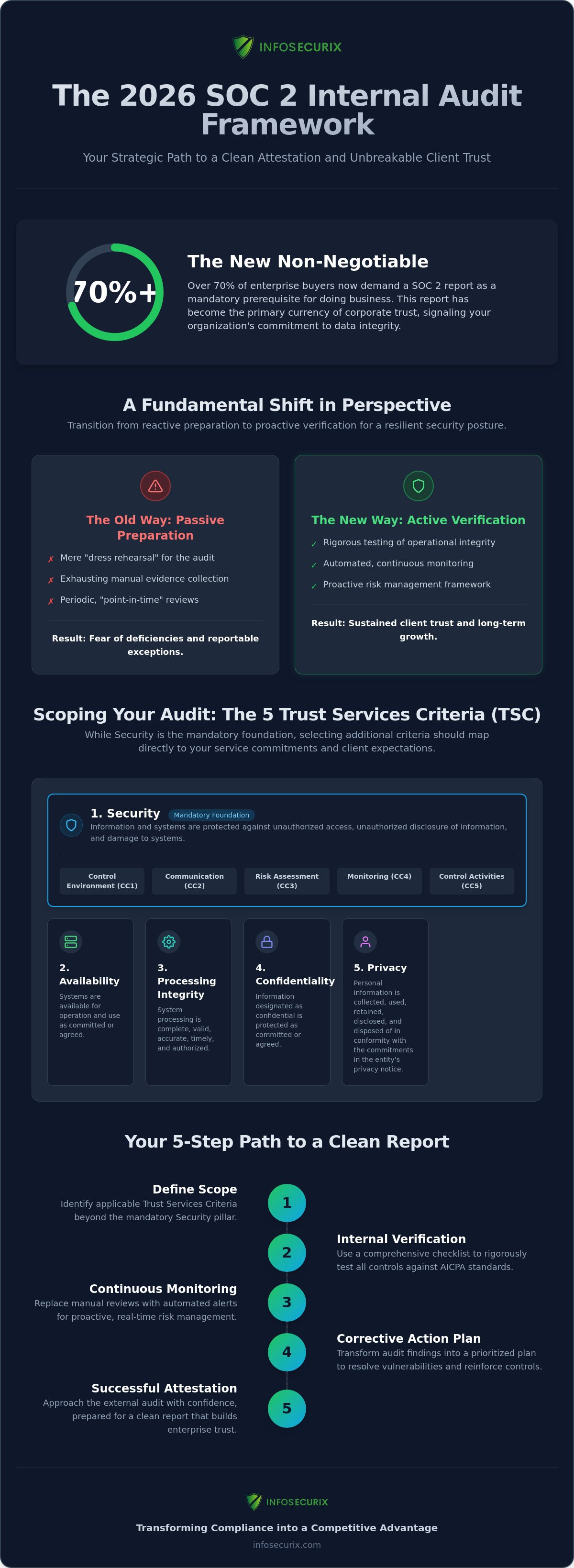
Over 70% of enterprise buyers now demand a SOC 2 report as a non-negotiable prerequisite for doing business. In 2026, this requirement has evolved into the primary currency of corporate trust: a definitive signal that your organization treats data integrity with the gravity it deserves. We recognize the pressure this creates for leadership teams. The ambiguity of selecting the correct Trust Services Criteria, coupled with the exhausting nature of manual evidence collection, often leads to a pervasive fear of deficiencies in the final report.
Our SOC 2 internal audit checklist serves as your strategic framework to eliminate this uncertainty. By treating the internal review not as a mere dress rehearsal but as a rigorous verification of operational resilience, you ensure your firm is prepared for a clean attestation. This guide provides a methodical path forward: we’ll examine the critical controls required for 2026, explore ways to streamline your internal processes, and establish the groundwork for a successful Type 2 audit. Through this structured approach, you’ll transform compliance from a burden into a powerful engine for client trust and long-term growth.
Key Takeaways
- Define the boundary between internal verification and the final CPA attestation: a critical step to maintaining an objective view of your security posture.
- Identify which Trust Services Criteria apply to your operations: beginning with the mandatory Security pillar before assessing the necessity of Privacy or Availability.
- Deploy a professional SOC 2 internal audit checklist to verify that your board-level governance and annual risk assessments meet 2026 standards.
- Shift from periodic reviews to a continuous monitoring framework: replacing manual evidence fatigue with automated alerts for proactive risk management.
- Transform audit findings into a prioritized corrective action plan that resolves complex vulnerabilities and reinforces enterprise trust with your clients.
Defining the SOC 2 Internal Audit: Verification vs. Preparation
A successful compliance journey begins with a fundamental shift in perspective: viewing the internal audit not as a rehearsal, but as a definitive verification of your operational integrity. This process aligns your internal standards with the broader requirements of System and organization controls (SOC), ensuring every technical and administrative control is scrutinized with the same rigor an external CPA would apply. In 2026, regulatory expectations have moved beyond simple snapshots. Organizations now face a landscape where “point-in-time” checks aren’t sufficient to satisfy enterprise clients who demand evidence of sustained, resilient security practices.
Implementing a comprehensive SOC 2 internal audit checklist allows your leadership team to transition from passive preparation to active verification. Preparation involves the design and implementation of controls; the internal audit involves the relentless testing of those controls to ensure they function as intended. This phase serves as your primary defense against reportable exceptions. By identifying control gaps early, you gain the opportunity to implement corrective actions long before the final attestation begins, protecting your organization from the reputational damage of a qualified opinion.
The Strategic Value of Internal Verification
The value of an independent internal review extends far beyond the audit report itself. It fosters a robust culture of accountability across departments, particularly within IT and HR, where data security must be woven into daily workflows. When these teams participate in the internal audit, they develop a deeper understanding of their role in the organization’s broader security narrative. Beyond the immediate compliance benefits, a disciplined internal process directly impacts your bottom line. External auditors often find that a well-documented internal verification allows them to work more efficiently. This often leads to reduced overall certification costs and a significantly smoother path to the final report.
Internal vs. External Audits: Closing the Trust Gap
Understanding the relationship between internal and external reviews is essential for any executive. The internal auditor acts as a “Seasoned Guide” or “Trusted Advisor” to the board, providing an unfiltered view of the organization’s risk posture. While the external CPA provides the final, independent attestation, their confidence is built upon the foundation of your internal verification. Transitioning from a preliminary readiness assessment to a formal internal audit marks a critical milestone in maturity. While a readiness assessment identifies what you need to do, the execution of your SOC 2 internal audit checklist provides the empirical evidence that your controls are mature, documented, and consistently effective.
Scoping the Five Trust Services Criteria (TSC)
Determining the scope of your audit is a pivotal decision that dictates the complexity and duration of your compliance journey. While the Security criterion is the mandatory foundation for every report, selecting additional criteria should be a deliberate act of mapping your business objectives to client expectations. A well-constructed SOC 2 internal audit checklist ensures you don’t overlook the “Points of Focus” established by the AICPA. These points are not rigid requirements; they are interpretive guideposts that auditors use to evaluate whether a control effectively meets a specific criterion.
Success in this phase requires an objective analysis of your service commitments. Research indicates that over 70% of enterprise buyers now require these reports, and they often look beyond basic security to ensure their specific risks are mitigated. If your platform manages high-volume financial transactions or sensitive personal data, simply meeting the Common Criteria might leave a trust gap. Scoping correctly from the outset prevents the need for costly mid-audit adjustments. When you engage in a SOC2 Readiness Assessment, defining these boundaries becomes the first step in building a resilient compliance posture.
The Common Criteria: Security and Beyond
The Security category, often referred to as the Common Criteria, incorporates the COSO framework principles (CC1-CC5). These five pillars address the control environment, communication, risk assessment, monitoring, and existing control activities. Your internal review must verify that logical and physical access controls are robustly implemented. This means looking past simple password policies to evaluate how your organization manages identity and system operations. Documented change management policies are equally vital: auditors expect to see a clear trail of how code or infrastructure changes are requested, tested, and approved.
Determining Optional Criteria for Enterprise Clients
Selecting optional criteria depends entirely on your service commitments and the nature of the data you handle. For B2C service providers, the Privacy criteria are often essential to demonstrate how personal information is collected, used, and retained. Financial and data-heavy platforms typically require Processing Integrity to prove that system processing is complete, valid, authorized, and accurate. Finally, SaaS providers with strict Service Level Agreements (SLAs) should prioritize the Availability criterion. This validates that systems are available for operation and use as committed, providing the transparency your clients need to trust your infrastructure.
The Comprehensive SOC 2 Internal Audit Checklist for 2026
Moving from the scoping phase into active verification requires a shift from theoretical planning to empirical testing. While many organizations confuse readiness with auditing, a true internal audit demands formal evidence that your controls are currently functioning as intended. This SOC 2 internal audit checklist serves as your strategic framework for this verification. It’s designed to ensure that when an external CPA begins their fieldwork, they find a mature environment where every security claim is backed by accessible, verifiable data.
Your internal review must prioritize the following foundational areas to ensure complete alignment with 2026 standards:
- Governance and Oversight: Verify that the Board of Directors or a dedicated security committee is actively reviewing security risks. You must provide meeting minutes or formal reports that demonstrate leadership’s involvement in the oversight of the control environment.
- Risk Management: Confirm that a formal, comprehensive risk assessment was conducted within the last 12 months. This assessment should identify internal and external threats, evaluate the likelihood of occurrence, and document the specific controls implemented to mitigate those risks.
- Logical Access: Audit your user access reviews to ensure the principle of least privilege is strictly enforced. This involves verifying that access is granted based on job necessity and that orphaned accounts from terminated employees are removed immediately.
- Incident Response: Test the effectiveness of your disaster recovery and incident response plans. It’s not enough to possess a written policy; you must document a tabletop exercise or a live test that proves your team can respond to and recover from a security event within your committed timelines.
Administrative and Physical Control Verification
Administrative controls form the backbone of your organizational security culture. During your internal audit, you should review employee background checks and non-disclosure agreements (NDAs) to ensure they’re complete for all current staff and contractors. Additionally, verify the physical security of your infrastructure: if you utilize cloud providers, you must collect and review their latest SOC reports to ensure their data center controls meet your standards. Finally, check the status of security awareness training. Auditors expect to see completion rates approaching 100% to validate that your workforce is prepared to identify modern threats.
Technical and Operational Control Testing
Technical verification focuses on the systems that protect your data assets. Your SOC 2 internal audit checklist should include a deep dive into encryption standards, ensuring data is protected both at rest and in transit using industry-standard protocols. You must also test your vulnerability management program: verify that scans are performed regularly and that patch deployment cycles align with your internal policies. Operational integrity is further confirmed by auditing system changes. Every infrastructure or code change must follow a formal, approved workflow that includes testing, peer review, and management authorization before deployment.
Continuous Monitoring for SOC 2: Beyond the Checklist
While the SOC 2 internal audit checklist provides a necessary baseline for verification, the dynamic threat landscape of 2026 demands a shift toward continuous monitoring. Periodic reviews are no longer enough to satisfy enterprise partners who require real-time assurance of your security posture. Continuous monitoring transforms compliance from a seasonal burden into an ongoing operational strength. This approach is the fundamental differentiator for a successful Type II audit, which examines control effectiveness over a sustained period of 3 to 12 months. It provides the empirical proof that your organization doesn’t just have controls on paper, but lives by them every day.
Adopting a model of continuous oversight allows your security team to remain proactive rather than reactive. By integrating automated checks into your environment, you achieve several strategic advantages:
- Implement automated alerts for control failures: Immediate notification of unauthorized access attempts or configuration drift ensures rapid remediation before a minor issue becomes a reportable deficiency.
- Leverage real-time dashboards: Centralized visibility allows leadership to monitor compliance health at a glance, providing the board with absolute confidence in the firm’s security status.
- Automate evidence logging: Continuous data collection eliminates the manual fatigue associated with traditional audit preparation, ensuring that your SOC 2 internal audit checklist is always backed by current data.
The Shift to Continuous Compliance
Manual evidence collection is no longer sufficient to maintain enterprise trust in a world of rapid deployment and cloud-native infrastructure. Integrating compliance monitoring directly into your DevSecOps pipeline ensures that security is a constant feature of your development lifecycle rather than an afterthought. Automated logs serve as an indisputable record for external auditors, providing the granular detail they need to validate your controls without disrupting your team’s productivity. This evolution from “point-in-time” to “always-on” verification is what separates industry leaders from those merely trying to pass an audit.
Strategic Implementation of Monitoring Tools
Selecting the right technological stack is essential. You must choose tools that map directly to your chosen Trust Services Criteria, whether you are focusing on Security, Availability, or Privacy. Implementing “compliance as code” helps prevent configuration drift by automatically enforcing security parameters across your entire environment. This proactive stance is a core component of Mastering Information Security Internal Audits. By embedding these checks into your daily operations, you ensure that your internal verification remains a living process that reflects a truly resilient organization. This level of maturity signals to your clients that you are a visionary partner committed to future-proofing their data against emerging risks.
If you’re ready to move beyond manual processes and establish a model of persistent oversight, our team can help you design a robust Internal Audit strategy tailored to your specific operational needs.
Navigating Corrective Actions with InfoSecurix
Completing your SOC 2 internal audit checklist is a significant milestone, yet the true value of the process lies in how your organization interprets and acts upon the findings. Transforming raw data into a prioritized corrective action plan is the bridge between identifying a vulnerability and achieving operational excellence. This phase requires a methodical approach to remediation: focusing first on high-risk gaps that could lead to a qualified opinion in your final report. By establishing a clear roadmap for improvement, you ensure that your organization doesn’t just meet the minimum requirements, but builds a culture of sustained security and resilience.
Positioning your SOC 2 report as a competitive advantage requires more than a checkbox mentality. In the national marketplace, a clean attestation serves as a powerful signal of enterprise trust, allowing you to accelerate sales cycles with sophisticated clients. Leveraging the insights gained during your internal review allows you to future-proof your business, turning compliance from a technical hurdle into a strategic asset. When you approach the final attestation with a fully remediated environment, you project the image of a seasoned leader who remains calm under the scrutiny of external auditors.
From Audit Findings to Strategic Remediation
Categorizing your findings is the first step toward effective resolution. You must distinguish between “non-conformities,” which represent a direct failure to meet a Trust Services Criterion, and “opportunities for improvement,” which are suggestions to enhance existing mature processes. Assigning clear ownership for each corrective action ensures that technical or administrative gaps don’t linger in the transition between the internal review and the final CPA attestation. This disciplined execution is further explored in The Strategic SOC 2 Readiness Checklist, which outlines the path to building long-term enterprise trust.
Partnering for Long-Term Compliance Success
Navigating the evolving SOC 2 landscape is a complex undertaking that benefits from the guidance of a “Seasoned Guide.” InfoSecurix brings over 25 years of information security experience to every engagement, specializing in the development of strategic corrective action plans that address even the most complex vulnerabilities. Our fixed-fee engagement model provides your organization with predictable compliance budgeting, eliminating the uncertainty often associated with professional services. By partnering with experts who have seen every possible scenario, you gain a collaborative ally invested in your long-term success. We invite you to secure your enterprise trust with a SOC 2 Readiness Assessment and transform your SOC 2 internal audit checklist into a foundation for growth.
Future-Proofing Your Enterprise Trust
Achieving a clean SOC 2 attestation is a milestone that signals mature operational integrity to your most discerning clients. By moving from simple preparation to a rigorous verification of your control environment, you ensure that your organization remains resilient in an increasingly complex regulatory landscape. We’ve explored how a professional SOC 2 internal audit checklist serves as the foundation for this journey: enabling you to identify gaps early and transition toward a model of continuous, automated monitoring. It’s a proactive stance that doesn’t just prepare you for an auditor; it builds a culture of security that drives long-term growth.
Success requires more than a checklist; it demands the insight of a partner who has navigated these complexities for decades. InfoSecurix provides the clarity you need through comprehensive internal audit reports and strategic corrective action plans designed to resolve vulnerabilities permanently. With over 25 years of compliance expertise, we stand ready to guide your team through every phase of the process. Partner with InfoSecurix for a Strategic SOC 2 Readiness Assessment and transform your compliance requirements into a definitive competitive advantage. Your path to enterprise trust is clear.
Frequently Asked Questions
Is an internal audit mandatory for SOC 2 compliance?
An internal audit is not explicitly mandated by the AICPA as a standalone document, yet it’s practically essential to satisfy the monitoring requirements of the Common Criteria. It provides the empirical evidence of control effectiveness that external auditors expect to see before issuing an attestation. Without this independent review, your organization lacks the formal verification needed to ensure the final report remains free of significant deficiencies or qualified opinions.
What is the difference between a SOC 2 internal audit and a readiness assessment?
A readiness assessment focuses on identifying which controls you need to implement, whereas an internal audit verifies that those controls are currently operational and effective. Think of the assessment as a strategic gap analysis and the internal audit as a formal test of the environment. Using a SOC 2 internal audit checklist during this phase ensures that your verification process mirrors the rigor of the final CPA attestation, providing absolute confidence.
How often should we perform a SOC 2 internal audit?
Organizations should perform a formal internal audit at least annually to maintain compliance and prepare for re-certification fieldwork. However, as enterprise requirements evolve in 2026, many high-growth firms are shifting toward a semi-annual or quarterly cadence. This more frequent schedule allows for the early detection of configuration drift. It ensures that your security posture remains aligned with the dynamic nature of modern cloud environments and strict service level commitments.
Can we perform our own SOC 2 internal audit or do we need a consultant?
You can technically perform an internal audit using internal staff, provided they remain independent of the specific functions they are auditing. However, most firms find that internal teams lack the specific expertise or objectivity required for a truly rigorous review. Engaging an external partner ensures that the audit is conducted with a high level of professional skepticism. This significantly reduces the risk of overlooked control failures that could compromise your final report.
What happens if we find significant control gaps during the internal audit?
Finding gaps is a positive outcome of the internal audit process because it allows for remediation before the external fieldwork begins. Once a deficiency is identified, your team should develop a prioritized corrective action plan to address the root cause. This proactive approach demonstrates to external auditors and enterprise clients that your organization possesses a mature, self-correcting security culture. It proves you’re capable of managing complex risks without external pressure.
How long does a typical SOC 2 internal audit take for a mid-sized firm?
A typical internal audit for a mid-sized organization generally spans two to four weeks, depending on the scope of the Trust Services Criteria selected. This timeline includes the initial planning phase, evidence collection, control testing, and the delivery of a formal report. Larger enterprises or those with complex multi-cloud environments may require additional time to ensure a comprehensive verification. This thoroughness is essential to provide a clear roadmap for any necessary remediation.
What is continuous monitoring for SOC 2 and why is it important for Type II?
Continuous monitoring involves using automated tools to track control effectiveness in real time rather than at a single point in time. It’s vital for Type II audits because they assess your controls over a period of 3 to 12 months. By implementing automated alerts and dashboards, you ensure that your SOC 2 internal audit checklist is perpetually satisfied. This provides the sustained evidence required for a clean, long-term attestation that builds enterprise trust.
How much does a SOC 2 internal audit cost?
The cost of an internal audit depends on the size of your environment and the number of Trust Services Criteria included in the scope. While industry averages for total compliance vary, we focus on a fixed-fee model that ensures predictable budgeting for your organization. This approach eliminates the uncertainty often found in professional services. It allows you to focus on the strategic value of the corrective action plans rather than fluctuating hourly rates.