
Compliance shouldn’t be a cage that slows your operations: it’s the high-performance engine that drives enterprise resilience. Most IT leaders view certification as a hurdle to clear rather than a foundation to build upon. It’s common to feel paralyzed by the dense technical language of ISO/IEC 20000-1:2018, or to fear that a single missing document could derail your entire audit. You aren’t alone in wanting to balance operational speed with the strict demands of global compliance. This guide introduces a strategic ISO 20000 requirements checklist that replaces uncertainty with a clear, actionable path toward IT service excellence.
We’ll show you how to master the complex requirements of the 2018 standard while future-proofing your organization for 2026 and beyond. By focusing on value creation and service outcomes, you can turn a mandatory compliance exercise into a powerful tool for business alignment. You’ll gain the confidence to lead your team through the certification process, armed with a roadmap that covers everything from leadership responsibilities to the latest guidance on service integration. Let’s move beyond basic adherence and start building a service management system that protects your growth and secures your legacy.
Key Takeaways
- Understand the strategic shift from traditional IT management to a holistic Service Management System (SMS) within the ISO 20000-1:2018 framework.
- Secure executive buy-in and organizational alignment by focusing on the leadership and context requirements outlined in Clauses 4 through 7.
- Master the operational “doing” phase of your certification journey with a detailed ISO 20000 requirements checklist focused on Clause 8 and service portfolio lifecycles.
- Streamline your audit preparation through a methodical roadmap that prioritizes a comprehensive gap analysis and the development of a robust service management plan.
- Transform compliance from a technical hurdle into a strategic asset that drives operational resilience and long-term enterprise trust.
What is ISO 20000 and Why Does Your Organization Need It in 2026?
Achieving a global standard for service excellence requires more than just good intentions: it demands a rigorous framework that aligns technical output with business value. ISO/IEC 20000-1:2018 stands as the definitive international requirement for a Service Management System (SMS). While earlier versions focused heavily on the mechanics of IT, the 2018 revision signaled a transformative shift toward general service management. This evolution recognizes that modern service delivery is no longer confined to the server room; it’s an enterprise-wide responsibility that impacts every stakeholder.
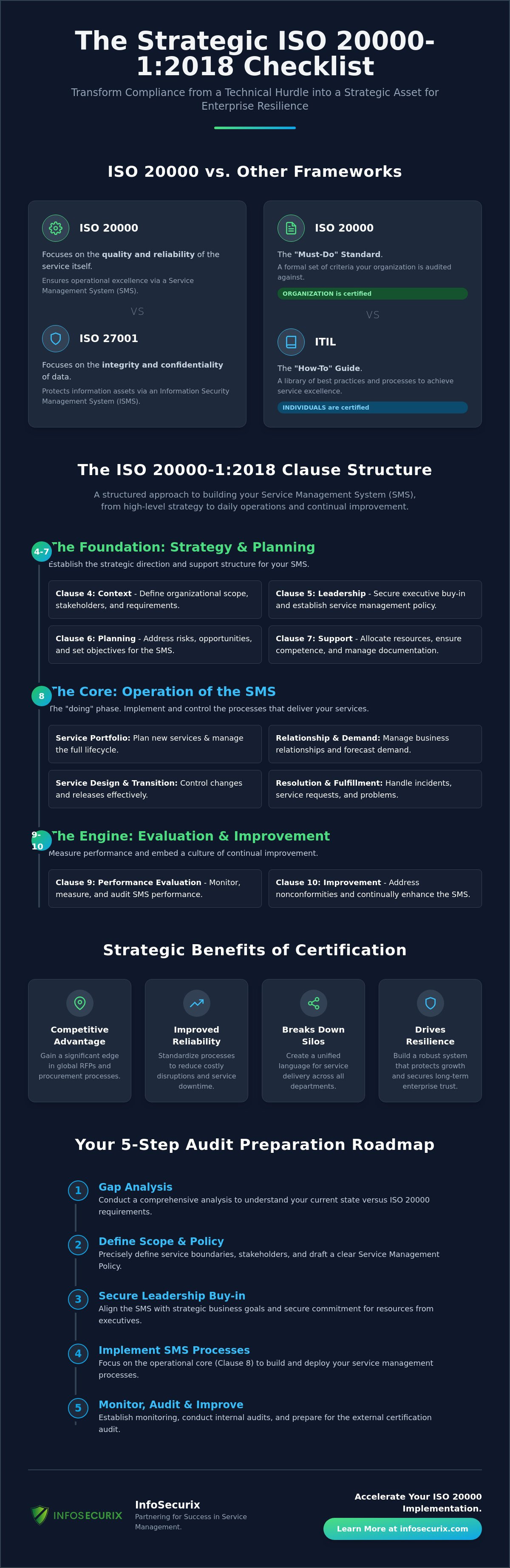
As we move through 2026, the relevance of this standard has reached a critical peak. We’re operating in an era of AI-driven service desks and hyper-automated IT operations where human oversight is often abstracted. Certification provides the necessary assurance that these automated processes are governed, measured, and consistently improved. It’s also vital to distinguish this from security-focused frameworks. While ISO 27001 protects the integrity and confidentiality of your data, ISO 20000 ensures the reliability and quality of the service itself. Utilizing a comprehensive ISO 20000 requirements checklist helps organizations bridge the gap between technical security and operational excellence.
The Strategic Benefits of Certification
Certification isn’t just a badge: it’s a strategic differentiator. Organizations that meet these rigorous standards enjoy a significant competitive advantage during global RFP and procurement processes where proof of service quality is mandatory. Beyond external perception, the internal benefits are profound. Standardizing incident and change management leads to improved service reliability and fewer costly disruptions. A unified SMS breaks down operational silos, ensuring that every department speaks the same language of service delivery and performance.
ISO 20000 vs. ITIL: Understanding the Relationship
Confusion often arises regarding the relationship between ITIL and ISO 20000. It’s simplest to think of ITIL as the “how-to” guide: a library of best practices and processes. In contrast, ISO 20000 is the “must-do” standard: the formal criteria against which an organization is audited. You can use ITIL processes to satisfy many of the items on your ISO 20000 requirements checklist, but they aren’t interchangeable. There’s also a clear distinction in certification: individuals become ITIL certified, while entire organizations achieve ISO 20000 certification. This organizational commitment proves your service management maturity to the world.
Core ISO 20000 Requirements: Clauses 4 through 7
Establishing a high-performance Service Management System (SMS) begins with a clear understanding of your organizational landscape. Clause 4 requires you to define the context of your organization: identifying the internal and external factors that influence your ability to deliver services. This isn’t a mere administrative task. It’s the moment you determine exactly what your certification will cover. Closely following this is Clause 5, which emphasizes leadership. Executive buy-in remains the primary success factor for any implementation. Leaders must demonstrate commitment by ensuring the service management policy and objectives are established and aligned with the strategic direction of the business. True leadership goes beyond documentation. It requires active engagement in resource allocation and the promotion of a culture focused on continual improvement.
Defining Your SMS Scope
Precision in scoping determines the longevity and utility of your SMS. You must identify specific services, customers, and physical or logical locations included in your certification journey. A well-drafted Service Management Policy serves as your declaration of intent. It’s a fine balance: a scope that is too narrow provides little value to the enterprise, while one that is too broad becomes unmanageable during the audit process. Your ISO 20000 requirements checklist should prioritize this boundary-setting to avoid scope creep. Consider these elements carefully:
- Service Boundaries: Define which technical and business services are included.
- Stakeholder Needs: Identify the requirements of customers and interested parties.
- Organizational Interfaces: Clarify how different departments interact within the SMS.
The Planning and Support Pillars
Clause 6 focuses on proactive planning. You must address risks and opportunities that could impact the SMS, frequently aligning these efforts with established Information Security Risk Assessment principles. This ensures that service delivery remains resilient even under pressure. Clause 7 then provides the necessary support structure: resources, competence, and awareness. Every team member must understand their specific role within the SMS to maintain compliance. Integrating these elements into your ISO 20000 requirements checklist ensures no support pillar is overlooked. Documentation is equally critical. The standard distinguishes between ‘maintaining’ documented information, such as policies, and ‘retaining’ documented information: the records and evidence generated by your processes.
Understanding the nuances of ISO/IEC 20000-1:2018 requirements allows you to build a system that is both robust and flexible. If you find the documentation requirements overwhelming, engaging with a seasoned guide for a risk assessment can reveal hidden gaps before the official certification body arrives. This methodical approach ensures your foundation is steady before moving into the operational core of the standard.
The Operational Core: Clause 8 Requirements Checklist
Clause 8 is the engine room of the SMS: it’s where strategic policies transform into tangible service delivery. While previous sections focused on the “why” and “who,” this clause defines the “how” through a rigorous set of process requirements. As the international standard for IT service management, ISO 20000 demands that every stage of the service lifecycle is documented and controlled. Your ISO 20000 requirements checklist must prioritize Service Portfolio Management: ensuring you have clear records of services from their initial pipeline stage through to active delivery and eventual retirement. This lifecycle approach ensures that no service exists in a vacuum and that resource allocation remains aligned with business needs.
Relationship management is another vital pillar of this clause. You’re required to maintain formal business relationship management processes to gauge customer satisfaction, alongside robust supplier management to ensure third-party performance aligns with your internal standards. Service Level Management acts as the glue here: mandating a clear structure of Service Level Agreements (SLAs), Operational Level Agreements (OLAs), and Underpinning Contracts (UCs). These aren’t just administrative documents; they’re the benchmarks for your operational integrity and the primary evidence auditors will examine to verify your service commitments.
This level of control is especially vital when working with external partners, where Managed IT Services and SOC monitoring can provide the continuous oversight and documented evidence needed to satisfy stringent audit requirements.
Service Operations and Control
Configuration Management serves as the single source of truth within your environment. Maintaining an accurate Configuration Management Database (CMDB) is a mandatory requirement that prevents blind spots during service delivery. Closely linked is Change Management, which requires a formal process to balance the need for speed with the necessity of risk mitigation. Every change must be evaluated, approved, and recorded to maintain a clear audit trail. Finally, Release and Deployment processes ensure that new or changed services transition into the live environment without disrupting existing operations. A high-quality ISO 20000 requirements checklist will include specific verification steps for each deployment to ensure stability and minimize the risk of unforeseen outages.
Resolution and Fulfillment Processes
The standard places heavy emphasis on how you handle disruptions and everyday requests. Incident Management focuses on restoring normal service as quickly as possible to minimize business impact. For standard, low-risk needs, Service Request Management provides a streamlined path for fulfillment that keeps your team productive. However, the true mark of a mature SMS is Problem Management. This process goes beyond fixing immediate symptoms: it identifies and eliminates root causes to prevent incidents from recurring. By documenting these resolution paths and the resulting known errors, you provide auditors with the evidence of a proactive, continuously improving service culture that values long-term stability over quick fixes.
A Step-by-Step ISO 20000 Audit Preparation Roadmap
Achieving certification requires a methodical approach that transforms your ISO 20000 requirements checklist from a static document into a living operational reality. Step 1 begins with a comprehensive Gap Analysis. This essential diagnostic identifies exactly where your current IT Service Management (ITSM) processes fall short of the ISO 20000-1:2018 standard. Once the gaps are identified, Step 2 involves developing the Service Management Plan. This document is the cornerstone of your documentation: it outlines the resources, timelines, and responsibilities necessary for a successful SMS. Moving forward, Step 3 focuses on implementing missing controls and refining existing processes. This is often the most labor-intensive phase as it requires shifting organizational habits to meet the standard’s rigorous demands. Following this, Step 4 introduces the Internal Audit. This is your ‘dress rehearsal’ to identify non-conformities before the official Registrar arrives. Finally, Step 5 concludes with the Management Review. This high-level evaluation ensures the SMS remains suitable, adequate, and effective for the organization’s long-term goals.
Executing the Internal Audit
Objectivity is the hallmark of a successful audit. Many organizations choose to leverage a specialized Information Security Internal Audit firm to gain an unbiased perspective on their readiness. During this phase, auditors will sample evidence to verify that your processes are actually being followed rather than just existing on paper. Sampling might include reviewing recent change requests or incident logs to ensure they align with your stated policies. Corrective actions identified during this stage shouldn’t be viewed as failures; instead, they’re strategic opportunities for improvement that strengthen your system before the final certification audit. Ensuring your ISO 20000 requirements checklist is fully validated during this phase is the best way to guarantee a smooth experience with the external Registrar.
Avoiding Common Audit Pitfalls
Even well-prepared teams can fall into common traps. The ‘Paper Tiger’ trap is perhaps the most frequent; it involves having beautiful documentation that fails to match the daily reality of your operations. Auditors are trained to spot these discrepancies quickly through interviews and evidence reviews. Another pitfall is inadequate supplier management. You must hold third parties to the same SMS standards you follow, ensuring that their performance is measured and recorded. Finally, a lack of evidence for Clause 10, ‘Continual Improvement,’ can be a major hurdle. You must prove that your organization isn’t just maintaining the status quo but is actively seeking ways to enhance service delivery through documented logs and review meetings.
Partner with a seasoned guide to ensure your readiness. Our specialists provide comprehensive Internal Audits that turn uncertainty into audit-ready confidence.
Partnering for Success: How InfoSecurix Accelerates ISO 20000 Implementation
Building a world-class Service Management System shouldn’t be a journey you take alone. With a 25-year legacy in compliance and readiness, InfoSecurix serves as a steady hand for organizations navigating complex international standards. Our approach to ISO 20000 Implementation is entirely bespoke: we tailor every process to fit your unique operational needs while ensuring strict adherence to the 2018 standard. We utilize a proprietary ISO 20000 requirements checklist to ensure every mandatory clause is addressed with absolute precision. This methodical preparation provides the cost certainty executive teams require. Our fixed-fee engagement model eliminates the risk of budget overruns, allowing you to plan your certification roadmap with total confidence. Before you engage an external registrar, we conduct a comprehensive Readiness Assessment that acts as your final safety net, ensuring no gaps remain in your documentation or evidence logs.
Why a Seasoned Guide Matters
A seasoned guide does more than simply check boxes. We significantly reduce your time-to-certification by identifying and avoiding the common documentation dead-ends that often trap less experienced teams. If your organization already manages other frameworks, we specialize in integrating ISO 20000 with existing SOC2 or ISO 27001 systems to prevent redundant controls and administrative bloat. This holistic strategy ensures your ISO 20000 requirements checklist works in harmony with your broader compliance portfolio. Beyond the technical requirements, we provide expert coaching for your staff. This empowers your team to be audit-ready and confident, capable of defending their processes during rigorous interviews with external auditors.
Securing Your Operational Future
True service excellence is measured by what happens after the certificate is hung on the wall. Our partnership is designed to move your organization beyond simple compliance toward a permanent culture of operational resilience. We remain a collaborative ally for the long term, offering support through regular internal audits and ongoing SMS maintenance to ensure your standards never slip. This visionary yet grounded approach future-proofs your IT services against the evolving demands of the global market. We invite you to take the first step toward mastery by engaging in a milestone-based readiness assessment that aligns your IT services with your most ambitious business goals.
Elevating Your Service Management Standards for 2026
Transitioning from a reactive IT posture to a proactive Service Management System requires more than just following a standard. It demands a fundamental shift in organizational culture where every process adds measurable value to the enterprise. By mastering the ISO 20000 requirements checklist, you’ve laid the essential groundwork for operational resilience and global competitiveness. You now understand that certification is a journey of continuous improvement, moving from the initial definition of your organizational context to the refinement of complex resolution processes.
Securing your operational future doesn’t have to be an overwhelming endeavor. With over 25 years of compliance expertise, InfoSecurix provides a steady, aspirational approach to technical standards that empowers your growth. Our fixed-fee milestone engagements ensure cost certainty while our seasoned guides lead you toward a successful audit. Schedule Your Strategic ISO 20000 Readiness Assessment today to transform your IT services into a protected, strategic asset. Your path to excellence is ready; it’s time to take the first step with absolute confidence.
Frequently Asked Questions
Is ISO 20000-1:2018 mandatory for IT companies?
ISO 20000 certification isn’t legally mandatory for IT organizations. However, it’s frequently a prerequisite for high-value government contracts and global procurement processes. This standard serves as a powerful signal of reliability to your stakeholders. Many enterprises choose to adopt it to streamline their internal operations even when it isn’t a contractual obligation.
How long does it take to get ISO 20000 certified?
The timeline for certification typically ranges from six to eighteen months. Your starting point depends heavily on your current process maturity and resource availability. Organizations with established ITSM practices often find they can accelerate the journey. Using a structured ISO 20000 requirements checklist helps keep the project on track by identifying necessary documentation early in the process.
What is the difference between ISO 20000-1 and ISO 20000-2?
ISO 20000-1 specifies the mandatory requirements that your organization must meet to achieve certification. It’s the “what” of the standard. In contrast, ISO 20000-2 provides guidance on the application of service management systems. It’s the “how” that helps you interpret the requirements. You’ll be audited against Part 1, while Part 2 serves as a helpful implementation reference.
Can a small business achieve ISO 20000 certification?
Small businesses can absolutely achieve certification. The standard is designed to be scalable and focuses on the effectiveness of your processes rather than the size of your team. Smaller organizations often benefit from being more agile during the implementation phase. It’s about demonstrating that your services are controlled and consistently delivered regardless of your total headcount.
Does ISO 20000 replace the need for ITIL?
ISO 20000 doesn’t replace ITIL; they work together in a complementary partnership. ITIL provides a comprehensive library of best practices that you can use to build your processes. ISO 20000 then provides the formal criteria to certify that those processes meet international standards. Most successful organizations use ITIL as their foundation to satisfy the items on their ISO 20000 requirements checklist.
What are the most common non-conformities in an ISO 20000 audit?
Common non-conformities often include a lack of objective evidence for continual improvement or insufficient supplier management. Auditors frequently find that organizations have documentation that doesn’t reflect their actual daily practices. Another common issue is failing to conduct regular management reviews. These gaps usually occur when the focus remains on technical mechanics rather than strategic governance.
How often do we need to perform an internal audit for ISO 20000?
You should perform internal audits at planned intervals, which typically means at least once per year. The standard requires you to verify that your SMS conforms to both the ISO requirements and your own organizational standards. Regular audits ensure that your processes remain effective and that you’re prepared for the annual surveillance audits conducted by your certification body.
What documented information is explicitly required by Clause 8.1?
Clause 8.1 explicitly requires you to maintain documented information that demonstrates the planning and control of your services. This includes your Service Management Plan and records that prove you’re following your operational processes. You must also retain evidence that your service delivery meets the specified requirements. This documentation serves as the primary proof of your operational integrity during an audit.