

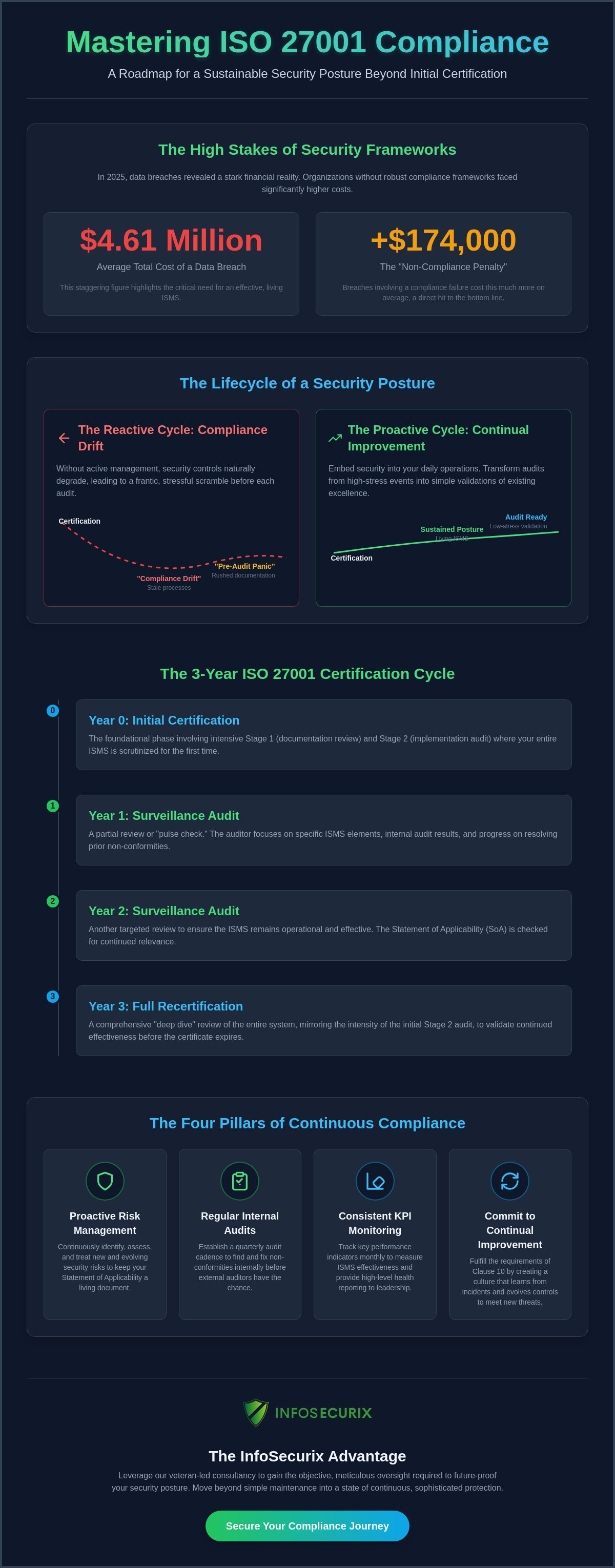
In 2025, data breaches involving a non-compliance factor cost organizations an average of $174,000 more than those with robust frameworks in place; the total cost of such breaches averaged a staggering $4.61 million. Achieving your initial certification was a monumental milestone, but you likely recognize that the true value lies in maintaining ISO 27001 compliance as a living, breathing part of your operational DNA. It’s natural to feel concerned about compliance drift or the administrative weight of manual documentation as your Year 2 surveillance audit approaches.
Transitioning from a successful audit to a sustainable security posture requires a shift from reactive preparation to proactive management. This article offers a comprehensive roadmap to master this evolution, ensuring your ISMS delivers genuine security improvements rather than just a checked box on a spreadsheet. We will examine the methods for creating a predictable, low-stress audit cycle while providing the high-level health reporting your senior leadership expects in 2026. Expect to move beyond simple maintenance into a state of continuous, sophisticated protection that enables your enterprise to grow with absolute confidence.
Key Takeaways
- Prevent compliance drift by evolving your ISMS from a static, post-audit document into a continuous and high-performance operational cycle.
- Master the critical nuances between surveillance and recertification audits to ensure your internal resources remain focused on the specific controls registrars prioritize most.
- Implement the four strategic pillars required for maintaining ISO 27001 compliance, moving your organization toward an agile and event-driven risk management model.
- Establish a predictable compliance calendar using monthly KPI reviews and quarterly internal audits to eliminate the traditional stress of annual audit preparation.
- Leverage a veteran-led consultancy approach to gain the objective, meticulous oversight required to future-proof your security posture against evolving global threats.
The ISO 27001 Maintenance Lifecycle: Beyond Initial Certification
Earning your certificate is a milestone, yet it’s merely the starting point of a much longer journey. Maintaining ISO 27001 compliance is the disciplined, ongoing operation of your Information Security Management System (ISMS) to ensure it remains suitable, adequate, and effective as your business scales. This process isn’t about static adherence to a list of rules; it’s about embedding security into your corporate culture. Without active management, organizations often experience “Compliance Drift.” This phenomenon describes the natural degradation of security controls that occurs when processes become stale or documentation fails to keep pace with operational changes.
To prevent such drift in your physical security environment, you can explore CCTV Systems to see how expert maintenance ensures your surveillance hardware remains a reliable part of your compliance framework.
Auditors view the three-year certification cycle as a maturity journey rather than a recurring hurdle. They’re specifically looking for evidence of Clause 10: Continual Improvement. This clause is frequently the most scrutinized area during maintenance audits. A stagnant ISMS is a non-compliant ISMS. Your system must demonstrate that it identifies weaknesses, learns from incidents, and evolves to meet new threats. Viewing the standard as a living framework ensures that security becomes a strategic enabler of growth rather than an administrative burden.
The 3-Year Certification Cycle Explained
The rhythm of the ISO/IEC 27001 standard is predictable and methodical. It breaks down into three distinct phases:
- Year 0: Initial Certification. This phase involves the intensive Stage 1 and Stage 2 audits where your entire system is scrutinized for the first time.
- Years 1 & 2: Surveillance Audits. These are partial reviews. The auditor focuses on specific ISMS elements, your internal audit results, and your progress in resolving any previously identified non-conformities.
- Year 3: Full Recertification. Before your certificate expires, a comprehensive review of the entire system is conducted to validate its continued effectiveness and alignment with your business objectives.
Why Maintenance Fails: Avoiding the Scramble
Many organizations suffer from “Pre-Audit Panic” syndrome. This occurs when security practices are neglected until the weeks leading up to an external assessment, resulting in rushed documentation and inaccurate data. Moving away from manual spreadsheets is vital for success. Transitioning to a structured internal audit cadence allows you to catch errors in real-time. A robust foundation established during your ISO 27001 certification readiness phase makes this ongoing maintenance significantly easier. By treating compliance as a daily operational rhythm, you transform the audit from a high-stress event into a simple validation of your existing excellence.
Surveillance Audits vs. Recertification: Understanding the Requirements
Understanding the distinction between surveillance audits and recertification is vital for any executive tasked with maintaining ISO 27001 compliance. While the initial certification process is exhaustive, the subsequent three-year cycle introduces a different set of expectations. A surveillance audit acts as a targeted pulse check, focusing on specific elements of the system to ensure the framework remains operational. In contrast, the Year 3 recertification is a comprehensive deep dive that mirrors the intensity of the original Stage 2 audit. Both are high-stakes events. A failed surveillance audit carries the same weight as a failed recertification; it can lead directly to certificate suspension or withdrawal, jeopardizing the benefits of ISO 27001 certification your organization has worked so hard to achieve.
Central to both audit types is the Statement of Applicability (SoA). During surveillance visits, the auditor verifies that the SoA still accurately reflects your risk environment and that no major changes have been ignored. Maintaining ISO 27001 compliance requires this document to be a dynamic record of your security decisions rather than a static filing. Auditors pay particular attention to how you have handled non-conformities found in previous years. If a minor issue was flagged during your last visit, the registrar will expect to see a documented, effective corrective action. Neglecting these minor findings is one of the fastest ways to trigger a major non-conformity during a surveillance cycle.
Key Focus Areas for Surveillance Audits
Focusing on the health of your ISMS requires a disciplined look at your management review minutes and internal audit results. Auditors want to see that your leadership is actively engaged in the security dialogue. They will examine the effectiveness of corrective actions taken since their last visit, ensuring that identified weaknesses were not merely patched but systematically resolved. Changes to your organizational context, such as a shift to a new cloud provider or the opening of a satellite office, must be documented and reflected in your risk landscape. Engaging an expert to perform an internal audit provides an objective second set of eyes, ensuring your system is truly audit-ready.
Preparing for Year 3: The Recertification Milestone
Treating Year 3 as a fresh start allows your team to validate the entire scope of the ISMS before the existing certificate expires. This milestone requires you to demonstrate that every Annex A control has been tested at least once during the three-year cycle. Success in this phase demands meticulous preparation. Scheduling a professional information security internal audit several months in advance is the most effective way to identify hidden gaps. This proactive approach ensures that your recertification is a validation of your established excellence rather than a stressful scramble to fix neglected controls.
The Four Pillars of Continuous ISO 27001 Compliance
Operationalizing your security framework requires more than periodic effort; it demands a shift toward a resilient, four-pillar strategy. Maintaining ISO 27001 compliance is not a destination reached every three years, but a state of constant readiness achieved through disciplined execution. This approach ensures that your Information Security Management System (ISMS) remains a protective force that enables growth rather than a hurdle that slows it down. By focusing on these core areas, you move away from reactive “audit prep” and toward a model of continuous, sophisticated protection.
- Pillar 1: Dynamic Risk Management. Abandon the static annual review in favor of event-driven assessments that respond to organizational changes in real-time.
- Pillar 2: The Internal Audit Cadence. Utilize internal audits as a diagnostic tool for discovery, identifying system weaknesses before an external registrar ever arrives.
- Pillar 3: Evidence and Documentation Hygiene. Maintain a “clean-as-you-go” philosophy for records, ensuring every control execution is documented at the moment it occurs.
- Pillar 4: Security Awareness and Culture. Strengthen the “People” control to be as formidable as your technical defenses, fostering a workforce that views security as a shared responsibility.
When implementing an ISMS, many organizations focus heavily on the technical configurations while neglecting the operational rhythm required for longevity. True excellence comes from the interconnectedness of these pillars: your risk assessments should inform your audit focus, and your audit findings should drive your security awareness topics. This holistic view prevents the fragmentation that often leads to compliance failures.
Evolving Your Risk Assessment Methodology
Transitioning to a strategic information security risk assessment is essential in 2026 to combat sophisticated threats like AI-driven social engineering. Modern risk management must link identified vulnerabilities directly to budget and resource allocation, ensuring that leadership understands the financial impact of security decisions. An evolved risk methodology prevents compliance drift by identifying new vulnerabilities before they become audit failures.
Cultivating a Culture of Compliance
Maintaining ISO 27001 compliance depends heavily on moving beyond once-a-year training videos toward continuous, role-based awareness. Leadership must demonstrate an unwavering commitment to the ISMS, as specified in Clause 5, by integrating security discussions into every executive meeting. Measuring security culture for audit evidence involves tracking more than just completion rates; it requires analyzing behavioral metrics, such as reporting speed for phishing simulations or the frequency of policy-related inquiries from different departments.
Actionable Steps: Building an Operational Compliance Calendar
Maintaining ISO 27001 compliance requires a transition from sporadic effort to a structured, operational calendar. This methodical approach ensures that no element of your ISMS is neglected, transforming compliance from a high-pressure project into a standard business function. By distributing tasks throughout the year, you maintain constant visibility into your security health while significantly reducing the administrative burden on your team. A predictable rhythm allows your staff to manage their primary responsibilities without the threat of an impending audit disrupting their workflow.
This methodical approach extends to the protection of all tangible business equipment; for organizations managing a corporate fleet, you can learn more about Carcarpit to see how custom-fit accessories help preserve the physical integrity of these assets as part of a comprehensive maintenance strategy.
- Step 1: Monthly ISMS Review. Conduct short, focused sessions to track key performance indicators (KPIs). Focus on incident response metrics, training completion rates, and the status of ongoing corrective actions.
- Step 2: Quarterly Internal Audits. Break your ISMS into manageable segments. Auditing specific control sets every three months ensures deeper scrutiny and prevents the end-of-year rush.
- Step 3: Bi-Annual Risk Reviews. Specifically analyze changes in business processes or technology. This is the time to evaluate how new tools, such as AI integrations, affect your risk profile.
- Step 4: Annual Management Review. Formalize the “Improvement” phase of the Plan-Do-Check-Act (PDCA) cycle. This session ensures that leadership remains informed and the ISMS remains aligned with corporate goals.
- Step 5: Continuous Documentation Updates. Policies must reflect current reality. Update your documentation as changes occur rather than waiting for an audit deadline.
Quarterly vs. Annual Internal Audits
Adopting a “rolling audit” approach offers superior depth compared to a single annual event. This strategy allows your team to focus on specific departments or technical controls with greater precision, identifying subtle gaps that a rushed annual audit might miss. Selecting auditors who are independent and competent is critical; those performing the audit shouldn’t have direct responsibility for the area being scrutinized. Mapping findings directly to your corrective action process ensures that every discovery leads to a measurable improvement in your security posture.
The Management Review: Your Strategic Compliance Tool
The management review is not a mere formality; it’s a requirement under Clause 9.3 that serves as your primary tool for securing executive buy-in. Required inputs include results of audits, feedback from interested parties, and the status of previous review actions. By presenting these findings clearly, you turn review outputs into a strategic roadmap for the coming year. This high-level dialogue is the ideal time to justify security investments and demonstrate how the ISMS supports overall business resilience. If your organization requires an objective perspective to meet these requirements, our team provides expert Internal Audits to ensure your system remains beyond reproach.
The InfoSecurix Advantage: Strategic Partnership for Longevity
While automation tools offer efficiency in evidence collection, they often lack the contextual awareness required for long-term resilience. Maintaining ISO 27001 compliance is a strategic endeavor that demands the insight of a seasoned professional who understands the nuances of your specific industry. InfoSecurix offers a veteran-led consultancy model that transcends the limitations of software-only approaches. We focus on the qualitative effectiveness of your ISMS, ensuring that your security posture is robust enough to withstand both external audits and evolving cyber threats.
Our internal audit services provide a rigorous, objective evaluation of your system before your registrar arrives. Drawing on over 25 years of experience navigating the most complex regulatory landscapes, our consultants identify vulnerabilities that automated scanners inevitably miss. We position ourselves as a collaborative ally: a protective force that enables your growth by future-proofing your business through meticulous standards. This partnership ensures that your compliance journey is characterized by steady progress rather than reactive crisis management.
Beyond Checklists: Strategic Corrective Actions
Moving beyond the constraints of generic templates allows your organization to build a truly bespoke security framework. We help teams pivot from fixing the symptom to curing the root cause through strategic corrective actions. For example, when a client faced recurring issues with access control, a standard checklist suggested simple password resets. Our strategic intervention identified a systemic failure in their employee offboarding process, resulting in a redesigned workflow that saved them from a major non-conformity during their Year 2 surveillance audit. It’s this level of curated problem-solving that distinguishes a high-performance ISMS from a mere administrative exercise.
Ready for Your Next Audit?
Choosing a partner with a legacy of success brings the absolute confidence needed to face any registrar visit. A professionally managed ISMS offers the peace of mind necessary to focus on your core business objectives without the anxiety of an upcoming audit cycle. Registrars don’t just look for evidence; they look for the maturity of your management processes. We invite you to partner with a seasoned guide who has navigated every possible audit scenario across diverse industries. Whether you require a comprehensive Internal Audit or a focused readiness assessment, our team is prepared to ensure your long-term success.
Future-Proofing Your Enterprise Security
Mastering the transition from a successful audit to a sustainable security posture is the definitive step toward organizational maturity. By embracing a structured compliance calendar and focusing on the four pillars of risk management, your team can eliminate the stress of surveillance visits. Maintaining ISO 27001 compliance should be viewed as a strategic enabler: a protective force that allows your business to scale with absolute certainty. This proactive approach ensures your ISMS remains a living, effective shield against the sophisticated threats of 2026.
InfoSecurix brings over 25 years of information security expertise to your organization, offering a national reach through a boutique, high-touch consultancy model. Our specialists provide deep expertise across ISO 27001, SOC2, and ISO 22301; this ensures your framework is both integrated and resilient. Secure your certification longevity with InfoSecurix readiness services and gain the peace of mind that comes from a professionally managed security posture. It’s time to move beyond the checklist and embrace a future where your security standards drive your competitive advantage.
Frequently Asked Questions
How often do we need to perform internal audits to remain ISO 27001 compliant?
You must perform internal audits at planned intervals to ensure the ISMS conforms to the standard’s requirements. While many organizations opt for a single annual event, a quarterly rolling cycle is often more effective for maintaining ISO 27001 compliance. This rhythmic approach allows for deeper scrutiny of specific controls and prevents the system from becoming stagnant. Every part of your ISMS must be audited at least once during the three-year certification cycle.
Can our ISO 27001 certification be revoked during a surveillance audit?
Yes, your certification can be suspended or revoked if a surveillance audit identifies major non-conformities that aren’t addressed within the required timeframe. Surveillance audits aren’t mere formalities; they’re rigorous assessments of your system’s ongoing effectiveness. If an auditor finds that your security practices have degraded significantly since the last visit, they have the authority to jeopardize your status. This underscores the necessity of consistent, daily ISMS management and leadership engagement.
What is the most common reason organizations fail their recertification audit?
The most common reason for failure is the inability to demonstrate “continual improvement” over the preceding three years. Auditors often discover that organizations have stopped performing regular risk assessments or have failed to act on previous internal audit findings. If your ISMS hasn’t evolved to address new threats or organizational changes, it’s considered ineffective. This lack of documented evolution is a primary driver of recertification denial during the Year 3 milestone.
Do we need to update our Statement of Applicability (SoA) every year?
You should review and update your Statement of Applicability at least annually or whenever significant changes occur within your business environment. The SoA is a dynamic document that must accurately reflect your current risk treatment decisions. If you’ve adopted new cloud technologies or retired old physical processes, your SoA must be adjusted to remain compliant. Auditors expect to see that this document is a living record of your actual security posture.
What is the difference between a minor and a major non-conformity in ISO 27001?
A major non-conformity represents a significant failure to meet a requirement of the standard or a total breakdown of a critical security control. It indicates that your ISMS is not achieving its intended outcomes. In contrast, a minor non-conformity is an isolated lapse or a single instance where a process wasn’t followed perfectly. While minor issues require documented corrective action, they don’t usually threaten your certification status immediately like a major finding does.
How much does it cost to maintain ISO 27001 compliance compared to initial certification?
Maintaining ISO 27001 compliance involves predictable recurring expenses that are generally lower than the initial implementation costs. The investment shifts from “building” the framework to “operating” it through surveillance audit fees, internal audit resources, and ongoing training. While the heavy lifting of framework design is complete, organizations must budget for the professional oversight required to prevent compliance drift. This ongoing investment is significantly more manageable than the cost of a major data breach.
Can we switch our certification body (registrar) during the 3-year cycle?
You can switch your certification body at any point through a process known as a “transfer of certification.” This is a common practice for organizations seeking better service, more industry-specific expertise, or a more collaborative auditor perspective. A new registrar will meticulously evaluate your historical audit records and perform a site visit to ensure your ISMS remains effective. They will then issue a new certificate for the remainder of your existing three-year cycle.
Is automated compliance software enough to satisfy an ISO 27001 auditor?
Automated compliance software is a valuable tool for evidence collection, but it’s rarely enough to satisfy a sophisticated auditor on its own. The standard places heavy emphasis on leadership commitment and the human elements of security culture. An auditor will look for qualitative evidence of management reviews and staff awareness that software simply cannot provide. You need a balance of technical automation and professional, human-led oversight to demonstrate a truly mature ISMS.