
Choosing between SOC 2 vs ISO 27001 shouldn’t feel like a high-stakes gamble where your global market access hangs in the balance. While many executives view these frameworks as competing hurdles, the most successful organizations recognize them as complementary pillars of a sophisticated security posture. You’ve likely felt the mounting pressure of the NIS2 Directive’s enforcement or the urgent need to satisfy a Tier-1 enterprise client’s security requirements to close a pivotal deal. It’s exhausting to manage overlapping standards while trying to maintain operational momentum, and the fear of wasting resources on the wrong roadmap is a valid concern for any seasoned leader.
This guide provides the strategic clarity you need to stop second-guessing your compliance journey and start building a foundation of absolute trust. We’ll examine the 65-75% control overlap between these standards to show you how to leverage one to achieve the other. You’ll gain a clear decision-making framework and a roadmap for audit readiness that minimizes disruption, ensuring your organization remains a protective force for your clients’ data in 2026 and beyond.
Key Takeaways
- Distinguish between the international rigor of an ISO 27001 Information Security Management System and the flexible, criteria-based reporting of a SOC 2 attestation.
- Navigate the strategic choice of SOC 2 vs ISO 27001 by aligning your compliance roadmap with your target markets: prioritize ISO for global expansion or SOC 2 for the North American SaaS ecosystem.
- Maximize operational efficiency through a “Test Once, Satisfy Many” approach; utilize the substantial control overlap to achieve dual certification with reduced resource expenditure.
- Secure a seamless audit experience by following a meticulous five-step readiness process: from initial gap analysis to a comprehensive internal audit that ensures no vulnerability remains unaddressed.
- Future-proof your organization’s security posture by understanding the distinct maintenance cycles of each framework to better forecast long-term resource allocation.
The Evolution of Trust: Defining SOC 2 and ISO 27001 in 2026
The security landscape in 2026 has moved decisively beyond the era of passive compliance. Today, enterprise clients view a static certificate as a mere starting point rather than a final destination. They’re looking for evidence of deep operational resilience. This shift has forced a strategic re-evaluation of the classic debate: SOC 2 vs ISO 27001. While both frameworks aim to protect data, they serve different functions in a market where “continuous compliance” is the new benchmark. Security is no longer a point-in-time event; it’s a living component of your corporate identity that must withstand constant scrutiny.
With the EU’s NIS2 Directive now in active enforcement as of March 2026, the demand for rigorous, verifiable security has reached a fever pitch. Organizations can’t rely on outdated versions of these standards. Success now requires an alignment with the ISO/IEC 27001:2022 update or the latest AICPA Trust Services Criteria. Stakeholders expect a proactive stance where vulnerabilities are managed in real time, transforming compliance from a bureaucratic hurdle into a powerful competitive differentiator.
ISO 27001: The Management System Approach
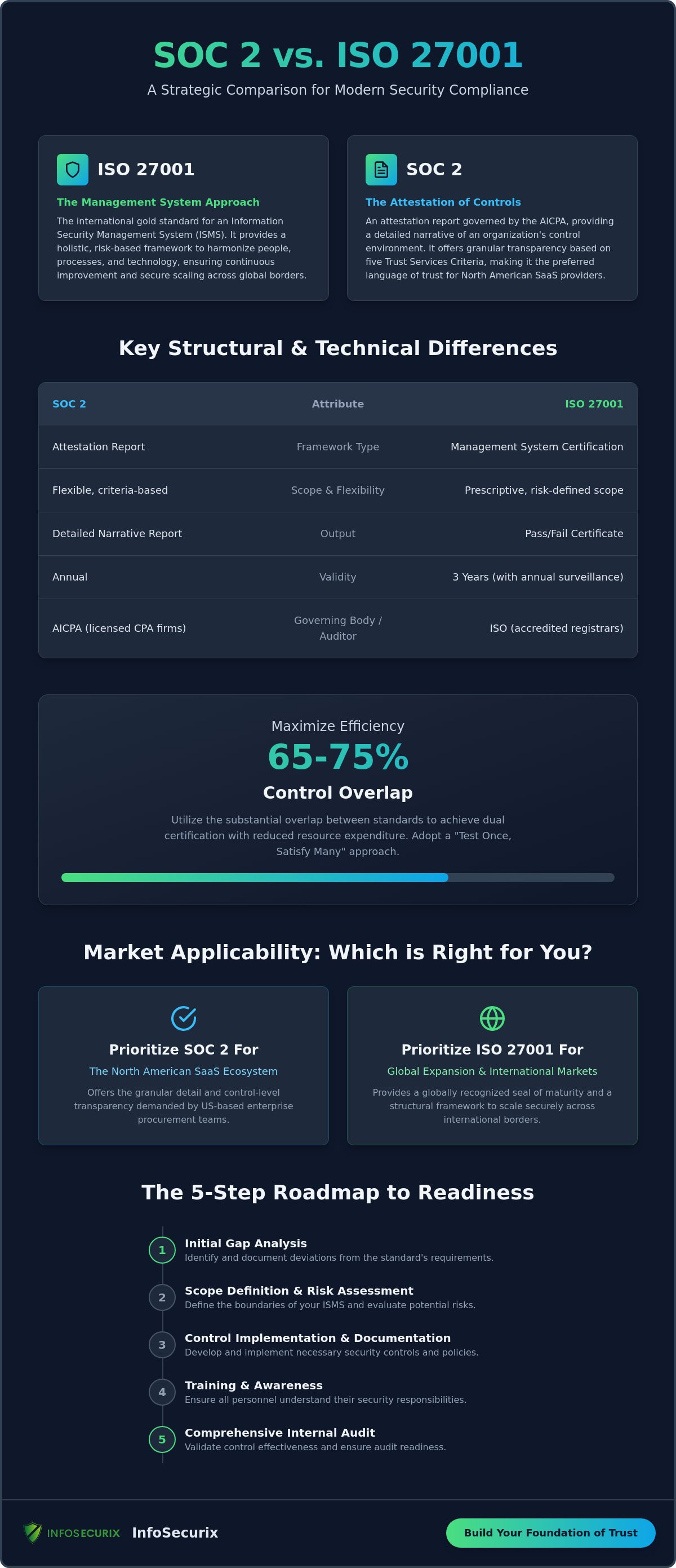
ISO 27001 stands as the international gold standard for an Information Security Management System (ISMS). It’s a holistic framework that harmonizes people, processes, and technology to safeguard your most valuable information assets. The core of this standard is the Plan-Do-Check-Act cycle. This iterative process ensures that security isn’t just a manual on a shelf; it’s a cycle of constant improvement that adapts to emerging threats. By focusing on risk management at the foundational level, it provides a globally recognized seal of maturity. ISO 27001 is a structural framework for governing organizational risk that enables businesses to scale securely across international borders.
SOC 2: The Attestation of Controls
While ISO is a certification, SOC 2 is an attestation report governed by the AICPA. It’s often categorized under the broader umbrella of System and Organization Controls (SOC) reporting. Unlike a pass/fail audit, SOC 2 provides a detailed narrative of your control environment. It evaluates your organization based on five Trust Services Criteria: Security, Availability, Confidentiality, Processing Integrity, and Privacy. For North American SaaS and cloud providers, SOC 2 remains the preferred language of trust. It offers the granular transparency that US-based enterprise procurement teams demand. Because it’s an auditor’s opinion rather than a simple certificate, it provides the “how” behind your security claims, offering a level of detail that many sophisticated buyers require before finalizing a partnership.
SOC 2 vs ISO 27001: Key Structural and Technical Differences
The architectural divergence in SOC 2 vs ISO 27001 defines how your organization demonstrates its commitment to security. ISO 27001 is prescriptive regarding the management system structure; it requires a specific governance approach to risk. SOC 2, by contrast, is known for its flexibility, allowing you to choose the criteria that matter most to your customers. While ISO 27001 is inherently focused on the “system,” SOC 2 is focused on the “controls” and the evidence of their operation. These differences extend to the very professionals who conduct the audits. ISO 27001 audits are performed by accredited registrars, while SOC 2 reports must be issued by licensed CPA firms.
The outputs of these engagements are as distinct as their structures. An ISO 27001 audit results in a formal, pass/fail certificate that is valid for three years. In contrast, SOC 2 produces a detailed narrative report, typically on an annual basis. This report provides stakeholders with a deep dive into your control environment, offering a level of transparency that a simple certificate cannot match. This granularity is why many enterprise procurement teams in North America insist on a SOC 2 report even if an ISO certificate is already in place.
Scope and Flexibility: Which Fits Your Business?
ISO 27001 empowers you to define your own scope based on a comprehensive risk assessment. You decide which parts of the organization are covered, provided the boundaries are clearly articulated. SOC 2 scope is dictated by the specific Trust Services Criteria you choose to include, such as Security, Availability, or Privacy. A common misconception suggests that SOC 2 is “easier” due to its flexible nature. In reality, the burden of proof in a SOC 2 audit is often higher, as auditors require exhaustive evidence for every control during the sampling process. If you’re unsure where your current maturity stands, a professional SOC2 Readiness Assessment can provide the necessary clarity before the formal audit begins.
Testing Effectiveness: Type II Reports vs. Surveillance Audits
The methodology for testing effectiveness represents a significant point of divergence. A SOC 2 Type II report evaluates the operating effectiveness of controls over a specific window, usually six to twelve months. This longitudinal view provides high assurance to enterprise procurement teams that security isn’t just a “point-in-time” achievement. ISO 27001 utilizes a different rhythm. After the initial certification, the organization undergoes annual surveillance audits. These audits focus more on the health and adherence of the management system rather than re-testing every technical control. Understanding the technical nuances of SOC 2 vs ISO 27001 ensures you select the framework that best aligns with your operational reality and client expectations.
Market Applicability: Navigating Global and Regional Expectations
Strategic market positioning requires a clear understanding of where your revenue will originate over the next three to five years. When evaluating SOC 2 vs ISO 27001, the decision often hinges on geographic reach and the maturity of your target audience. ISO 27001 acts as a universal passport for organizations targeting European, Asian, or Middle Eastern markets. It’s the standard that international regulators and global enterprises recognize instantly. In contrast, SOC 2 remains the undisputed leader in the North American tech sector. It’s an essential requirement for any SaaS vendor looking to partner with US-based corporations that prioritize granular control descriptions over broad management systems.
Industry-specific trends also dictate your choice. FinTech and healthcare sectors often demand a dual approach to satisfy both regulatory bodies and private stakeholders. Fortune 500 procurement teams have moved toward a “trust but verify” model, where they scrutinize the depth of your security posture during the vendor selection process. They aren’t just looking for a badge; they’re looking for a partner that mirrors their own internal rigor. Holding the right standard can be the difference between a stalled negotiation and a signed contract.
The Rise of the Global Security Standard
The 2026 regulatory environment has triggered a significant convergence of security expectations. Cross-border compliance is no longer a luxury for growth-stage companies; it’s a fundamental requirement for survival. Ambitious firms realize that a “US-only” approach creates artificial ceilings for their expansion. Achieving ISO 27001 certification readiness provides the structural integrity needed to enter any market with confidence. It signals to international partners that your security maturity is not limited by geography and that your processes are designed to meet global excellence.
Satisfying Client Demands: When One is Not Enough
Modern security questionnaires are becoming increasingly complex, often requiring proof of compliance across multiple frameworks. You’ve likely encountered RFPs where the comparison of SOC 2 vs ISO 27001 isn’t an “either/or” scenario: the prospect wants to see both. Position your organization as the most compliant vendor by proactively maintaining a unified security posture that addresses both sets of criteria. InfoSecurix serves as a seasoned guide in these scenarios, helping you interpret and satisfy the most demanding client requirements. We ensure that your compliance efforts translate directly into closed deals and long-term enterprise trust, allowing you to focus on innovation while we handle the complexities of audit readiness.
The Roadmap to Readiness: Preparing for a Successful Audit
Achieving a clean report or certificate is the culmination of a deliberate, five-stage journey. Whether you’re weighing the merits of SOC 2 vs ISO 27001 for your next fiscal year, the path to audit success follows a structured methodology: Gap Analysis, Risk Assessment, Remediation, Internal Audit, and Final Engagement. This methodical progression ensures that your organization doesn’t just pass a test, but actually strengthens its underlying security culture. Documentation serves as the primary language of the audit. Policies, procedures, and evidence logs aren’t merely administrative tasks; they’re the tangible proof that your controls are intentional, repeatable, and effective.
A frequent objection from technical teams is the belief that existing security tools automatically equate to compliance. It’s a dangerous misconception. While your EDR and SIEM platforms provide essential technical telemetry, they don’t provide the governance framework an auditor requires. Compliance is the bridge between your technical capabilities and your business’s risk management strategy. Before the external auditor arrives, conducting a professional internal audit is non-negotiable. This “dress rehearsal” identifies vulnerabilities in a safe environment, allowing you to rectify issues before they ever appear on a public-facing report.
The Criticality of the Gap Analysis
A readiness assessment acts as a strategic insurance policy for your audit investment. By identifying “exceptions” early, you prevent the reputational damage of a qualified opinion or a failed certification. InfoSecurix develops bespoke remediation plans that bridge these identified gaps, ensuring your team focuses their energy on the controls that matter most. We transform the overwhelming complexity of overlapping standards into a clear, actionable punch list. If you’re ready to move from uncertainty to audit readiness, schedule your SOC2 Readiness Assessment today.
Selecting the Right Partner: Consulting vs. Automation
The rise of compliance automation software has simplified evidence collection, yet software alone cannot replace the “Seasoned Guide” advisory model. Complex organizations with nuanced workflows require human expertise to interpret how specific controls apply to their unique environment. Automation is a powerful tool, but it lacks the strategic foresight needed to navigate a difficult auditor’s questions. Utilizing a soc 2 readiness checklist alongside expert guidance ensures that your compliance program is robust enough to satisfy the most rigorous Fortune 500 procurement teams. This hybrid approach combines technical efficiency with the high-level consulting necessary for long-term enterprise trust.
Unified Compliance: Strategic Synergy Between SOC 2 and ISO 27001
Viewing SOC 2 vs ISO 27001 as a binary choice is a strategic oversight that often leads to redundant efforts and fragmented resources. Sophisticated organizations increasingly adopt a Unified Compliance Framework, operating under the principle of “Test Once, Satisfy Many.” This approach recognizes that the vast majority of controls required for an ISO 27001 Information Security Management System are identical to the Common Criteria found in a SOC 2 report. By establishing a single, rigorous security baseline, InfoSecurix enables your business to satisfy multiple stakeholders without doubling the operational burden. Organizations pursuing this integrated path can realize cost savings of 25-35% on their initial investment by leveraging shared evidence and unified testing cycles.
The synergy between these frameworks isn’t just about efficiency; it’s about building a more resilient organization. When you align your security controls to meet the highest common denominator, you eliminate the gaps that often exist in siloed compliance programs. This holistic view provides executive leadership with absolute confidence that their security posture is consistent across every global region. It transforms compliance from a defensive necessity into an empowering asset that facilitates rapid market entry and builds lasting enterprise trust.
Mapping Controls for Maximum Efficiency
The technical overlap between these standards is most evident in core operational areas: access control, incident response, and risk management. For instance, a single, well-documented access review process can satisfy the requirements of both an ISO auditor and a SOC 2 CPA, provided the evidence is captured with sufficient granularity. Managing documentation becomes an exercise in precision rather than volume. Central to this efficiency is a comprehensive information security risk assessment. This foundational process serves as the bedrock for both frameworks, ensuring that every control implemented is directly tied to a verified organizational risk, which simplifies the narrative for any external auditor.
Future-Proofing Your Security Posture
Beyond the immediate benefits of dual certification, a unified approach builds a foundation for long-term scalability. This robust security baseline allows your organization to pivot toward other rigorous standards, such as ISO 22301 for business continuity or ISO 20000 for service management, with minimal friction. Perhaps more importantly, it fosters a “compliance by design” culture within your engineering and IT teams. Instead of facing annual audit fatigue, your staff operates within a steady, predictable environment where security is a default state. For many growing firms, this stability is underpinned by reliable managed IT support for SMEs UK that maintains the technical infrastructure required for ongoing compliance. We invite you to engage with InfoSecurix to design a bespoke, multi-standard compliance roadmap. Our seasoned guides will help you navigate the technical nuances of SOC 2 vs ISO 27001, transforming your security posture into a visionary asset that enables your organization’s global growth.
Future-Proofing Your Global Trust Strategy
The journey toward enterprise-grade security is no longer a matter of checking boxes. It’s about establishing a legacy of trust that enables your organization to scale without borders. By understanding the strategic nuances of SOC 2 vs ISO 27001, you’ve moved from reactive confusion to a position of absolute clarity. You now recognize that these standards aren’t rivals; they’re complementary tools that provide a comprehensive shield for your data when managed through a unified framework.
Success in the 2026 regulatory environment requires more than just automation. It demands the steady hand of a partner who understands the high-stakes nature of executive risk management. InfoSecurix brings over 25 years of strategic compliance expertise to your organization, offering a boutique consultancy approach that has secured a proven track record for global enterprise clients. We invite you to determine your optimal compliance path with a Strategic Readiness Assessment from InfoSecurix. Let’s transform your security obligations into a powerful engine for market leadership. Your organization’s future is secure when your standards are meticulous.
Frequently Asked Questions
Which is better for a SaaS company: SOC 2 or ISO 27001?
The optimal choice depends entirely on your target market and geographic focus. When evaluating SOC 2 vs ISO 27001, SaaS companies operating primarily in North America find that SOC 2 is the expected standard for enterprise procurement. If your growth strategy includes European or Asian markets, ISO 27001 is often preferred due to its international recognition. Many mature organizations eventually choose to maintain both to ensure they never lose a deal due to regional compliance gaps.
Can I use my ISO 27001 certification to satisfy a SOC 2 request?
No, an ISO certificate cannot replace a SOC 2 report because they are fundamentally different outputs. One is a pass/fail certification while the other is a detailed attestation report from a CPA. However, your existing ISO 27001 management system will provide roughly 70% of the evidence required for a SOC 2 audit. This makes the additional reporting process significantly faster and more cost effective.
How much overlap is there between SOC 2 and ISO 27001 controls?
There is a substantial 65-75% overlap between the two frameworks. Most of the core security requirements, such as access control, encryption, and incident response, are nearly identical in their technical expectations. This high degree of commonality in SOC 2 vs ISO 27001 controls allows organizations to use a unified compliance approach to satisfy both standards with minimal extra effort.
Is SOC 2 mandatory for doing business in the United States?
SOC 2 is not a legal requirement or a government-mandated regulation in the United States. It is a de facto market requirement for any SaaS or cloud service provider selling to enterprise-level customers. Most US-based procurement teams won’t finalize a contract without reviewing a recent SOC 2 Type II report to verify your security posture and operational resilience.
How long does it take to get ISO 27001 certified versus a SOC 2 report?
Achieving ISO 27001 certification generally takes six to twelve months depending on your current maturity. A SOC 2 Type I report can be completed in as little as two to three months because it only measures control design at a specific point in time. A SOC 2 Type II report requires a mandatory observation period, typically six to twelve months, to prove the controls work effectively over time.
What is the difference between a SOC 2 Type I and Type II report?
A SOC 2 Type I report is a point-in-time assessment that confirms your security controls are designed correctly. A SOC 2 Type II report is much more rigorous; it evaluates whether those controls operated effectively over a duration of several months. Enterprise clients almost always prefer a Type II report because it offers proof of consistent performance rather than a single snapshot of your environment.
Who can perform a SOC 2 audit versus an ISO 27001 audit?
SOC 2 audits must be performed by a licensed CPA firm that specializes in information technology audits. ISO 27001 audits must be conducted by an accredited certification body, also known as a registrar. These registrars are governed by national accreditation bodies to ensure they meet strict international standards for auditing competence, impartiality, and professional conduct.
How do I know if I need the Privacy or Confidentiality criteria in SOC 2?
Confidentiality is necessary if you handle sensitive business information that is protected by non-disclosure agreements or intellectual property laws. You should include the Privacy criteria if your platform processes personal identifiable information (PII) and you need to demonstrate adherence to specific privacy principles. Most organizations start with the Security criteria and add others based on specific customer contractual requirements and data types.