
Achieving ISO 27001:2022 certification isn’t merely a defensive maneuver to protect data: it’s a strategic offensive that unlocks high-value contracts and fuels enterprise expansion. For leadership teams, partnering with an expert ISO 27001 consultant Pittsburgh transforms the daunting pursuit of compliance into a streamlined asset for national growth. You’ve likely felt the weight of overwhelming documentation requirements and the mounting pressure of mandatory internal audits that your current staff isn’t equipped to handle. It’s a common frustration to see potential partnerships stall because your security framework doesn’t yet meet the rigorous global standards that modern enterprises demand.
We understand that the path to a resilient Information Security Management System (ISMS) should empower your business rather than anchor it in bureaucracy. This article details how a strategic consultancy approach simplifies the 93 controls of the 2022 standard: replacing the fear of failed audits with the confidence of a repeatable, global security framework. You’ll discover how to bridge the gap between your current posture and total readiness: ensuring your organization doesn’t just pass the audit but gains a permanent competitive engine. We’ll outline the systematic steps to turn complex regulations into a clear, audit-ready roadmap that future-proofs your operations and enhances your market credibility.
Key Takeaways
- Understand how ISO 27001 serves as the definitive global benchmark for information security by anchoring your strategy in the core principles of confidentiality, integrity, and availability.
- Learn how a dedicated ISO 27001 consultant Pittsburgh navigates the complexities of Annex A controls; converting abstract regulatory requirements into a tangible competitive advantage for your enterprise.
- Differentiate between the essential discovery phase of a gap analysis and the mandatory rigor of an internal audit to ensure your roadmap to certification is both efficient and audit-ready.
- Master the critical steps of scoping your Information Security Management System and conducting a thorough risk assessment to define your organization’s unique security boundaries and risk appetite.
- Explore why a seasoned partnership focused on long-term resilience provides far more value than a one-time audit: future-proofing your business against an evolving regulatory landscape.
Navigating the Modern Compliance Landscape: Why ISO 27001 is the Global Benchmark
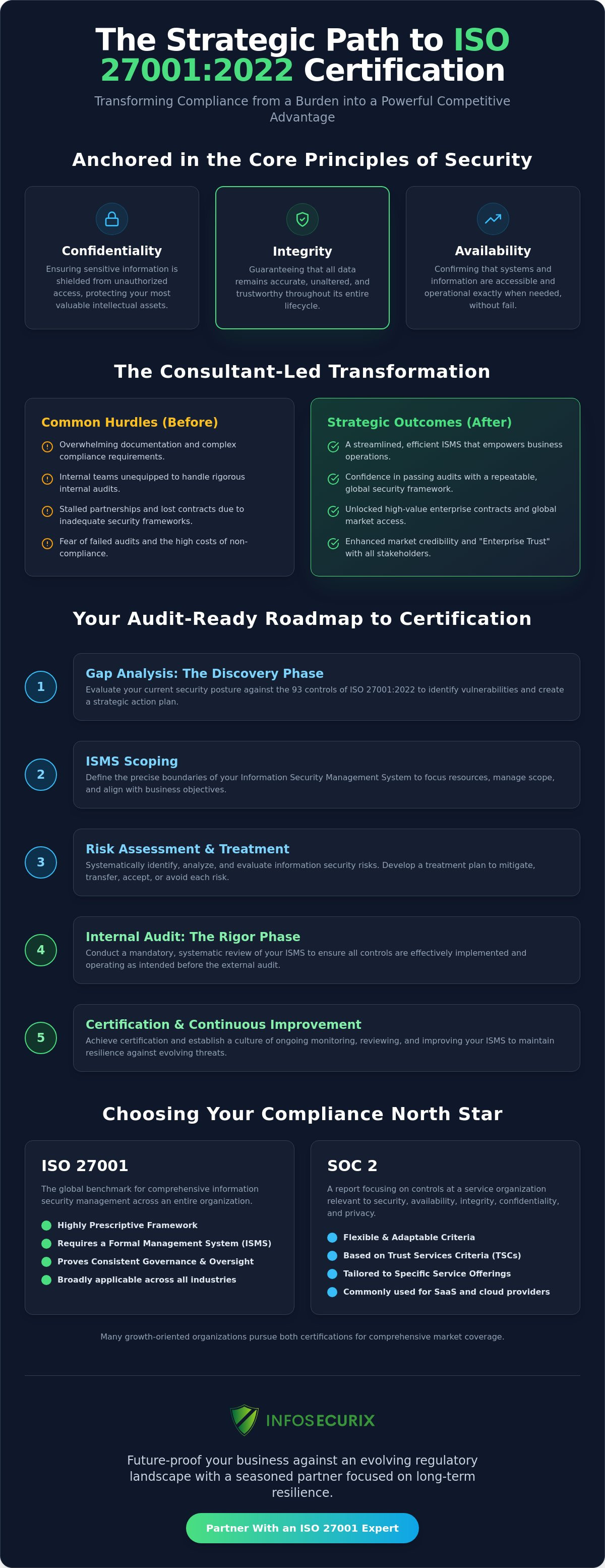
The ISO/IEC 27001 standard represents the definitive international framework for establishing, implementing, and maintaining a robust Information Security Management System (ISMS). It’s far more than a technical checklist: it’s a strategic architecture designed to protect your organization’s most valuable intellectual assets. At its core, the standard is anchored by the CIA Triad: a philosophy focusing on Confidentiality, Integrity, and Availability. Confidentiality ensures that sensitive information remains shielded from unauthorized access. Integrity guarantees that data remains accurate and unaltered. Availability ensures that your systems and information are ready for use exactly when they’re needed. These three pillars form the foundation of a resilient enterprise.
The Strategic Advantage of a Certified ISMS
Achieving certification provides an immediate competitive edge: it opens doors to global markets and high-security enterprise contracts that are often closed to uncertified vendors. Many Fortune 500 companies now require ISO 27001 as a non-negotiable prerequisite for any new partnership. Beyond market expansion, a certified ISMS significantly reduces the frequency and severity of security breaches. This leads to massive cost savings by avoiding the financial penalties, legal fees, and operational downtime associated with data leaks. Ultimately, compliance builds “Enterprise Trust” with your stakeholders: proving that your organization treats data protection with the highest level of professional rigor.
ISO 27001 vs. SOC 2: Choosing Your Compliance North Star
While both frameworks aim to secure sensitive data, they serve different strategic purposes. ISO 27001 is highly prescriptive: it requires a formal management system and specific documentation that proves your governance is consistent. SOC 2 is often perceived as more flexible: it’s based on Trust Services Criteria that can be tailored to specific service offerings. Many growth-oriented organizations eventually pursue both to ensure comprehensive market coverage across different industries. If you’re evaluating which path to take first, our strategic SOC 2 readiness checklist offers a detailed comparison to help you align your compliance journey with your long-term business goals.
The Architecture of Readiness: How a Consultant Transforms Security into a Competitive Advantage
Navigating the 93 controls of the ISO 27001:2022 standard requires more than a simple checklist; it demands a strategic architectural vision. A seasoned guide doesn’t just read the requirements. They translate abstract international standards into actionable corporate policies that align with your specific operational flow. This methodology ensures that security isn’t a bolt-on feature but a core component of your business model. By right-sizing controls to fit your unique risk profile, an expert prevents the common documentation bloat that often hinders smaller, more agile organizations. They organize these controls into the four modern themes: organizational, people, physical, and technological: ensuring every facet of your enterprise is covered without redundant effort.
Many teams fear that rigorous compliance will create a “compliance slowdown” that stifles innovation. An experienced ISO 27001 consultant Pittsburgh mitigates this risk by identifying the most efficient path to maturity. They focus on the benefits of ISO 27001 certification that extend beyond simple data protection, such as improved internal efficiency and clearer vendor management. This strategic oversight allows your team to maintain its momentum while simultaneously building a fortress around your intellectual property. It’s about building a framework that supports growth rather than one that acts as a bureaucratic anchor.
Bridging the Expertise Gap with a Trusted Advisor
Choosing a “DIY” approach often leads to expensive misinterpretations and unnecessary documentation bloat. Without the perspective that comes from 25 plus years of experience, internal teams may over-engineer solutions or miss critical audit roadblocks entirely. A trusted advisor provides a bespoke approach that generic “compliance-in-a-box” templates simply can’t match. They foresee potential hurdles long before the auditor arrives: identifying gaps in your software supply chain or remote access protocols that an internal team might overlook. This foresight is what transforms a stressful certification process into a steady, predictable march toward enterprise excellence.
Integrating Security into Organizational DNA
True resilience requires moving security from a back-office IT problem to a board-level strategic priority. A successful ISO 27001 implementation depends heavily on leadership engagement and a clear commitment from the top. A consultant facilitates this culture change through targeted awareness and training that speaks the language of executive decision-makers. They help the board understand that an Information Security Management System is an investment in longevity, not a sunk cost. When security becomes part of the organizational DNA, it ceases to be a hurdle and becomes a powerful engine for trust. Partnering with a specialized readiness team ensures this transition is seamless and permanent.
Strategic Gap Analysis vs. Internal Audits: Evaluating Your Path to Certification
Understanding the distinction between a gap analysis and a formal internal audit is vital for any leadership team aiming for certification success. While many organizations conflate these two processes, they serve entirely different strategic purposes. A gap analysis acts as the initial discovery phase: a high-level assessment that identifies exactly where your current security controls fall short of the ISO 27001:2022 requirements. It provides the baseline for your implementation roadmap. In contrast, the internal audit is a mandatory, independent review required by Clause 9.2 of the standard. This audit must be conducted before you ever face the Stage 1 certification audit to verify that your ISMS is not only documented but effectively operationalized.
Securing an ISO 27001 consultant Pittsburgh ensures that this internal audit meets the strict criteria for objectivity and competence. Clause 9.2 specifically dictates that auditors cannot audit their own work. This creates a significant hurdle for internal teams who have spent months building the system. A seasoned consultant provides the necessary distance to evaluate the framework impartially. They identify non-conformities that an internal stakeholder might overlook due to familiarity or bias. This phase isn’t about finding fault; it’s about fortification. It’s the final dress rehearsal that ensures your organization is ready for the scrutiny of an external certification body.
The Critical Role of the Internal Auditor
The standard is uncompromising regarding the rigor of the information security internal audit. A consultant brings the technical depth required to test controls across all four themes of the 2022 revision. They produce two critical deliverables: a detailed audit report and the inputs for the mandatory management review. These documents prove to external auditors that your leadership is actively monitoring and improving the system. By providing an external perspective, a consultant mitigates the risk of “blind spots” that often lead to major non-conformities during the final certification stage.
From Findings to Fortification: Strategic Corrective Actions
The “Corrective Action” phase is where audit findings are transformed into institutional strength. Rather than rushing to fix every minor observation, a consultant helps prioritize remediation based on actual risk impact. They guide you in documenting the “reasoning” behind every control selection within your Statement of Applicability (SoA). This document is the heart of your audit: it explains why certain controls were included or excluded. Integrating these practical tips for ISO certification ensures your remediation efforts are efficient and defensible. This meticulous preparation turns potential vulnerabilities into evidence of a maturing, high-value security framework.
Executing the ISO 27001 Roadmap: From Risk Assessment to Continuous Improvement
Executing the roadmap requires a methodical transition from high-level strategy to granular operational control. For leadership teams in Pennsylvania, an ISO 27001 consultant Pittsburgh provides the technical precision needed to define the ISMS scope: ensuring that your certification boundary is neither too narrow to be useful nor too broad to be manageable. This initial scoping phase prevents the common pitfall of scope creep that often derails internal projects. Once the boundaries are set, the implementation moves through five critical stages:
- Step 1: Scoping the ISMS. Defining exactly which departments, locations, and assets are included in the certification.
- Step 2: Risk Assessment. Identifying vulnerabilities and determining the organization’s risk appetite.
- Step 3: Control Implementation. Mapping the 93 Annex A controls to the specific needs of your Risk Treatment Plan.
- Step 4: Documentation and Training. Developing the policies and staff awareness required to prove the system is operational.
- Step 5: Monitoring and Measurement. Establishing Key Performance Indicators (KPIs) to track the health and efficacy of the ISMS.
Establishing these pillars ensures that your security framework is not a static document, but a living system that evolves with your business. By partnering with experts to handle these technical milestones, your internal teams can remain focused on their core objectives while the foundation of your enterprise security is meticulously built. If you are ready to secure your organization’s future, our team provides the ISO 27001 certification readiness services needed to ensure your roadmap leads to a successful audit.
The Risk Assessment: The Foundation of the ISMS
The information security risk assessment serves as the intellectual engine of your entire security framework. During this phase, a consultant helps you identify, analyze, and evaluate risks in a way that is both reproducible and consistent. These are non-negotiable requirements for ISO auditors. This process leads directly to the creation of the Risk Treatment Plan (RTP) and the Statement of Applicability (SoA). These documents serve as the definitive record of which controls you’ve chosen to implement and, crucially, the strategic reasoning behind those choices.
Establishing a Culture of Continuous Improvement
Clause 10 of the ISO standard mandates a commitment to non-conformity management and continual improvement. This is best achieved through the Plan-Do-Check-Act (PDCA) cycle: a steady rhythm of assessment and refinement that characterizes a mature ISMS. A seasoned advisor doesn’t just help you pass the audit; they help you automate monitoring and measurement processes. This reduces the long-term administrative burden on your staff while ensuring that your security posture remains resilient against the emerging threats of 2026 and beyond.
Securing Your Enterprise Future: The Value of a Seasoned ISO 27001 Partnership
Choosing to partner with a seasoned ISO 27001 consultant Pittsburgh is an investment in the long-term structural integrity of your enterprise. Certification shouldn’t be viewed as a finish line: it’s the commencement of a more mature, resilient phase of your business lifecycle. At InfoSecurix, we don’t just prepare you for a one-time audit. We act as a collaborative ally, leveraging over 25 years of experience to ensure your security framework remains a permanent asset that enables growth. This partnership transforms compliance from a source of anxiety into a foundation of operational confidence: allowing your leadership to focus on expansion while we safeguard the architecture of your data.
The transition from a reactive security posture to a proactive, risk-based governance model is the hallmark of a future-proofed organization. By moving beyond the “checkbox” mentality, you create a culture where security is woven into every business process. This evolution doesn’t happen by accident; it requires the steady hand of a guide who has navigated the complexities of global standards across dozens of industries. Our role is to provide that clarity: replacing the overwhelming documentation requirements with a streamlined, high-value framework that resonates with executive stakeholders and auditors alike.
Why National Organizations Choose InfoSecurix
National enterprises require a partner who remains unfazed by complexity and provides absolute predictability in both outcome and investment. InfoSecurix embodies the “Trusted Advisor” persona: offering a calm, steady expertise that is particularly valuable under the pressure of an upcoming audit. We believe that security should work for your business, not against it. This is why we provide bespoke services tailored to your specific operational flow rather than forcing you into generic templates. To ensure total transparency, we utilize fixed-fee, milestone-based engagements. This approach provides the budget predictability that modern CFOs demand: ensuring there are no hidden costs as you move toward certification.
Your Next Steps Toward Certification
The journey toward a certified ISMS begins with a single strategic move: a formal gap analysis. This discovery phase provides the necessary clarity to understand exactly where your current controls stand against the ISO 27001:2022 standard. It’s the most efficient way to build a realistic roadmap that respects your time and resources. For those ready to explore the deeper mechanics of the process, we invite you to review our comprehensive ISO 27001 certification readiness pillar. If you’re prepared to elevate your security posture and unlock new market opportunities, contact our team today for a professional consultation. Let’s transform your compliance requirements into your greatest competitive engine.
Empower Your Growth Through Strategic Security Excellence
Achieving ISO 27001 certification is a transformative milestone that signals your commitment to excellence to the global market. You’ve seen how a structured Information Security Management System (ISMS) serves as a powerful multiplier for business growth and enterprise trust. The transition from a meticulous gap analysis to a culture of continuous improvement ensures that your organization remains resilient against an evolving threat landscape. By treating security as a strategic asset, you don’t just protect your data: you unlock new opportunities for national and global expansion.
As a boutique consultancy with national reach, InfoSecurix brings over 25 years of information security excellence to every engagement. Our deep expertise across ISO 27001, SOC2, and ISO 22301 allows us to provide the bespoke guidance your leadership team requires. When you secure the services of a seasoned ISO 27001 consultant Pittsburgh, you ensure that your compliance journey is handled with the precision of a veteran guide. We’re ready to help you navigate these complexities with a steady, professional hand.
Partner with InfoSecurix to secure your ISO 27001 certification readiness today. Your journey toward operational confidence and expanded market credibility starts with a single strategic conversation.
Frequently Asked Questions
What is the primary role of an ISO 27001 consultant?
A consultant acts as a seasoned guide who translates complex international standards into a functional business architecture. They identify security gaps, facilitate risk assessments, and ensure that your Information Security Management System (ISMS) aligns with your operational goals. By providing an objective perspective, they help leadership avoid the pitfalls of documentation bloat and ensure the organization is fully prepared for the rigor of an external audit.
How long does the ISO 27001 certification process typically take with professional help?
The timeline for achieving certification typically ranges from six to twelve months, depending on the size and complexity of your organization. While professional help streamlines the process, the standard requires evidence of the ISMS being operational for several months before the final audit. A consultant accelerates this by providing clear roadmaps and templates, ensuring that milestones are met without unnecessary delays or resource waste.
Can we use ISO 27001 readiness software instead of a consultant?
While readiness software can assist with documentation management, it cannot replace the strategic oversight and nuanced judgment of a human expert. Software provides a generic template, whereas an ISO 27001 consultant Pittsburgh delivers a bespoke framework tailored to your unique risk profile. A consultant navigates the cultural and organizational changes required for compliance, ensuring that your security posture is integrated into your business DNA rather than just living in a database.
What is the difference between a Gap Analysis and an Internal Audit?
A Gap Analysis is a preliminary discovery phase designed to identify where your current controls fall short of the standard’s requirements. It serves as the foundation for your implementation roadmap. An Internal Audit is a mandatory, independent review required by Clause 9.2 of the standard. It must be conducted after the system is implemented to verify that it is fully operational and compliant before you face the external certification body.
Is ISO 27001 certification mandatory for my industry?
Certification is rarely a legal mandate in the United States, but it has become a non-negotiable prerequisite for many high-security enterprise contracts and global partnerships. Industries handling sensitive data, such as technology, finance, and healthcare, often find that certification is essential for market credibility. For government contractors working with the Department of Defense, it provides a strong foundation for meeting CMMC and other federal requirements.
How does an ISO 27001 consultant help with the Risk Assessment phase?
A consultant ensures that your risk assessment methodology is both reproducible and consistent, as strictly required by the ISO standard. They facilitate the identification of threats and vulnerabilities across your organizational, physical, and technological themes. This expert guidance leads to the creation of a defensible Risk Treatment Plan and Statement of Applicability, ensuring that your control selections are grounded in professional rigor rather than guesswork.
What happens if we fail the Stage 1 or Stage 2 certification audit?
Failing an audit typically results in the identification of non-conformities that must be addressed within a specific timeframe. Stage 1 focuses on documentation readiness, while Stage 2 evaluates operational effectiveness. If issues are found, your ISO 27001 consultant Pittsburgh will help you implement corrective actions to remediate the findings. Once these improvements are documented and verified, the certification body will typically proceed with the recommendation for certification.
How often do we need to conduct an internal audit after achieving certification?
The standard requires that internal audits be conducted at planned intervals to ensure the ISMS remains effective and compliant. Most organizations adopt an annual audit cycle to align with the mandatory surveillance audits performed by the certification body in years two and three. This consistent oversight ensures that your security framework evolves alongside your business and remains resilient against new threats, maintaining your certification over the long term.