
With the average cost of a data breach climbing to a record $10.22 million in 2026, a perfunctory approach to security documentation is no longer a viable corporate strategy. It’s understandable to feel the pressure of Clause 6.1.2 requirements, especially when trying to translate complex technical vulnerabilities into a narrative that resonates with the Board of Directors. You likely find that an outdated ISO 27001 risk assessment report template fails to capture the nuances of the 2022 Annex A restructuring, leaving your organization exposed during rigorous external audits. We understand that your goal isn’t just to check a box; it’s to build a steady foundation for long-term growth and absolute security.
This guide offers a sophisticated framework for documenting information security risks that satisfies both meticulous auditors and executive stakeholders. By adopting a repeatable, professional structure, you’ll align your operations with the current ISO 27001:2022 standards and the essential 2024 environmental amendments. We’ll walk through the exact components needed for a successful report, focusing on how to communicate risk with the precision and clarity that seasoned leadership expects. This is your roadmap to transforming technical data into a strategic asset for business resilience.
Key Takeaways
- Bridge the gap between technical vulnerabilities and the Statement of Applicability by mastering the mandatory requirements of Clause 6.1.2.
- Identify the essential components of a professional ISO 27001 risk assessment report template designed to satisfy both external auditors and executive stakeholders.
- Learn to translate static security data into a strategic narrative that communicates risk in terms of business impact and revenue resilience.
- Follow a methodical five-step roadmap to ensure your risk identification process is consistent, repeatable, and aligned with your business objectives.
- Gain insight into how expert implementation and third-party gap analysis transform a standard document into a catalyst for certification success.
Defining the Strategic Value of Your ISO 27001 Risk Assessment Report
A robust risk assessment isn’t merely a compliance hurdle; it’s the intellectual core of your security posture. While many organizations treat the process as a technical audit, the most resilient firms view their ISO 27001 risk assessment report template as a strategic roadmap. This document serves as the essential bridge between raw technical vulnerabilities and the final Statement of Applicability (SoA). It transforms granular data into a narrative that justifies control selection to both auditors and the Board, ensuring that every security investment is rooted in a documented business need.
Adhering to the ISO/IEC 27001 standard requires more than just identifying threats. Clause 6.1.2 specifically mandates a process that is consistent, valid, and repeatable. This means your report must do more than list problems. It must demonstrate the logic behind every conclusion. You should distinguish clearly between your data and your analysis to maintain professional clarity:
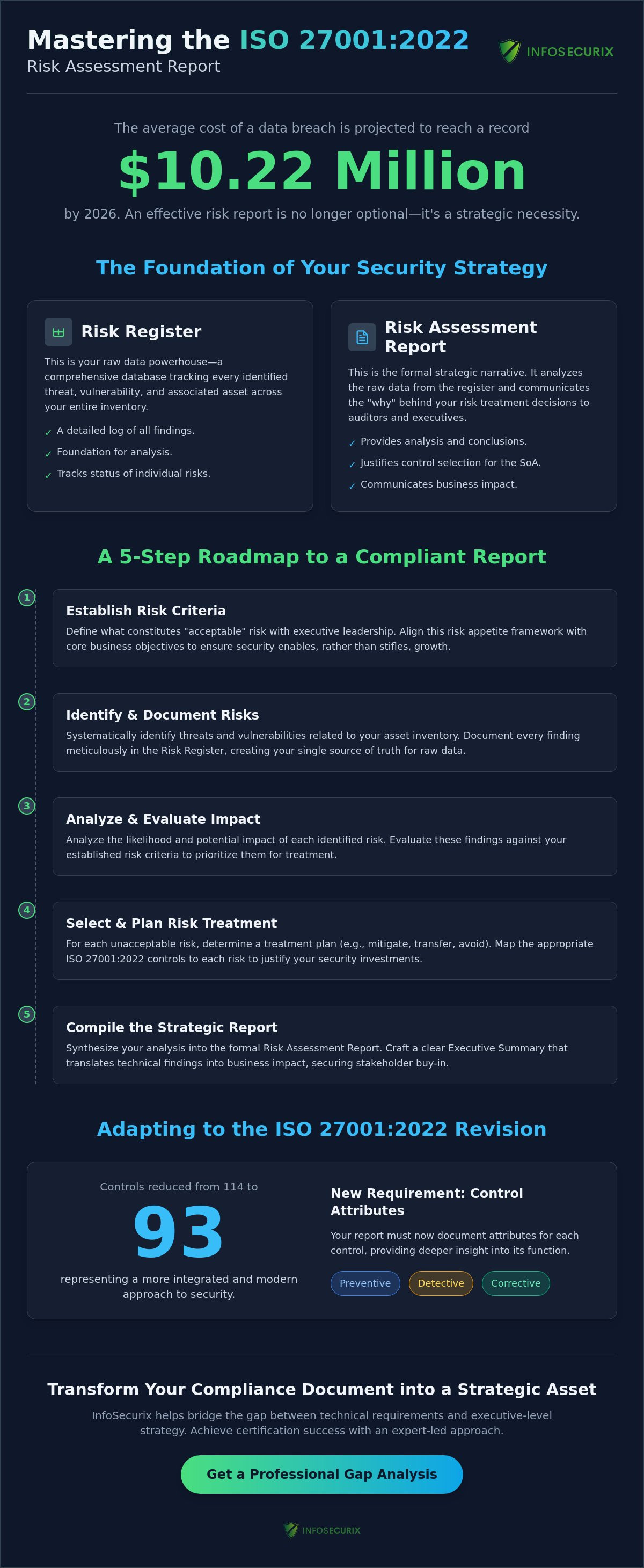
- Risk Register: This acts as your database of raw findings, tracking every identified threat and vulnerability across your asset inventory.
- Risk Assessment Report: This is the formal analysis and conclusion, providing the “why” behind your risk treatment decisions for executive review.
Establishing Risk Acceptance Criteria
Defining what constitutes an “acceptable” risk is a prerequisite for any meaningful assessment. Your report must articulate these criteria before listing any findings. This isn’t a task for the IT department alone; executive leadership must sign off on the risk appetite framework to ensure security measures don’t stifle innovation. When you align these criteria with core business objectives, the ISMS becomes an enabler of growth. It provides a steady baseline that allows your team to move forward with absolute confidence, knowing exactly which risks are tolerated and which require immediate mitigation.
The Impact of the 2022 Revision on Reporting
The transition to the 2022 version of the standard introduced significant structural changes that your ISO 27001 risk assessment report template must reflect. The reduction from 114 to 93 controls represents a more integrated approach to modern security challenges. Modern reports should now document specific “Attributes” for each control, such as whether they are Preventive, Detective, or Corrective. Whether you utilize an asset-based or process-based methodology, your report must clearly map these new controls to the specific risks identified. This level of detail provides auditors with the transparency they require while giving stakeholders a visionary look at the organization’s defensive depth.
Essential Components of a Modern ISO 27001 Risk Assessment Template
A sophisticated ISO 27001 risk assessment report template functions as a formal narrative, moving beyond simple data entry to provide a comprehensive view of organizational health. The Executive Summary serves a singular, vital purpose: it distills the dense technicalities of your security environment into a strategic overview for decision-makers who hold the budget. By focusing on business impact rather than just technical flaws, you transform the document from a compliance requirement into a tool for securing executive buy-in. This high-level perspective allows stakeholders to see security as a protective force that enables growth.
Proving the validity of your findings requires a robust Methodology Statement. Auditors look for evidence that your process is repeatable and grounded in recognized logic, such as the principles found in the NIST Risk Management Framework (RMF). Your template must clearly define the steps taken to identify, analyze, and evaluate risks to ensure consistency across different audit cycles. This methodological rigor builds a sense of absolute confidence in the final results, demonstrating that your security posture is the result of deliberate planning.
Asset Inventory and Ownership ensure that risk isn’t a theoretical concept but a localized business reality. By mapping threats to specific business functions and responsible parties, you assign accountability to the individuals best positioned to manage those risks. The technical core of the document remains the Threat and Vulnerability Matrices. Here, the intersection of likelihood and impact creates a prioritized list of concerns that informs your entire security strategy, ensuring that resources are allocated where they’re most needed.
The Risk Treatment Plan (RTP) Integration
Every risk identified must lead to a definitive action. Your template should categorize treatments into four clear paths: Avoid, Transfer, Mitigate, or Accept. The most critical metric for any auditor is the “Residual Risk,” which represents the vulnerability remaining after your controls are active. Linking these decisions directly to the 93 Annex A controls from the 2022 revision ensures absolute transparency in your compliance journey. This integration proves that your treatment plan isn’t just a list of tasks but a systematic reduction of corporate exposure.
Evidence Sources and Validation
Surviving a Stage 2 certification audit requires more than just claims; it requires verifiable proof. Your report must list specific evidence sources, including system logs, stakeholder interviews, and automated vulnerability scans. These references provide the factual basis that prevents your assessment from appearing subjective or incomplete. Comprehensive Risk Assessments depend on these validated data points to maintain the integrity of the final risk score. Ultimately, the presence of diverse evidence sources confirms that your risk scoring is a reflection of reality rather than a product of estimation.
Strategic Narrative vs. Static Data: Why Most Templates Fail
Many organizations treat their ISO 27001 risk assessment report template as a static repository for technical data. This approach often leads to the “Checklist Trap,” where the document satisfies the letter of the law but fails to provide any strategic value. A “Critical” risk rating is an abstract concept; it only gains meaning when it’s translated into potential lost revenue, legal liability, or a catastrophic breach of client trust. Auditors quickly identify and often reject reports that lack human analysis. They seek evidence of professional judgment that considers the unique context of your industry and operational environment.
Presenting a narrative that resonates with the Board requires a shift in perspective. You aren’t just managing servers; you’re protecting the organization’s future. Aligning your internal findings with established standards, such as CISA cybersecurity guidance, adds a layer of authoritative weight to your conclusions. This strategic approach yields tangible results. A prominent SaaS firm recently leveraged a well-narrated risk report to secure a 20% increase in their security budget. They succeeded because they didn’t just show a list of flaws; they presented a compelling story of risk mitigation and business resilience.
Communicating Residual Risk to the Board
Executives value clarity and visual evidence. Utilizing a heat map within your ISO 27001 risk assessment report template allows you to illustrate the dramatic shift from inherent risk to residual risk. This visual representation makes the impact of your security investments undeniable. When discussing “Risk Acceptance,” it’s crucial to frame the conversation around informed consent. This protects the CISO and leadership by documenting that specific risks were acknowledged and accepted as part of the broader risk appetite. Referencing the Strategic Guide to Information Security Risk Assessment can help you tailor these high-level communications to ensure they remain sophisticated and empowering.
The Role of Internal Audit in Report Refinement
An internal audit acts as a rigorous filter, catching inconsistencies before they reach the certification body. It’s essential that your risk report remains in total lockstep with the findings of your Information Security Internal Audit. This synchronization demonstrates a mature, interconnected ISMS that values accuracy over convenience. By documenting the clear path from “Risk” to “Resolved” through structured corrective actions, you provide auditors with a narrative of proactive management. This methodical flow instills confidence in your organization’s ability to maintain the highest standards of security over the long term.
How to Complete Your ISO 27001 Risk Assessment Report: A 5-Step Roadmap
Executing a meticulous risk assessment requires more than just technical knowledge; it demands a structured, logical sequence that translates operational reality into a formal record. Your ISO 27001 risk assessment report template serves as the vessel for this journey: guiding you through five critical milestones that ensure both compliance and strategic clarity. This methodical approach transforms a complex requirement into a manageable, repeatable process that instills absolute confidence in your security posture.
- Step 1: Define the Scope and Methodology. Ensure your report remains strictly within the ISMS boundaries established in your foundational documentation.
- Step 2: Identify Assets and Threats. Contextualize potential vulnerabilities within your specific business processes to avoid generic, unhelpful findings.
- Step 3: Analyze and Evaluate. Assign risk scores based on the pre-defined acceptance criteria your leadership has already approved.
- Step 4: Formulate the Risk Treatment Plan. Select appropriate Annex A controls to address high-priority findings with precision.
- Step 5: Final Review and Approval. Secure formal sign-off from the Risk Owner to ensure accountability at the highest levels.
Step 2 Deep-Dive: Asset Identification
Effective identification starts with categorizing your assets into four primary pillars: Information, Software, Physical, and People. Assigning specific owners to these categories is vital; every identified risk must have a name attached to it to ensure long-term accountability. This granular level of detail prevents risks from becoming orphaned within the organization. The inherent value of an asset directly dictates the potential business impact should its confidentiality, integrity, or availability be compromised.
Step 4 Deep-Dive: Selecting Controls
Selecting the right safeguards involves a careful mapping of findings to the 93 controls outlined in the 2022 revision. Utilizing a comprehensive ISO 27001 Readiness Checklist ensures that no critical Annex A requirements are overlooked during this phase. You must also provide a clear justification for any controls excluded from your Statement of Applicability (SoA) to maintain auditor transparency. Modern reporting now requires mapping these selections to specific “Attributes,” such as Preventive or Detective, to provide a visionary view of your defensive depth. If you’re ready to validate your current posture, scheduling professional Risk Assessments is the most effective way to ensure your report meets the highest industry standards.
Professional Readiness: Bridging the Gap Between Template and Certification
A sophisticated ISO 27001 risk assessment report template provides the necessary structural integrity for your ISMS; however, the document itself represents only 20% of the journey toward successful certification. The remaining 80% of the value is found in expert implementation: the process of weaving technical findings into the unique operational fabric of your business. This contextualization ensures that your security posture is not just a theoretical exercise but a functional shield. With a 25-year legacy of excellence, InfoSecurix specializes in turning these compliance requirements into a definitive competitive advantage for our partners.
Engaging in a third-party gap analysis serves as a critical validation step for your internal efforts. This objective review identifies the subtle nuances that internal teams might overlook, providing a sense of absolute confidence before the formal certification body arrives. Modern organizations are increasingly moving toward a “Continuous Compliance” model to maintain this high standard. By treating your risk report as a living document that evolves alongside emerging threats, you ensure that your security narrative remains accurate and effective between annual audits. This proactive approach reflects a mature organization that prioritizes longevity and resilience.
Leveraging Expert Guidance for Audit Success
Seasoned consultants identify the “blind spots” in your internal risk assessment that could lead to non-conformities during an audit. This high-level guidance is particularly valuable when your organization seeks to align with multiple frameworks, such as the transition from ISO 27001 to SOC 2 Readiness. Customizing your ISO 27001 risk assessment report template to meet the stringent demands of specific industry regulations like HIPAA or FedRAMP requires the precision of a trusted advisor who has navigated these complexities many times before.
Next Steps: Securing Your Organization
The transition from preparation to certification requires a methodical final push. Requesting a formal review of your current risk management documentation is the most effective way to ensure your report meets the elevated standards of 2026. Following this review, scheduling a comprehensive internal audit will allow you to stress-test your ISMS under simulated audit conditions. This final layer of scrutiny ensures that every asset, threat, and control is perfectly aligned with your business objectives. To ensure your organization is truly audit-ready, Partner with InfoSecurix for Expert ISO 27001 Readiness and secure your path to enterprise trust.
Securing Your Legacy of Information Security Excellence
Navigating the complexities of the 2022 standard requires a shift from passive documentation to active, strategic storytelling. You’ve learned that a professional ISO 27001 risk assessment report template is more than a compliance requirement; it’s a vital bridge between technical vulnerabilities and business resilience. By following a methodical roadmap and prioritizing human analysis over automated checklists, you position your organization as a leader in corporate integrity. Confidence is the result of precision. This approach ensures that your security posture isn’t just a defensive measure but a catalyst for long-term growth.
InfoSecurix brings over 25 years of information security expertise to your certification journey. Our national coverage for complex enterprise compliance ensures that your unique operational challenges are met with bespoke, high-level solutions. Through our milestone-based engagements, we provide a structured path to guaranteed readiness that instills absolute confidence in your stakeholders. We invite you to Download Your Strategic ISO 27001 Roadmap or Book a Consultation today. Your commitment to these rigorous standards today will future-proof your business for the challenges of tomorrow.
Frequently Asked Questions
What is the difference between a risk assessment and a risk treatment plan?
The risk assessment identifies and evaluates potential threats to your information security, while the risk treatment plan defines your specific response to those findings. Think of the assessment as the diagnostic phase that uncovers vulnerabilities and assigns scores. The treatment plan is the strategic prescription, detailing whether you’ll avoid, transfer, mitigate, or accept each risk through the application of Annex A controls.
How often should the ISO 27001 risk assessment report be updated?
You should update your report at least annually or whenever a significant change occurs within your business environment. Major shifts include acquiring new assets, implementing different technologies, or experiencing a change in physical location. Regular updates ensure your ISMS remains a living, protective force that reflects your current threat landscape and operational reality, providing absolute confidence to your stakeholders and auditors alike.
Is an asset-based risk assessment still required in the 2022 version of ISO 27001?
No, the 2022 version doesn’t strictly mandate an asset-based approach for your documentation. Organizations have the flexibility to choose between asset-based, process-based, or threat-based methodologies depending on their specific needs. While the standard is now more flexible, many seasoned guides still recommend an asset-based model because it provides a precise, granular view of vulnerabilities that’s easy for auditors to follow and validate.
What are the most common mistakes in ISO 27001 risk assessment reports?
The most frequent errors include failing to define clear risk acceptance criteria and neglecting to document residual risk. Many reports also become too focused on granular technical mechanics without explaining the strategic business impact. If your report doesn’t translate a “High” risk into potential revenue loss or legal liability, it’ll likely fail to secure the necessary buy-in from executive decision-makers during budget discussions.
Can I use a free Excel template for my ISO 27001 certification audit?
You can utilize a free ISO 27001 risk assessment report template in Excel, but these basic tools often lack the sophistication required for a successful Stage 2 audit. Most free versions don’t account for the 2022 Annex A restructuring or the new control “Attributes.” For complex enterprises, a bespoke framework is usually necessary to ensure the document functions as a strategic roadmap rather than just a simple checklist.
Who is responsible for signing off on the risk assessment report?
The designated Risk Owner is the individual responsible for the formal sign-off on the final report. This person must have the appropriate level of authority to accept the residual risk on behalf of the organization. Their approval confirms that the identified risks and the proposed treatment plan align with the established corporate risk appetite, ensuring accountability is maintained at a high leadership level.
How do the new 2022 Annex A controls affect my existing risk report?
The transition to the 2022 version requires you to re-map your entire treatment plan to the updated 93 controls. You’ll need to update your ISO 27001 risk assessment report template to reflect the four new themes: Organizational, People, Physical, and Technological. This process ensures your reporting remains compliant with current standards and accurately documents the 11 new controls introduced to address modern cybersecurity challenges.
What is the relationship between the risk assessment report and the Statement of Applicability (SoA)?
The risk assessment report provides the logical justification for every selection made within your Statement of Applicability. It acts as the evidence-based foundation that proves why certain controls are necessary and why others were excluded. Without a robust assessment report, the SoA appears arbitrary to auditors, as it lacks the documented analysis required to prove your security posture is rooted in actual risk.