

Most organizations treat their information security policies as a static hurdle to be cleared rather than a strategic shield to be wielded. With over 70,000 active certifications worldwide as of May 2026, the distinction between simple paper compliance and a truly resilient security framework has become a defining factor in corporate growth. You’ve likely found that generic templates fail to capture the nuances of your specific business processes. This is why specialized ISO 27001 policy development services are no longer just a luxury for the enterprise. They’re a necessity for any firm that views security as a competitive advantage.
It’s understandable to feel overwhelmed by the requirement to map 93 restructured Annex A controls to high-level policy language while maintaining internal relevance. We believe that your documentation should empower your team instead of hindering them. This article provides a professional framework to master the complexities of ISO 27001:2022 documentation and transform your policies into strategic assets. We’ll explore the essential roadmap of required documents, the specific value of expert-led development, and the steps you need to take to pass your Stage 1 audit with complete confidence.
Key Takeaways
- Define the strategic role of policies as the foundational “constitution” of your ISMS to ensure a seamless Stage 1 readiness review.
- Differentiate between high-level strategic policies and granular procedures to create a documentation framework that meets ISO 27001:2022 requirements.
- Recognize the value of professional ISO 27001 policy development services in eliminating the hidden costs and compliance gaps found in generic templates.
- Maintain a dynamic governance lifecycle through rhythmic review cycles: ensuring your documentation evolves alongside emerging security threats.
- Leverage a bespoke, audit-hardened methodology to transform static documents into protective assets that enable organizational growth.
The Strategic Role of ISO 27001 Policies in Modern Compliance
Think of your Information Security Management System (ISMS) as a sovereign state. In this analogy, your policies serve as the foundational constitution: the governing principles that dictate how information is protected, processed, and preserved. Within the framework of the ISO/IEC 27001 standard, these documents aren’t merely administrative formalities. They’re the primary evidence of management’s commitment to security. When an auditor begins a Stage 1 readiness review, they don’t start with your firewall logs or server configurations. They start with your policies. This initial examination determines if your system’s design is theoretically capable of meeting the standard’s rigorous requirements.
Engaging professional ISO 27001 policy development services ensures that this constitution is more than a binder on a shelf. In the 2026 regulatory environment, the industry has shifted decisively away from static documentation. Modern compliance demands “active controls”: policies that function as living, breathing instructions that directly influence technical configurations and human behavior. A robust policy set acts as a blueprint for organizational resilience, providing a steady hand when cyber threats escalate or operational complexities increase. It’s the difference between a reactive IT department and a proactive, security-first enterprise.
Beyond Compliance: Policies as Business Enablers
High-quality policy development transforms security from a cost center into a powerful business driver. When you present clear, authoritative documentation to potential partners, you’re doing more than checking a box; you’re building enterprise trust. This level of transparency is essential for securing high-value contracts in 2026. Clear policies also eliminate the ambiguity that often plagues internal operations. They provide employees with a definitive “source of truth,” which reduces operational friction and speeds up decision-making. By aligning security objectives with your overall corporate strategy, you ensure that every protective measure also supports your long-term growth goals.
The Pitfalls of Policy Ambiguity
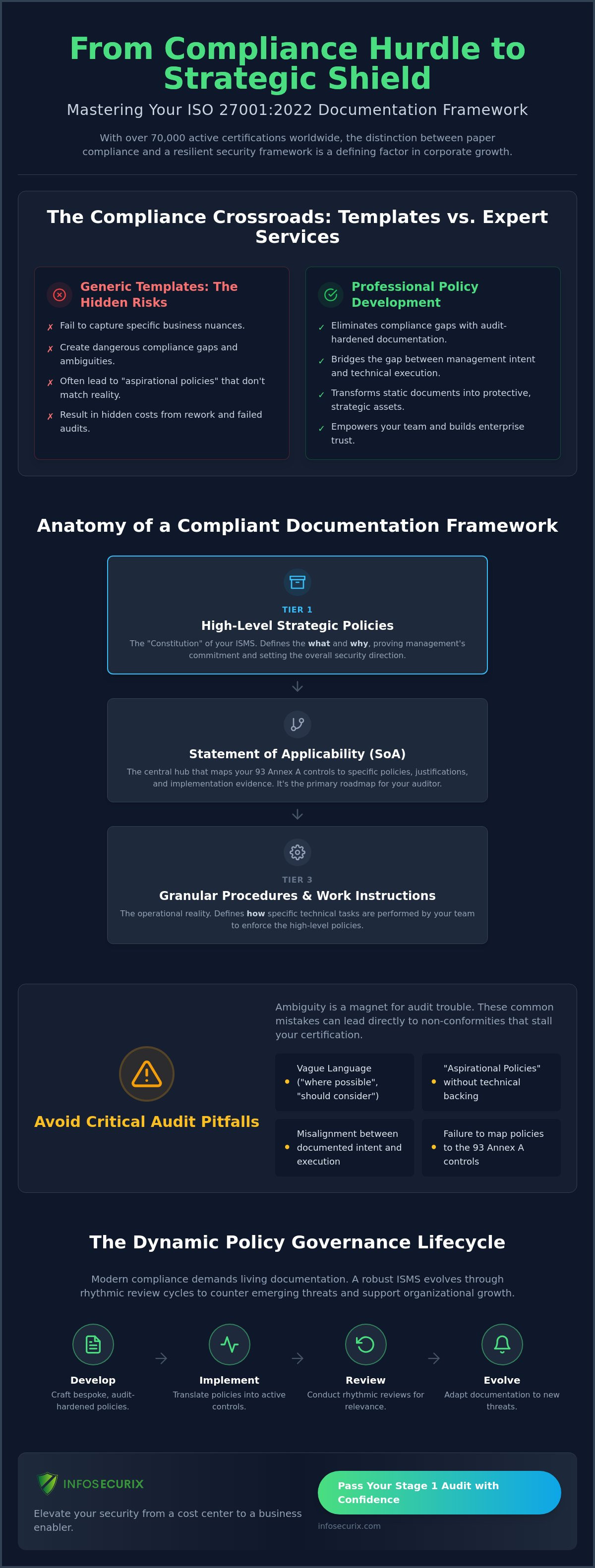
Vague language is a magnet for audit trouble. If a policy uses non-committal terms like “where possible” or “should consider,” it creates a gap that auditors will inevitably exploit. The most common danger is the “aspirational policy.” This occurs when an organization documents a world-class security posture that their actual technical capabilities or internal expertise cannot support. During a certification audit, this misalignment leads directly to non-conformities that can stall your progress. A non-conformity is a formal finding where an organization’s documented policy fails to meet the standard’s requirements or where the organization’s actual practices fail to follow its own documented rules.
Utilizing expert ISO 27001 policy development services helps bridge this gap between intent and execution. By crafting documentation that is both compliant and achievable, you set your organization on a path toward a successful Stage 1 audit and a more secure future.
Core Components of a Compliant ISO 27001 Policy Framework
Developing a compliant framework for the official ISO/IEC 27001 standard involves more than just drafting a list of rules. It requires a structured hierarchy that translates management intent into operational reality. Utilizing professional ISO 27001 policy development services helps organizations master the transition to the 2022 revision by establishing a clear distinction between high-level ‘Tier 1’ policies and granular ‘Tier 3’ procedures. Tier 1 documents define the “what” and “why” for the entire organization. Tier 3 procedures provide the “how” for specific technical tasks. This separation is vital: it prevents your high-level strategy from becoming bogged down in technical minutiae that changes frequently.
The Statement of Applicability (SoA) acts as the central hub of this framework. It maps your chosen controls to specific policies and implementation evidence, serving as the primary roadmap for your auditor. Within this map, certain Annex A control areas demand dedicated policy coverage. Access Control and Cryptography are prime examples: these areas are so technically complex and risk-heavy that a single paragraph in a general policy is rarely sufficient. Expert ISO 27001 policy development services ensure these critical areas receive the depth they require to survive a rigorous Stage 1 audit. Ensuring your framework is truly audit-hardened requires a level of precision that only comes with seasoned experience.
The Information Security Policy (Clause 5.2)
Clause 5.2 requires more than a signature; it demands a demonstration of executive leadership commitment. This policy must align with your organization’s purpose and provide the specific framework for setting security objectives. It’s a statement of intent that must be communicated to every stakeholder: ensuring that security is seen as a shared responsibility rather than an IT burden. Without this top-down alignment, even the most technical controls risk failing during a certification review.
Mapping Annex A Controls to Documentation
The 2022 revision consolidated the previous 114 controls into 93, organized into four distinct themes: Organizational, People, Physical, and Technological. Grouping these controls into manageable policy sets is essential for maintaining clarity and ownership. For a broader look at the path to compliance, consult The Strategic Guide to ISO 27001 Certification Readiness in 2026. Integrating these themes into your documentation ensures that physical security and human resource controls are treated with the same rigor as your technological defenses: creating a truly comprehensive security posture.
Templates vs. Professional Policy Development Services
Many organizations begin their compliance journey by purchasing a $500 template kit: assuming it’s the most efficient path to certification. While these toolkits offer a baseline, they often carry significant hidden costs in the form of internal labor and audit failure risks. When your team spends hundreds of hours attempting to customize generic language to fit your specific technical environment, the perceived savings evaporate. Professional ISO 27001 policy development services provide a different path: one that prioritizes accuracy and strategic alignment from the outset. A seasoned consultant acts as a trusted advisor, interpreting the complex requirements of the standard through the lens of your specific industry and tech stack.
Choosing a bespoke approach doesn’t mean starting from a blank page. Instead, it means applying a refined, audit-hardened framework that is meticulously curated to your business. The most common objection we hear is that an internal team can handle the documentation with a basic toolkit. However, a toolkit is merely a set of parts; a professional service is the engineering that ensures those parts function as a unified shield. This distinction is critical when transitioning to the new standard, where the nuances of the 2022 revision require deep technical and regulatory insight.
The Limitations of Generic Documentation Kits
Generic kits suffer from the “square peg, round hole” problem. They frequently include irrelevant controls that have no bearing on your operations, such as physical security measures for a fully remote, cloud-native firm. Including these unnecessary elements creates audit overhead: forcing you to defend why certain controls aren’t implemented. Most templates are also disconnected from your specific risk assessment. They offer a one-size-fits-all solution that fails to address the unique threats your organization faces in 2026. This lack of integration can lead to significant non-conformities during your certification audit.
The ROI of Professional Engagement
Engaging experts provides an immediate return through accelerated timelines. Professional consultants often reduce the documentation phase by more than half: allowing your internal team to focus on core business activities rather than deciphering the intricacies of Annex A. This engagement also provides audit-ready assurance, backed by decades of experience in navigating Stage 1 and Stage 2 reviews. To ensure your policies are truly effective before the external auditor arrives, it’s essential to integrate them with Mastering Information Security Internal Audits. This holistic approach ensures your documentation isn’t just compliant on paper but resilient in practice.
The Lifecycle of Policy Governance and Maintenance
Establishing a robust set of security documents is a significant milestone, yet it’s only the beginning of a continuous journey. Policies aren’t meant to be static artifacts; they’re dynamic controls that require a rhythmic lifecycle of governance and maintenance. Engaging professional ISO 27001 policy development services provides your organization with the structural discipline needed to ensure these documents remain “fit for purpose” as your business evolves and new threats emerge. This ongoing lifecycle is what separates a mere paper exercise from a truly resilient Information Security Management System (ISMS).
Internal audits play a critical role in this cycle by verifying policy adherence across every department. They serve as a vital feedback loop, identifying where documented rules might be failing in practice or where employee behavior has drifted from established standards. To manage this complexity, many sophisticated organizations leverage GRC (Governance, Risk, and Compliance) tools. These platforms simplify version control and approval workflows, ensuring that your team always has access to the most current, authorized documentation. This methodical approach prevents the confusion that often arises when multiple versions of a policy circulate simultaneously.
The final, and perhaps most vital, stage of the lifecycle is training and awareness. A policy only truly exists when it’s understood and followed by your staff. Effective governance involves turning legalistic text into observable employee behavior through consistent communication and education. For organizations that require a seasoned guide to manage this enduring cycle, our ISO 27001 certification readiness services offer the expertise needed to maintain a high-performance compliance posture.
Annual Reviews and Version Control
While an annual review is the standard expectation, certain triggers should prompt an immediate, unscheduled reassessment. Significant organizational changes, such as a merger or a major tech stack migration, necessitate a fresh look at your security framework. Maintaining a meticulous audit trail of every modification is essential for satisfying certification bodies during surveillance audits. This level of governance is deeply intertwined with The Strategic Guide to Information Security Risk Assessment in 2026, as your policies must always reflect your most current risk profile.
Measuring Policy Effectiveness
You can’t manage what you don’t measure. Defining Key Performance Indicators (KPIs) for your security documentation allows you to quantify its impact on your organization. If an internal review reveals a gap, use “Corrective Actions” to refine the policy language or improve the underlying technical process. This cycle of continuous improvement is reinforced by executive sign-off. When leadership formally approves policy updates, it sends a clear signal that security is a non-negotiable priority: fostering a culture of accountability that permeates the entire enterprise.
Elevating Your Compliance with InfoSecurix Expertise
InfoSecurix stands as a boutique consultancy defined by a legacy of excellence: over 25 years of specialized experience in navigating the most complex regulatory landscapes. Recognizing that your organization requires more than a standard checklist, our methodology moves decisively beyond the limitations of generic templates. We deliver bespoke, audit-hardened documentation that reflects your unique operational DNA. Choosing our specialized ISO 27001 policy development services ensures you aren’t just hiring a contractor; you’re engaging a seasoned guide who understands how to bridge the gap between technical ISO requirements and your high-level strategic objectives. Our confidence comes from a legacy of success and a deep-rooted knowledge of the certification process.
Rooted in collaborative partnership, the “InfoSecurix Advantage” focuses on the positive outcomes of rigorous standards. We don’t operate in a vacuum. Instead, we work alongside your leadership team to ensure every policy serves as a protective force that enables corporate growth. This visionary approach focuses on future-proofing your business through meticulous standards that are both achievable and rigorous. We act as a steadying presence, ensuring that the burden of compliance is transformed into a streamlined asset for your enterprise. It’s an empowering transition that positions your firm as a trusted leader in your industry.
Our ISO 27001 Policy Development Process
Our engagement begins with a comprehensive gap analysis and risk-based scoping of your documentation needs. This foundational step ensures we only develop what is necessary for your specific threat profile, which avoids the overhead of irrelevant controls. Collaborative drafting sessions follow: a process where operational reality is meticulously mapped to policy language to ensure total alignment across all departments. Ensuring your documentation is prepared to withstand the scrutiny of a certification body, we conclude with an intensive auditor-readiness check. This final review provides the absolute confidence required to move toward certification with poise and clarity.
Partnering for National Excellence
Leading firms across the United States trust InfoSecurix for our high-level consulting and deep-rooted knowledge of the modern threat landscape. We remain committed to serving organizations with a sophisticated balance of authoritative expertise and reassuring partnership. Our reputation for excellence extends beyond ISO standards to include comprehensive SOC 2 readiness assessments and internal audit capabilities. Maintaining a steady, authoritative presence throughout the certification journey allows you to focus on your core business while we handle the complexities of the framework. We invite you to Experience the Precision of InfoSecurix Policy Development Services and secure your organization’s long-term resilience today.
Future-Proofing Your Enterprise through Strategic Compliance
Mastering the transition to the 2022 standard requires a fundamental shift in perspective: viewing your policies as active strategic assets rather than static administrative burdens. We’ve explored how a robust documentation framework acts as the constitution of your ISMS, bridging the gap between management intent and operational reality. By moving beyond the limitations of generic templates and embracing a lifecycle of continuous governance, you position your organization for long-term resilience and market trust. Specialized ISO 27001 policy development services offer the precision and technical depth necessary to survive the scrutiny of modern audits while supporting your broader corporate growth.
With over 25 years of boutique consultancy experience and deep expertise across ISO 27001, SOC 2, and ISO 22301, InfoSecurix remains a steadfast partner in your compliance journey. Our proven track record of 100% audit readiness success ensures that your path to certification is both smooth and certain. We invite you to Secure Your Certification with Bespoke Policy Development from InfoSecurix. Your commitment to these rigorous standards today establishes the foundation for a secure and prosperous digital future.
Frequently Asked Questions
What are the mandatory policies required for ISO 27001:2022 certification?
The standard specifically mandates a high-level Information Security Policy as defined in Clause 5.2. Beyond this foundational document, you must establish clear policies for specific Annex A controls: including access control, cryptography, and physical security. Utilizing professional ISO 27001 policy development services ensures that every mandatory requirement is addressed with the precision necessary to satisfy an external auditor during your Stage 1 review.
Can we use templates to develop our information security policies?
While templates offer a baseline, they often fail to reflect the unique technical and operational nuances of your specific organization. Relying solely on generic kits can lead to significant non-conformities if the documented rules don’t match your actual internal practices. Professional engagement provides the bespoke tailoring required to transform static documents into active, protective controls that support your executive business objectives and long-term growth.
How often should ISO 27001 policies be reviewed and updated?
You should review your policies at least annually or whenever a significant organizational change occurs. Triggers for an unscheduled review include major tech stack migrations, mergers, or the emergence of new security threats in the 2026 landscape. This rhythmic maintenance ensures that your documentation remains “fit for purpose” and accurately reflects your current risk profile: maintaining the integrity of your ISMS over the entire certification cycle.
What is the difference between a policy, a process, and a procedure in ISO 27001?
A policy defines high-level goals and management intent: essentially the “what” and “why” of your security posture. A process outlines the workflow and interaction between different departments, while a procedure provides granular, step-by-step instructions for specific technical tasks. Maintaining this clear hierarchy prevents your strategic documents from becoming cluttered with granular technical details that may require frequent updates as your technology evolves.
Who is responsible for approving the Information Security Policy?
Top management is ultimately responsible for approving the Information Security Policy to demonstrate executive leadership commitment. This formal sign-off is a critical requirement of Clause 5.1 and 5.2 of the standard. It signals to both employees and auditors that security is a core priority of the enterprise: fostering a culture of accountability and resilience that permeates every level of the organization.
How long does it typically take to develop a full suite of ISO 27001 policies?
Developing a comprehensive suite of policies typically takes between three to six months for organizations managing the process internally. This timeline can be significantly accelerated through expert ISO 27001 policy development services: often reducing the documentation phase by more than half. The actual duration depends on the complexity of your technical environment and the availability of internal stakeholders for collaborative drafting sessions.
Do we need separate policies for SOC 2 and ISO 27001?
You don’t need separate policies for SOC 2 and ISO 27001; instead, you should develop an integrated framework that addresses both standards simultaneously. Since there is a 60-80% overlap between these frameworks, a unified documentation set reduces administrative overhead and ensures operational consistency. Mapping your controls to both standards allows you to demonstrate compliance to diverse global partners with a single, authoritative source of truth.
How do we ensure employees actually follow the security policies we develop?
Ensuring adherence requires moving beyond the written document and focusing on continuous training and awareness programs. Employees are more likely to follow policies when they understand the strategic value of the rules and how those rules protect the organization’s reputation. Regular monitoring and internal audits provide the necessary feedback loops to verify compliance: allowing you to refine your documentation and training efforts based on actual behavioral data.