
With 58% of organizations undergoing four or more audits in 2025, the pressure to maintain a state of perpetual readiness has never been higher. You’re likely familiar with the uncertainty of determining the appropriate Trust Services Criteria or the fear that a single audit exception could compromise a major enterprise contract. It’s a complex environment where internal resource constraints often lead to documentation gaps and missed controls. Our meticulously curated soc2 readiness assessment services offer the professional oversight needed to manage these challenges with precision. We believe that rigorous standards should empower your growth: not hinder it.
This article demonstrates how a strategic assessment provides a clear, actionable roadmap to audit success while minimizing remediation costs through early gap identification. You’ll learn how to transform your compliance posture into a foundation of enterprise trust. We’ll examine the systematic steps required to future-proof your business and ensure your next audit is a milestone of achievement rather than a source of stress. By identifying vulnerabilities early, you can focus on what matters most: scaling your organization with total security confidence.
Key Takeaways
- Recognize the assessment as a sophisticated diagnostic tool; it functions as a comprehensive review of your control environment before the formal CPA examination.
- Navigate the five pillars of the Trust Services Criteria to determine which specific requirements align with your unique customer commitments.
- Distinguish between internal diagnostic phases and public attestation reports; this clarity ensures your organization focuses on design before testing operational effectiveness.
- Leverage professional soc2 readiness assessment services to conduct a systematic gap analysis, allowing you to identify and remediate vulnerabilities before they impact audit outcomes.
- Transition from a reactive security posture to one of continuous compliance, positioning your rigorous standards as a strategic differentiator for enterprise growth.
Defining the SOC 2 Readiness Assessment: A Strategic Precursor to Compliance
A SOC 2 readiness assessment is a comprehensive diagnostic review of your organization’s control environment. It serves as a sophisticated risk-mitigation strategy that secures enterprise growth by ensuring your security framework is resilient before external scrutiny begins. Rather than viewing this as a simple hurdle, consider it a curated opportunity to align your internal operations with the rigorous standards established for System and Organization Controls (SOC) reporting. Our specialized soc2 readiness assessment services act as a strategic mirror, reflecting the maturity of your current processes against the AICPA Trust Services Criteria.
This process functions essentially as a mock audit. It allows your team to identify vulnerabilities and documentation gaps in a controlled, non-public environment before the formal CPA examination takes place. By simulating the pressures and requirements of the actual audit, you gain the clarity needed to refine your controls. This proactive alignment doesn’t just prepare you for a report; it strengthens the very foundation of your information security posture. It’s a methodical approach to excellence that transforms compliance from a technical requirement into a competitive advantage.
The Value of Pre-Audit Diagnostics
Engaging in a diagnostic review before the official reporting period begins is a move of seasoned foresight. Identifying control gaps early prevents the significant reputational and financial damage of audit exceptions or a qualified opinion. This phase provides management with a clear, authoritative baseline of their current compliance posture. Beyond the security benefits, this preparation reduces the overall time and financial commitment required for the final Type 1 or Type 2 audit. Choosing professional soc2 readiness assessment services allows management to enter the formal audit cycle with absolute confidence, knowing that the heavy lifting of remediation is already complete.
Who Needs a Readiness Assessment?
Organizations pursuing SOC 2 for the first time find the most immediate value in building a foundational compliance roadmap. Without a guide, the complexities of the Trust Services Criteria can feel overwhelming. Additionally, companies undergoing significant infrastructure changes or entering new market sectors require a fresh look at their control environment to ensure new risks are mitigated. Enterprises looking to consolidate multiple security frameworks, such as ISO 27001 and SOC 2, into a unified strategy also benefit from this diagnostic approach. It ensures that every control is purposeful, documented, and ready for the highest level of professional verification.
The Readiness Framework: Navigating the Trust Services Criteria (TSC)
The architecture of a successful audit rests upon the five pillars of the Trust Services Criteria: Security, Availability, Processing Integrity, Confidentiality, and Privacy. While Security remains the mandatory foundation—often referred to as the Common Criteria—the remaining four are selected based on your specific operational commitments and customer expectations. A professional engagement with soc2 readiness assessment services clarifies these complexities by mapping your existing organizational policies directly to the CC series established by the AICPA. This methodical alignment ensures your framework is neither over-engineered nor insufficient for your market needs.
Evaluating the maturity of these controls requires a granular analysis of the 2022 revised Points of Focus. These updated guidelines provide the necessary context for modern, cloud-native environments and evolving cyber threats. By analyzing how your controls perform against these specific benchmarks, we move beyond a simple “pass or fail” mentality. We focus on the strategic impact of your technical processes. This thoroughness ensures that your security culture is as robust as your software, providing a steady hand as you prepare for formal verification.
Selecting the Right Scope for Your Business
Defining the system boundaries is a critical exercise in precision. You must analyze your service offerings to determine which TSC categories are non-negotiable for your specific client base. For example, a data hosting provider might prioritize Availability, whereas a financial platform would focus heavily on Processing Integrity. We work alongside your stakeholders to align these compliance goals with your broader corporate objectives. This collaborative approach ensures that the assessment covers all relevant data and personnel without creating unnecessary administrative drag. It’s about being thorough where it matters most.
Leveraging Cross-Framework Synergy
Many enterprises find that their existing ISO 27001 certification readiness efforts already fulfill a significant portion of SOC 2 requirements. Identifying this overlap allows you to streamline documentation and reduce the “audit fatigue” often felt by internal teams. By creating a centralized control repository, you can serve multiple compliance standards simultaneously. This unified strategy is a hallmark of a mature organization. If you’re ready to harmonize your security standards, our team can help you design a tailored compliance roadmap that maximizes your existing investments and accelerates your path to market.
Strategic Comparison: Readiness Assessment vs. SOC 2 Type 1 and Type 2 Audits
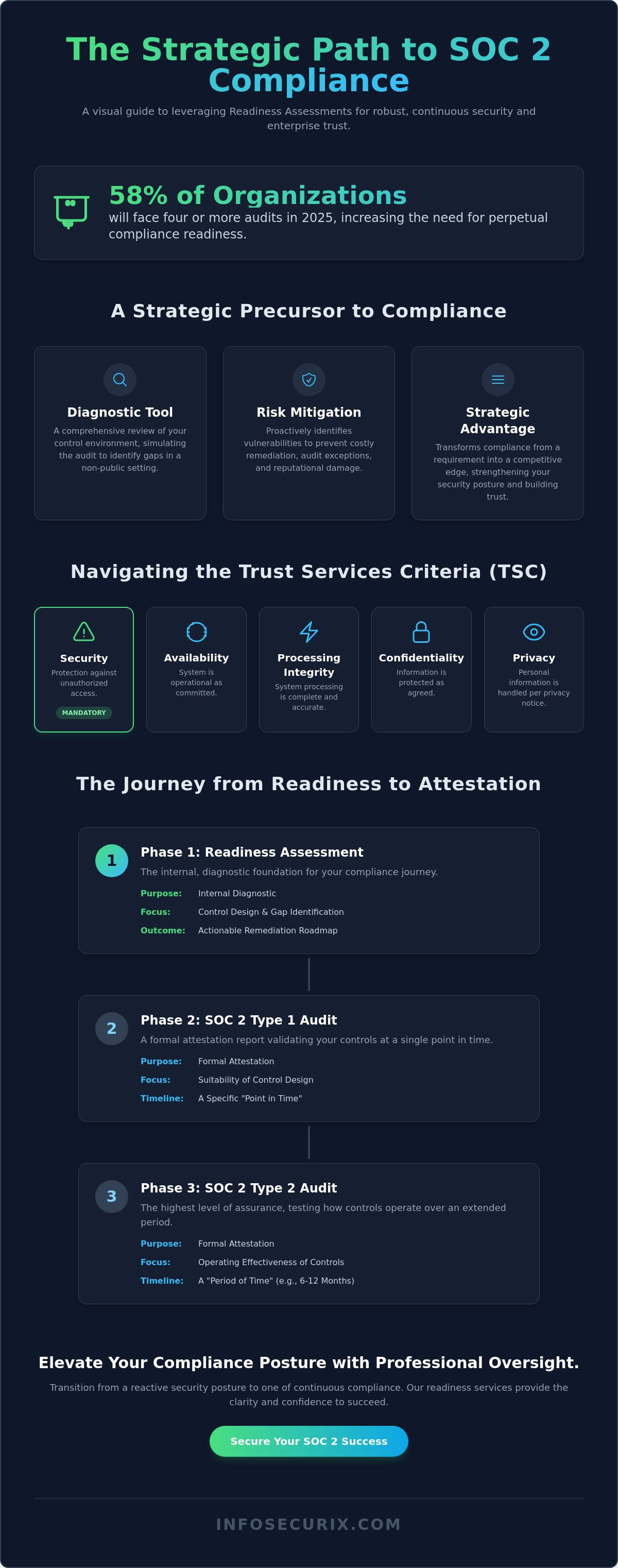
Understanding the distinction between preparatory diagnostics and formal reporting is fundamental to a successful compliance strategy. While Type 1 and Type 2 reports are public facing attestation documents, readiness assessments are internal, non public diagnostics designed to fortify your organization before an auditor arrives. Choosing professional soc2 readiness assessment services provides a critical remediation window that formal audits simply don’t allow. This phase focuses primarily on the design of your controls: ensuring that the policies and technical configurations you have in place are capable of meeting the Trust Services Criteria before they’re officially tested.
In contrast, a SOC 2 Type 1 audit verifies the design of these controls at a specific point in time, while a Type 2 audit evaluates their operating effectiveness over a period, usually three to twelve months. Transitioning from a readiness state to a Type 1 report is often a strategic move for enterprises needing immediate, verified proof of compliance for a pending contract. By completing the readiness phase first, you ensure that the formal audit is a confirmation of excellence rather than a discovery of failure. It’s the difference between practicing for a performance and the performance itself.
The Compliance Timeline
The path to a successful Type 2 report follows a methodical three phase progression that reflects an organization’s growing maturity:
- Phase 1: Readiness and Gap Analysis – This initial diagnostic typically spans several weeks or months. It involves a deep dive into your current environment to identify where controls are missing or insufficient.
- Phase 2: Remediation and Control Implementation – During this stage, your team closes identified gaps, formalizes documentation, and implements the technical safeguards identified in the previous phase.
- Phase 3: The Formal Observation Period – This is the historical window required for a Type 2 report. An auditor will collect evidence of consistent control performance over several months to ensure longevity.
Investment and Resource Allocation
Allocating resources to a readiness engagement is a strategic investment in risk mitigation. When you compare the upfront effort of preparation against the potential loss of a failed audit or a delayed enterprise deal, the value becomes clear. This process requires dedicated internal personnel to manage documentation and evidence collection, ensuring that compliance becomes an integrated part of daily operations. Maintaining this state of readiness requires a commitment to the information security internal audit as a tool for ongoing maintenance. This proactive approach ensures that your organization remains unfazed by the complexities of the regulatory landscape, protecting your growth and your reputation simultaneously.
Executing the Gap Analysis: From Identification to Strategic Remediation
The gap analysis is the pivot point where theoretical compliance meets operational reality. It begins with a systematic review of every technical, administrative, and physical control within your defined system boundaries. We document ‘gaps’ where current practices fail to meet the specific Trust Services Criteria, creating a transparent record of where your organization stands today. This isn’t a list of failures; it’s a blueprint for refinement. Our soc2 readiness assessment services prioritize these remediation efforts based on the actual risk to your data security and the likelihood of audit impact.
Developing a formal Corrective Action Plan (CAP) is the next logical step. This document serves as your strategic roadmap, assigning responsibility and timelines to address every identified deficiency. By focusing on high-risk vulnerabilities first, you ensure that your resources are allocated with maximum efficiency. This structured approach transforms a potentially overwhelming list of tasks into a series of manageable, high-impact improvements. It’s a methodical transition from vulnerability to verified resilience.
Technical and Administrative Remediation
Remediation often requires a sophisticated blend of technical upgrades and policy formalization. You might find it necessary to implement missing technical controls such as multi-factor authentication (MFA) or robust encryption-at-rest protocols. Simultaneously, we focus on formalizing administrative policies, including incident response plans and periodic access review procedures. Every newly implemented control must be documented with sufficient evidence for future auditors. This meticulous attention to detail ensures that when the formal observation period begins, your evidence trail is already established and defensible.
The Human Element: Security Awareness
Technology alone cannot secure an enterprise; the human element is equally critical. Training your personnel on new compliance requirements ensures that controls are followed consistently and understood as part of a broader mission. We help you establish a culture of security that extends beyond the IT department to every level of the organization. Utilizing a soc 2 readiness checklist allows teams to track progress and maintain accountability during the remediation phase. If you’re ready to close the gaps in your security posture, schedule your strategic readiness review today to begin your journey toward verified excellence.
Elevating Your Compliance Posture with InfoSecurix Readiness Services
Leveraging over 25 years of information security expertise provides our clients with the steady hand needed to navigate a complex regulatory landscape. We believe that rigorous standards should be a catalyst for growth, not a source of friction. Our soc2 readiness assessment services go beyond the surface level automation favored by many providers. Instead, we offer a bespoke diagnostic process that prioritizes your strategic business goals alongside technical requirements. This high level focus ensures that your security framework is as visionary as your organization’s future.
Operating as a Seasoned Guide, we partner with your team to ensure a seamless transition to the formal audit. We don’t just identify gaps; we provide the context and expertise required to future proof your business through meticulous standards. This collaborative approach focuses on the strategic impact of technical processes, allowing executive decision makers to move forward with absolute confidence. By building a foundation of trust, you unlock new market opportunities and accelerate your sales cycles with verified security excellence.
The InfoSecurix Advantage
Choosing InfoSecurix means opting for a collaborative, non adversarial approach to the assessment process. While automated tools can flag missing files, they cannot interpret the complex remediation scenarios that define modern enterprise operations. Our consultants provide expert guidance that bridges the gap between technical controls and business logic. We provide dedicated support for soc 2 for small business as well as large scale enterprise operations, ensuring that every engagement is curated to the client’s specific maturity level. This human centric expertise is what distinguishes a successful audit from a mere technical exercise.
Next Steps Toward Enterprise Trust
Transforming your compliance posture begins with a formal consultation to define the scope of your readiness assessment. During this initial phase, we’ll align our diagnostic framework with your customer commitments and internal infrastructure. You’ll have the opportunity to review our strategic corrective action plans, allowing you to visualize the exact path to audit success before you commit to formal reporting. Meticulous preparation is the hallmark of a secure organization. Contact InfoSecurix today to begin your journey toward SOC 2 certification.
Securing a Foundation of Enterprise Excellence
Building a resilient security posture requires more than just meeting technical requirements; it demands a visionary approach to risk management. We’ve examined how a thorough diagnostic review identifies vulnerabilities early, allowing your team to remediate gaps before external auditors arrive. By selecting the appropriate Trust Services Criteria and mapping your controls to the Common Criteria, you ensure your organization is prepared for the highest level of scrutiny. Our specialized soc2 readiness assessment services provide the clarity and professional oversight necessary to navigate this complex journey with total confidence.
InfoSecurix leverages over 25 years of information security expertise to guide your organization through the intricacies of the regulatory landscape. As a specialized boutique consultancy, we offer a comprehensive risk assessment and internal audit portfolio that prioritizes your long-term growth. We invite you to secure your enterprise trust with a Strategic SOC 2 Readiness Assessment from InfoSecurix. Your commitment to these rigorous standards today ensures a legacy of reliability and success for years to come.
Frequently Asked Questions
What is included in a SOC 2 readiness assessment service?
A comprehensive engagement includes a diagnostic review of your technical, administrative, and physical controls mapped against the Trust Services Criteria. Professionals evaluate your existing policies, interview key personnel, and inspect system configurations to determine alignment with the AICPA standards. The process concludes with a detailed report outlining your current compliance maturity and specific recommendations for remediation. This ensures your team has a clear, actionable path toward a successful audit outcome.
How long does a typical SOC 2 readiness assessment take to complete?
Most organizations complete this preparatory phase within four to eight weeks, though the duration depends on the complexity of your environment. Smaller startups with streamlined infrastructures may finish sooner, while larger enterprises with multi-cloud environments require more extensive documentation reviews. This timeline ensures a thorough analysis of every control without rushing the diagnostic process. It’s a methodical investment that prevents future delays during the formal audit period.
Can we perform a SOC 2 readiness assessment internally without a consultant?
While an internal team can certainly review their own controls, they often lack the objective distance required for a rigorous diagnostic. Engaging professional soc2 readiness assessment services provides the seasoned perspective of a third party who understands exactly what an auditor will seek. This external validation identifies blind spots that internal stakeholders might overlook due to familiarity with existing processes. It also lends immediate credibility to your compliance program when presenting to stakeholders.
What is the difference between a gap analysis and a readiness assessment?
A gap analysis is a specific component that identifies missing controls, whereas a readiness assessment is a more holistic diagnostic project. The assessment includes the gap analysis but also encompasses scoping, stakeholder interviews, and the development of a strategic remediation roadmap. It’s a comprehensive preparation phase designed to ensure your organization is fully positioned for a successful formal audit. Think of the gap analysis as the diagnosis and the assessment as the entire treatment plan.
How much do SOC 2 readiness assessment services typically cost?
The investment required for these services varies significantly based on the size of your organization and the number of Trust Services Criteria included in the scope. Factors such as the complexity of your data processing systems and the maturity of your existing documentation also influence the final cost. We recommend a formal consultation to define a precise scope for soc2 readiness assessment services that aligns with your unique enterprise goals and budget requirements.
Will a readiness assessment guarantee that we pass the formal SOC 2 audit?
No service can provide an absolute guarantee of audit success, as the final opinion rests solely with the independent CPA firm. However, a professional assessment drastically reduces the risk of audit exceptions by identifying and remediating vulnerabilities before the formal observation period begins. It provides the confidence and evidence required to navigate the audit process with a high degree of certainty. You’re essentially conducting a dress rehearsal to ensure the final performance is flawless.
How often should an organization undergo a readiness assessment?
Organizations typically undergo a full assessment before their initial SOC 2 audit or when significant infrastructure changes occur. If you’re expanding your scope to include new Trust Services Criteria, such as Privacy or Confidentiality, a fresh diagnostic is essential. Maintaining a state of continuous readiness ensures that your compliance posture evolves alongside your business growth and the modern threat landscape. It’s a proactive habit that future-proofs your organization against shifting regulatory expectations.
What happens if significant gaps are found during the assessment?
Identifying significant gaps is a positive outcome of the readiness phase because it allows for remediation before they become public audit exceptions. Our team works with you to develop a formal Corrective Action Plan that prioritizes high-risk deficiencies. This strategic roadmap ensures that every vulnerability is addressed through technical upgrades or policy formalization, securing your path toward a successful attestation report. It transforms potential obstacles into documented evidence of your commitment to how to prepare for a security audit and your organization’s long-term resilience. For organizations also managing IT service delivery frameworks, understanding the strategic distinctions between ISO 20000 vs ITIL can further strengthen your overall compliance and operational maturity.