
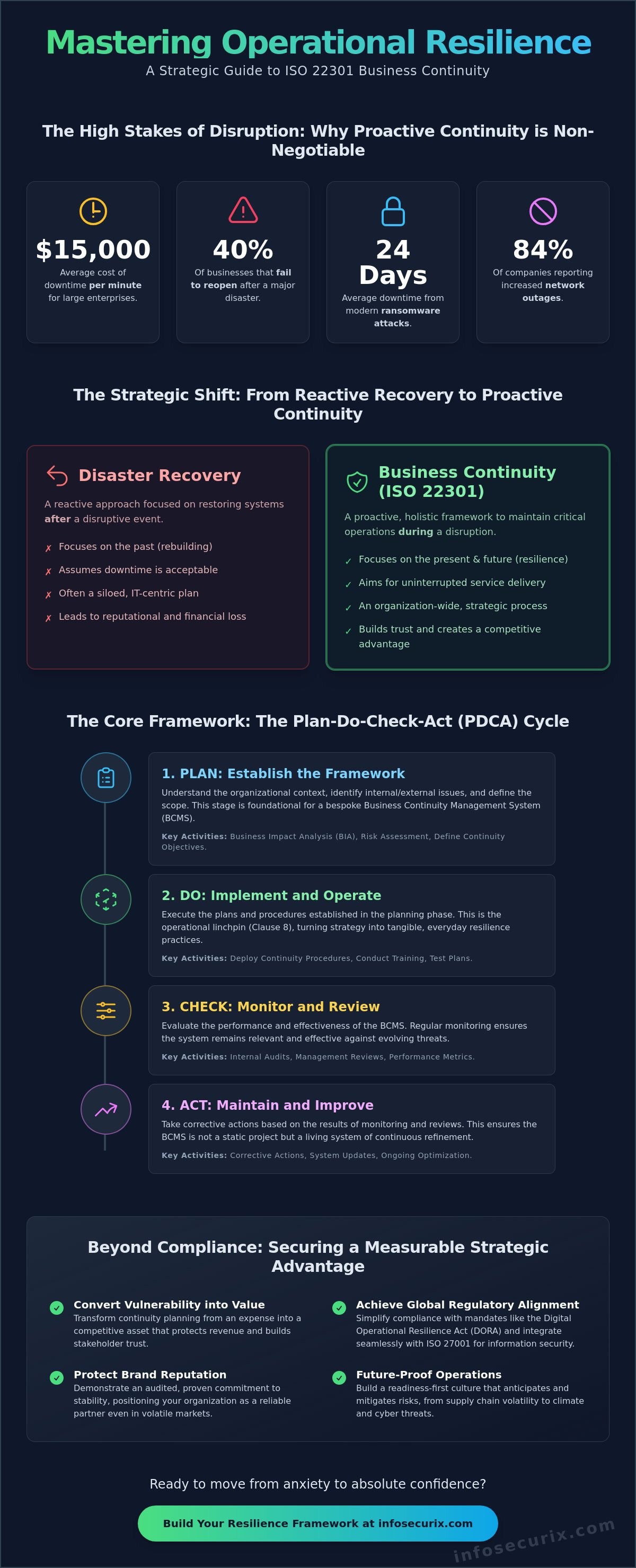
With the average cost of downtime reaching $15,000 per minute for larger enterprises, a reactive approach to disruption is no longer a viable business strategy. Organizations often view iso 22301 business continuity as a dense thicket of regulatory requirements; however, it’s actually the most sophisticated framework available for converting organizational vulnerability into a measurable competitive asset. You’ve likely felt the mounting pressure from boardrooms and stakeholders to provide more than just a basic emergency manual. They’re demanding a proven, audited commitment: a level of operational resilience that holds up under the rigorous scrutiny of global regulations like DORA.
Acknowledging the overwhelming complexity of international standards is the first step toward mastering them. We understand that the fear of operational downtime remains a significant concern, especially when 40% of businesses fail to reopen after a major disaster. This guide provides the clarity you need to move from anxiety to absolute confidence: a roadmap to compliance that transforms continuity planning into a strategic advantage. Ensuring your stability aligns with global expectations, we’ll explore how to future-proof your operations against the 24-day average downtime typical of modern ransomware attacks through meticulous, current-day standards.
Key Takeaways
- Distinguish between reactive disaster recovery and a proactive Business Continuity Management System to ensure your organization remains operational during unforeseen disruptions.
- Build a bespoke iso 22301 business continuity framework by applying the Plan-Do-Check-Act cycle to your specific organizational context.
- Master the Business Impact Analysis (BIA) to accurately quantify the cost of downtime and identify the critical functions that require the highest levels of protection.
- Execute a strategic implementation roadmap: starting with a comprehensive gap analysis to identify vulnerabilities and define the scope of your resilience efforts.
- Secure a measurable strategic advantage by adopting a readiness-first approach that ensures certification success and aligns your business with global regulatory mandates.
Defining ISO 22301 and the Modern Resilience Mandate
ISO 22301 represents the premier international standard for Business Continuity Management Systems (BCMS). It provides a structured methodology to protect against, prepare for, and respond to disruptive incidents. While many firms rely on a basic disaster recovery plan, this approach is fundamentally reactive. A true iso 22301 business continuity framework shifts the focus toward proactive resilience. It ensures that critical functions remain operational during a crisis rather than simply attempting to rebuild after the damage is done. Resilience isn’t an accident. It’s the result of a deliberate, well-constructed framework that anticipates the “what ifs” before they become “what nows.”
The current environment demands this level of foresight. Global supply chain volatility has become a persistent reality. Recent data indicates that 84% of companies have experienced an increase in network outages over the last two years. Additionally, the 2024 Climate Action Amendment now mandates that organizations explicitly integrate climate change risks into their BCMS assessments. This isn’t just about compliance; it’s about survival in an era of unpredictable environmental and digital shifts. Organizations that embrace ISO 22301 position themselves as stable forces in an unstable market.
The Strategic Shift from Recovery to Continuity
Recovery focuses on the past, while continuity focuses on the present and future. The aspirational goal is uninterrupted service. This serves as a powerful market differentiator. When competitors are struggling to restore operations, an ISO 22301 certified organization continues to deliver. This reliability builds immense stakeholder trust and protects brand reputation. It transforms your organization from a vendor into a reliable partner that remains calm under pressure. By embedding these standards into the corporate DNA, firms protect their long-term growth.
Synergy with Global Regulatory Frameworks
Achieving alignment with this standard simplifies compliance with broader mandates like the Digital Operational Resilience Act (DORA). For US enterprises serving European or global markets, this alignment is non-negotiable. There is also significant overlap with iso 27001 certification readiness. While ISO 27001 focuses on information security, ISO 22301 ensures the physical and operational availability of those secured systems. Together, they form a comprehensive shield for the modern enterprise. This integrated approach allows executive decision-makers to focus on the strategic impact of technical processes rather than getting lost in granular mechanics.
The Core Architecture: Navigating the ISO 22301 BCMS Framework
The architecture of a robust iso 22301 business continuity system is built upon the iterative Plan-Do-Check-Act (PDCA) cycle. This framework ensures that resilience is not a static achievement but a continuous process of refinement. It begins with the “Context of the Organization” (Clause 4), which serves as the bedrock for a bespoke BCMS. By identifying internal and external issues, executive leaders can tailor their resilience strategy to the specific needs of their enterprise. This isn’t a one-size-fits-all approach; it’s a curated strategy designed to protect what matters most. It reflects the unique DNA of your business.
Leadership and commitment (Clause 5) act as the primary drivers of this culture. Without active involvement from the board, a business continuity plan remains a dormant document. Seasoned guides understand that true resilience requires a top-down mandate to prioritize stability over short-term gains. Following this commitment, Clause 6 focuses on the planning phase. Here, organizations establish measurable continuity objectives that align with their strategic vision. These aren’t just aspirations. They are the benchmarks by which the entire system is judged, ensuring every effort contributes to a measurable strategic advantage.
The Role of Clause 8: The Operational Linchpin
Clause 8 represents the practical execution phase of the BCMS. It’s the most critical section for both daily operations and external audits. Operational planning and control provide the mechanisms for managing continuity risks in real-time. Auditors focus heavily on the documentation within this clause because it proves that the organization can actually perform under pressure. It bridges the gap between high-level strategy and granular execution. If you’re seeking to refine these operational controls, starting with a comprehensive iso 22301 gap analysis is the most effective way to ensure your documentation meets the highest standards.
Integrating Climate Change Considerations
The 2024 Amendment to ISO 22301 explicitly requires organizations to determine whether climate change is a relevant issue in their risk landscape. This shift reflects the reality that extreme weather events are no longer “black swan” occurrences but predictable variables. Organizations must now model these scenarios into their continuity plans to remain compliant. Updating Clause 4.1 to reflect environmental operational risks is essential for modern resilience. By acknowledging these factors, businesses demonstrate a visionary approach to future-proofing their operations against an increasingly volatile climate. It’s a necessary step for any organization aiming for longevity in 2026.
Quantifying Impact: Business Impact Analysis (BIA) and Risk Assessment
Quantifying the financial and operational impact of a disruption is the cornerstone of a mature iso 22301 business continuity strategy. This process begins with a Business Impact Analysis (BIA), which is a systematic evaluation designed to determine the precise cost of downtime for every critical function. While a basic plan might guess at priorities, a BIA provides the empirical data required to make high-stakes decisions with absolute confidence. It identifies which activities are the lifeblood of the enterprise and which can be temporarily paused. The ISO 22301 business continuity management standard mandates this rigorous approach to ensure that resilience is built on evidence rather than intuition. Utilizing professional business impact analysis services ensures this data is accurate, granular, and defensible during a certification audit. This analysis directly informs the subsequent Risk Assessment phase, creating a logical bridge between identified vulnerabilities and the strategies required to mitigate them.
Determining MTPD and RTO
The Maximum Tolerable Period of Disruption (MTPD) represents the “drop-dead” point: the moment when a disruption causes irreparable damage to the organization’s viability. Establishing this threshold allows leaders to set clear, defensible priorities. From here, we derive the Recovery Time Objective (RTO), which is simply the target time for resuming a function, and the Recovery Point Objective (RPO), which determines the acceptable amount of data loss measured in time. Balancing the cost of rapid recovery against the potential cost of disruption is a delicate exercise. It requires a seasoned perspective to ensure that investments in resilience are both protective and economically sound. You don’t want to over-invest in low-priority areas while leaving critical functions exposed.
Conducting a Meticulous Risk Assessment
While the BIA identifies what is at stake, the Risk Assessment investigates how those disruptions might occur. This phase moves beyond generalities to examine specific organizational vulnerabilities, from sophisticated cyber threats to regional environmental hazards. Adopting a bespoke methodology is essential; a generic checklist cannot account for the unique operational landscape of a national enterprise. This process should be closely integrated with your broader information security risk assessment pillars. By aligning these two disciplines, you create a unified defense that protects both the integrity of your data and the continuity of your operations. It’s this interconnectedness that transforms a standard compliance exercise into a formidable strategic advantage.
A Strategic Roadmap to ISO 22301 Implementation
Implementing a robust iso 22301 business continuity system requires a methodical, top-down approach that moves beyond simple checklists. It’s a journey of architecting stability within the enterprise. The process begins with a diagnostic phase, ensuring that every subsequent effort is targeted and efficient. By following a structured roadmap, organizations can transform a complex international standard into a manageable strategic advantage. This deliberate pace reflects a commitment to accuracy and long-term success.
- Step 1: Conduct a comprehensive iso 22301 gap analysis to identify your current status against the standard’s requirements. This baseline is essential for identifying specific vulnerabilities.
- Step 2: Define the scope of the BCMS. For national organizations, this means ensuring the system covers all critical operations across diverse geographies and service lines.
- Step 3: Execute the BIA and Risk Assessment. These data points allow you to prioritize resources where they’re needed most, focusing on the functions that sustain the organization.
- Step 4: Develop and document business continuity plan development protocols. This creates a clear playbook for the moment of truth.
- Step 5: Implement a rigorous exercise and testing program. Capabilities must be validated in controlled environments to ensure they work when it matters.
Developing Robust Continuity Procedures
Effective procedures are the operational translation of your strategy. A well-structured plan integrates incident response, clear communication channels, and recovery steps into a single, cohesive narrative. It’s essential to adopt a people-centric approach. Plans often fail because they assume staff availability; instead, account for the human element during a regional crisis. Incorporating specialized safety training, such as the programs offered by Guardian Safety, ensures your team is prepared for the physical demands of emergency response. Establish clear escalation paths. Decision-making authority must be pre-defined so the organization remains decisive when every second counts.
The Exercise Program: Validating Resilience
A plan is only as good as its last successful test. Validation isn’t a one and done event. It’s a cycle of continuous improvement. Organizations should utilize a mix of exercise types to build muscle memory. Tabletop walkthroughs are excellent for executive alignment. Simulations test specific functional responses. Full-scale rehearsals provide the ultimate proof of readiness. These results aren’t just for internal peace of mind; they’re critical for meeting the Continuous Improvement requirement of Clause 10. If you’re ready to move from planning to proven readiness, our team can help you conduct Internal Audits to verify your testing outcomes and ensure you’re prepared for certification.
Beyond Compliance: The Value of InfoSecurix Partnership
Navigating the intricate requirements of international standards requires more than a checklist; it demands a seasoned guide who has managed every possible disruption scenario. InfoSecurix occupies this role as a trusted advisor, bringing over 25 years of specialized expertise to the national compliance landscape. We understand that for a US enterprise, iso 22301 business continuity is not merely a box to be checked for a regulator. It’s a fundamental commitment to your clients and stakeholders that your operations will remain steady, even when the market is not. Our partnership model is built on a perceived legacy of success, ensuring that your journey toward resilience is both methodical and empowering.
We champion a “readiness-first” approach that prioritizes thorough preparation over hasty implementation. This philosophy aims to instill absolute confidence in your leadership team, ensuring certification success on the first attempt. By positioning ourselves as a collaborative ally rather than a distant auditor, we invest deeply in your long-term achievement. This relationship enables us to bridge the gap between high-level strategic vision and the granular mechanics of operational stability. We remain unfazed by complexity, providing the calm, authoritative direction necessary to future-proof your growth.
Our Bespoke Readiness and Assessment Approach
Every organization possesses a unique operational DNA, and a rigid, one-size-fits-all framework often fails to capture the nuances of complex business processes. InfoSecurix tailors the ISO 22301 framework to your specific organizational complexity, ensuring that the resulting BCMS is as agile as it is robust. A critical component of our methodology involves conducting independent Internal Audits before your final certification engagement. This proactive step identifies potential friction points and ensures your system is fully optimized. We invite you to explore our business continuity planning services to see how we orchestrate resilience across your entire enterprise.
Future-Proofing Your National Operations
ISO 22301 serves as a visionary tool for long-term enterprise survival, providing the structure needed to withstand the volatility of the 2026 landscape. InfoSecurix remains committed to delivering the precision and longevity required to protect your national operations against tomorrow’s disruptions. We focus on the strategic impact of technical processes, ensuring your standards are as durable as they are meticulous. This top-down approach secures your position as a reliable force in your industry. Contact us today for a strategic resilience consultation and discover how a dedicated partnership can transform your organizational vulnerability into a measurable strategic advantage.
Architecting a Resilient Future
Mastering the complexities of iso 22301 business continuity is no longer just about meeting a regulatory mandate; it’s about building a foundation for enduring organizational success. By integrating a rigorous Business Impact Analysis with a proactive risk assessment, you move from a state of vulnerability to one of measurable strategic advantage. This journey requires a commitment to continuous improvement: ensuring that your operational controls remain effective against the evolving threats of the 2026 landscape. Whether you’re navigating the new climate action requirements or aligning with global frameworks like DORA, a structured approach is your greatest asset.
With over 25 years of compliance expertise, InfoSecurix provides the nationwide strategic resilience support needed to protect your most critical operations. Our milestone-based readiness success ensures that your organization is fully prepared for certification on the first attempt. Don’t leave your stability to chance. Secure Your Operational Future with InfoSecurix ISO 22301 Consulting. Together, we can transform your continuity planning into a powerful engine for growth and long-term security.
Frequently Asked Questions
What is the difference between ISO 22301 and ISO 27001?
ISO 27001 focuses specifically on the confidentiality, integrity, and availability of information assets. In contrast, iso 22301 business continuity addresses the resilience of the entire organization’s critical functions. While they share the “Availability” pillar, ISO 22301 provides a broader operational framework. It ensures the business remains viable during any disruption, whether it involves digital data or physical infrastructure.
Is ISO 22301 certification mandatory for US businesses?
Certification isn’t a universal legal requirement for all US businesses. However, it’s increasingly mandated by specific regulations like the Digital Operational Resilience Act (DORA) for firms with European operations. Many national enterprises also require it as a contractual prerequisite for their supply chain partners. It acts as a sophisticated proof of reliability in an increasingly volatile global market.
How long does it typically take to achieve ISO 22301 certification?
The timeline typically ranges from six to twelve months. This duration depends heavily on your current organizational maturity and the complexity of your operational scope. Smaller firms with established processes might move faster, while large enterprises require more time to conduct a thorough BIA and execute necessary exercises. A structured roadmap ensures this process remains methodical and accurate.
What are the most common reasons for failing an ISO 22301 audit?
Auditors frequently cite a lack of top-level leadership commitment as a primary reason for failure. Other common pitfalls include an underdeveloped Business Impact Analysis that fails to identify critical dependencies or resource requirements. If the exercise program is nonexistent or doesn’t reflect realistic scenarios, the organization cannot prove its capabilities. Meticulous documentation is the only way to verify compliance during the final audit.
How often must a business continuity plan be tested under ISO 22301?
ISO 22301 requires testing at planned intervals or whenever significant changes occur within the organization. Most seasoned professionals recommend at least one major exercise annually to maintain operational readiness. This ensures that your procedures remain current and that your staff maintains the necessary muscle memory. Regular validation is the only way to bridge the gap between a written plan and a proven capability.
Can ISO 22301 be integrated with existing SOC 2 compliance efforts?
Integration with SOC 2 is highly effective, particularly within the Availability Trust Service Criterion. Both frameworks require evidence of risk assessment, incident response, and recovery procedures. Aligning these efforts reduces administrative overhead and provides a unified view of your resilience posture. It’s a strategic way to demonstrate comprehensive security and stability to your stakeholders simultaneously through a curated compliance journey.
Does ISO 22301 cover cybersecurity incidents or just natural disasters?
The standard is designed to be “effects-based,” meaning it covers any event that causes a disruption to critical services. This includes sophisticated cybersecurity incidents like ransomware as well as traditional natural disasters or supply chain failures. To minimize physical risks, many firms use specialists like AG Property Services to ensure all property compliance and safety documentation is professionally managed. Because the focus is on maintaining essential functions, the specific cause of the outage is less important than the ability to respond. It provides a universal shield for your organization’s most essential operations.
What is the first step an organization should take toward ISO 22301 readiness?
Conducting a comprehensive gap analysis is the essential first step toward iso 22301 business continuity readiness. This diagnostic phase identifies where your current practices fall short of the international standard’s requirements. It allows you to build a bespoke implementation plan that targets your specific vulnerabilities. Securing a board-level mandate at this stage is also critical to ensure the necessary resources are allocated for long-term success.