
Sixty percent of small businesses that suffer a cyberattack go out of business within six months; this stark reality underscores why security is no longer an optional luxury but a fundamental requirement for survival. Achieving ISO 27001 for small business often feels like an insurmountable climb reserved for global giants with endless budgets. You likely feel the mounting pressure from enterprise prospects who demand rigorous certification before they’ll even consider a contract. Seeing lucrative opportunities slip away because your internal team is already stretched thin is a common frustration for growing firms.
We understand that you view certification as a potential bureaucratic burden that might paralyze your daily operations. This guide changes that perspective by demonstrating how ISO 27001:2022 serves as a flexible growth lever rather than a rigid constraint. You’ll discover a realistic roadmap to attain enterprise-level trust, protect your critical data, and compete on a global scale without needing an army of experts. Outlining the strategic ROI of the 2022 standard and the recent climate change considerations will give you the clarity needed to pass your audit with absolute confidence and future-proof your organization.
Key Takeaways
- Discover how ISO 27001 serves as a definitive competitive advantage, enabling smaller firms to meet the rigorous security demands of global enterprise clients.
- Learn to implement a risk-based Information Security Management System (ISMS) that prioritizes relevant threats: a strategy that makes iso 27001 for small business both achievable and scalable.
- Evaluate the most effective implementation models for your organization, balancing internal resources with the precision of strategic consulting for maximum efficiency.
- Follow a structured, five-phase roadmap that guides your team from initial gap analysis through to the successful completion of your final certification audit.
- Gain clarity on how bespoke readiness assessments future-proof your operations by identifying vulnerabilities before they impact your compliance or your reputation.
The Strategic Value of ISO 27001 for Small Businesses in 2026
Securing a seat at the table with global enterprises requires more than a handshake and a promising product; it demands a verifiable commitment to security. The ISO/IEC 27001 standard serves as the international gold standard for Information Security Management Systems (ISMS), providing a rigorous framework to protect sensitive data. In 2026, implementing iso 27001 for small business is no longer just a technical checkbox. It’s a fundamental shift from periodic compliance to a culture of continuous trust. This evolution reflects a digital economy where security is woven into the very fabric of operational excellence.
Modern enterprise procurement teams have reached a point of zero-tolerance regarding vendor risk. They don’t just ask if you’re secure; they demand proof that your security matures alongside emerging threats like AI-driven social engineering and automated phishing. By adopting the 2022 version of the standard, your organization demonstrates its ability to manage these sophisticated risks while also addressing the mandatory climate change considerations now required for certification. This proactive stance transforms security from a cost center into a powerful catalyst for long-term stability.
Beyond Compliance: Unlocking Enterprise-Level Market Access
High-value contracts often come with exhaustive security questionnaires that can stall the sales cycle for months. Certification removes this friction by providing an immediate, universally recognized answer to complex security inquiries. It creates a distinct competitive advantage during the RFP process, allowing you to outshine uncertified peers who may struggle to prove their reliability. This “halo effect” extends beyond sales, boosting investor confidence and enhancing your brand’s reputation as a steady, professional partner that remains calm under pressure.
Protecting Your Scale: Data Integrity as a Growth Lever
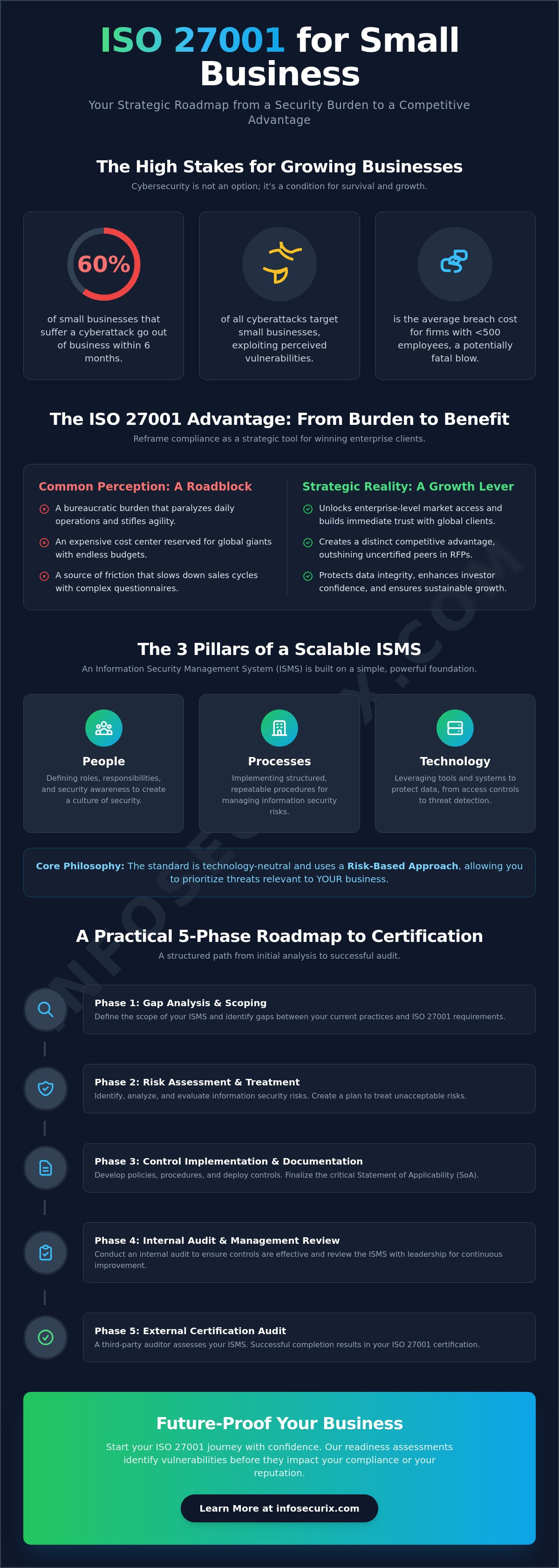
Growth remains sustainable only if your foundations are secure. Research indicates that 43% of all cyberattacks target small businesses, and the average cost of a data breach for firms with fewer than 500 employees has climbed to $3.31 million. A structured ISMS acts as a protective shield against these catastrophic events, ensuring that a single breach doesn’t lead to the 60% failure rate seen among small firms post-attack. Furthermore, the framework naturally satisfies global privacy regulations like GDPR and CCPA, while formalizing security roles to eliminate the “key person risk” that often plagues agile, lean teams.
Decoding ISO 27001 Requirements for Smaller Organizations
Understanding the architecture of an Information Security Management System (ISMS) is the first step toward a successful implementation. An effective ISMS rests on three pillars: people, processes, and technology. For many, a misconception exists that this standard requires a massive overhaul of existing systems or a complete change in company culture. In reality, the framework is technology-neutral, making it perfectly suited for the lean, cloud-native environments that define modern startups. By focusing on how your specific organization operates, you can build a system that enhances security without stifling the agility that gives you a competitive edge. Implementing iso 27001 for small business is about creating a bespoke shield that fits your unique operational profile.
The core philosophy of the standard is its risk-based approach. This methodology empowers you to identify and prioritize the specific threats that actually impact your operations rather than chasing every theoretical vulnerability. It’s about managing risks effectively by allocating resources where they provide the most significant protection. Central to this strategy is the Statement of Applicability (SoA). Think of the SoA as your customization map; it allows you to explicitly state which controls are relevant to your business and, just as importantly, justify why others are not. This document is a small business’s best friend because it prevents the “over-engineering” of security protocols.
The ISMS Framework: Tailoring the Seven Mandatory Clauses
Clauses 4 through 10 form the structural backbone of the certification. While they may sound academic, they translate into practical actions like defining your scope and demonstrating leadership commitment. Small teams can manage “Management Reviews” through concise, quarterly strategy sessions rather than exhaustive monthly boards. This ensures your ISMS remains a living ecosystem: a dynamic set of practices that evolve with your growth rather than a static binder gathering dust on a shelf. To ensure your framework is built on solid ground, engaging in professional risk assessments early in the process is vital.
Annex A Controls: Right-Sizing Security for Lean Teams
The 2022 update reduced the number of Annex A controls to 93, categorized into four manageable themes. Right-sizing these controls is essential for teams operating in remote or co-working environments. Consider the following focus areas for lean operations:
- Access Control: Moving beyond simple passwords to robust multi-factor authentication across all SaaS platforms.
- Supplier Management: Ensuring your third-party cloud providers meet the same rigorous standards you’ve set for yourself.
- Threat Intelligence: Utilizing automated tools to stay ahead of emerging vulnerabilities without needing a dedicated security team.
In 2026, there is a heightened emphasis on secure coding and data masking, particularly for small SaaS providers. By addressing these controls systematically, you protect your scale and build a foundation of integrity that enterprise clients find irresistible. Before implementing these controls, working through a comprehensive ISO 27001 readiness checklist ensures you approach each requirement with the strategic clarity needed to avoid costly rework.
Navigating the Feasibility Challenge: Resources, Time, and Strategy
Deciding to pursue iso 27001 for small business often triggers a predictable wave of skepticism regarding cost and personnel. You might feel your organization is too lean to absorb the administrative weight of a global standard. This hesitation is understandable. However, the true risk lies in the cost of inaction; 60% of small firms that suffer a breach fail within six months. The challenge isn’t the standard itself, but rather the method of implementation. By moving away from a one-size-fits-all mentality, you can transform certification from an operational drain into a streamlined strategic asset.
Choosing the right path to compliance requires a careful evaluation of three common models: DIY templates, pure automation platforms, and strategic consulting. While generic templates are inexpensive, they often lead to “policy drift” where your actual practices don’t match your documentation. Relying solely on automated software might offer a convenient dashboard, but it frequently fails to prepare your team for the nuances of a human auditor. InfoSecurix brings 25 years of seasoned expertise to this process, ensuring you don’t over-engineer controls or waste time on irrelevant documentation. We act as a protective partner, focusing your limited resources on the specific risks that impact your unique business model.
Strategic Readiness vs. Automated Compliance Platforms
Automated platforms have gained popularity in 2026 for their ability to sync with cloud environments, yet they aren’t a silver bullet. An auditor isn’t just looking for a green checkmark on a screen; they’re looking for evidence of a living security culture. A “Trusted Advisor” is essential to interpret this data and bridge the gap between technical settings and organizational intent. Investing in a professional ISO 27001 certification readiness assessment provides the clarity needed to ensure your automated tools actually satisfy the rigorous requirements of the 2022 standard.
Managing the Resource Drain: A Phased Implementation Approach
Avoiding compliance burnout is critical for small teams. Instead of a frantic sprint, we recommend a phased implementation that spreads the workload over several months. You can leverage existing tools like Google Workspace or AWS to meet many control requirements, such as access logging and encryption, without purchasing expensive new software. Engaging an external consultant to act as a “Part-Time CISO” provides the high-level expertise you need without the overhead of a full-time executive hire. This measured pace ensures that security becomes a natural part of your workflow rather than a temporary disruption to your daily operations.
While you focus on optimizing your security budget, it’s also worth looking at broader operational savings. For instance, businesses can reduce overhead on office essentials by using Cashback Nederland to earn money back on daily purchases, allowing more resources to be allocated toward your certification goals.
A Practical Roadmap to Achieving ISO 27001 Certification
Your journey toward certification begins with a commitment to precision. By following a methodical path, you transform a complex set of requirements into a manageable series of milestones. The ISO 27001 certification process provides this essential structure, guiding your team through five distinct phases of maturity. In 2026, the trend of remote auditing has become the standard for agile organizations. Auditors now prioritize digital evidence: cloud configuration logs, timestamped policy acknowledgments, and screen-sharing sessions. Preparing your digital environment for this level of scrutiny ensures that iso 27001 for small business remains a streamlined achievement rather than a logistical hurdle.
Phase 1 & 2: Scoping, Gap Analysis, and Risk Assessment
Defining a lean scope is the most effective way to control the cost of ISO 27001 certification. You don’t need to certify every corner of your business; you only need to protect the boundaries where your sensitive data resides. A Gap Analysis serves as a diagnostic tool that prevents wasted effort by pinpointing the specific areas where your existing controls diverge from the 2022 standard. Once identified, your risk assessment should inform actual business decisions, such as which cloud vendors to trust or how to handle remote access. This ensures your security posture is rooted in reality, not just theory. Pairing your gap analysis with a structured iso 27001 readiness checklist gives your team a clear, actionable benchmark for measuring progress against the 2022 standard’s 93 controls.
Phase 3 & 4: Control Implementation and the Internal Audit
Success in Phase 3 depends on creating living documentation: policies and procedures that your employees actually understand and use daily. Complex manuals that sit unread are a major red flag for auditors. Phase 4 introduces the information security internal audit, which acts as your most critical safety net. This independent review identifies non-conformities early, giving you the opportunity to remediate issues before the external registrar arrives. Finally, select an accredited certification body that understands the small business context and values the efficiency of your systems over the sheer volume of your paperwork.
Secure your path to compliance and eliminate the stress of the unknown by scheduling a professional internal audit to validate your readiness.
Future-Proofing Your Business with InfoSecurix Readiness Services
Navigating the final stages of certification requires more than just technical precision; it demands a partner who understands the high stakes of your growth. InfoSecurix serves as a seasoned guide, ensuring that implementing iso 27001 for small business doesn’t become an anchor that slows you down. We specialize in translating complex technical requirements into clear, strategic business value that resonates with executive decision-makers. This transition from a project-based mindset to a culture of continuous security is where true resilience begins. Viewing certification as a starting point rather than a finish line allows your organization to build a foundation of trust that lasts for decades. Our bespoke readiness assessments are designed to avoid the one-size-fits-all trap, focusing instead on the specific operational realities of your lean team.
The modern digital economy rewards those who can prove their reliability. By aligning your operations with the 2022 standard, you’re not just satisfying a requirement; you’re building a protective force that enables your client’s growth alongside your own. Our role is to ensure that this protective force is integrated seamlessly into your existing workflows, avoiding the operational paralysis that often comes with poorly managed compliance projects. We focus on the strategic impact of your technical processes, ensuring your leadership remains unfazed by the complexity of global security standards.
The InfoSecurix Advantage: 25 Years of Seasoned Guidance
Our approach is built on a foundation of 25 years of experience, having witnessed every possible audit scenario across diverse industries. This legacy of success allows us to anticipate pitfalls before they manifest, saving your team significant time and frustration. We operate as a collaborative ally, empowering your internal staff through knowledge transfer rather than simply checking boxes. Our readiness assessments focus on identifying corrective actions that actually improve your business operations. By refining your processes, we ensure that your security posture is robust enough to satisfy the most meticulous auditor while remaining flexible enough to support your daily agility. This partnership ensures that iso 27001 for small business is implemented with the same level of sophistication found in global corporations, but tailored for your specific scale.
From Readiness to Resilience: Your Professional Invitation
The journey from initial skepticism to becoming a market-leading, certified organization is a transformative one. You’ve seen how a structured framework protects your scale and unlocks access to elite enterprise contracts. Now is the time to solidify those gains. Moving forward with an initial consultation or a targeted gap analysis provides the clarity needed to finalize your security roadmap. We invite you to step into a future where your data integrity is a guaranteed asset rather than a constant worry. Our mission is to future-proof your organization through meticulous standards that reflect your commitment to excellence. Secure your competitive advantage with an InfoSecurix ISO 27001 Readiness Assessment.
Secure Your Competitive Advantage in the Global Marketplace
Achieving iso 27001 for small business represents a pivotal moment in your organization’s growth. It marks the transition from being a simple vendor to becoming a trusted enterprise partner. You’ve seen that the 2022 standard is not a rigid burden but a flexible framework designed to scale with your ambitions. By focusing on a risk-based approach and a phased roadmap, you can protect your data integrity without sacrificing the agility that defines your success.
InfoSecurix stands ready to guide you through this transformation. With over 25 years of specialized experience in information security consulting, we provide the seasoned perspective necessary to navigate complex audits with absolute confidence. Our milestone-based engagements ensure you remain on track for a successful certification outcome. We don’t just identify gaps; we deliver specialized corrective action plans tailored to maintain your operational momentum. Take the first step toward future-proofing your operations and unlocking high-value market access. Request a Strategic ISO 27001 Readiness Assessment today. The path to enterprise-level trust is within your reach.
Frequently Asked Questions
Is ISO 27001 compulsory for small businesses in the US?
No, it isn’t legally mandated by US federal law, but it’s frequently a prerequisite for securing contracts with enterprise-level clients. Many large corporations require their vendors to prove compliance to manage their own supply chain risks. Adopting the standard voluntarily allows your firm to demonstrate a proactive security posture before a prospect even requests it.
How much does ISO 27001 certification cost for a small business in 2026?
The total investment for certification depends on your organization’s scope, headcount, and existing security controls. Expenses typically include the initial gap analysis, internal training, and the fees charged by an accredited certification body for the audit. Small firms should also account for the ongoing costs of annual surveillance audits required to maintain the three-year certification cycle.
How long does it take for a small company to get ISO 27001 certified?
Most small organizations complete the journey in six to twelve months. This timeframe depends heavily on your current security maturity and the resources you dedicate to the implementation phase. A structured approach ensures that iso 27001 for small business remains a steady progression rather than a rushed disruption to your daily operations.
Can a small business achieve ISO 27001 without a dedicated IT department?
Yes, achieving certification is entirely possible without an internal IT team by leveraging external expertise. Many lean firms partner with a Trusted Advisor to manage the technical and administrative requirements of the ISMS. This collaborative model allows your existing staff to focus on core operations while ensuring your security standards meet international benchmarks.
What is the difference between ISO 27001 and SOC 2 for a startup?
ISO 27001 is an internationally recognized framework focused on the management system, while SOC 2 is a US-centric report focused on specific trust service criteria. Startups often pursue ISO 27001 to gain global market access, whereas SOC 2 is frequently requested by North American enterprise customers. Both serve to build trust but cater to different geographic and contractual requirements.
What happens if a small business fails the ISO 27001 certification audit?
An audit rarely results in an immediate fail; instead, the auditor identifies non-conformities that require resolution. You’ll receive a formal report outlining these gaps and a specific timeframe to implement corrective actions. Don’t view these findings as failures, but as necessary steps to ensure your system is robust enough to protect your organization’s longevity.
Does ISO 27001 cover AI security and governance for small firms?
The 2022 version of the standard provides a flexible framework that naturally encompasses AI security through its technological and organizational controls. By performing a rigorous risk assessment, your firm can identify AI-specific threats and implement relevant safeguards. This ensures iso 27001 for small business remains relevant as you adopt emerging technologies and automation.
How often do small businesses need to be re-certified for ISO 27001?
The certification follows a three-year cycle. After the initial certification, you’ll undergo annual surveillance audits in the second and third years to ensure the ISMS remains effective and compliant. At the end of the third year, a full recertification audit is required to maintain your standing and continue future-proofing your business against evolving cyber threats.