
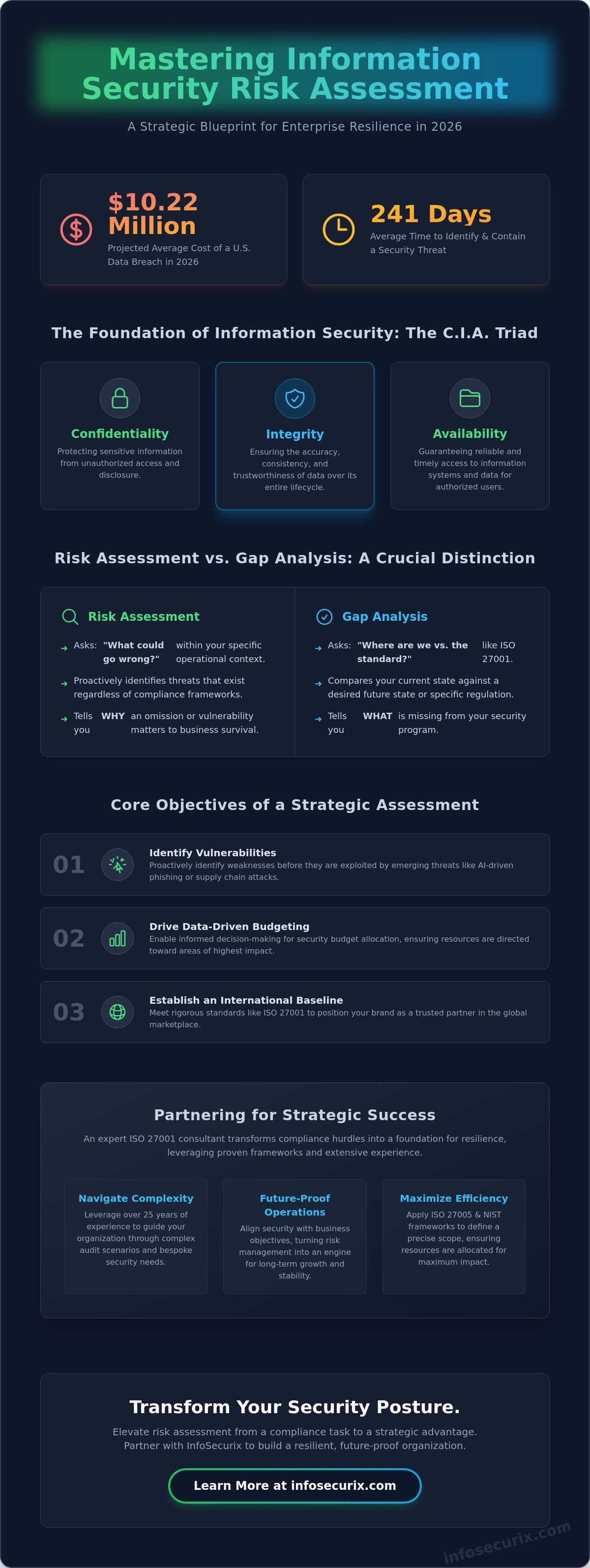
Reaching a record $10.22 million in 2026, the average cost of a U.S. data breach has eliminated the margin for error in modern security strategies. It’s a reality where identifying and containing a threat now takes an average of 241 days, leaving organizations exposed for far too long. You likely feel the weight of complex regulatory requirements and the constant fear that an overlooked vulnerability could lead to a catastrophic breach. Partnering with a seasoned ISO 27001 consultant Pittsburgh provides the steady, authoritative guidance needed to transform these concerns into a foundation of absolute security.
It’s understandable to view risk assessment as a hurdle, yet it’s actually the strategic blueprint for your organization’s resilience. This guide promises to help you master the fundamental principles and methodologies of information security risk assessments to future-proof your business. You’ll discover a clear roadmap for achieving compliance while improving your operational stability. We’ll explore how to align your security standards with your broader business objectives, turning your risk management process into a powerful engine for long-term growth.
Key Takeaways
- Learn how to elevate risk assessment from a compliance hurdle to a systematic framework for identifying and prioritizing organizational threats.
- Master the application of ISO 27005 and NIST frameworks to define a precise assessment scope; this ensures your resources are allocated with maximum efficiency.
- Discover why compliance is merely the baseline for enterprise resilience and how an ISO 27001 consultant Pittsburgh helps you future-proof operations against evolving regulatory shifts.
- Understand the critical role of multi-disciplinary collaboration across Legal, HR, and Operations to ensure every vulnerability is documented and addressed.
- Identify the strategic advantages of partnering with a seasoned guide who leverages over 25 years of experience to navigate complex audit scenarios and bespoke security needs.
Defining Information Security Risk Assessment in the Modern Era
Information security risk assessment represents a meticulous, systematic process designed to identify, estimate, and prioritize risks to your organization’s essential operations. It’s the mechanism that translates abstract digital threats into manageable business decisions. By partnering with an ISO 27001 consultant Pittsburgh, your leadership team gains the clarity needed to transform security from a reactive cost center into a proactive strategic asset. This national-standard approach eliminates the pitfalls of fragmented, localized security efforts that often leave critical gaps in an organization’s perimeter.
Every robust assessment is built upon the foundations of information security known as the CIA Triad. This framework serves as the foundational pillar for evaluating how risks impact Confidentiality, Integrity, and Availability. Protecting these three elements in 2026 requires a sophisticated blend of qualitative and quantitative risk analysis. Qualitative methods provide a nuanced understanding of probability and impact based on expert insight. Quantitative analysis assigns concrete values to potential disruptions. This dual-layered approach allows for a level of precision that “check-the-box” methodologies simply cannot match.
The Core Objectives of a Strategic Assessment
A high-level assessment serves three primary functions that drive enterprise value. First, it identifies vulnerabilities before they are exploited by emerging 2026 threat vectors, such as AI-driven phishing or complex supply chain incursions. Second, it enables data-driven decision-making for security budget allocation. This ensures resources are directed toward the areas of highest impact. Finally, establishing a formal baseline with an ISO 27001 consultant Pittsburgh ensures your security posture meets the most rigorous international standards, positioning your brand as a trusted partner in the global marketplace.
Risk Assessment vs. Gap Analysis: Understanding the Difference
Distinguishing between these two concepts is vital for any executive team. A gap analysis measures exactly where your organization sits in relation to a specific regulatory standard; it’s a comparison of your current state versus a desired future state. A risk assessment examines what could go wrong within your specific operational context, identifying threats that exist regardless of which compliance framework you follow. While a gap analysis tells you what is missing from your program, a risk assessment tells you why those omissions matter to your specific business survival. These two processes complement each other by ensuring that while you meet the standard, you also address the specific vulnerabilities that threaten your unique business model.
The Methodology: A Systematic Framework for Enterprise Resilience
Establishing a rigorous framework requires more than a simple checklist; it demands a structured alignment with internationally recognized standards like ISO/IEC 27005 and the NIST Risk Management Framework. This systematic approach ensures your organization doesn’t just react to threats but anticipates them through a repeatable, defensible process. Engaging an ISO 27001 consultant Pittsburgh allows you to tailor these global standards to your specific operational environment. For a deeper dive into the technical nuances of these frameworks, explore our guide on it risk assessment methodology.
Defining the scope is the most critical precursor to any assessment. Without a clearly delineated boundary, organizations often succumb to resource drain by attempting to secure everything with equal intensity. A precise scope focuses your efforts on the systems, data, and processes that truly drive value. This ensures your security investment is both surgical and effective. A professional ISO 27001 consultant Pittsburgh helps you draw these boundaries to protect your most vital interests while maintaining operational agility.
Step 1: Asset Identification and Valuation
Identifying your critical information assets is the bedrock of resilience. This inventory extends far beyond hardware; it encompasses proprietary intellectual property, customer data, and internal processes. In 2026, the complexity of hybrid environments makes manual tracking nearly impossible. This inventory must be precise.
- Automated Discovery: Utilize modern tools to map your digital footprint in real-time, capturing transient cloud assets and shadow IT.
- Value Assignment: Assign value based on the business impact of a loss, considering replacement costs, regulatory fines, and reputational damage.
Step 2: Threat and Vulnerability Analysis
Once assets are identified, you must map internal and external threats against specific vulnerabilities. The 2026 landscape is dominated by AI-enhanced phishing attacks and sophisticated supply chain incursions. Cloud misconfigurations remain a primary entry point for adversaries. Adopting a continuous monitoring mindset isn’t just a recommendation; it’s the only way to catch vulnerabilities as they emerge in a dynamic environment. This proactive stance is essential for ISO 27001 certification readiness.
Step 3: Risk Calculation and Treatment Selection
The standard formula, Risk equals Impact multiplied by Likelihood, provides the mathematical basis for prioritization. This calculation leads directly to your treatment strategy. You have four primary paths: Accept, Avoid, Transfer, or Mitigate. Each choice must be deliberate. The ultimate goal is to manage Residual Risk, which is the risk that remains after controls are applied. This final level of exposure must align perfectly with your board’s risk appetite to ensure long-term stability. Verifying that your chosen controls are actually performing as intended requires a rigorous security controls assessment to confirm their real-world effectiveness before a formal audit.
Strategic Value: Why Compliance is the Floor, Not the Ceiling
Viewing a risk assessment as a mere “check-the-box” requirement is a missed opportunity for strategic differentiation. While meeting regulatory mandates is necessary, the true value lies in how these insights empower your organization to scale with confidence. A professional provider of cybersecurity risk assessment services helps you look beyond the immediate audit to build a resilient enterprise. By identifying the intersection of technical vulnerability and business impact, you transform a compliance exercise into a tool for future-proofing your business against shifting regulatory landscapes. This proactive stance ensures you’re never caught off guard by new state-level privacy laws or federal mandates.
Securing investor confidence and winning enterprise-level contracts requires more than a verbal assurance of safety. Modern partners demand evidence of a mature risk management culture before they’ll sign a high-value agreement. Demonstrating that your organization treats security as a fundamental business pillar creates a distinct competitive advantage. It signals to stakeholders that you’re a seasoned veteran who remains calm under pressure because you’ve already accounted for the variables. Engaging an ISO 27001 consultant Pittsburgh provides the authoritative validation needed to reassure these critical stakeholders of your long-term stability.
Aligning Security with Business Objectives
Effective risk management prevents the common trap of “security for the sake of security.” Instead, it focuses on return on investment by prioritizing the protection of assets that directly drive revenue. This alignment bridges the gap between the server room and the boardroom; it provides the empirical evidence needed to justify security staffing and technology investments. Your brand’s reputation isn’t built on a single firewall but on the consistent, reliable protection of client data over the long term. Using an assessment to frame security in terms of business continuity ensures that every dollar spent is a deliberate step toward growth.
Facilitating ISO 27001 Certification Readiness
Within the context of international standards, a formal assessment isn’t optional. Clause 6.1.2 of the ISO/IEC 27001:2022 standard specifically mandates a rigorous process for identifying and treating information security risks. A robust methodology simplifies the creation of your Statement of Applicability (SoA), ensuring every control is justified by a specific business need. For organizations aiming for international recognition, following the strategic guide to ISO 27001 readiness provides the roadmap necessary to navigate the complexities of the certification journey with absolute certainty. This structured path ensures your readiness efforts are both thorough and efficient.
Best Practices for Conducting a Comprehensive Assessment
Effective risk management requires a departure from the traditional “IT silo” mentality. You can’t view digital threats as purely technical hurdles when human error remains a factor in 68% of all data breaches according to recent industry data. Success hinges on a multi-disciplinary approach that integrates insights from Legal, HR, and Operations. This collaborative effort ensures that physical security, employee behavior, and contractual obligations are all viewed through the same lens of resilience. Partnering with a seasoned ISO 27001 consultant Pittsburgh helps facilitate these high-level discussions, ensuring that every department understands its role in the protective ecosystem.
Rigorous documentation serves as the primary evidence of your commitment to security. The mantra “if it isn’t documented, it didn’t happen” remains the gold standard for both internal accountability and external certification. You must maintain detailed records of your methodology, findings, and remediation plans. These documents aren’t static artifacts; they require regular review cycles at least annually or whenever a significant organizational change occurs. This disciplined approach instills a sense of absolute confidence in your stakeholders and auditors alike.
Establishing a Repeatable Lifecycle
Integrating your assessment into the existing Plan-Do-Check-Act (PDCA) cycle ensures that risk management becomes a continuous habit rather than a sporadic event. You should establish clear triggers for “interim assessments” that bypass the standard annual schedule. These triggers typically include:
- New Software Deployments: Implementing enterprise tools that handle sensitive data.
- Office Expansions: Moving into new physical locations or scaling remote work infrastructure.
- Mergers and Acquisitions: Integrating the digital assets of another organization.
While standardized templates provide a necessary structure for consistency, they should be paired with bespoke analysis to capture the unique nuances of your specific business model. This combination allows for both scalability and precision. If you’re ready to formalize this process, our team can help you design and implement bespoke risk assessment frameworks tailored to your needs.
Leveraging Internal Audit for Continuous Improvement
Internal audits act as a critical validation layer, confirming that the risk treatments you’ve selected are actually performing as intended. This “independent eye” is essential for identifying the natural biases that occur during risk self-assessments. By mastering information security internal audits, your organization moves beyond basic compliance and enters a state of continuous optimization. This systematic review process ensures that your ISO 27001 consultant Pittsburgh can help you refine your controls based on real-world performance data, keeping your organization steady and secure even as the threat landscape shifts.
Partnering with a National ISO 27001 Consultant for Strategic Success
Choosing the right partner is a decision that defines your organization’s security legacy. While generic firms often focus solely on achieving a passing audit score, a boutique consultancy like InfoSecurix prioritizes your long-term operational resilience. Engaging an ISO 27001 consultant Pittsburgh ensures your strategy is grounded in precision and tailored to your unique business objectives. This partnership bridges the gap between granular technical risks and the high-level strategic vision required by executive leadership, transforming security from a technical requirement into a business enabler.
With over 25 years of experience in the field, our team has encountered every possible audit scenario. This depth of knowledge allows us to remain unfazed by complexity, providing a steady hand during high-stakes assessments. We don’t just identify vulnerabilities; we provide the authoritative guidance needed to treat them effectively. This seasoned perspective is what separates a standard service provider from a trusted advisor who is invested in your continued growth. You’re not just hiring an auditor; you’re gaining a collaborative ally.
The InfoSecurix Advantage: Expertise and Partnership
Our engagement model is built on transparency and mutual success. We utilize fixed-fee structures to ensure your project remains on track without the uncertainty of fluctuating costs. This milestone-based approach guarantees that every phase of your security journey provides tangible value. While our roots are deep, our national reach allows us to support organizations across the country, bringing a wealth of cross-industry insights to your specific challenges. We’re committed to future-proofing your business through meticulous standards and a collaborative spirit that empowers your team.
Next Steps: Initiating Your Security Roadmap
The journey toward a resilient posture begins with a clear understanding of your current state. Our first engagement typically involves a comprehensive discovery session and a targeted gap analysis to identify where your existing controls stand against international standards. To prepare your leadership team, focus on the strategic benefits of this process: improved operational resilience and a stronger market position. It’s time to move from a reactive defense to a proactive, resilient future. We invite you to schedule a strategic consultation to begin building your custom security roadmap with an ISO 27001 consultant Pittsburgh today.
Building a Legacy of Digital Trust and Resilience
Mastering the transition from reactive defense to proactive strategic alignment is the hallmark of a mature enterprise. By establishing a rigorous risk assessment methodology, you’ve moved beyond the baseline of compliance to create a comprehensive blueprint for organizational resilience. This systematic approach ensures your business remains steady in the face of a shifting threat landscape; digital integrity now directly correlates with market leadership. It’s about more than just securing data; it’s about enabling the growth of your brand through meticulous standards.
Partnering with a seasoned ISO 27001 consultant Pittsburgh allows your leadership team to leverage 25+ years of information security excellence. InfoSecurix provides bespoke, milestone-based compliance roadmaps that navigate the complexities of ISO 27001, SOC2, and ISO 22301 standards with absolute precision. For organizations preparing for SOC 2 alongside ISO 27001, following a structured SOC 2 readiness checklist ensures your controls are aligned with enterprise trust requirements before your audit begins. This authoritative guidance ensures your security investments are both surgical and effective, protecting your most vital assets while fostering stakeholder trust. Secure your enterprise resilience with a strategic consultation from InfoSecurix today. We’re here to help you build a foundation of security that empowers your organization to scale with confidence.
Frequently Asked Questions
What is the primary goal of an information security risk assessment?
The primary goal is identifying and prioritizing threats to protect organizational operations and assets. It transforms abstract digital dangers into actionable business intelligence. This process enables leadership to move beyond guesswork; it provides a clear understanding of where vulnerabilities exist. By focusing on the most critical risks, you ensure that your security budget is spent where it delivers the highest return on investment.
How often should an organization conduct a formal security risk assessment?
Assessments should be conducted annually or whenever significant changes occur within your business environment. Triggers such as adopting new cloud services, merging with another entity, or restructuring internal departments necessitate a fresh look at your risk profile. This rhythmic review ensures your defenses don’t become stagnant. It’s a proactive habit that keeps your security posture resilient against the rapid shifts seen in the 2026 threat landscape.
Is an information security risk assessment required for ISO 27001 certification?
Certification to ISO 27001 absolutely requires a formal risk assessment as part of the Information Security Management System. Clause 6.1.2 mandates a documented process for identifying, analyzing, and evaluating risks. Working with an ISO 27001 consultant Pittsburgh guarantees that your methodology is defensible during a certification audit. This professional oversight ensures your Statement of Applicability is grounded in a rigorous, evidence-based analysis that satisfies international auditors.
What is the difference between a risk assessment and a vulnerability scan?
A risk assessment is a high-level strategic analysis while a vulnerability scan is a granular technical exercise. Scans are automated tools that search for known software bugs or misconfigurations; assessments look at the entire business ecosystem. An assessment considers the “why” and “how” behind a threat, including physical access and administrative policies. It uses the data from scans to help calculate the potential impact on your business objectives.
How long does a typical information security risk assessment take to complete?
Completion usually requires four to eight weeks to ensure a thorough and accurate result. This period includes initial discovery, asset valuation, and the final prioritization of risk treatments. Rushing this process often leads to overlooked assets or superficial threat mapping. A deliberate, methodical pace reflects a commitment to accuracy. It allows for deep collaboration between your team and your consultant to produce a truly bespoke security roadmap.
Can a small business perform its own risk assessment without a consultant?
Small businesses can attempt self-assessments, but they often lack the “independent eye” needed to identify hidden weaknesses. Professional consultants bring a legacy of success across multiple industries, allowing them to spot patterns that internal staff might miss. This partnership provides a level of reassurance that your security program is built on a solid foundation. It’s an investment in your organization’s longevity and its ability to win enterprise-level contracts.
What are the most common mistakes found during a security risk assessment?
Common pitfalls include neglecting to document the risk treatment plan and failing to involve non-technical departments like HR and Legal. Many organizations also succumb to “scope creep,” attempting to assess too much at once and diluting their resources. These mistakes undermine the strategic value of the assessment. Avoiding these errors requires a structured approach that emphasizes clear documentation and a multi-disciplinary perspective on organizational safety.
How do you determine the “likelihood” of a threat in a risk assessment?
Determining likelihood involves evaluating threat frequency, control effectiveness, and the current landscape of cyber activity. You must look at how often specific threats occur and how easy it would be for an adversary to bypass your current safeguards. An ISO 27001 consultant Pittsburgh provides the expert insight needed to calibrate these variables. This ensures your risk ratings are realistic and that your board has absolute confidence in the resulting security strategy.