
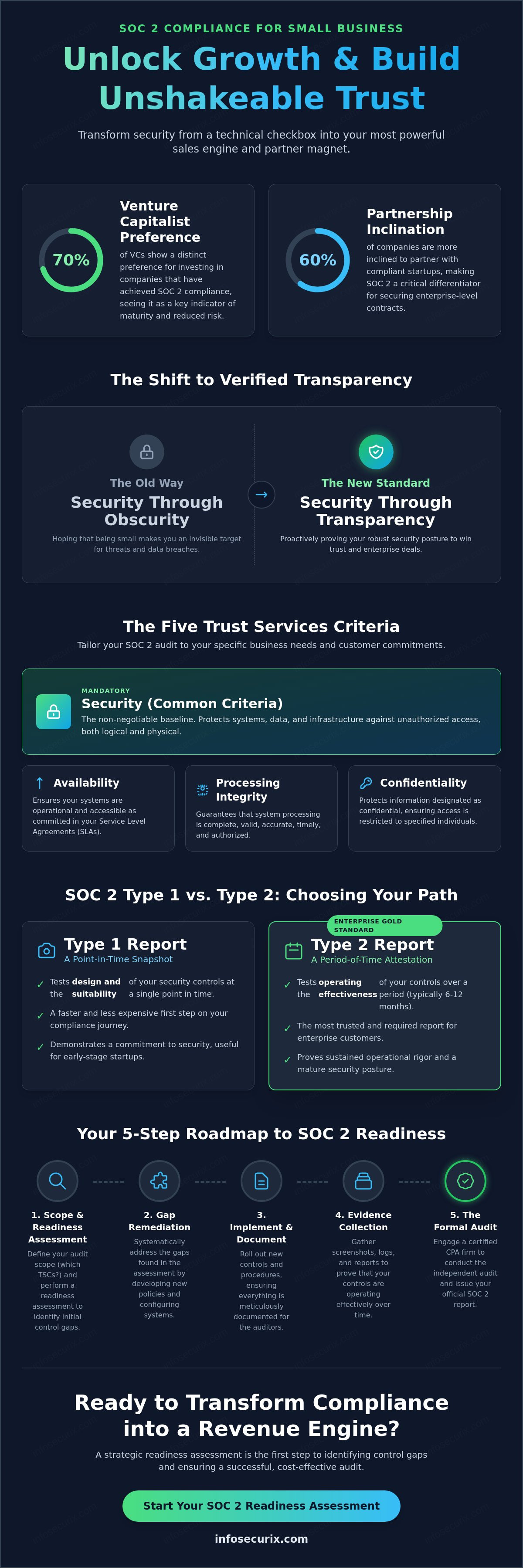
Seventy percent of venture capitalists now show a distinct preference for investing in companies that have achieved SOC 2 compliance. You likely understand that security is no longer merely a technical checkbox: it has evolved into the primary gatekeeper between your organization and the enterprise-level contracts required for true scale. Mastering soc 2 for small business isn’t just about passing an audit. It’s about establishing a foundation of trust that resonates with the 60% of companies more inclined to partner with compliant startups.
Achieving this standard often feels daunting when you’re managing limited internal staff and the fear of an expensive audit failure. You need a clear, methodical path that balances rigorous standards with operational agility. This guide provides a strategic roadmap to navigate the framework: from understanding the mandatory Security criterion to addressing the 2026 surge in AI-related data exposure. By following this readiness plan, you’ll transform complex compliance requirements into a powerful sales engine that secures your firm’s future and protects your long-term growth.
Key Takeaways
- Understand the shift from internal security protocols to a model of verified transparency that satisfies the rigorous demands of enterprise procurement teams.
- Navigate the five Trust Services Criteria to select the specific controls that align with your business objectives without over-extending your operational resources.
- Evaluate the strategic differences between the point-in-time assessment of a Type 1 report and the sustained operational rigor required for a Type 2 attestation.
- Execute a high-impact roadmap for soc 2 for small business by prioritizing a comprehensive readiness assessment to identify and resolve control gaps before your audit begins.
- Build a scalable compliance foundation that streamlines future certifications, such as ISO 27001, as your organization expands into new global markets.
Demystifying SOC 2 for Small Business: Why Trust is the New Currency
Security used to be a quiet, internal function. In the current market, it has become the loudest signal of your company’s maturity and reliability. SOC 2 is a voluntary reporting framework developed by the AICPA, designed to provide independent assurance regarding a service organization’s controls. Achieving soc 2 for small business success requires a fundamental shift in philosophy. You’re moving away from the outdated concept of security through obscurity: the hope that being small makes you invisible to threats. Instead, you’re embracing security through verified transparency.
Understanding the foundational elements of System and Organization Controls (SOC) is essential for any leadership team. While many stakeholders use the term certification, it’s technically an attestation report. This distinction is vital: unlike an ISO 27001 certification which validates a management system against a standard, a SOC 2 report is a formal opinion from a CPA firm regarding the effectiveness of your specific controls. By 2026, this report has become the primary gatekeeper in the B2B sector. Enterprise procurement teams have largely moved away from manual security questionnaires, now requiring a SOC 2 report as a baseline for all SaaS vendors.
The Business Impact of SOC 2 Compliance
Compliance is a revenue driver, not a cost center. It significantly shortens your sales cycles by pre-empting the exhaustive, 200-row security spreadsheets that typically stall enterprise deals. When you provide a verified report upfront, you’re demonstrating an elite level of data protection that unlocks access to Tier-1 clients. Beyond sales, a robust control environment can lead to reduced cyber insurance premiums. Insurers are increasingly rewarding businesses that can prove their security posture through independent audits rather than simple self-assessments.
Who Actually Needs SOC 2?
If your organization stores, processes, or transmits customer data in a cloud environment, you likely need to prioritize soc 2 for small business readiness. SaaS providers are the most frequent adopters, but Managed Service Providers (MSPs) and data center operators face equal pressure from their partners. Any small firm acting as a vendor for financial institutions, healthcare providers, or government agencies will find that SOC 2 is a non-negotiable requirement. Completing a SOC2 readiness assessment services engagement is the most logical first step to determine if your current controls meet these high-stakes expectations.
The Five Trust Services Criteria (TSC) Explained for SMB Leaders
The AICPA’s Trust Services Criteria represent the technical and operational pillars upon which every SOC 2 report rests. While the framework is comprehensive, small business leaders must understand that compliance is not a monolithic requirement. You have the strategic latitude to define the scope of your audit based on your specific service commitments and customer expectations. This flexibility is the cornerstone of a successful approach to soc 2 for small business, allowing you to demonstrate excellence without overwhelming your internal resources.
Selecting the right criteria requires a deep understanding of your data lifecycle. While the Security criterion is mandatory, adding Availability or Confidentiality should be a deliberate choice driven by your contractual obligations. If you’re unsure where your current controls stand against these benchmarks, beginning with a SOC2 Readiness Assessment can provide the clarity needed to avoid over-scoping your first audit. By focusing on what your clients actually value, you turn a technical requirement into a bespoke trust-building tool.
Security, Availability, and Processing Integrity
Security, often referred to as the Common Criteria, is the non-negotiable baseline for every report. It focuses on protecting systems against unauthorized access, both logical and physical, while ensuring the integrity of your infrastructure. Availability addresses the operational uptime of your systems. This is particularly vital for SaaS providers whose clients rely on strict Service Level Agreements (SLAs). Processing Integrity ensures that data remains complete, valid, and authorized throughout its journey. For platforms handling complex transactions, this criterion proves that your system’s outputs are as reliable as its inputs.
Confidentiality vs. Privacy: The Critical Distinction
Startups frequently conflate Confidentiality and Privacy, leading to significant scoping errors that increase audit costs. Confidentiality focuses on protecting information that is restricted to a specific set of users, such as intellectual property or sensitive business plans. Privacy, however, is a much broader undertaking. It governs how personal information is collected, used, retained, and disclosed in alignment with your organization’s privacy notice and the AICPA’s Generally Accepted Privacy Principles. Managing privacy requires meticulous documentation of data subject rights and consent mechanisms. Because this criterion introduces complex legal and operational requirements, many small businesses choose to focus on Confidentiality first to prove data protection before tackling the broader privacy landscape.
SOC 2 Type 1 vs. Type 2: Choosing the Right Path for Your Growth Stage
Selecting the appropriate audit type is a pivotal moment in the lifecycle of soc 2 for small business maturity. While both reports utilize the same Trust Services Criteria, they serve vastly different commercial purposes. A Type 1 report provides a snapshot of your control design at a specific moment in time. Conversely, a Type 2 report evaluates the operational effectiveness of those controls over a sustained period, typically ranging from six to twelve months. For a growing organization, the choice often depends on the urgency of current contract negotiations versus the long-term goal of established market credibility.
When analyzing the cost-to-value ratio, it’s helpful to view the first year of compliance as a strategic capital expenditure. A Type 1 audit has a lower initial price point, but its utility is often temporary. Most enterprise customers will eventually require a transition to Type 2 within a year of signing. By starting with a Type 1, you’re effectively funding your entry into the market. By progressing to Type 2, you’re securing your seat at the table for the long term. This phased approach allows you to manage cash flow while steadily building the “compliance-first” culture that defines successful implementations.
SOC 2 Type 1: The Quick-Start Advantage
Startups often face a dilemma when a promising enterprise prospect demands proof of security within a matter of weeks. In these scenarios, the Type 1 report offers a vital quick-start advantage. Because it only examines the design of your controls, it can be completed significantly faster than its Type 2 counterpart. While it carries less weight in enterprise procurement due to its limited scope, it serves as an essential stepping stone. It proves to your partners that you’ve built a compliant foundation, allowing you to close urgent deals while you begin the longer observation period required for the next stage of maturity.
SOC 2 Type 2: The Gold Standard for Enterprise Trust
Achieving a Type 2 report is the ultimate signal of security maturity. It demonstrates to major financial and tech firms that your controls aren’t just well-designed on paper, but are consistently applied in daily operations. This rigor builds a level of trust that a Type 1 simply cannot match. Maintaining this status requires ongoing vigilance and a commitment to regular information security internal audit cycles. These internal reviews ensure that your team remains audit-ready throughout the year, preventing the last-minute scramble that often leads to non-conforming reports. For a small business, the investment in a Type 2 report pays dividends through higher contract values and a significant reduction in the friction associated with enterprise vendor onboarding.
The Small Business Roadmap to SOC 2 Readiness: A 5-Step Implementation Guide
Readiness is the cornerstone of a successful audit. It is the strategic phase where you identify vulnerabilities and implement corrections before an external auditor arrives at your door. It’s critical to remember that your auditor cannot serve as your consultant. Legal standards require independent readiness to maintain the objectivity of the final attestation. For a typical 50-person organization, the journey of soc 2 for small business alignment usually spans three to six months. Success during this window depends entirely on executive buy-in. Without leadership actively championing policy adoption, technical controls often fail to take root within the team’s daily workflow.
To ensure your organization is fully prepared for this journey, consider scheduling a professional soc2 readiness assessment services engagement to build your custom roadmap.
Step 1: Scoping and Gap Analysis
Scoping is your first hurdle. You must determine exactly which systems, employees, and data silos fall under the audit umbrella. A formal gap analysis serves as the essential bridge between your current operational state and the rigorous requirements of compliance. By meticulously mapping your existing environment against the Trust Services Criteria, you’ll uncover the specific areas where your defenses require reinforcement. This clarity prevents wasted effort on out-of-scope systems and ensures your resources are focused on the most critical data paths.
Step 2: Policy Development and Remediation
Once gaps are identified, you move into the intensive phase of policy development and remediation. This involves drafting comprehensive documents for Access Control, Incident Response, and Business Continuity to codify your security expectations. Simultaneously, your team must implement technical safeguards such as multi-factor authentication, data encryption, and centralized logging. This phase offers significant synergy with ISO 27001 certification readiness; many of these controls satisfy both frameworks, easing your eventual expansion into global markets.
Step 3: Internal Audit and Evidence Collection
The final preparatory stage is the internal audit. Running a “mock audit” allows you to verify that your controls are operating effectively in a low-stakes environment. Engaging a specialized firm for an objective internal review provides the professional distance needed to spot overlooked issues that an internal team might miss. During this time, you’ll begin the methodical process of organizing your evidence. You’ll need to gather screenshots, system logs, and meeting minutes into a structured, accessible repository. This preparation ensures that when the external auditor begins their review, you can provide proof of compliance with absolute confidence and speed. Using a comprehensive SOC 2 readiness checklist during this stage helps ensure no critical control area is overlooked before your formal audit begins.
Scaling with Confidence: How Strategic Readiness Assessments Future-Proof Your SMB
Establishing a compliance-first culture is the most effective way to ensure that your security standards evolve alongside your revenue. By embedding these controls into your daily operations, you eliminate the friction often associated with high-growth phases. This proactive approach to soc 2 for small business maturity creates a repeatable framework that simplifies future audits. As your organization expands, the work completed for SOC 2 provides a substantial head start for other rigorous standards: such as ISO 27001 for international expansion or HIPAA for healthcare-specific ventures. Strategic readiness acts as the ultimate insurance policy against a failed audit; it ensures that your public-facing attestation reflects a truly robust environment.
With over 25 years of experience guiding small and mid-sized businesses through the complexities of the regulatory landscape, InfoSecurix provides the seasoned perspective necessary to anticipate challenges before they arise. Our team understands that security is not a static destination but a dynamic asset. We focus on aligning your technical processes with your overarching business goals, ensuring that compliance supports your growth rather than hindering it. Positioned as your trusted advisor, we help you transition from basic security protocols to a sophisticated, enterprise-grade posture.
Beyond the Audit: Continuous Compliance
Mature organizations move away from the annual fire drill mentality, choosing instead to maintain a steady, automated security posture. Continuous compliance ensures that your controls remain effective even as your infrastructure changes. Robust internal audits play a vital role here, acting as a diagnostic tool to prevent compliance drift during rapid scaling. Partnering with a seasoned guide allows you to focus on your core product while we manage the intricate details of your security journey, ensuring that your defenses remain resilient against evolving threats.
Your Next Step Toward Enterprise Trust
Security is not a cost center; it is a powerful revenue enabler that distinguishes your brand in a crowded marketplace. Defining your SOC 2 scope early is the most efficient way to protect your investment and accelerate your path to enterprise trust. We invite you to begin this journey with a preliminary consultation to assess your current posture and identify your strategic priorities. Schedule your SOC 2 Readiness Assessment with InfoSecurix today.
Empowering Your Competitive Advantage Through Verified Security
Transitioning from a reactive security stance to a proactive, compliance-first culture is the most significant strategic move an organization can make in 2026. You’ve seen that the journey toward soc 2 for small business success isn’t merely a technical hurdle; it’s a deliberate choice to align your operations with the expectations of the world’s most demanding enterprise clients. By mastering the Trust Services Criteria and selecting the appropriate audit type, you’re building a foundation of transparency that accelerates growth and mitigates risk.
Realizing this vision requires more than just automated tools. It demands a partner with the depth of experience to navigate complex regulatory landscapes. InfoSecurix brings over 25 years of information security expertise to every engagement, offering a national reach with specialized roadmaps tailored specifically for SMBs. Our proficiency across ISO 27001, SOC 2, and Business Continuity standards ensures your business remains resilient as it scales. Secure your enterprise future with a professional SOC 2 Readiness Assessment from InfoSecurix. We’re ready to help you transform compliance into a lasting engine for growth.
Frequently Asked Questions
How long does it take for a small business to get SOC 2 compliant?
Most small businesses complete the initial readiness phase and Type 1 audit within three to six months. Achieving a Type 2 report requires an additional observation period, typically spanning six to twelve months, to prove control effectiveness over time. This timeline depends on your current security maturity and the speed at which your team can implement necessary remediations identified during your gap analysis.
What is the average cost of a SOC 2 audit for a startup in 2026?
Total investment for first-year compliance varies based on your organization’s size, the selected Trust Services Criteria, and the complexity of your technical environment. These costs generally encompass audit fees, readiness assessments, and the internal resources required for remediation. To obtain a precise estimate tailored to your specific scope, we recommend engaging in a preliminary consultation to define your unique audit parameters and resource needs.
Can a small business fail a SOC 2 audit?
An organization doesn’t fail in a traditional sense, but an auditor may issue a qualified opinion or an adverse report if significant control gaps exist. These results indicate that your security measures didn’t meet the required standards during the audit period. Conducting a thorough soc 2 for small business readiness assessment is the most effective way to identify and resolve these issues before the formal audit begins.
Does SOC 2 compliance expire?
SOC 2 reports don’t have a formal expiration date, but they are typically considered valid for twelve months from the date of issuance. Enterprise partners usually require an annual audit to ensure your controls remain effective as your systems and the threat landscape evolve. Maintaining a cycle of continuous compliance prevents your security posture from becoming outdated in the eyes of sophisticated procurement teams.
What is the difference between SOC 1, SOC 2, and SOC 3?
SOC 1 focuses on internal controls over financial reporting, while SOC 2 evaluates security, availability, and privacy controls relevant to your operations. SOC 3 is a simplified, public-facing version of the SOC 2 report that omits sensitive technical details, making it ideal for marketing purposes. Most SaaS providers prioritize SOC 2 because it directly addresses the data protection concerns of their enterprise customers and partners.
Is SOC 2 compliance mandatory for US-based small businesses?
There is no federal law requiring SOC 2 compliance for all US-based small businesses. It has, however, become a de facto market requirement for any organization selling software or services to enterprise-level clients. Without an attestation report, you’ll likely find it difficult to bypass complex security questionnaires or win contracts with financial, healthcare, or government institutions that prioritize rigorous vendor risk management.
How does SOC 2 readiness compare to ISO 27001 preparation?
SOC 2 readiness focuses on the operational effectiveness of specific security controls, while ISO 27001 preparation centers on building a comprehensive Information Security Management System. While SOC 2 is the preferred standard in North America, ISO 27001 carries more weight in international markets. Fortunately, many controls overlap, allowing you to leverage your SOC 2 efforts when pursuing global certifications as your business expands.
Can I use automated compliance software to bypass a readiness assessment?
Automation platforms are excellent for evidence collection, but they cannot replace the strategic depth of a professional readiness assessment. Software often fails to account for the unique nuances of your business processes or the qualitative aspects of control implementation. A human-led assessment ensures your soc 2 for small business roadmap is bespoke and addresses specific risks that automated scanners might overlook.