
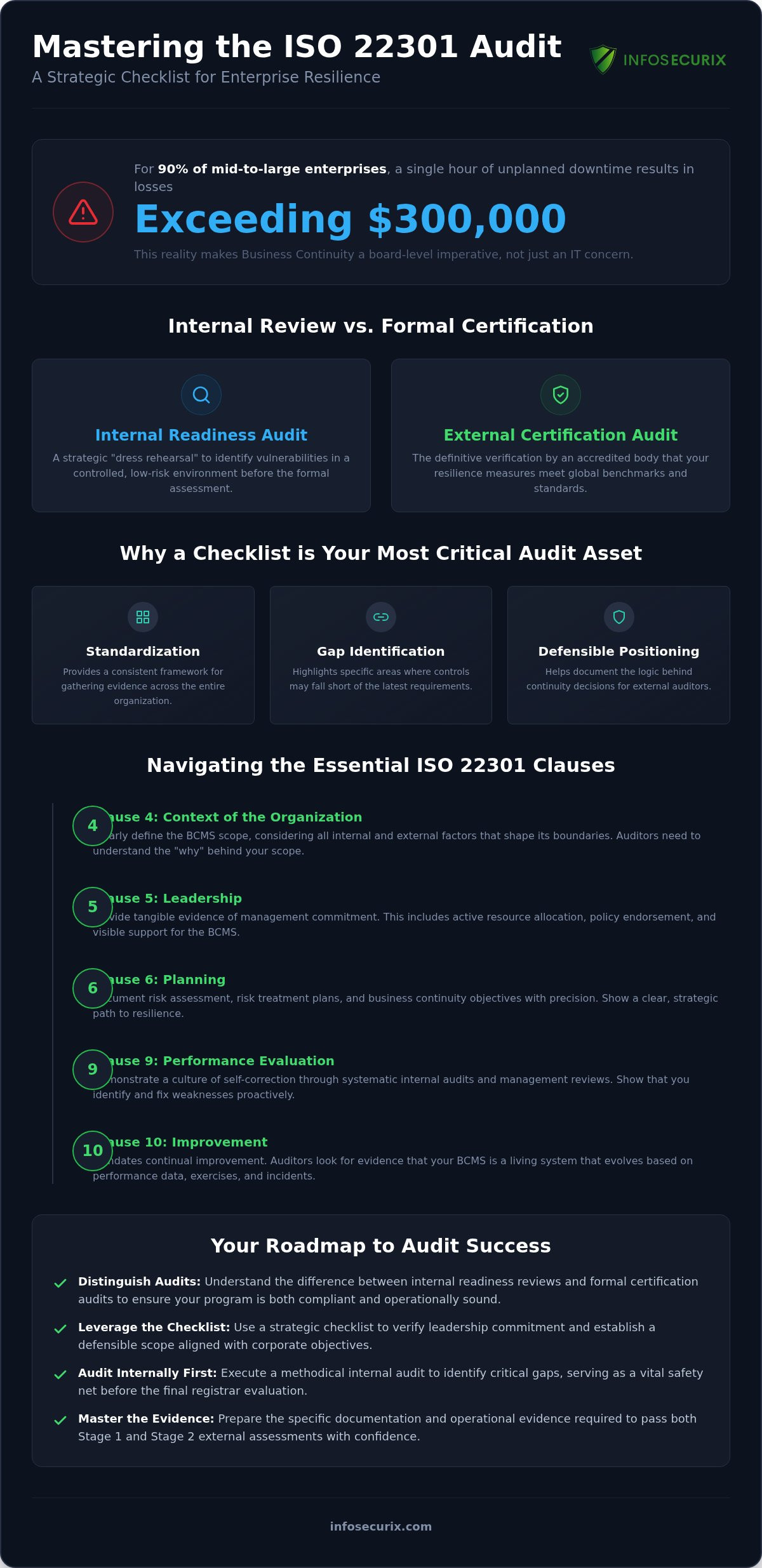
For 90% of mid-to-large enterprises, a single hour of unplanned downtime results in losses exceeding $300,000. It’s a sobering reality that underscores why business continuity isn’t just an IT concern anymore; it’s a board-level imperative. You likely feel the weight of this responsibility while staring at a mountain of documentation requirements or trying to translate abstract clauses into actionable tasks. Managing an external certification can feel like a high-stakes gamble where the rules are constantly shifting. Our ISO 22301 audit checklist is designed to eliminate that uncertainty, providing a structured path to verify your organization’s readiness.
We understand that achieving certification shouldn’t just be about surviving a registrar’s visit. It’s about building a defensible framework that protects your growth and reputation. This guide moves beyond the basics to address the 2024 climate change amendments and the critical integration of cybersecurity into your continuity plans. You’ll gain a clear roadmap to identify gaps, satisfy auditor expectations, and transform your Business Continuity Management System into a genuine competitive advantage. We’ll explore the specific evidence you need to produce and how to ensure your resilience program stands up to the most rigorous scrutiny.
Key Takeaways
- Distinguish between internal readiness reviews and formal certification audits to ensure your continuity program is both compliant and operationally sound.
- Leverage a strategic ISO 22301 audit checklist to verify leadership commitment and establish a defensible scope that aligns with your corporate objectives.
- Execute a methodical two-phase internal audit that identifies critical gaps and serves as a vital safety net before the final registrar evaluation.
- Master the specific documentation and operational evidence required to move through Stage 1 and Stage 2 external assessments with absolute confidence.
- Discover how a milestone-based readiness assessment transforms the certification process into a structured journey toward long-term enterprise resilience.
The Strategic Imperative of the ISO 22301 Audit
The ISO 22301 audit represents far more than a simple compliance exercise. It’s a systematic evaluation of your Business Continuity Management System (BCMS) designed to ensure your organization can withstand the unthinkable. While many view audits as a bureaucratic hurdle, they’re actually a validation of your operational integrity. Understanding the distinction between an internal readiness audit and a formal third-party certification is the first step toward mastery. An internal audit serves as your strategic dress rehearsal, identifying vulnerabilities in a controlled environment. In contrast, the external certification audit is the definitive verification by an accredited body that your resilience measures meet global benchmarks.
In the business environment of 2026, operational resilience has become a non-negotiable requirement for high-stakes enterprise partnerships. A successful audit serves as a powerful signal of reliability to your clients, investors, and regulators. It demonstrates that you’ve moved beyond reactive measures and have embraced a proactive culture of preparedness. When you can prove your ability to maintain critical functions during a crisis, you transform a technical requirement into a significant market differentiator.
The Evolution of Business Continuity Standards
The discipline has evolved significantly from its origins in traditional disaster recovery, which focused almost exclusively on IT restoration. Today, we embrace a holistic approach where ISO 22301:2019 stands as the gold standard for managing organizational disruption across every department. This shift recognizes that true resilience requires a deep understanding of dependencies, people, and processes. The BCMS acts as the core engine of corporate longevity, ensuring that critical functions remain operational regardless of the external pressures your business faces.
Why a Checklist is Your Most Critical Audit Asset
Precision is the hallmark of a mature resilience program. Utilizing a comprehensive ISO 22301 audit checklist ensures that no single clause of the standard, from leadership commitment to continual improvement, is overlooked during your preparation. These checklists provide a standardized framework for evidence gathering, allowing you to synthesize data from disparate departments into a cohesive narrative of compliance. They serve several vital functions:
- Standardization: They provide a consistent framework for gathering evidence across the entire organization.
- Gap Identification: They highlight specific areas where current controls may fall short of the 2019 requirements.
- Defensible Positioning: They help you document the logic behind your continuity decisions, which is essential for external auditors.
At InfoSecurix, we use these structured tools to help our clients build a defensible position. You won’t just meet the requirements; you’ll provide irrefutable proof of your readiness. By following a structured roadmap, you eliminate the guesswork that often leads to anxiety during the certification process.
The ISO 22301 Audit Checklist: Essential Domains and Clauses
A comprehensive ISO 22301 audit checklist is your most reliable tool for navigating the standard’s intricate requirements. We begin with Clause 4, which demands a clear definition of the BCMS scope. Auditors don’t just want to see a boundary; they want to understand the internal and external factors that shaped it. Clause 5 shifts the focus to leadership. You must provide evidence that management isn’t just endorsing a policy but is actively allocating the resources necessary for success. Clause 6 addresses the planning phase, where risk treatment and continuity objectives must be documented with precision. Utilizing BSI’s ISO 22301 self-assessment checklist can provide an early indication of whether these foundational layers are sufficiently robust.
The later clauses focus on performance and improvement. Clause 9 requires a systematic evaluation of the BCMS through internal audits and management reviews. Auditors look for a culture of self-correction; they want to see that you’re identifying and fixing weaknesses before they become failures. Clause 10 mandates continual improvement. If your system isn’t evolving based on performance data and changing threat landscapes, it won’t meet the standard’s expectations for long-term resilience.
Clause 8: The Heart of the Audit-BIA and Strategy
Clause 8 represents the operational heart of your resilience program. When auditing the Business Impact Analysis (BIA), the primary question is whether your Recovery Time Objectives (RTOs) are realistic. It’s a common pitfall to set ambitious targets that the current infrastructure cannot actually support. Auditors will also review your continuity strategies to ensure they cover every critical dependency: people, data, facilities, and third-party partners. Most importantly, you must demonstrate that these plans have been tested. Rigorous exercises and simulations are the only way to prove that your strategies will actually work when a disruption occurs.
Documentation Requirements: The Paper Trail of Compliance
Auditors rely on a clear paper trail to verify compliance. Mandatory documentation includes the BCMS scope, the business continuity policy, and evidence of personnel competence. However, the presence of these documents is only half the battle. Auditors look for strict version control and formal approval records to ensure that your team is always using the most recent, authorized procedures. Integrating these requirements into an iso 22301 business continuity framework helps maintain organization and accessibility. If you find the documentation requirements overwhelming, a professional readiness assessment can help streamline your preparation and identify any remaining gaps.
Executing the Internal Audit: A Prerequisite for Success
The internal audit serves as your organization’s primary defense against a failed certification. It’s a strategic dress rehearsal that uncovers vulnerabilities before they’re exposed by an external registrar. Integrating a rigorous ISO 22301 audit checklist into your internal process ensures that every control is scrutinized with the same intensity you’ll face during the official assessment. This phase begins with defining a clear audit plan that aligns with your BCMS scope. You must select auditors who possess the necessary technical expertise and, crucially, remain independent of the functions they’re evaluating. Objectivity is the cornerstone of a successful internal review.
Once the plan is set, the execution shifts to a deep-dive document review and personnel interviews. While the documentation provides the theoretical framework, the interviews reveal the operational reality of your continuity efforts. You’re looking for the delta between what’s written and what’s practiced. Identifying non-conformities and opportunities for improvement (OFI) at this stage allows for proactive remediation. After the data is synthesized, you’ll draft an internal audit report for executive review, providing a clear picture of your current resilience posture. The process concludes only when corrective actions are fully executed, transforming findings into tangible security enhancements.
The Role of Independence in Internal Auditing
Self-auditing is a common trap that often leads to overlooked vulnerabilities. When teams audit their own work, they’re prone to confirmation bias, missing the subtle systemic failures that an outsider would spot immediately. Partnering with a cybersecurity internal audit firm provides an unbiased perspective that internal resources simply can’t replicate. This “fresh eyes” phenomenon is often the difference between identifying a critical gap in your recovery strategy and being blindsided during the final certification audit. It’s an investment in the integrity of your entire resilience program.
From Findings to Corrective Actions
Understanding the severity of audit findings is essential for prioritization. A major non-conformity represents a systemic failure to meet a requirement of the standard, such as a complete lack of testing for a critical recovery plan. A minor non-conformity is typically an isolated lapse, like a single missing training record, that doesn’t compromise the overall integrity of the BCMS. Addressing these requires a disciplined root cause analysis (RCA). You aren’t just fixing the immediate error; you’re identifying the underlying process failure to ensure it doesn’t recur. This “closed-loop” remediation must be completed and verified before the external registrar arrives, providing proof of your commitment to continual improvement.
Navigating the External Certification Audit with Confidence
The transition from internal preparation to the external spotlight represents a pivotal moment in your resilience journey. Stage 1, often called the Readiness Review, focuses on whether your documentation meets the standard’s minimum requirements. It’s a high-level assessment where the auditor ensures your ISO 22301 audit checklist has been fully addressed in your policies and procedures. Once Stage 1 is cleared, you move to Stage 2: the Certification Audit. This phase is a deep dive into your operational effectiveness. The auditor will look for proof that your team actually follows the plans you’ve written, seeking evidence through observation and direct inquiry.
Success during these interactions requires a specific “audit etiquette.” You should provide clear, evidence-based answers without wandering into unnecessary tangents or over-sharing details that fall outside the scope of the question. Professionalism and transparency are key; if you don’t have an answer immediately, it’s better to document the request and provide the evidence later than to guess. The process concludes with the Closing Meeting. Here, the auditor presents their findings and provides a recommendation for certification. Understanding this feedback is crucial for your long-term improvement cycle.
Selecting the Right Certification Body
Choosing an accredited registrar is a strategic decision that shouldn’t be based solely on price. You need a partner that understands your specific industry vertical and the unique risks you face. A registrar should view the audit as a value-add exercise rather than a mere policing action, providing insights that help you strengthen your posture. InfoSecurix frequently assists clients in vetting these external bodies, ensuring you select a registrar whose approach aligns with your corporate culture. If you’re ready to finalize your path to certification, our team provides the expert guidance needed to secure your ISO 22301 certification.
Common Pitfalls During External Audits
Even well-prepared organizations can stumble on specific operational details. One frequent failure is a lack of employee awareness. If your staff can’t explain their role in the business continuity plan, the auditor may conclude the BCMS isn’t truly embedded in the culture. Another pitfall is outdated BIA data. Your impact analysis must reflect your current business reality, not the state of your company two years ago. Finally, auditors have a saying: if it wasn’t documented, it didn’t happen. Incomplete exercise records are a major red flag that suggests your tests were either insufficient or never performed.
Elevating Resilience with InfoSecurix Readiness Assessments
Selecting a partner for your resilience journey requires more than just technical aptitude; it demands a legacy of proven success across diverse and demanding industries. InfoSecurix stands as a strategic ally for organizations pursuing excellence, bringing over 25 years of experience in navigating complex regulatory landscapes and national infrastructures. Our Readiness Assessment service provides a low-friction, high-impact way to gauge your audit maturity without the immediate pressure of a formal registrar visit. We position the internal audit as the ultimate dress rehearsal, ensuring every requirement on your ISO 22301 audit checklist is refined, tested, and defensible before the certification event begins. By identifying these nuances early, we protect your reputation and ensure a smooth transition to formal certification.
The InfoSecurix Methodology: Precision Meets Partnership
Our methodology is built on the principle that precision enables corporate growth. We employ a bespoke approach to information security risk assessment, ensuring your BCMS isn’t a siloed effort but a deeply integrated part of your broader risk posture. This often involves aligning ISO 22301 requirements with existing frameworks like ISO 27001 or SOC 2, eliminating redundant controls and maximizing your operational efficiency. Following every engagement, we deliver strategic corrective action plans that provide a clear, prioritized path toward remediation. We don’t just identify gaps; we collaborate with your leadership to close them through sustainable, scalable solutions that stand up to the most rigorous scrutiny.
Your Next Step Toward Certified Resilience
Moving beyond static checklists requires the guidance of a seasoned expert who has navigated every possible disruption scenario. True resilience comes from the confidence that your compliance roadmap is professionally managed and future-proofed against the evolving threats of 2026. Engaging with a trusted advisor provides the peace of mind necessary to focus on your core business objectives while we manage the granular mechanics of the standard. Our goal is to instill absolute confidence in your stakeholders, proving that your business is built to endure regardless of the challenges ahead. Your organization deserves a resilience program that transcends mere compliance to provide a genuine, strategic competitive advantage. Partner with InfoSecurix for your ISO 22301 Readiness Assessment and take the definitive step toward certified excellence.
Securing Your Legacy through Strategic Resilience
Achieving ISO 22301 certification is far more than a technical milestone. It’s a definitive statement of your organization’s ability to endure and excel during periods of profound disruption. We’ve explored how a professional-grade ISO 22301 audit checklist serves as the backbone of this journey, providing the structure needed to verify leadership commitment and operational effectiveness. By treating the internal audit as a strategic dress rehearsal, you ensure that your Business Continuity Management System isn’t just a document on a shelf but a living engine of corporate longevity.
InfoSecurix stands ready to be your seasoned guide through these complex regulatory landscapes. Drawing on 25+ years of compliance expertise, our team specializes in milestone-based engagements that provide predictable outcomes for ISO 22301, ISO 27001, and SOC 2. We help you move beyond checking boxes to build a defensible, future-proof resilience program. Secure Your Certification with an InfoSecurix Readiness Assessment. Your path to absolute operational confidence begins with a single, decisive step toward excellence.
Frequently Asked Questions
Is an ISO 22301 audit mandatory for every business?
ISO 22301 certification isn’t legally mandatory for all businesses, though it’s increasingly required by enterprise clients and regulatory bodies in critical sectors. You might find it’s a prerequisite for high-value contracts or government tenders. Even without a mandate, organizations adopt the standard to protect their reputation and ensure they can maintain critical operations during a crisis.
How long does the ISO 22301 certification audit typically take?
The duration of a certification audit depends on your organization’s size, complexity, and the number of locations in scope. Typically, Stage 1 takes one to two days, while Stage 2 can last anywhere from three days to over a week. Using a comprehensive ISO 22301 audit checklist during your preparation helps streamline this process by ensuring all evidence is organized and readily available for the registrar.
What is the difference between an internal audit and a gap analysis?
A gap analysis is a preliminary assessment used to identify which requirements of the standard aren’t yet addressed in your current framework. In contrast, an internal audit is a formal, systematic evaluation of your implemented controls to verify they’re operating effectively. While a gap analysis helps you build your program, the internal audit proves that your program actually works as intended.
How often must we conduct an ISO 22301 internal audit?
You should conduct an internal audit at least once every twelve months to satisfy the standard’s requirements for performance evaluation. It’s also best practice to perform an audit following any significant organizational change, such as a major merger or a shift in your primary technology stack. Regular reviews ensure your resilience strategies stay aligned with your evolving business objectives and current threat landscape.
What are the most common reasons for failing an ISO 22301 audit?
Failure often stems from a lack of leadership commitment or an inadequate Business Impact Analysis that doesn’t reflect operational reality. Auditors also frequently cite a lack of rigorous testing and poor employee awareness as critical weaknesses. If your staff can’t articulate their specific roles during a disruption, the auditor will likely conclude that your business continuity management system isn’t effectively embedded in the corporate culture.
Can we integrate our ISO 22301 audit with an ISO 27001 audit?
You can certainly integrate these audits, as both standards follow the high-level structure of Annex SL. This alignment allows you to streamline your ISO 22301 audit checklist to cover shared requirements like leadership, planning, and performance evaluation. Combining audits reduces administrative overhead and provides a more holistic view of your organization’s security and resilience posture across disparate departments.
What happens if the auditor identifies a major non-conformity?
If a major non-conformity is identified, the certification body won’t issue your certificate until the issue is fully remediated and verified. You’ll need to perform a root cause analysis and implement corrective actions within a specific timeframe, usually 90 days. This finding indicates a systemic failure in your BCMS, requiring a disciplined response to ensure your organization’s resilience isn’t fundamentally compromised.
How much does a professional ISO 22301 readiness assessment cost?
The investment for a professional readiness assessment varies based on the scale of your operations and the complexity of your existing business continuity framework. Because each engagement is bespoke, we recommend a consultation to define a scope that meets your specific needs. This proactive approach identifies critical gaps early, providing a predictable roadmap to certification while avoiding the high costs associated with audit failures.