

Your security budget is far more than a defensive line item; it is a strategic asset that requires a sophisticated information security risk assessment methodology to deliver true value. Many leadership teams feel paralyzed by the sheer volume of vulnerability data, often finding it difficult to translate technical gaps into the language of business risk. You likely recognize the frustration of manual processes that yield inconsistent results or the confusion of selecting between competing frameworks like NIST, ISO, and FAIR. It’s a common challenge to feel overwhelmed by technical complexity while trying to maintain a steady course toward long-term organizational resilience.
Establishing a robust, repeatable process is the foundational step toward transforming these technical hurdles into a clear roadmap for growth. We will demonstrate how to move beyond ad-hoc assessments to create a defensible framework that ensures absolute confidence during your next audit. This article outlines the strategic approach necessary to achieve certification readiness for standards like ISO 27001 and SOC2. By the end of this guide, you’ll understand how to optimize your security spend based on quantified risks, effectively future-proofing your business through meticulous, high-level standards.
Key Takeaways
- Learn to distinguish between a single risk event and a repeatable methodology to ensure your security posture remains resilient over time.
- Evaluate the differences between NIST, ISO, and FAIR frameworks to identify the ideal alignment for your organization’s unique compliance trajectory.
- Implement a structured information security risk assessment methodology that maps critical data flows and bridges the gap between technical gaps and business impact.
- Discover how a meticulous assessment process serves as the essential first step for achieving successful ISO 27001 or SOC2 certification readiness.
- Shift your perspective from “checking the box” to using risk data as a strategic tool that’s essential for securing executive buy-in and optimizing your security budget.
What is an Information Security Risk Assessment Methodology?
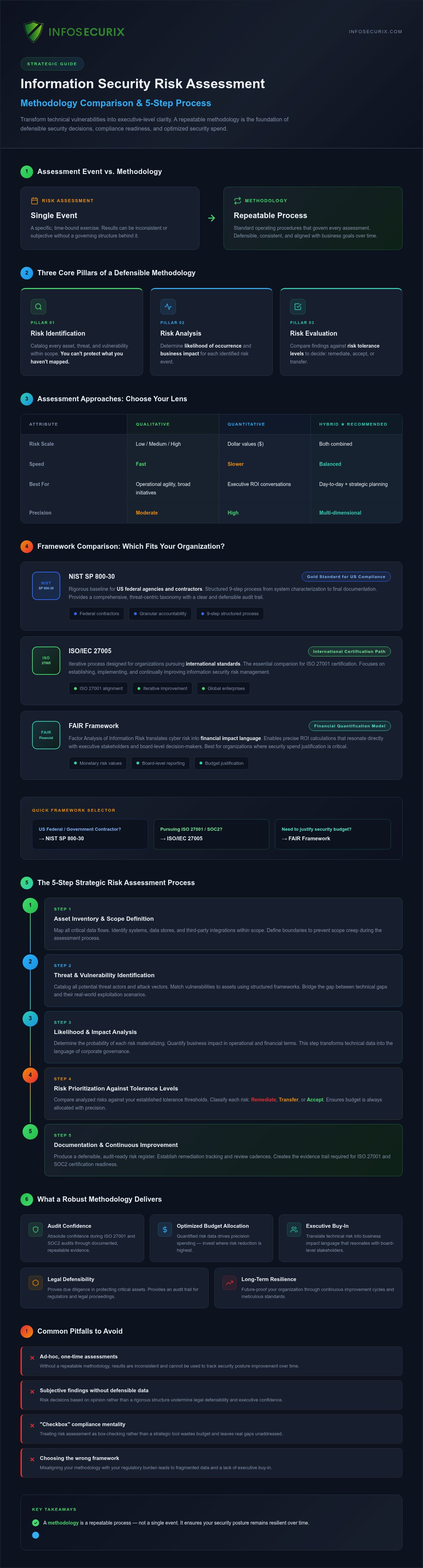
An information security risk assessment methodology is far more than a simple checklist or a one-time exercise. It is a systematic process designed for identifying, estimating, and prioritizing risks to organizational operations and assets. While a risk assessment is a specific event, the methodology represents the repeatable logic and standard operating procedures that govern that event. It provides the “why” and the “how” behind every security decision, ensuring that your findings aren’t just subjective opinions but are based on a rigorous, defensible structure.
Adopting a standardized information security risk assessment methodology is a vital prerequisite for information security internal audit success. It creates a bridge between granular technical vulnerabilities and high-level corporate governance. By establishing a clear, documented approach, you provide the Board with a sense of absolute confidence. This transparency transforms risk data into a tool for legal defensibility, proving that your organization has exercised due diligence in protecting its most critical assets.
The Core Components of a Defensible Methodology
A sophisticated framework relies on three interconnected pillars to remain effective under pressure. First, Risk Identification involves cataloging every asset, threat, and vulnerability within your scope. You can’t protect what you haven’t mapped. Second, Risk Analysis moves into the mechanics of exploitation, determining the likelihood of an event occurring and the resulting impact on the business. Finally, Risk Evaluation compares these findings against your established risk tolerance levels. This step allows leaders to decide which risks require immediate remediation and which can be accepted or transferred, ensuring your security budget is always allocated with precision.
Qualitative vs. Quantitative Approaches
Organizations typically choose between two primary lenses to view their risk profile. Qualitative assessments use descriptive scales, such as Low, Medium, or High, to build consensus quickly. This approach is excellent for operational agility and prioritizing broad initiatives without getting bogged down in complex calculations. In contrast, quantitative methods assign specific monetary values to risks. This allows for precise ROI calculations that speak directly to the financial interests of executive stakeholders.
Modern enterprises increasingly favor a hybrid model. By balancing the speed of qualitative insights with the precision of quantitative data, you gain a multi-dimensional view of your security posture. This combined approach ensures your information security risk assessment methodology provides the clarity needed for both day-to-day management and long-term strategic planning.
Comparative Analysis: NIST SP 800-30 vs. ISO 27005 vs. FAIR
Selecting an information security risk assessment methodology isn’t merely a technical choice. It’s a foundational commitment to how your organization perceives and manages uncertainty. The framework you adopt dictates the language your technical teams use and the clarity with which you present risks to stakeholders. Whether you’re a federal contractor or a global enterprise, your methodology must align with your specific regulatory burden and operational maturity. Choosing the wrong path can lead to fragmented data and a lack of executive buy-in, while the right choice instills absolute confidence in your security posture.
NIST SP 800-30: The Gold Standard for Compliance
NIST SP 800-30 serves as the rigorous baseline for US federal agencies and their extensive network of contractors. Its structured nine-step process guides organizations through every phase, from initial system characterization to the final documentation of results. NIST’s approach is a comprehensive, threat-centric taxonomy. This framework is ideal for entities that require high levels of transparency and strict alignment with federal mandates. It ensures that every potential threat is cataloged with meticulous detail, providing a clear and defensible audit trail for regulators who demand granular accountability.
ISO 27005: Streamlining International Certification
ISO/IEC 27005 offers an iterative process designed specifically for organizations pursuing international standards. It focuses heavily on establishing context and determining risk treatment options. This methodology is the natural choice for organizations undergoing ISO 20000 implementation or seeking ISO 27001 certification. Unlike more rigid frameworks, ISO 27005 emphasizes the critical phase of “Risk Treatment.” It moves your team beyond simple identification into corrective action, ensuring that your security efforts lead to tangible improvements in operational resilience and audit readiness.
FAIR Methodology: The Future of Risk Quantification
FAIR (Factor Analysis of Information Risk) has emerged as the premier framework for financial risk quantification. It breaks down complex security scenarios into two manageable variables: Loss Event Frequency and Loss Magnitude. This structure is perfect for communicating technical risk to the Board of Directors in dollars and cents. FAIR doesn’t replace NIST or ISO frameworks; instead, it complements them by providing the mathematical rigor needed for precise ROI calculations. It allows you to prioritize your security spend based on the actual financial impact of a potential breach. For those seeking a specialized risk assessment, integrating FAIR can transform raw data into high-level business intelligence.
Selecting the right framework requires a seasoned perspective on your industry’s specific needs. Consider these factors:
- Regulatory Burden: Federal mandates often necessitate NIST, while global trade favors ISO.
- Organizational Maturity: Start with qualitative ISO processes before moving to quantitative FAIR models.
- Stakeholder Needs: Use FAIR when the Board requires financial justification for security investments.
The 5-Step Strategic Risk Assessment Process
Moving from a theoretical framework to active execution requires a disciplined roadmap. A high-level information security risk assessment methodology serves as your operational blueprint, transforming broad organizational goals into a series of actionable, measurable steps. This systematic journey ensures that no critical asset is overlooked and every vulnerability is addressed with surgical precision. By following a structured process, you move beyond reactive firefighting and begin to build a culture of proactive resilience that stakeholders can trust.
Step 1 & 2: Setting the Strategic Boundary
Successful preparation begins with defining a strict scope to avoid the common trap of analysis paralysis. By identifying essential stakeholders early, you ensure the assessment reflects the operational realities of every department, from IT to Finance. Asset identification follows this, involving a meticulous mapping of data flows and critical infrastructure. Within this phase, asset valuation is the process of assigning business criticality to data sets. This step is vital: not all data is created equal in the eyes of the law or your customers. Categorizing assets based on their legal and operational impact establishes a defensible foundation for the entire framework.
Step 3 & 4: Analyzing the Threat Landscape
Analyzing your threat landscape requires adopting an adversarial mindset through formal threat modeling. This allows your team to anticipate how a sophisticated actor might exploit hidden weaknesses. You should integrate automated scan results directly into your manual information security risk assessment methodology to maintain a comprehensive, real-time view of your environment. This integration helps in determining “what could go wrong” and specifically “where we are weak.” By calculating likelihood through data-driven probability rather than guesswork, you can perform an impact assessment that accurately reflects the business consequences of a potential breach.
Step 5: The Risk Treatment Plan
The final stage involves creating a risk treatment plan that prioritizes remediation based on a visual “Heat Map.” This map guides executive decision-making by highlighting risks that exceed your tolerance levels. Every identified risk requires a deliberate choice:
- Accept: Retaining the risk when it fits within your strategic appetite.
- Avoid: Altering business processes to remove the threat entirely.
- Transfer: Utilizing ISO 22301 business continuity strategies to shift the burden to insurers or partners.
- Mitigate: Deploying technical or administrative controls to reduce the risk to a manageable state.
Developing these corrective actions satisfies external auditors and secures your most valuable assets. This methodical approach ensures that your security budget is always allocated to the areas of greatest impact, providing a clear path toward long-term operational success.
Overcoming Common Methodology Pitfalls and Objections
Implementing a sophisticated information security risk assessment methodology often reveals organizational friction that can stall even the most well-intentioned initiatives. One of the most pervasive pitfalls is treating the process as a mere “check-the-box” exercise. When leadership views the assessment as a compliance hurdle rather than a strategic asset, the results lack the depth needed to inform real business decisions. Another frequent challenge is scope creep. Teams often feel compelled to assess every individual laptop or mobile device instead of focusing on the critical business processes that drive value. This granular distraction dilutes the impact of your findings and exhausts resources without improving your overall security posture.
Resistance often stems from the objection that an organization lacks the internal expertise to run a NIST-level assessment. While the frameworks are complex, they are designed to be scalable. You don’t need a massive team of auditors to begin; you need a structured approach that prioritizes high-impact areas first. By addressing these objections head-on, you transform the risk assessment from a source of anxiety into a repeatable, defensible process that instills absolute confidence in your partners and stakeholders.
Eliminating Subjectivity through Calibration
A common executive concern is that risk results feel too subjective to be actionable for the Board. To counter this, you must normalize risk scores across different departments. This ensures a “High” risk in Marketing carries the same weight as a “High” risk in Engineering. Using historical data grounds your likelihood estimates in reality, moving the conversation from hypothetical fears to data-driven probabilities. A seasoned guide acts as a neutral party to facilitate objective workshops, challenging assumptions and driving consensus among stakeholders. This calibration ensures that your final heat map reflects an accurate, unified view of organizational risk rather than a collection of departmental biases.
Scaling the Methodology for Growth
Your information security risk assessment methodology should evolve alongside your business. You don’t have to tackle every requirement on day one. Starting with a targeted gap analysis allows you to identify immediate priorities before committing to a full framework. Smaller businesses can adopt “NIST-Lite” approaches, focusing on the core controls that enterprise clients demand for vendor approval. As your maturity grows, you can integrate these assessments into your Software Development Life Cycle (SDLC), ensuring security is baked into every new product. If you’re ready to move beyond fragmented processes, our specialized risk assessment services bridge the gap between technical data and executive clarity.
Leveraging Expert Methodology for Certification Success
Selecting an information security risk assessment methodology is the single most critical decision in your certification journey. An ill-fitting framework often leads to audit failure, resulting in expensive remediation cycles and delayed market entry. When the underlying logic is flawed, your team wastes valuable resources fixing the wrong problems while leaving high-impact gaps exposed. Utilizing a specialized risk assessment ensures that your methodology aligns perfectly with the requirements of SOC 2 or ISO 27001, providing a clear path to success.
At InfoSecurix, we leverage over 25 years of industry experience to guide organizations through these complexities. Our approach isn’t a one-size-fits-all template. We develop bespoke methodologies refined through decades of high-stakes engagements, ensuring your risk process is as unique as your business operations. A methodology is only as good as the strategic actions it inspires; it should act as a catalyst for meaningful change rather than a static record of vulnerabilities. By focusing on the strategic impact of your technical processes, we help you build a framework that is both visionary and grounded.
The InfoSecurix Advantage in Readiness
Our role is to bridge the gap between technical vulnerability and executive risk. We don’t just identify technical flaws; we translate them into the language of business impact that your Board can understand and support. This clarity allows us to develop documentation that stands up to the most rigorous third-party audits. By establishing a collaborative partnership, we empower your internal teams with the knowledge and tools they need for long-term resilience. You’ll move through your certification audit with absolute confidence, knowing every control is backed by a sound, defensible information security risk assessment methodology.
Next Steps: From Assessment to Resilience
A completed assessment is the beginning of your resilience journey, not the end. The transition from identifying risks to executing a Corrective Action Plan is where real security is built. This plan serves as your roadmap for technical and administrative improvements, ensuring every identified gap is closed before the auditor arrives. To maintain continuous compliance, we recommend scheduling an annual review of your risk framework. This proactive cadence keeps your process aligned with the evolving threat landscape and changing business goals. If you’re ready to transform your risk profile into a strategic asset, we invite you to Schedule a strategic readiness assessment with InfoSecurix today.
Future-Proofing Your Enterprise Resilience
Mastering a robust information security risk assessment methodology is the essential catalyst for transforming technical gaps into strategic business intelligence. You’ve seen how a structured approach, whether aligned with NIST, ISO, or FAIR, provides the repeatable logic necessary to satisfy rigorous audit requirements and secure executive buy-in. By moving beyond ad-hoc processes and embracing a calibrated framework, you position your organization for long-term growth and absolute audit readiness.
InfoSecurix brings over 25 years of strategic security consulting to this journey. We offer a bespoke methodology tailored to your unique compliance scope and operational needs. Our fixed-fee engagements ensure transparency and eliminate the risk of hidden remediation costs, allowing you to focus on your core mission with total peace of mind. It’s time to elevate your security posture from a defensive necessity to a powerful competitive advantage.
Secure your enterprise trust with a professional SOC 2 Readiness Assessment and begin building a legacy of operational excellence today.
Frequently Asked Questions
What is the primary goal of an information security risk assessment methodology?
The primary goal is to provide a repeatable, logical structure that transforms raw data into actionable business intelligence. It ensures that security investments are prioritized based on the actual impact to organizational operations and assets. By following a consistent process, you move beyond guesswork to build a defensible security posture that satisfies both internal stakeholders and external auditors.
How often should an organization update its risk assessment methodology?
You should review your methodology annually or whenever significant changes occur in your business environment or threat landscape. While the core logic may remain steady, the specific parameters for likelihood and impact often require calibration to reflect current market realities. Regular updates ensure that your risk profile remains accurate and that your strategic roadmap continues to protect your most critical assets effectively.
Can we use a free risk assessment template for ISO 27001 certification?
While free templates offer a starting point, they rarely provide the bespoke depth required for successful ISO 27001 certification. Certification bodies look for a methodology that’s deeply integrated into your specific operational context. A generic template often lacks the nuance needed to define your unique risk appetite or treatment strategies, potentially leading to audit non-conformities and wasted remediation efforts.
What is the difference between a threat-based and an asset-based methodology?
An asset-based approach focuses on identifying and valuing specific data sets or infrastructure, while a threat-based methodology prioritizes potential adversarial actions. Most modern frameworks now advocate for a hybrid approach. This ensures that you not only protect what’s valuable but also understand the specific methods an attacker might use to exploit your unique vulnerabilities.
How do we choose between NIST and ISO frameworks for our risk assessment?
Your choice depends on your regulatory environment and market focus. NIST frameworks are often required for organizations working with the US federal government, offering a highly granular, threat-centric taxonomy. ISO frameworks are the international standard of choice for global commercial entities. If your goal is ISO 27001 certification, selecting the ISO 27005 information security risk assessment methodology ensures seamless alignment with your broader compliance objectives.
What role does the Board of Directors play in the risk assessment process?
The Board’s primary role is to define the organization’s risk tolerance and ensure that security efforts align with business objectives. They provide the high-level oversight necessary to validate that risks are being managed appropriately. By reviewing the results of your methodology, the Board can make informed decisions about budget allocation and strategic prioritization, ensuring the company’s long-term resilience.
Is automated risk assessment software better than manual methodology?
Automation excels at processing large volumes of technical data, but it can’t replace the strategic insight of a manual methodology. Software provides the “what,” while human expertise provides the “why.” A hybrid approach is often most effective, using automated tools to gather vulnerability data and expert analysis to translate that data into meaningful business risk and corrective action plans.
How does a risk assessment methodology impact our cyber insurance premiums?
Insurers increasingly reward organizations that demonstrate a disciplined, documented approach to risk management. A robust information security risk assessment methodology proves that you’ve exercised due diligence in identifying and mitigating threats. Providing evidence of a repeatable process can lead to more favorable terms or lower premiums, as it signals to the insurer that your organization is a lower-risk entity with a proactive security culture.