

If forty percent of businesses never reopen their doors following a major disaster, can you be certain your current strategy isn’t just a collection of untested assumptions? Most executives understand the immense pressure of demonstrating rigorous readiness to auditors, yet they often struggle to move beyond static documentation into true operational agility. Effective resilience begins with a precise business impact analysis for ISO 22301, which identifies your critical dependencies before a crisis strikes. You’ve likely felt the weight of stakeholder indifference during tabletop exercises or the nagging doubt that your plan might fail when it’s needed most.
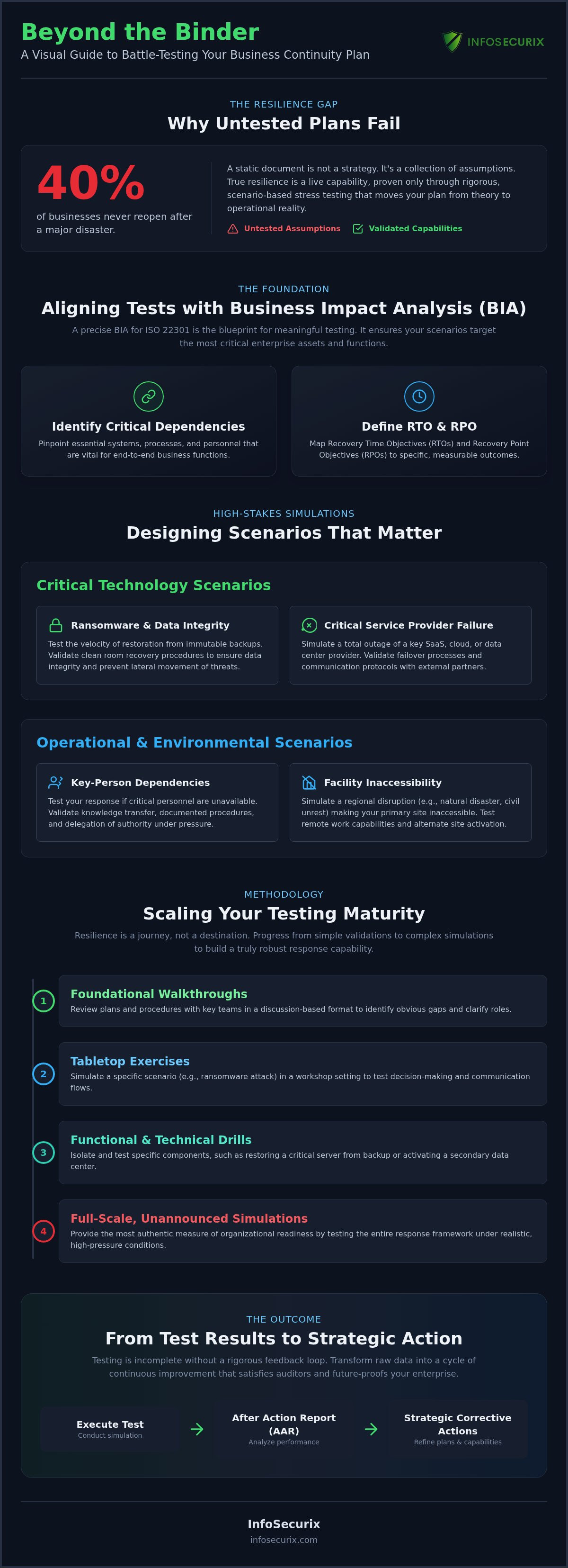
This guide transforms your theoretical disaster recovery into a battle-tested framework using strategic testing scenarios and proven methodologies. You’ll explore a robust roadmap for compliance with the latest ISO 22301:2019 standards, including the mandatory 2024 climate action amendments, to ensure your organization remains steady when others falter. We’ll examine how to reduce downtime through systematic validation and turn your compliance requirements into a strategic advantage. By the end of this article, you’ll have the tools to move from basic survival to sophisticated enterprise resilience.
Key Takeaways
- Move beyond static documentation by implementing scenario-based stress tests that bridge the gap between theoretical planning and operational reality.
- Leverage the insights from your business impact analysis for ISO 22301 to design high-stakes simulations for ransomware attacks and critical service provider failures.
- Address the complexities of human systems by testing for key-person dependencies and the physical inaccessibility of facilities during regional disruptions.
- Scale your testing maturity from foundational walkthroughs to unannounced simulations that provide an authentic measure of your organization’s response capabilities.
- Transform raw test data into strategic corrective actions through rigorous After Action Reports that satisfy auditors and future-proof your enterprise.
The Strategic Imperative of Business Continuity Plan Testing Scenarios
True organizational resilience is never a static achievement. It is a live capability that requires constant validation through strategic testing. Many enterprises fall into the trap of treating their continuity plans as mere administrative requirements; they believe that a documented plan is the same as a functional one. This is a dangerous assumption. Business continuity plan testing is the formal validation of your operational resilience. It’s the process that moves your strategy beyond paper and into the hands of the people who must execute it. Without this validation, your plan is simply a collection of untested hypotheses.
Theoretical documentation often disintegrates when it meets the friction of a real-world crisis. Without rigorous, scenario-based stress testing, hidden operational silos remain invisible until it is too late. These silos create gaps in communication and resource allocation that can paralyze a recovery effort. Rigorous testing is a core pillar of achieving ISO 22301 business continuity certification. It transforms your compliance journey from a box-ticking exercise into a genuine culture of readiness. This shift requires deep executive engagement. Leadership must view testing as a high-value investment in the company’s longevity rather than a scheduled disruption.
Aligning Scenarios with Business Impact Analysis (BIA)
Performing a meticulous Business Impact Analysis is the first step toward meaningful testing. A high-quality business impact analysis for ISO 22301 ensures that your scenarios target the most critical enterprise assets rather than peripheral systems. You must design exercises that test end-to-end business functions. If your IT systems recover but your supply chain remains paralyzed, the test has failed to validate true resilience. Every exercise should map Recovery Time Objectives (RTOs) and Recovery Point Objectives (RPOs) to specific, measurable outcomes. This alignment proves the organization can sustain its most vital operations during a period of intense pressure.
Setting Clear Objectives for Every Exercise
Success in a resilience exercise is defined by more than just finishing the drill. It involves measuring the nuances of human performance and system reliability. You need to evaluate communication efficacy and the speed of executive decision-making. Is information flowing to the right people? Are the emergency contact lists and recovery documents actually current for 2026? Validating these granular details ensures that your response is as precise as it is fast. By setting clear objectives, you build stakeholder confidence and demonstrate that your resilience framework is grounded in operational reality; it shows you aren’t just prepared on paper, but ready for action.
Critical Technology Scenarios: Validating Digital Resilience
Digital resilience is the cornerstone of modern enterprise survival. While the strategic framework provides the vision, technical scenarios provide the proof. These exercises shouldn’t just confirm that systems exist; they must validate that systems perform under extreme duress. Integrating the findings from your business impact analysis for ISO 22301 allows you to prioritize the digital assets that would cause the most catastrophic disruption if lost. Without this technical validation, even the most sophisticated recovery plans remain theoretical.
Ransomware and Data Integrity Drills
Testing for ransomware is no longer optional. You must move beyond the simple comfort of knowing backups exist and instead focus on the velocity of restoration. Simulating a large-scale attack requires your team to verify immutable backup integrity while operating in a high-pressure environment. A clean room recovery environment is a secure, isolated staging area where data is scrubbed and verified for integrity before being reintroduced to the production network. This isolation is critical. You must test your ability to quarantine infected network segments while maintaining core operations to prevent lateral movement. This process ensures that your Recovery Point Objectives (RPOs) are achievable in a high-volume data environment.
Infrastructure and Connectivity Failures
The shift toward distributed workforces and cloud-native architectures has introduced new vulnerabilities. Testing the failure of a primary cloud service provider or a critical SaaS application is essential to validate your multi-cloud redundancy. Organizations should look to authoritative guidance on business continuity to frame these infrastructure drills effectively. These exercises ensure that the priorities identified during your business impact analysis for ISO 22301 are technically supported by your failover architecture.
Beyond the cloud, physical connectivity remains a risk. Validating secondary connectivity during a total network outage is vital for maintaining productivity across national teams. Simulating a regional power grid failure tests the transition to local UPS or generator systems. This transition must be seamless to prevent data corruption. Similarly, evaluating the impact of a sustained internet blackout on remote operations reveals the true efficacy of your cellular failover solutions. If these transitions aren’t practiced, they won’t work when the lights go out. Engaging in a readiness assessment can help identify which of these technical gaps require immediate attention before your next audit.
Operational and Environmental Scenarios: Testing Human Systems
While digital systems are the engine of the enterprise, the human element is the navigator. Testing human systems involves simulating scenarios where the physical or social environment becomes hostile to business as usual. By grounding these exercises in the results of your business impact analysis for ISO 22301, you ensure that your response strategies account for the most vulnerable links in your operational chain. This isn’t just about safety; it’s about maintaining the duty of care while protecting the organization’s mission. These drills move beyond the technical to address the complex realities of leadership and logistics.
Consider the impact of a key person risk where fifty percent of your leadership or specialized IT staff is suddenly unavailable. This scenario forces the organization to evaluate the efficacy of its succession plans and emergency communication systems. You must ensure that your national workforce receives clear, unified messaging even when the usual channels are strained. Similarly, simulating a critical supply chain disruption with a primary vendor allows you to test alternative procurement and logistics paths before a real shortage occurs. These exercises validate that your organization can remain steady even when external partners fail.
Workforce Scarcity and Remote Transition
A sudden shift to 100% remote work for an office-based team can stress-test even the most robust digital collaboration tools. You must validate the scalability of your VPNs and security protocols under maximum load to prevent operational bottlenecks that could stall recovery. These simulations also reveal the true depth of your institutional knowledge. By testing how well your cross-training programs hold up when specialists are absent, you confirm that your organization can function without its usual pillars of expertise. It’s a vital measure of how well your team can adapt to workforce scarcity without losing momentum.
Physical Access and Facility Disruption
Physical facility inaccessibility, whether due to natural disasters or local unrest, requires a rapid pivot to alternate work sites. Testing these hot sites ensures they’re truly ready for immediate occupancy, with all necessary data and hardware in place. This level of preparedness is a requirement of the ISO 22301:2019 standard. During such transitions, you must also evaluate the security of physical assets and data when a facility is abandoned in haste. Integrating health and safety protocols into your continuity response protects your most valuable asset: your people. This holistic approach ensures that your business impact analysis for ISO 22301 translates into a compassionate, effective recovery strategy that stands up to the pressures of the real world.
Selecting the Right Testing Methodology for Your Scenarios
Selecting a testing methodology is a strategic decision that must align with your organization’s current maturity level. It’s counterproductive to attempt a full-scale simulation if your information security internal audit reveals fundamental gaps in your baseline documentation. Instead, a logical progression ensures that each test builds upon the success of the previous exercise. This measured approach allows you to balance the depth of the exercise with the inherent operational risk of the test itself. You want to validate your resilience without causing self-inflicted downtime. Engaging external observers or independent auditors provides an unbiased lens. Their perspective ensures that your perceived readiness matches your actual capability. The findings from your business impact analysis for ISO 22301 serve as the primary roadmap for this selection process. By identifying the most critical dependencies, you can determine which functions require high-pressure validation and which are better suited for a strategic walkthrough.
Tabletop Exercises: The Strategic Walkthrough
Tabletop exercises are low-friction, high-impact sessions where key stakeholders discuss a specific scenario in a controlled environment. These discussions are designed to identify policy gaps and logic failures before they manifest during a crisis. The focus remains on communication silos and decision-making logic; it ensures the brain of the organization stays functional when the body is under stress. To be effective, these sessions must be non-confrontational. Facilitators should encourage honest feedback and discovery, turning every identified weakness into a strategic opportunity for growth. This methodology is particularly effective for engaging executives who need to understand the strategic impact of their decisions without the noise of a technical drill.
Simulation and Parallel Testing: Real-World Pressure
Simulation and parallel testing offer the ultimate proof of technical readiness. By testing recovery systems in an isolated environment that mimics live production, you can verify performance without disrupting daily operations. Introducing ‘injects’—unforeseen pieces of information—simulates the chaotic and evolving nature of a true corporate crisis. This methodology validates that technical staff can execute recovery procedures under intense time pressure, even without the direct guidance of senior leadership. It is the bridge between theoretical planning and battle-tested operational resilience. If you are ready to move beyond documentation, our experts can guide you through a Risk Assessment to identify your most critical testing priorities and baseline your current capabilities.
Moving from Test Results to Strategic Corrective Actions
The conclusion of a resilience exercise is not the end of the cycle; it’s the beginning of the strategic refinement phase. The After Action Report (AAR) serves as the critical bridge between identified vulnerabilities and operational perfection. Without a structured debrief, the insights gained from your business impact analysis for ISO 22301 remain untapped potential. InfoSecurix specializes in converting these raw findings into a roadmap for long-term stability. By documenting the path to perfection, you demonstrate to stakeholders that your organization doesn’t just identify problems, but systematically resolves them. This commitment to documentation is what separates a compliant organization from a truly resilient one.
Analyzing Gaps and Documenting Findings
Effective gap analysis requires a forensic approach to problem-solving. You must distinguish between technical failures, process gaps, and human error to ensure the correct fix is applied. If a backup fails to restore, the solution is technical; if the team didn’t know the restoration password, the failure is procedural. Prioritizing remediation based on the potential impact on business resilience allows you to focus on the “vital few” risks that truly threaten your mission. Creating a formal record of these findings does more than satisfy regulatory requirements: it builds a foundation of audit readiness that protects your corporate reputation. This rigorous documentation ensures that every test contributes to a measurable increase in enterprise security.
The Continuous Improvement Loop
A Business Continuity Plan (BCP) should never be a static document. It’s a living framework that must evolve alongside your enterprise. By updating the BCP with real-world test data, you ensure your strategies reflect current operational realities. This data also feeds directly into your information security risk assessment for 2026, providing a data-driven basis for future security investments. Closing the loop on operational risk requires re-testing specific components to validate that corrective actions were successful. InfoSecurix leverages over 25 years of experience to guide clients through these strategic improvements, ensuring that every identified gap is permanently closed. Integrating this testing evidence into your SOC 2 readiness checklist provides the rigorous proof required to satisfy even the most demanding enterprise clients. This systematic approach ensures that your resilience is not a matter of chance, but a product of deliberate, continuous improvement.
Securing Your Enterprise Future Through Rigorous Validation
Transformative resilience is built on the foundation of evidence, not assumptions. Moving from theoretical documentation to battle-tested operational agility requires a commitment to diverse testing methodologies; it’s the only way to bridge the gap between compliance and true security. By grounding your scenarios in a precise business impact analysis for ISO 22301, you ensure that every exercise targets the most vital enterprise assets. This systematic approach doesn’t just satisfy auditors: it builds a culture of readiness that protects your reputation and your people.
InfoSecurix brings over 25 years of strategic compliance expertise to help you navigate high-stakes resilience. As a national consultancy specializing in ISO 22301 and SOC2 readiness assessments, we provide the seasoned guidance needed to turn audit findings into resilient operations. Your path to operational excellence starts with a partner who remains calm under pressure. Partner with InfoSecurix to build a resilient, audit-ready organization and ensure your business is future-proofed against any disruption.
Frequently Asked Questions
How often should we test our business continuity plan scenarios?
Aim for at least one full-scale exercise annually; however, more frequent tabletop sessions are recommended for high-risk sectors. You should also trigger a re-test following any major infrastructure changes or leadership transitions. This iterative approach ensures that your resilience strategies remain aligned with the current operational landscape. It’s the key to transforming a static plan into a live, adaptive capability that satisfies both internal stakeholders and external auditors.
What is the difference between a tabletop exercise and a simulation?
A tabletop exercise is a collaborative, discussion-based walkthrough where stakeholders analyze a hypothetical crisis to identify policy gaps. In contrast, a simulation involves the actual execution of recovery procedures in a realistic environment. While tabletops focus on decision-making logic, simulations provide the technical proof that your systems and personnel can perform under pressure. Both methodologies are essential for a comprehensive validation of your enterprise resilience framework.
Should we inform employees before a business continuity test?
You should typically inform your staff during the early stages of your testing program to ensure safety and foster a culture of readiness. As your resilience maturity grows, unannounced simulations become valuable tools for measuring authentic response times and decision-making speed. For most organizations, it’s best to use a hybrid approach: announce the broad testing window to minimize panic while keeping the specific scenario and timing confidential from the response teams.
How do we choose which testing scenarios are most relevant for our industry?
Selecting the right scenarios begins with a deep dive into your business impact analysis for ISO 22301. You must prioritize threats that target your most critical dependencies, such as data centers for tech firms or logistics hubs for retailers. By mapping your testing to the specific risks identified in your BIA, you ensure that your resilience efforts are strategically focused on the areas of highest potential impact.
What are the most common failures discovered during BCP testing?
Most organizations discover that their recovery documentation is either outdated or too complex for use during a high-pressure crisis. Communication breakdowns and a lack of clear decision-making authority are also frequent points of failure. Testing often reveals that while the technical backups are intact, the human systems required to activate them are fragmented. These discoveries are high-value opportunities to refine your procedures before a real disruption occurs.
How does business continuity testing relate to ISO 22301 compliance?
Testing is a core requirement of the ISO 22301 standard, specifically within the performance evaluation and improvement clauses. It serves as the objective evidence that your Business Continuity Management System is functional and effective. Without documented testing results, an organization cannot demonstrate the continuous improvement necessary for certification. It bridges the gap between having a plan on paper and proving operational readiness to an independent auditor.
Can we use a single scenario to test both IT disaster recovery and business continuity?
Integrated scenarios are highly effective because they mirror the complexity of modern disruptions. A ransomware simulation, for instance, allows you to test IT data restoration alongside the business workarounds required to maintain service during downtime. This holistic approach ensures that your technical recovery and operational continuity are synchronized. It provides a more accurate measure of your total enterprise resilience than testing IT or business functions in isolation.
What documentation is required to prove a successful BCP test to auditors?
Auditors require a comprehensive audit trail that includes the initial test plan, the scenario objectives, and the final After Action Report. This report must clearly document the gaps discovered and the strategic corrective actions taken to address them. Providing evidence of these improvements, grounded in your business impact analysis for ISO 22301, is vital for demonstrating compliance. You should also include attendance logs to prove that the exercise involved the necessary stakeholders.