
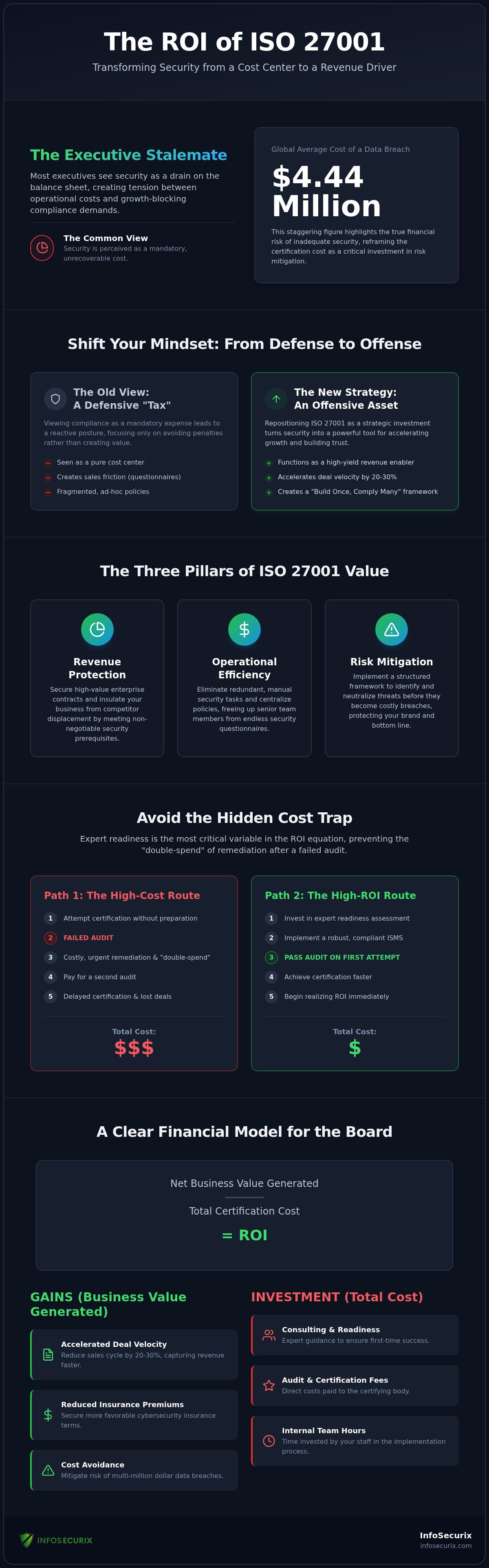
Why do most executives view information security as a drain on the balance sheet when the global average cost of a data breach has reached a staggering $4.44 million? It’s a common frustration for leaders who feel the weight of the ISO 27001 certification cost but struggle to articulate its value in clear, dollar-denominated terms. You’re likely facing intense pressure to reduce operational overhead while simultaneously losing enterprise deals because you lack a recognized global standard. This tension often creates a stalemate between the security team and the board that stalls organizational growth.
We believe that security shouldn’t be a black hole for capital; it should be a catalyst for corporate expansion. This article provides the strategic framework you need to master the financial metrics that turn compliance into a high-yield business asset. We’ll explore the exact ROI formula used by high-growth firms to justify their investment, reduce cybersecurity insurance premiums, and dramatically improve deal velocity. By the end of this guide, you’ll have the tools to position ISO 27001:2022 as a foundational pillar for your organization’s long-term success and resilience.
Key Takeaways
- Transform your approach to compliance by shifting from a defensive “tax” mindset to a strategic framework where security serves as a potent revenue enabler.
- Quantify the direct financial benefits of certification, specifically how it accelerates enterprise deal velocity and secures more favorable cybersecurity insurance terms.
- Protect your budget by identifying the hidden traps that often inflate the total ISO 27001 certification cost, such as the “double-spend” of remediation after a failed audit.
- Master a step-by-step mathematical model to present a compelling ROI case to the board, balancing implementation investment against long-term business value.
- Discover why expert readiness is the most critical variable in the ROI equation for ensuring a seamless certification journey and sustained operational excellence.
The Strategic Framework for ISO 27001 ROI: Beyond Compliance
Viewing information security through a purely fiscal lens often leads to a skewed perception of value. To truly understand the return on investment for your organization, you must define ROI as the ratio of net business value generated against the total ISO 27001 certification cost. This calculation moves beyond simple expense tracking; it’s a strategic assessment of how a robust Information Security Management System (ISMS) accelerates your market position. Rather than treating compliance as a mandatory corporate tax, visionary executives recognize it as a high-performance revenue enabler that protects the bottom line while fueling top-line growth.
Successful implementation rests on three critical pillars. First, Revenue Protection ensures that your most valuable enterprise contracts remain secure and insulated from competitor displacement. Second, Operational Efficiency eliminates the redundant, manual security tasks that drain your team’s productivity. Third, Risk Mitigation provides a structured approach to identifying and neutralizing threats before they manifest as costly breaches. By aligning your strategy with the ISO/IEC 27001 Standard, you’re not just buying a certificate; you’re investing in a scalable governance model that serves as a foundational asset for all future compliance needs, including SOC 2 and ISO 20000.
The Shift from Defensive to Offensive Security
Certification transforms your security posture from a defensive hurdle into a potent sales weapon. Sales teams frequently find themselves trapped in a cycle of answering exhaustive security questionnaires that can delay a deal for months. Possessing a recognized certification allows your team to bypass these hurdles, demonstrating a mature security posture that builds immediate trust with procurement officers. This trust is vital during the RFQ process for national or international contracts where proof of rigorous standards is often a non-negotiable prerequisite for participation. Ultimately, ROI is a measure of long-term resilience rather than short-term savings.
Foundational Value of the ISMS
The ISO 27001 certification readiness process streamlines internal governance by centralizing policies and standardizing response protocols. This “build once, comply many” philosophy is essential for multi-standard organizations; it allows you to map a single control to multiple regulatory requirements. A well-implemented system offers longevity that a check-the-box approach simply cannot match. It creates a culture of continuous improvement where security is woven into the fabric of daily operations. While the initial ISO 27001 certification cost may seem significant, the cost of fragmented, uncoordinated security efforts over time is far higher. Meticulous preparation ensures that your ISMS remains a durable asset that evolves alongside your business objectives.
Direct vs. Indirect Returns: Quantifying the Intangible
Executives often struggle to justify the upfront ISO 27001 certification cost because they focus solely on the auditor’s invoice. This narrow view ignores the substantial indirect returns that accumulate over time. When an organization achieves certification, it essentially creates a “fast track” for revenue. Industry data suggests that certified organizations can reduce their sales cycle by an average of 20% to 30%; the certification serves as pre-verified proof of security maturity. This acceleration isn’t just about speed; it’s about capturing market share before a competitor can even finish their security questionnaire.
Beyond deal velocity, certification addresses the “compliance debt” that plagues many growing firms. Fragmented, ad-hoc security policies are expensive to maintain and difficult to scale. By consolidating these into a unified ISMS, you realize significant operational efficiencies. This systemic approach also bolsters brand equity, positioning your firm as a Tier-1 partner in the national marketplace. Investors and stakeholders increasingly view a certified ISMS as a tangible asset that increases the overall valuation of the business.
Accelerating the Sales Pipeline
The security questionnaire bottleneck is a silent killer of executive productivity. Senior engineers and C-suite leaders often spend dozens of hours every month manually documenting their security controls for prospective clients. This diversion of talent represents a massive opportunity cost. By providing a certificate upfront, you effectively buy back this time. Calculating the value of time-to-close improvements is straightforward: multiply your average deal size by the number of days saved, and the financial impact becomes undeniable. In a competitive bidding environment, being the only certified provider can be the deciding factor that secures the contract.
Risk-Based Financial Benefits
A rigorous information security risk assessment is the heartbeat of the ISO 27001 framework. This process doesn’t just check boxes; it identifies the specific vulnerabilities that could lead to a multi-million dollar breach. Insurance underwriters recognize this level of due diligence. Many providers now use the NIST Cybersecurity Framework and ISO standards as benchmarks for “reasonable security.” Consequently, certified organizations often see a direct reduction in cybersecurity liability premiums. While the initial ISO 27001 certification cost represents a capital outlay, the resulting insurance savings and breach prevention provide a powerful counterweight. You’ll also notice a sharp decline in third-party audit requests from your own clients, as they can rely on your accredited certification rather than conducting their own expensive investigations. If you’re ready to move beyond guesswork and secure these tangible gains, it’s time to partner with specialists who understand the nuances of the ISO journey.
The Hidden Cost Trap: Why Readiness Prevents ROI Leakage
Many organizations fall into the “Double-Spend” trap. This phenomenon occurs when a firm attempts to minimize the initial ISO 27001 certification cost by engaging budget-tier consultants or relying exclusively on automated software platforms. While automation offers efficiency, it lacks the strategic nuance required to align controls with specific business risks. Consequently, these firms often pay twice: once for the inadequate initial setup and again for the high-priced emergency remediation required to fix systemic flaws before a final audit. True ROI is found in doing it right the first time; any other path is merely a deferment of expense.
This “compliance friction” also impacts internal morale and retention. When security controls are poorly integrated into existing workflows, employee productivity drops and frustration rises. If the system feels like a hindrance rather than a help, your most talented staff may seek opportunities elsewhere. Expert-led gap analysis ensures that your ISMS is a bespoke fit for your operational reality, protecting your corporate culture as much as your digital assets.
The True Price of Audit Failure
Failing to meet requirements during a Stage 1 or Stage 2 audit is a significant financial setback. Beyond the immediate re-audit fees, which have risen by 20% in 2026 due to a professional shortage, the secondary costs are often more damaging. A failed audit can delay major contract signatures by months, potentially costing millions in lost revenue if a competitor with a valid certificate steps in. Internal morale also suffers as teams are forced to repeat grueling preparation cycles. Readiness is a one-time investment to prevent recurring financial loss.
Remiation vs. Proactive Readiness
Strategic corrective actions are always more cost-effective than emergency firefighting. Addressing a non-conformity during the preparation phase allows for a measured, logical implementation that doesn’t disrupt daily business. In contrast, remediation after an audit failure or, worse, a data breach occurs under extreme pressure, often at triple the hourly rate of proactive planning. This is why a rigorous information security internal audit serves as a critical ROI-protection mechanism. Leveraging over 25 years of experience allows a seasoned guide to identify “silent” non-conformities that software might miss, ensuring your path to certification is steady and predictable. This level of foresight transforms a potential liability into a durable, high-yield business asset.
The Mathematical Model: A Step-by-Step ROI Calculation
Proving the value of a security framework requires a transparent financial model that moves beyond the “black box” logic of automated calculators. To accurately assess the ISO 27001 certification cost, executives must follow a methodical five-step process that balances capital outlay against tangible business gains. This approach ensures that every dollar spent is tied to a specific strategic outcome, providing the board with the clarity they require for long-term commitment.
- Step 1: Calculate Total Investment. Aggregate all external consulting fees, certification audit costs, and the internal man-month value of your implementation team.
- Step 2: Quantify Revenue Enablement. Identify the total contract value of deals that were previously inaccessible or stalled due to security concerns.
- Step 3: Factor in Cost Avoidance. Include projected reductions in cybersecurity insurance premiums and the statistically weighted avoidance of data breach expenses.
- Step 4: Apply the ROI Formula. Use the standard equation: [(Total Benefits – Total Investment) / Total Investment] x 100.
- Step 5: Adjust for the Compliance Multiplier. Recognize that the framework’s value compounds over a three-year cycle as security maturity increases.
By following this sequence, you transform security from a vague technical requirement into a quantifiable financial asset. It’s not just about what you spend; it’s about the friction you remove from your revenue engine. When the math is transparent, the decision to invest becomes a matter of strategic growth rather than reluctant compliance.
Defining Your Investment Variables
Accurately estimating internal costs is the most common oversight in ROI modeling. You must calculate the fully burdened hourly rate of your project team and multiply it by the estimated man-months required for implementation. It’s helpful to differentiate between CAPEX for the initial build-out and OPEX for ongoing maintenance and surveillance audits. If your organization is pursuing multiple standards, budgeting for ISO 20000 implementation simultaneously can often unlock a higher multi-standard ROI by sharing core governance controls and reducing redundant efforts.
Projecting the 3-Year Value Horizon
ROI shouldn’t be a snapshot of the first year; it’s a narrative that unfolds over the full certification cycle. This includes the initial certification followed by two annual surveillance audits. As your ISMS matures, the ISO 27001 certification cost associated with maintenance typically diminishes as processes become automated and embedded in daily operations. This creates a financial buffer where residual risk reduction continues to grow while operational friction decreases. If you’re looking for a partner to help refine these variables for your specific business case, reach out to our senior consultants for a tailored readiness assessment.
InfoSecurix: Maximizing ROI Through Expert Readiness
InfoSecurix acts as the primary stabilizer in your ROI equation. While previous sections explored the revenue gains and risk avoidance potential of a mature ISMS, this final phase focuses on optimizing the “Investment” side of the ledger. By leveraging over 25 years of specialized experience, we ensure that your initial ISO 27001 certification cost remains a controlled, predictable investment rather than an open-ended liability. Our seasoned guides identify potential pitfalls before they become costly non-conformities; this foresight effectively insulates your budget from the remediation “leakage” that often plagues less experienced implementations.
We understand the budgetary precision required by modern CFOs. To provide absolute financial certainty, InfoSecurix utilizes a transparent, fixed-fee engagement model. This approach eliminates the hidden surprises and hourly escalations that can derail a project’s financial feasibility and damage internal trust. Beyond mere cost control, our strategic corrective action plans transform standard audit findings into genuine operational improvements. We don’t just help you pass an audit: we help you refine your internal processes to support long-term growth.
The Value of a Seasoned Guide
Expert guidance is the most effective defense against scope creep. It’s surprisingly easy for an ISMS to expand into operational areas that don’t add strategic value, unnecessarily inflating the ISO 27001 certification cost and taxing your internal resources. Our consultants define precise, bespoke boundaries that align strictly with your business objectives. Professional, meticulously curated documentation further accelerates the process, often resulting in significantly faster audit cycles and higher first-time success rates. This efficiency allows your leadership team to stop viewing compliance as a burdensome task and start wielding it as a sharp competitive edge.
Securing Your Organization’s Future
The ultimate return on your investment isn’t found in a single framed certificate. It’s found in the enduring enterprise trust you build with your global partners and the peace of mind that comes from a resilient infrastructure. Operational resilience becomes a part of your corporate DNA, future-proofing your business against an increasingly complex and aggressive threat landscape. Your journey toward transforming security into a high-yield asset begins with a clear, honest understanding of your current posture. Precision is our baseline. Trust is the result.
Schedule a strategic readiness assessment today to ensure your investment delivers the measurable results your organization deserves.
Request a Consultation for ISO 27001 Certification Readiness
Driving Long-Term Enterprise Value through Strategic Compliance
Mastering the financial narrative of information security requires a fundamental shift in perspective. By moving beyond the initial ISO 27001 certification cost and focusing on the compound benefits of deal velocity, risk avoidance, and operational efficiency, you transform a technical requirement into a high-yield business asset. The mathematical model we’ve discussed provides the clarity needed to prove that meticulous preparation is an investment in your organization’s future resilience rather than a mere administrative hurdle.
Navigating this journey successfully depends on the precision of your roadmap. InfoSecurix offers a partnership built on 25+ years of information security expertise. Our fixed-fee readiness engagements provide the budgetary certainty that CFOs demand; meanwhile, our expert-led gap analysis ensures you avoid the costly failures that stall corporate momentum. We provide the steady hand and seasoned perspective required to turn rigorous standards into sustainable growth. Take the first step toward future-proofing your enterprise and realizing the full strategic potential of your security posture. Secure Your Strategic ISO 27001 Roadmap with InfoSecurix today and begin building a legacy of trust and excellence.
Strategic Insights: Frequently Asked Questions
How long does it typically take to see a positive ROI on ISO 27001?
Most organizations realize a positive return within 12 to 18 months of achieving their initial certification. This timeline is primarily driven by the immediate reduction in sales friction and your ability to capture enterprise contracts that were previously inaccessible. While the initial ISO 27001 certification cost is front-loaded, the recurring revenue generated from accelerated deal velocity often offsets implementation expenses by the time you reach your second annual surveillance audit.
Can a small business achieve a high ROI with ISO 27001 certification?
Small businesses frequently achieve a higher proportional ROI than larger enterprises by using certification as a potent market differentiator. In a crowded field of boutique providers, being the only certified firm allows you to compete for national contracts and bypass exhaustive vendor risk assessments. This strategic positioning creates a bridge of trust that levels the playing field against much larger, non-certified competitors who may still rely on ad-hoc security claims.
What are the most common hidden costs that sink an ISO 27001 budget?
The most common hidden costs involve poorly defined project scopes and the “double-spend” required for emergency remediation after a failed gap analysis. If the boundaries of your ISMS are too broad, you’ll incur unnecessary expenses for controls that don’t add strategic value. Additionally, the 20% rise in auditor fees seen in 2026 means that failing to prepare correctly the first time results in significantly higher financial penalties for re-audits and delayed certification.
How much can ISO 27001 reduce cybersecurity insurance premiums?
Certification provides a reliable benchmark for mature security governance, which often leads to more favorable terms from insurance underwriters. While specific reductions vary by provider, many organizations see a direct impact on their liability premiums because they’ve demonstrated a structured approach to risk management. This cost avoidance is a critical component of the ROI equation, especially as the global average cost of a data breach remains high at $4.44 million.
Is software automation enough to guarantee a positive ROI?
Software automation is a powerful efficiency tool, but it’s not a guarantee of a positive return on its own. While platforms streamline evidence collection, they often lack the strategic nuance required to align security controls with your specific business risks. A positive ROI requires expert-led interpretation to ensure the ISMS remains lean and effective without creating compliance friction that drains employee productivity and slows down your internal operations.
What happens to the ROI if we fail our initial certification audit?
Failing an initial audit causes your ROI to turn negative temporarily due to the immediate requirement for re-audit fees and the opportunity cost of stalled contracts. Beyond the fiscal hit, a failure damages your reputation with stakeholders and drains internal morale as teams are forced to repeat grueling preparation cycles. This risk highlights why investing in expert readiness is a critical protection mechanism for your total ISO 27001 certification cost.
How does ISO 27001 ROI compare to SOC 2 compliance?
ISO 27001 generally offers a broader international ROI because it’s a globally recognized standard, whereas SOC 2 remains primarily focused on the North American market. For organizations with global expansion goals, ISO 27001 provides a more versatile trust signal that satisfies international procurement requirements. Many high-growth firms find the highest return by using ISO as their foundational framework and mapping SOC 2 controls onto it as their market presence expands.
Should I include internal staff time in my ROI calculation?
You must include the fully burdened cost of internal staff time to ensure your ROI calculation is honest and transparent. Ignoring the man-months spent by your project team leads to an artificially inflated return that won’t hold up under rigorous CFO scrutiny. Documenting these resource hours allows you to demonstrate the true efficiency gains achieved as your ISMS matures and manual security tasks are replaced by streamlined, standardized processes.