A 150-page audit report should be your most powerful shield, yet for many procurement leaders, it remains an impenetrable wall of technical jargon and dense fine print. You likely feel the mounting pressure to onboard innovative partners at record speed while your risk department demands absolute certainty before any sensitive data changes hands. It’s frustrating to spend hours deciphering complex audit exceptions only to wonder if a specific finding is a minor administrative oversight or a catastrophic security failure. Effectively analyzing a SOC 2 report for vendor due diligence has evolved into a high-stakes strategic exercise that requires far more than a simple glance at the auditor’s opinion.
We’re here to help you master this evaluation process to safeguard your enterprise and mitigate third-party risks with clinical precision. By moving beyond a binary pass-fail mindset, you can build a culture of verified trust that empowers organizational growth rather than hindering it. This guide delivers a repeatable framework for your reviews, highlighting the critical red flags that should halt a partnership and ensuring every vendor aligns perfectly with your internal risk appetite.
Key Takeaways
- Transform your vendor evaluation process from a simple checklist into a strategic assessment of verified resilience and long-term security stability.
- Understand why the SOC 2 Type II report remains the essential benchmark for high-stakes partnerships by proving a vendor’s operational effectiveness over an extended period.
- Master a methodical framework to review every SOC 2 report for vendor due diligence, ensuring the audit scope, service locations, and auditor opinions align with your specific corporate standards.
- Develop the critical ability to interpret audit exceptions, distinguishing between manageable administrative oversights and systemic failures that present unacceptable risks.
- Align external compliance data with your internal risk appetite to make confident, data-driven onboarding decisions that support rapid business growth.
The Strategic Importance of SOC 2 Reports in Vendor Due Diligence
The SOC 2 framework, established by the American Institute of Certified Public Accountants (AICPA), functions as a rigorous, independent validation of a service organization’s internal controls. In the 2026 enterprise landscape, the paradigm has shifted from blind trust to verified resilience. Organizations no longer accept simple verbal assurances regarding data safety. Instead, they demand a System and Organization Controls (SOC) report to confirm that a partner can withstand sophisticated modern threats. As businesses deepen their reliance on third-party cloud and SaaS providers, the SOC 2 report for vendor due diligence becomes the primary mechanism for ensuring supply chain integrity. A single vulnerability within a vendor’s infrastructure can tarnish your corporate brand reputation. Meticulous audit reviews are the only way to protect your operational legacy.
Why SOC 2 is the Benchmark for Enterprise Trust
Security questionnaires often fall short because they rely entirely on self-reporting. A vendor might claim to have robust encryption, but without an external audit, that claim remains unverified. SOC 2 represents a higher standard: an objective third party examines the actual evidence of control performance over time. This transition to verified standards enables companies to scale with absolute confidence. When you align vendor compliance with broader frameworks like ISO 27001, you create a synergistic defense that covers both technical and management controls. This holistic approach ensures that your third-party ecosystem meets stringent regulatory requirements such as GDPR or CCPA. It transforms compliance from a bureaucratic hurdle into a strategic enabler of growth.
The Business Impact of Overlooking Vendor Audits
Ignoring vendor audits creates a significant risk of cascading failures. If a critical service provider suffers a breach, the impact ripples through your entire operation. It can halt production or expose sensitive customer data in a matter of minutes. A proactive SOC 2 report for vendor due diligence review identifies these gaps before they become liabilities. Investing in this level of scrutiny saves thousands in potential breach remediation and legal costs. For the vendors themselves, maintaining a clean report isn’t just a requirement: it’s a competitive advantage. It signals to the market that they are a stable, reliable partner. They become the preferred choice for enterprises that value longevity and comprehensive security scope.
Navigating the Architecture: SOC 2 Type I vs. Type II
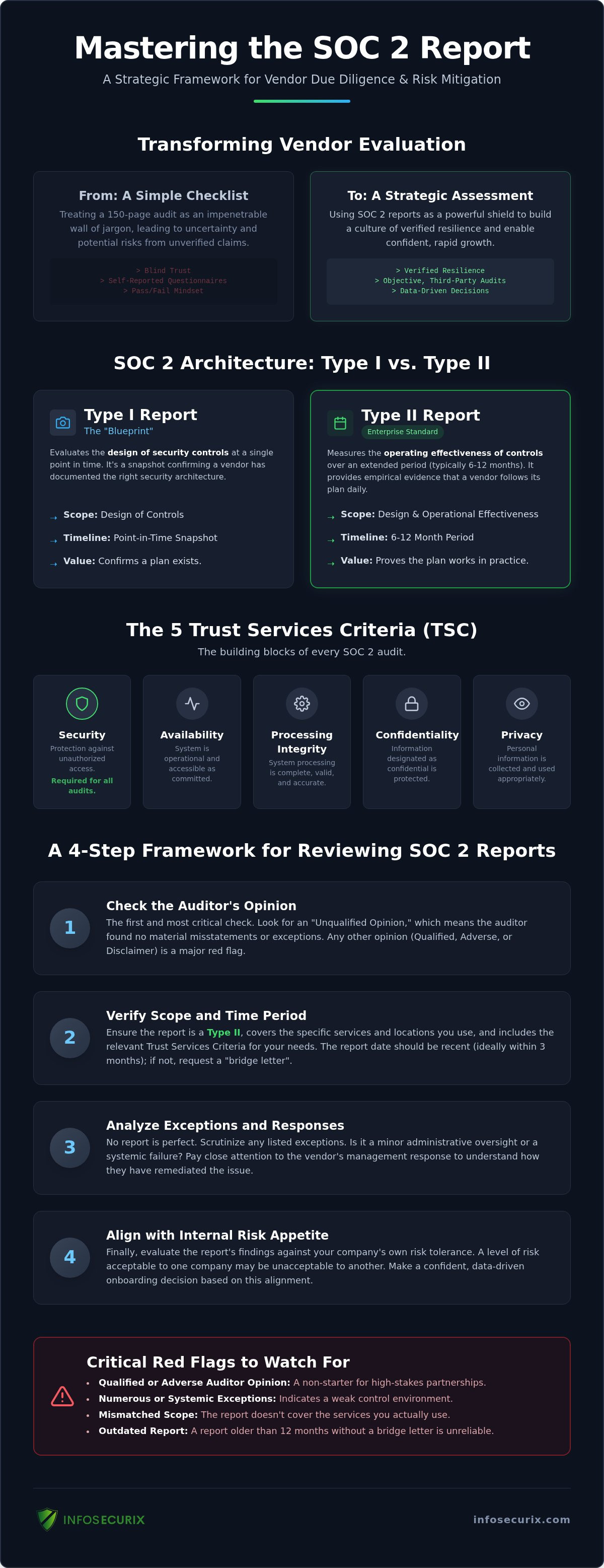
Understanding the structural nuances of an audit is critical for any executive tasked with auditing a vendor management program. While both report types originate from the same criteria, they serve vastly different purposes in risk mitigation. A SOC 2 Type I report evaluates the design of controls at a specific point in time. It’s essentially a snapshot that confirms a vendor has documented the right security architecture. In contrast, a SOC 2 Type II report measures the operating effectiveness of those controls over a review period, typically lasting six to twelve months. For high-stakes partnerships in 2026, the Type II report is the non-negotiable standard. It provides the empirical evidence that a vendor doesn’t just have a plan but actually follows it daily. When reviewing a SOC 2 report for vendor due diligence, always look for the bridge letter if the report’s end date is more than three months old. This document ensures no significant changes have occurred since the audit concluded.
Decoding the Five Trust Services Criteria (TSC)
The architecture of these reports is built upon five Trust Services Criteria. Security, often called the Common Criteria, is the foundational requirement for every audit. Depending on the nature of the service, you might also require Availability, Processing Integrity, Confidentiality, or Privacy. A data hosting provider should naturally include Availability; a firm handling sensitive consumer data must prioritize Privacy. Aligning these selections with your specific risk profile is a core step in the SOC 2 readiness checklist. This alignment helps you understand where a vendor stands on their maturity journey and whether their controls match your internal standards.
When a SOC 2 Type I is Sufficient (and When It Isn’t)
There are instances where a Type I report is acceptable. It’s often the first milestone for emerging startups or an interim measure during a rapid onboarding phase. However, relying on a Type I for long-term critical infrastructure is what we call the Type I Trap. It lacks the historical performance data necessary to predict future resilience. Evaluating a SOC 2 report for vendor due diligence requires a clear-eyed look at the historical data that only a Type II provides. A vendor’s transition from Type I to Type II is a powerful marker of organizational maturity. If you’re looking to strengthen your own compliance posture, a professional SOC 2 readiness assessment can ensure you meet these elevated enterprise expectations.
The 2026 Framework for Reviewing Vendor SOC 2 Compliance
Executing a methodical review of a SOC 2 report for vendor due diligence requires a structured approach that moves beyond a cursory glance at the cover page. Our five-step framework provides the logical path necessary to validate a vendor’s security posture with absolute precision. By following this sequence, you ensure that every technical control is scrutinized through the lens of your organization’s specific risk tolerance.
- Step 1: Verify the Scope. Confirm the report covers the exact services, platforms, and physical locations your organization intends to use. A report for a vendor’s billing system is insufficient if you’re utilizing their cloud storage infrastructure.
- Step 2: Examine the Auditor’s Opinion. Distinguish between an unqualified opinion (a clean report), a qualified opinion (specific issues were noted), an adverse opinion (controls are not reliable), and a disclaimer of opinion (the auditor couldn’t gather enough evidence).
- Step 3: Analyze the Management Assertion. This section confirms the vendor takes full, formal accountability for their control environment. It’s the vendor’s own statement that their system description is accurate and their controls are designed effectively.
- Step 4: Evaluate the Description of the System. Check for alignment with the vendor’s actual operational reality. This narrative should detail the boundaries of the system, the people involved, and the automated tools used to maintain security.
- Step 5: Review Test Results and Exceptions. This is the core technical deep-dive. You must examine each test the auditor performed and identify any instances where controls failed to operate as intended.
The Critical Role of Complementary User Entity Controls (CUECs)
Complementary User Entity Controls (CUECs) represent the shared responsibility model in action. These are specific security responsibilities that fall directly on your organization to ensure the vendor’s controls remain effective. Common examples include performing regular user access reviews and enforcing strict corporate password policies. Failing to implement these required CUECs can effectively invalidate the protections promised in the vendor’s SOC 2 report. It’s a collaborative effort where your internal discipline must mirror the vendor’s audited standards.
Mapping Vendor Controls to Your Internal Risk Framework
Bridging vendor audit results with an information security internal audit elevates the review from a technical task to a strategic governance function. You should create a crosswalk between the SOC 2 Trust Services Criteria and your existing ISO 27001 Annex A controls to identify any gaps in your supply chain defense. Documenting this alignment is essential for board reporting and demonstrates a high level of maturity in your third-party risk management program. It ensures that every SOC 2 report for vendor due diligence you process contributes to a unified, resilient corporate architecture.
Interpreting Exceptions: When a SOC 2 Report Signals Red Flags
Exceptions within an audit aren’t always a reason to abandon a partnership, but they do require a sophisticated level of scrutiny. An exception occurs when the auditor finds that a specific control didn’t operate as intended during the testing period. When you analyze a SOC 2 report for vendor due diligence, your primary objective is to differentiate between isolated administrative lapses and systemic security failures. A single missing signature on a quarterly review might be a minor oversight. However, a failure in automated patch management or a breakdown in database encryption suggests a fundamental flaw in the vendor’s security culture. These patterns of negligence often indicate that a vendor is merely “checking boxes” rather than maintaining a genuine commitment to resilience.
Certain red flags should be considered non-negotiable deal-breakers in the modern threat environment. These critical failures often include:
- Widespread Multi-Factor Authentication (MFA) Failures: If a vendor cannot consistently enforce MFA across its administrative accounts, your data is at immediate risk.
- Lack of Encryption at Rest or in Transit: Failing to protect data through modern cryptographic standards is an unacceptable liability.
- Inadequate Incident Response Testing: A vendor that hasn’t tested its breach response plan within the last year is fundamentally unprepared for a real-world crisis.
Always examine the ‘Management Response’ section to see how the vendor addresses these findings. A credible response includes a specific timeline for remediation and evidence of corrective actions already taken. If the response is vague or dismissive, it’s a clear signal that the vendor lacks the maturity required for a high-stakes partnership.
The Strategic Response to a Qualified Opinion
Receiving a report with a qualified opinion doesn’t have to end the conversation. Instead, it should initiate a rigorous ‘Corrective Action’ dialogue. You can set specific milestones for remediation and require the vendor to provide evidence of the fix before final onboarding. This is where you must leverage your internal information security risk assessment to determine if the identified risks fall within your organization’s appetite. If the risk is temporary and manageable, a collaborative path forward may still be viable. It’s about finding a partner willing to grow and improve alongside your own standards.
Evaluating Subservice Organizations (The ‘Carve-Out’ Method)
Modern SaaS ecosystems are deeply interconnected, often relying on giants like AWS or Azure for their underlying infrastructure. When reviewing a SOC 2 report for vendor due diligence, pay close attention to whether the vendor uses the ‘Inclusive’ or ‘Carve-Out’ method for these subservice organizations. The ‘Carve-Out’ method is common, meaning the vendor’s audit does not cover the controls of their data center provider. In these cases, you’re responsible for requesting and reviewing the SOC 2 report of that fourth-party provider separately. Managing this layer of the supply chain is essential to prevent blind spots in your defense strategy. If you need assistance validating these complex layers, consider scheduling a SOC 2 readiness assessment to ensure your own vendors are meeting the mark.
Elevating Your Compliance Posture with InfoSecurix
Securing the modern enterprise requires more than a passive review of a SOC 2 report for vendor due diligence; it demands a proactive partner who understands the intricate architecture of executive trust. Leveraging over 25 years of information security expertise, InfoSecurix serves as a seasoned guide for organizations navigating the complex regulatory landscapes of the United States. Our bespoke SOC 2 readiness assessment identifies critical control gaps before the formal audit begins. This strategic approach ensures your security measures are operationally resilient rather than just technically compliant, bridging the gap between granular mechanics and high-level business goals.
Performing a readiness assessment allows your team to address vulnerabilities in a controlled environment. We don’t simply check boxes. Instead, we focus on strategic corrective actions that align with your specific risk appetite. This methodical preparation transforms the audit from a source of anxiety into a professional milestone. It provides the absolute confidence needed to present your security posture to the most demanding enterprise clients.
Preparing Your Organization to Be the ‘Preferred Vendor’
Winning enterprise deals in 2026 requires proof of rigorous standards. We guide vendors through the disciplined journey toward their first SOC 2 Type II report, turning compliance into a powerful competitive advantage. By integrating ISO 20000 implementation alongside SOC 2 criteria, we help you achieve total service excellence. Regular internal audits maintain this state of continuous compliance, ensuring your firm remains a reliable, high-tier partner whenever a client requests a SOC 2 report for vendor due diligence.
Strategic Corrective Actions and Long-Term Resilience
Future-proofing your security posture involves moving beyond the immediate audit cycle to build a legacy of reliability. We help organizations implement strategic corrective actions that strengthen their core infrastructure against emerging threats. Integrating ISO 22301 business continuity into your SOC 2 framework maximizes operational reliability even during unexpected disruptions. This holistic vision ensures your organization remains a protective force for your clients’ data. Consulting with our seasoned experts provides the visionary guidance necessary to secure your next compliance milestone. We invite you to engage with us to build a culture of verified trust that enables your long-term growth.
Building a Future of Verified Resilience
Mastering the SOC 2 report for vendor due diligence is no longer a peripheral compliance task; it’s a foundational requirement for securing your corporate legacy. By shifting your focus from point-in-time checklists to the deep analysis of operating effectiveness, you ensure that every partner in your supply chain meets your internal standards for excellence. Identifying systemic red flags and demanding rigorous Type II evidence allows you to onboard new technologies with absolute confidence. This proactive methodology transforms third-party risk management into a strategic engine for sustainable growth.
InfoSecurix stands ready to guide you through these complex regulatory waters with over 25 years of specialized cybersecurity consulting expertise. Our boutique, high-touch service model provides a bespoke approach to SOC 2, ISO 27001, and ISO 22301 alignment across the United States. We invite you to Schedule a SOC 2 Readiness Consultation with InfoSecurix to bridge the gap between technical controls and executive trust. Together, we can build a resilient infrastructure that protects your organization today and future-proofs it for the challenges of tomorrow.
Frequently Asked Questions
What is the difference between a SOC 2 Type I and Type II report for vendor due diligence?
A SOC 2 Type I report evaluates the design of controls at a specific point in time, while a Type II report assesses the operating effectiveness of those controls over an extended period. For high-stakes partnerships, the Type II report is the gold standard. It provides the historical evidence needed to verify that a vendor’s security claims are consistently met in practice rather than just appearing correct on paper.
How often should my organization request an updated SOC 2 report from a critical vendor?
You should request an updated report annually for every critical service provider in your ecosystem. If the current report’s end date was more than three months ago, it’s essential to request a formal bridge letter signed by the vendor’s management. This document confirms that no significant changes have occurred in their control environment since the last audit was completed, maintaining your continuous visibility into their security posture.
What are Complementary User Entity Controls (CUECs) and why do they matter?
Complementary User Entity Controls (CUECs) are the specific security responsibilities that your organization must fulfill to ensure the vendor’s controls remain effective. For instance, a cloud provider might offer robust encryption tools, but it’s your responsibility to manage the keys and access permissions. Failing to implement these controls can leave a significant gap in your defense, effectively invalidating the protections outlined in the vendor’s audit.
Can a vendor pass a SOC 2 audit if they have exceptions in their report?
Yes, a vendor can receive a clean audit opinion even if their report contains specific exceptions. These findings indicate that a control didn’t operate perfectly during the testing period. Your role is to determine if the exception was a minor administrative lapse or a systemic failure. A reputable vendor will provide a management response detailing the corrective actions they’ve taken to remediate the issue and prevent its recurrence.
Is a SOC 3 report sufficient for a deep-dive vendor security assessment?
A SOC 3 report is generally insufficient for a comprehensive technical assessment because it lacks the granular detail found in a SOC 2 report for vendor due diligence. While SOC 3 reports are designed for public distribution and marketing, they omit the specific descriptions of tests and results. To perform a rigorous risk assessment, you require the full Type II report to see exactly how controls were tested and where they failed.
What should I do if a critical vendor refuses to provide a SOC 2 report?
If a critical vendor refuses to share their audit findings, you must evaluate this as a significant transparency risk. You might accept an ISO 27001 certification or a detailed security questionnaire as an interim measure, but these rarely provide the same level of independent validation. In such cases, your procurement team should consider including a right-to-audit clause in the contract to ensure you can verify their security posture through other means.
How do I verify the independence and reputation of the CPA firm that signed the SOC 2 report?
You can verify an auditor’s credentials by checking their status with the AICPA and the relevant state board of accountancy. It’s vital to ensure the firm has the specialized expertise required to evaluate complex technical environments. A report signed by a well-regarded CPA firm with a legacy of success in information security provides a higher level of assurance to your board and other executive stakeholders.
Does a SOC 2 report cover the same requirements as an ISO 27001 certification?
While both frameworks aim to secure data, they approach the task from different angles. ISO 27001 is a global certification for a management system, whereas a SOC 2 report for vendor due diligence is an attestation of specific controls based on Trust Services Criteria. Many organizations find that these two standards are highly complementary. Using them together creates a more resilient and comprehensive security posture that satisfies both international and domestic requirements.