

If your employees still view security protocols as a hurdle to their daily productivity, your compliance framework is already failing. You likely feel the frustration of recurring audit findings that cite a “lack of awareness” despite your team completing every required training module. It’s a common struggle; the gap between documented policy and actual workplace behavior often feels insurmountable when technical controls aren’t matched by human commitment. Building a culture of security compliance requires moving beyond the annual slide deck to create a resilient environment where secure habits are second nature.
This guide provides a strategic framework to transform your security posture from a static obligation into a proactive organizational strength. We’ll explore how to align executive leadership with frontline operations, ensuring that ISO 27001 or SOC 2 certification cycles become a seamless reflection of your daily excellence rather than a period of frantic preparation. Shifting the focus from simple checkbox exercises to genuine accountability allows your organization to foster a workforce that proactively identifies vulnerabilities and protects your long-term growth.
Key Takeaways
- Understand why technical controls often fail without a human-centric foundation, shifting your focus from static policy manuals to dynamic organizational habits.
- Discover the strategic pillars essential for building a culture of security compliance, emphasizing visible executive stewardship and deep cognitive alignment across all departments.
- Learn to move beyond vanity metrics, such as training completion rates, by utilizing qualitative data to measure genuine employee sentiment and behavioral shifts.
- Follow a structured roadmap for embedding security into your corporate DNA, beginning with a comprehensive cultural baseline assessment and mission-aligned messaging.
- Leverage 25 years of institutional expertise to bridge the gap between rigorous ISO 27001 or SOC 2 requirements and sustainable, long-term human resilience.
Beyond the Policy Manual: Why Culture is the Invisible Core of Compliance
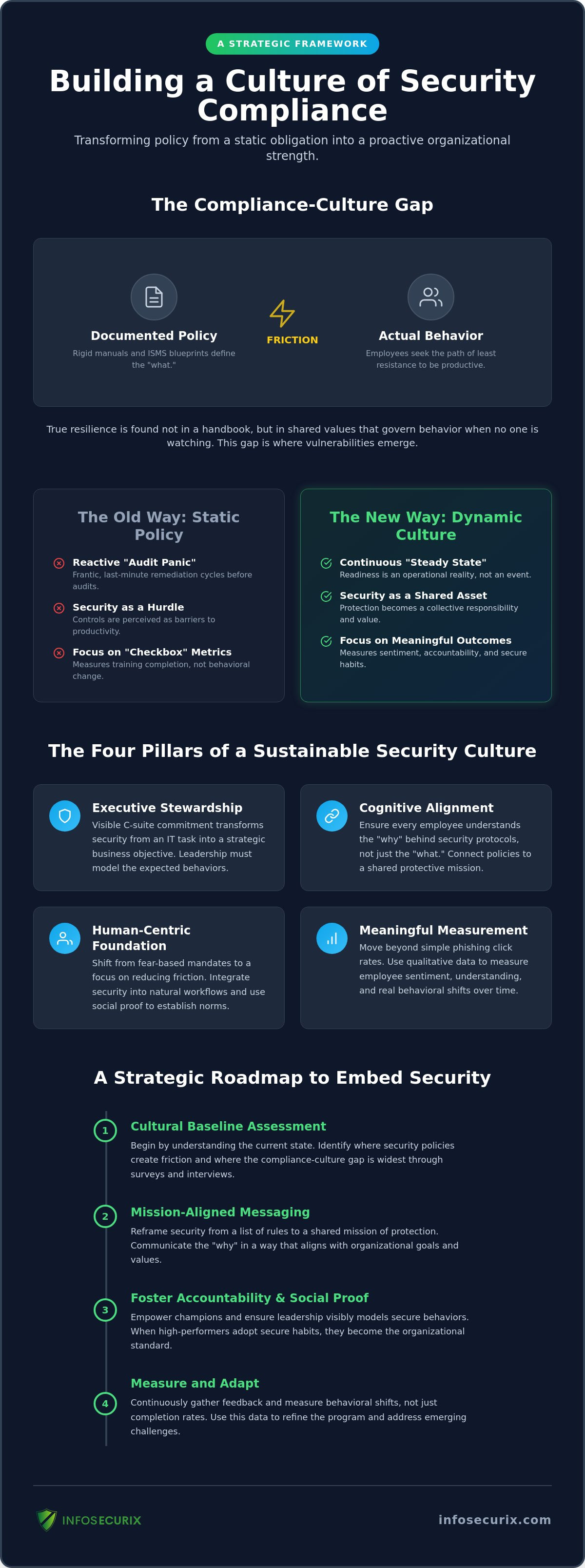
Rigid policy manuals often collect digital dust while employees navigate their daily tasks using the path of least resistance. While a documented Information Security Management System (ISMS) provides the necessary blueprint, it cannot dictate the split-second decisions made by a developer under pressure or a sales lead handling sensitive client data. This disconnect represents the compliance-culture gap, where documented procedures exist in isolation from the actual workflow of the staff. True resilience isn’t found in the thickness of a handbook; it’s found in the shared values that govern behavior when no auditor is watching.
Building a culture of security compliance requires a fundamental shift in how leadership perceives the human element. A sophisticated information security culture serves as the bedrock of this transition, moving the organization away from reactive checkbox exercises. Within an ISO 27001 framework, this cultural alignment transforms passive controls into active defenses, ensuring that risk management is a collective responsibility rather than a siloed IT task. When security becomes an ingrained social norm, it functions as a living control that adapts to new threats more rapidly than any static document could.
The Psychology of Compliance Failure
Compliance failures rarely stem from a lack of intelligence; they’re almost always a response to friction. When security controls are perceived as barriers to productivity, employees will naturally seek workarounds to meet their primary performance goals. We address this friction vs. security debate by replacing fear-based mandates with aspirational messaging that highlights the protective nature of these standards. Utilizing social proof is equally vital. When high-performing departments visibly model secure habits, those behaviors quickly become the established standard for the entire organization, reducing the psychological burden of compliance.
Compliance as a Steady State
Many organizations suffer from “audit panic,” a frantic period of remediation typically seen in the final quarter of the fiscal year. This cycle is symptomatic of a culture that views compliance as an external event rather than a continuous operational reality. A strong security culture maintains a steady state of readiness, ensuring that building a culture of security compliance remains a facilitator of business growth and client trust. By integrating these values into the organizational DNA, security stops being a cost center and becomes a competitive advantage. Security culture acts as the essential bridge between technical policy and operational reality; it ensures that theoretical standards manifest as consistent, daily actions.
The Four Pillars of a Sustainable Security Culture Framework
Establishing a resilient framework requires more than technical controls: it necessitates a strategic integration of human behavior and organizational values. While many organizations struggle with the nuance of Compliance vs. Culture, a sustainable approach focuses on specific pillars that transform security from a burden into a shared asset. By moving beyond surface-level awareness, leadership can ensure that building a culture of security compliance becomes a permanent operational habit rather than a temporary reaction to an upcoming audit.
Executive Stewardship and the Tone at the Top
The efficacy of any security initiative is directly proportional to the visible commitment of the C-suite. When leadership treats compliance as a peripheral IT concern, middle management naturally prioritizes operational speed over rigorous standards. True stewardship involves active participation: executives must model the behaviors they expect from their teams. This commitment to safety often extends beyond digital assets to the physical security of key leaders; those interested in comprehensive risk management can explore Executive Protection to ensure leadership remains secure in all environments. Integrating security-related KPIs into executive performance reviews ensures that security is viewed as a strategic business objective rather than a technical checkbox. This top-down visibility creates a ripple effect, instilling confidence and clarity throughout every level of the hierarchy.
Ensuring that every employee understands the “why” behind the “what” is the essence of cognitive alignment. It’s not enough for staff to follow a procedure: they must recognize the strategic value of their actions in protecting the organization’s longevity. This commitment to inclusivity ensures no one is left behind; those looking to optimize internal communication can explore British Sign Language (BSL) Interpreting to support a truly accessible compliance culture. When the workforce understands how their vigilance directly supports business continuity and client trust, compliance becomes a source of professional pride, positioning every team member as a conscious stakeholder in the company’s success.
Reporting Resilience: The End of the Blame Game
Fear of retribution is often the greatest hidden threat to an organization’s compliance posture. If employees believe that reporting a near-miss or a potential vulnerability will lead to disciplinary action, they’ll likely hide mistakes until they become catastrophic breaches. Building reporting resilience requires a “no-blame” environment where proactive communication is celebrated. By rewarding the “see something, say something” habit, you create a workforce of active defenders. This transparency is vital for mastering information security internal audits, as it provides the raw data needed to improve systems before a formal certification cycle begins.
Validation shouldn’t be reserved for annual reviews. Utilizing internal audits to measure cultural health, rather than just technical uptime, allows leadership to identify behavioral drift in real-time. This methodical approach ensures that your standards remain robust even as the regulatory landscape evolves. For organizations seeking a bespoke SOC2 readiness assessment, this continuous validation serves as the ultimate proof of a mature, resilient culture that is prepared for any external scrutiny.
Measuring What Matters: Moving Beyond Phishing Click Rates
Relying solely on phishing simulations provides a narrow and often distorted view of organizational resilience. While these tests offer a snapshot of technical awareness, they fail to capture the underlying sentiment that dictates daily behavior. Building a culture of security compliance requires a more sophisticated approach to measurement, moving beyond superficial metrics to identify true behavioral shifts. High training completion rates are often vanity metrics; they signify administrative compliance but do not guarantee that an employee will act correctly when a real threat emerges. True security is found in the transition from forced participation to voluntary vigilance.
To gain a comprehensive understanding of your posture, you must balance quantitative data with qualitative insights. Surveys designed to gauge employee sentiment toward security can reveal whether protocols are viewed as protective assets or productivity barriers. By tracking behavioral indicators, such as the frequency of policy exception requests or the speed of internal incident reporting, you gain a much clearer picture of your actual risk profile than any quiz score could provide. This data allows for a bespoke approach to intervention, targeting specific departments where cultural drift is most prevalent.
The Hierarchy of Security Metrics
A mature organization categorizes its data into a hierarchy that reflects strategic impact. We focus on primary and secondary indicators to provide a balanced view for executive leadership. Primary metrics include reporting rates for suspicious activity, time-to-detect internal anomalies, and the consistency of policy adherence across different departments. Secondary metrics encompass training completion percentages, simulation results, and individual quiz scores. When presenting these findings to the Board of Directors, emphasize the primary metrics. Demonstrating a measurable reduction in human-related security incidents through improved reporting habits provides the strategic buy-in needed for long-term cultural investment.
Internal Audits as Cultural Health Checks
Internal audits serve as proactive diagnostic tools rather than mere disciplinary exercises. By conducting unannounced reviews, leadership can observe real-world behavior in its natural state, uncovering cultural blind spots that scheduled audits might miss. This process is instrumental when working through a SOC 2 readiness checklist, as it identifies where procedures are failing in practice. Turning audit findings into teaching moments reinforces the no-blame environment established in our framework. This ensures that every gap identified becomes an opportunity for collective growth and refined resilience, rather than a source of organizational friction.
A Strategic Roadmap for Embedding Security in the Organizational DNA
Transforming organizational behavior requires a deliberate, sequential journey that moves from initial assessment to long-term habituation. Building a culture of security compliance is not a project with a fixed end date; it’s a strategic evolution of how your workforce perceives risk and responsibility. The process begins with a baseline cultural assessment to identify where current attitudes diverge from your desired security posture. Once these gaps are identified, leadership must align security messaging with the existing corporate mission. When security is framed as a protector of the company’s core values, it gains a level of legitimacy that generic, off-the-shelf training modules can never provide.
Identifying and Empowering Security Champions
The most effective advocates within your organization aren’t always the most technical. We look for influence: individuals who are respected peers within their specific departments. These Security Champions act as local translators, converting high-level security policy into practical, departmental workflows that make sense for their teams. By providing these individuals with specialized training and direct access to the CISO, you create a decentralized network of vigilance. This peer-driven approach ensures that security is seen as a shared value rather than a mandate from a distant IT office. It bridges the gap between technical requirements and the operational reality of the frontline staff.
Incentivizing the Right Behaviors
Traditional compliance models often rely on punitive measures for failed simulations, which typically breeds resentment and leads to the “blame game” mentioned in our framework. A more sophisticated strategy implements a tiered incentive program that rewards proactive compliance. Recognition programs for employees who identify sophisticated, real-world threats or report vulnerabilities create a culture of active defense. Gamification strategies also foster healthy competition between teams: use departmental rewards or public recognition to drive engagement. This positive reinforcement solidifies the behavioral habits needed for long-term resilience, making security a source of professional pride rather than a burden.
Maintaining momentum is the final, ongoing step in this roadmap. Schedule recurring ISO 27001 certification readiness reviews to ensure your cultural progress consistently matches your technical controls. These milestones prevent the drift that often occurs between formal audits and keep the organization in a steady state of preparedness. For organizations seeking to bridge the gap between technical policy and human behavior, a bespoke risk assessment from a seasoned guide provides the clarity needed to secure your future growth.
Professionalizing Your Compliance Culture with InfoSecurix
Transforming a fragmented security posture into a cohesive, resilient culture requires a partner who understands that technical controls are only as effective as the people who manage them. InfoSecurix brings over 25 years of institutional knowledge to this challenge, offering a boutique consultancy experience that prioritizes strategic outcomes over generic checklists. Our approach to building a culture of security compliance is rooted in the belief that human behavior is a measurable, manageable asset. By combining technical rigor with sophisticated organizational change management, we help you move beyond simple awareness to a state of absolute audit readiness.
We integrate this cultural evaluation into every engagement, including our comprehensive ISO 20000 implementation services. While automated tools are excellent for identifying missing patches or misconfigured servers, they often miss the nuanced human risks that lead to systemic failure. Our readiness assessments are designed to uncover these hidden vulnerabilities, ensuring that your workforce is not just following procedures, but actively contributing to the organization’s protective shield. This meticulous level of detail ensures your internal standards stand up to the most rigorous scrutiny from international auditors.
The Advantage of Seasoned Guidance
Objective evaluation is often difficult to achieve from within. A third-party perspective is essential for conducting a truly impartial cultural audit, as it identifies blind spots that internal teams may have grown accustomed to over time. Our methodology focuses on bridging the gap between your current operational state and a certification-ready environment. We provide bespoke corrective action plans that address both technical deficiencies and human behavioral drift. This dual-focus ensures that your path to ISO 27001 or SOC 2 certification is steady, predictable, and free from the friction often associated with regulatory milestones.
Your Partner in Long-Term Resilience
Securing a certificate is merely the beginning of your journey. We focus on establishing a cycle of continuous improvement that future-proofs your organization against an increasingly complex regulatory landscape. As new mandates like DORA or the UK Cyber Security and Resilience Bill emerge, your ingrained security culture will allow you to adapt without the need for disruptive, last-minute overhauls. We remain a collaborative ally, invested in your growth and dedicated to maintaining the meticulous standards that define industry leaders. Consult with InfoSecurix to professionalize your internal security standards and ensure your compliance framework remains a dynamic, living asset.
Securing Your Competitive Advantage Through Cultural Resilience
The evolution of regulatory standards in 2026 demands a shift from reactive remediation to a steady state of readiness. By prioritizing executive stewardship and empowering departmental champions, you move beyond the limitations of technical controls to address the human element of risk. We’ve explored how qualitative metrics and a no-blame reporting environment provide a much clearer picture of your actual resilience than superficial training scores. Building a culture of security compliance ensures that your organization remains protected, agile, and prepared for the scrutiny of any international auditor.
InfoSecurix offers 25+ years of strategic compliance experience. We help you navigate this transition with absolute confidence. Our milestone-based engagements provide expert guidance for ISO 27001, SOC 2, and ISO 22301, focusing on measurable results that align with your corporate mission. We bridge the gap between technical policy and operational reality, transforming security into a facilitator of long-term growth. Consult with InfoSecurix to build an audit-ready security culture. Your commitment to these standards today secures your competitive advantage for years to come.
Frequently Asked Questions
What is the first step in building a security culture?
The initial phase involves conducting a comprehensive baseline cultural assessment to identify existing attitudes and friction points. This diagnostic process allows leadership to tailor their strategy to specific departmental needs rather than applying a generic solution. By understanding the current state, you can create a more effective roadmap for building a culture of security compliance that resonates with your staff.
How long does it take to see a real change in security behavior?
Establishing a noticeable shift in behavioral norms typically requires six to twelve months of consistent, strategic reinforcement. While technical changes can be implemented quickly, human habits evolve through repeated exposure and positive validation. Organizations should focus on milestone-based progress to maintain momentum during this long-term transition. It’s a journey of continuous refinement rather than a one-time event.
Can security culture be measured for ISO 27001 compliance?
Measuring cultural health is an operational requirement for modern standards like ISO 27001:2022. You can track qualitative data through sentiment surveys and quantitative data through reporting rates or policy adherence statistics. These metrics provide auditors with tangible evidence that security is a living component of your management system. A well-documented cultural framework demonstrates that your organization takes a proactive approach to risk management.
What is the role of the CEO in security compliance?
The CEO is responsible for establishing the “tone at the top” and ensuring security remains a core business priority. When leadership visibly participates in security initiatives and integrates compliance KPIs into executive reviews, it signals that security is a shared value. This high-level commitment is the most significant driver of organizational change. Without executive stewardship, even the most sophisticated technical controls will fail to achieve long-term resilience.
How do we handle employees who consistently fail security simulations?
Recurring failures should be met with targeted coaching rather than immediate disciplinary action. Identifying whether the failure stems from a lack of understanding or a specific workflow friction is essential for long-term resolution. This supportive approach reinforces the no-blame environment necessary for building a culture of security compliance. It ensures that every team member feels empowered to improve rather than fearing retribution for an honest mistake.
Why do traditional security awareness programs often fail?
Most traditional programs focus on passive knowledge transfer through annual training modules that employees view as a checkbox exercise. They fail because they don’t address the psychological drivers of behavior or the practical friction of secure protocols. Effective programs prioritize habit formation and the “why” behind every policy. Shifting the focus from simple awareness to ingrained behavior is what separates resilient organizations from those that are merely compliant.
Is a strong security culture enough to prevent all cyberattacks?
A resilient culture is a critical layer of defense, but it doesn’t replace the need for robust technical controls. It serves to significantly reduce the risk of human error, which remains a primary factor in the majority of data breaches. A strong culture ensures that your technical defenses are supported by a vigilant and proactive workforce. It’s one component of a broader, defense-in-depth strategy that protects your organization from every angle.
How does culture impact the cost of a SOC 2 audit?
A mature security culture significantly reduces the time and resources needed for a SOC 2 audit by ensuring continuous readiness. When staff consistently follow procedures and document their actions, the evidence collection process becomes a seamless reflection of daily operations. This efficiency prevents the high costs associated with last-minute remediation and frantic audit preparation. A steady state of compliance is always more cost-effective than reactive, high-pressure remediation cycles.