
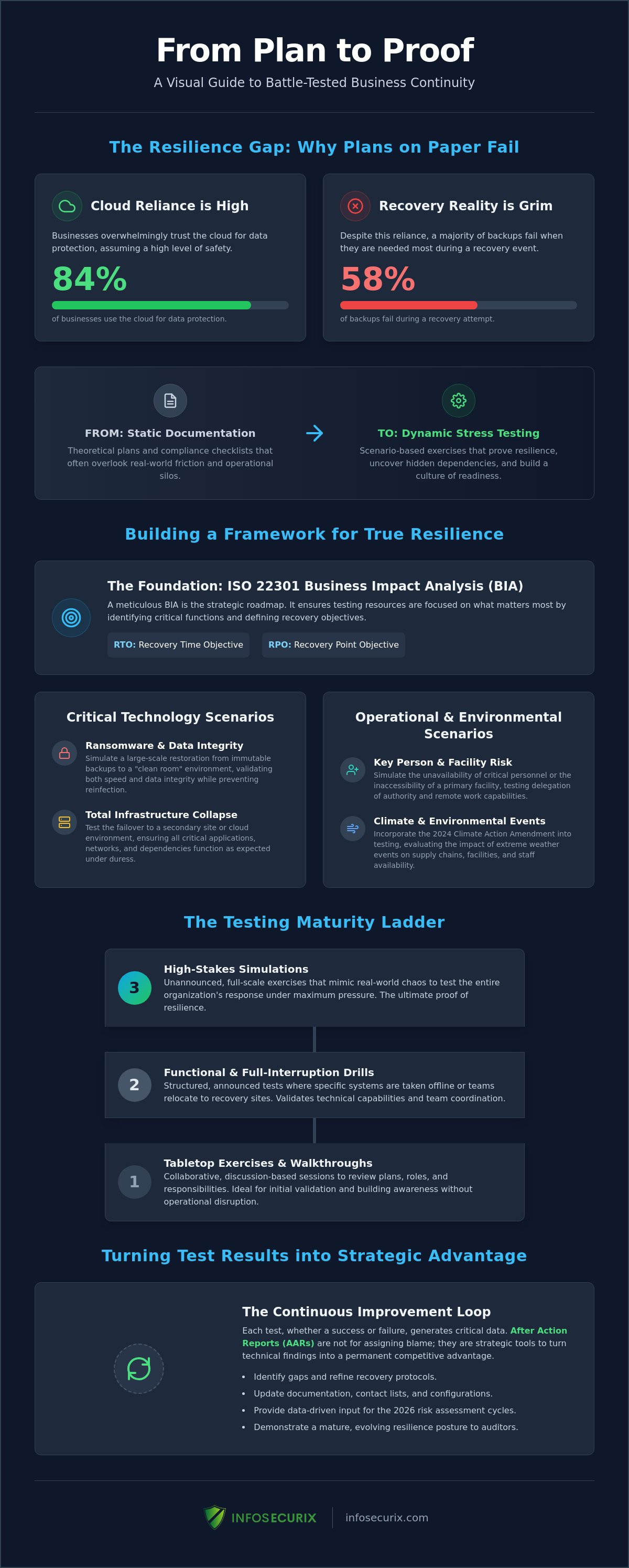
While 84% of businesses rely on the cloud for data protection, research shows that 58% of backups fail during an actual recovery event. This gap between theoretical preparation and operational reality often leaves executive teams feeling exposed during a crisis. A meticulous business impact analysis for ISO 22301 serves as the foundation for resilience; however, its true value is only realized through rigorous, high-stakes testing. You likely recognize the pressure to move beyond simple compliance to demonstrate a battle-tested capability that satisfies both rigorous auditors and internal stakeholders.
We believe that a robust continuity framework shouldn’t just exist on paper. It should empower your organization to remain steady under pressure. This article transforms your disaster recovery strategy into a sophisticated roadmap for enterprise-wide resilience. You’ll discover strategic testing scenarios designed to validate your most critical assumptions and reduce downtime. We’ll examine how to integrate the 2024 Climate Action Amendment into your testing cycles. Our guide provides the methodologies needed to turn audit findings into a permanent competitive advantage.
Key Takeaways
- Validate your organization’s resilience by shifting from static documentation to dynamic, scenario-based stress testing that uncovers hidden operational silos.
- Align recovery priorities with your business impact analysis for ISO 22301; it’s the most effective way to ensure technical testing focuses on critical enterprise functions.
- Strengthen human systems by simulating challenges like facility inaccessibility and key person risk, protecting your workforce while maintaining momentum.
- Match your testing complexity to your current audit maturity, moving from collaborative walkthroughs to high-stakes, unannounced simulations that mimic real-world chaos.
- Utilize After Action Reports to turn technical failures into strategic data, creating a continuous loop of improvement for your 2026 risk assessment cycles.
The Strategic Imperative of Business Continuity Plan Testing Scenarios
Testing is the crucible where theoretical plans meet the friction of reality. It represents the formal validation of operational resilience, moving your organization beyond the static comfort of documentation. A meticulous business impact analysis for ISO 22301 provides the strategic roadmap; however, only rigorous testing provides the definitive proof of capability. This process is a core component of Business continuity and disaster recovery auditing, providing the empirical evidence that your safeguards are functional and your recovery strategies are sound.
Theoretical plans frequently collapse because they lack the nuance of real-world friction. When teams operate in silos, they often overlook how a failure in one department cascades into another. Scenario-based stress testing uncovers these invisible links. By simulating complex disruptions, you force these silos to communicate, exposing gaps in the workflow that a simple document review would never reveal. This level of scrutiny is what separates a compliant organization from a truly resilient one, ensuring that your business can withstand pressure without fracturing.
Achieving ISO 22301 business continuity certification requires more than a simple table of contents. It demands a demonstrated ability to respond. Shifting the organizational mindset from a “check the box” mentality to a genuine culture of readiness requires deep executive engagement. Leadership must view testing not as a disruptive drill, but as a strategic investment in the brand’s longevity and security. When executives participate in these exercises, they signal a commitment to protection that resonates throughout the entire enterprise.
Aligning Scenarios with Business Impact Analysis (BIA)
Performing a meticulous business impact analysis for ISO 22301 ensures that your testing scenarios target the most critical enterprise assets rather than peripheral systems. This strategic alignment allows you to test critical business functions to validate end-to-end recovery capabilities. It’s essential to map your Recovery Time Objectives (RTOs) and Recovery Point Objectives (RPOs) to specific, measurable outcomes. These metrics transform a subjective exercise into a data-driven validation of your resilience framework, ensuring that resources are allocated where they are needed most during a crisis.
Setting Clear Objectives for Every Exercise
Defining success involves looking beyond the mere completion of a drill. True success is measured by stakeholder confidence and the efficiency of the response process. During the high-pressure moments of a simulated crisis, you must evaluate communication efficacy and decision-making speed. These exercises also serve a vital maintenance role: they validate the accuracy of recovery documentation and emergency contact lists to ensure they remain current for 2026. Using these sessions to refine your internal response protocols turns a compliance requirement into a sophisticated operational advantage that protects your bottom line.
Critical Technology Scenarios: Validating Digital Resilience
Digital resilience serves as the backbone of modern enterprise survival. While your business impact analysis for ISO 22301 identifies which systems are vital, testing proves whether those systems can actually withstand a sophisticated cyber assault or a total infrastructure collapse. Validating these technical layers requires moving beyond simple connectivity tests to simulate complex, multi-layered failures that mimic current threat actor tactics. It’s about ensuring that your digital infrastructure doesn’t just exist, but remains functional under extreme duress.
Ransomware and Data Integrity Drills
Modern ransomware doesn’t just encrypt data; it often targets your backups first to eliminate any hope of a free recovery. Testing must verify the integrity of immutable storage by simulating a large-scale restoration process in a secure environment. It’s not enough to know a backup exists. You must determine how fast your team can scrub and restore data while preventing the lateral movement of threats. For the purposes of modern cyber resilience, a “clean room” recovery is defined as the process of isolating restored data in a sterile, air-gapped environment to verify it’s free of malware before reintegrating it into the production network. This rigorous approach ensures that your Recovery Point Objectives (RPOs) are grounded in reality rather than optimistic projections.
Infrastructure and Connectivity Failures
Regional disruptions often expose the fragility of distributed workforces. Testing should include a total primary ISP outage to validate secondary connectivity and cellular failover solutions. If your business impact analysis for ISO 22301 designates remote operations as a critical recovery strategy, you must confirm that your redundant systems can handle the redirected traffic load without performance degradation. Simulating the failure of a primary cloud service provider or a critical SaaS application further validates your multi-cloud redundancy strategy, ensuring that a vendor’s downtime doesn’t become your terminal event.
Redundancy isn’t resilience until it’s been tested under fire. Simulating a regional power grid failure allows you to verify the seamless transition to local UPS or generator systems without data loss. This level of preparation is a hallmark of a mature Business Continuity Plan. If you find your current technical safeguards are lacking, a professional risk assessment can help identify the specific investment areas needed to bridge the gap between your current state and ISO-level readiness.
High-volume data environments face unique challenges during off-site backup retrieval. By measuring the actual time it takes to shift workloads between providers or restore from off-site repositories, you transform theoretical uptime into a battle-tested operational reality. This methodical validation provides the evidence required by auditors while instilling absolute confidence in your executive team.
Operational and Environmental Scenarios: Testing Human Systems
Resilience is not merely a digital attribute; it’s a human one. While previous sections focused on technological failovers, your business impact analysis for ISO 22301 identifies that people and physical spaces are the true heartbeat of the organization. Testing these human systems requires scenarios that move beyond the server room. It involves preparing for physical facility inaccessibility due to local unrest or natural disasters. In these moments, duty of care is your primary mandate. You must ensure that your team remains safe while maintaining the continuity of critical operations.
Consider the “key person” risk: a scenario where 50% of your specialized IT staff or executive leadership is suddenly unavailable. Testing this scenario forces you to evaluate the depth of your institutional knowledge and the efficacy of your succession plans. Similarly, simulating a critical supply chain disruption with a primary vendor allows you to test alternative procurement and logistics. It’s about ensuring that your supply chain doesn’t become a single point of failure when a regional crisis strikes. These exercises reveal whether your recovery strategies are truly executable when your usual resources are stripped away.
Evaluating emergency communication systems across a national workforce is equally vital. Clear, unified messaging prevents the fragmentation of response efforts. Testing these systems ensures that every employee receives timely instructions, regardless of their location. This validation is a direct extension of the priorities established during your business impact analysis for ISO 22301, ensuring that the communication flow matches the criticality of the business function being recovered.
Workforce Scarcity and Remote Transition
Simulating a sudden shift to 100% remote work remains a vital exercise for office-based teams. This stress-tests digital collaboration tools and evaluates the scalability of VPNs under maximum load. It’s essential to identify and prevent operational bottlenecks before a real crisis occurs. Beyond the technical infrastructure, this scenario assesses the resilience of your cross-training programs. When specialists are absent, the depth of your institutional knowledge is put to the test, proving whether your team can maintain momentum during periods of workforce scarcity.
Physical Access and Facility Disruption
Testing the activation of alternate work sites or “hot sites” ensures they’re ready for immediate occupancy. It’s one thing to have a contract for a secondary location; it’s another to verify that power, seating, and connectivity are functional. You must also evaluate the security of physical assets if a facility must be abandoned quickly, balancing employee safety with data protection. Integrating health and safety protocols into your continuity response protects your organization’s most valuable asset: its people. This holistic approach ensures that your environmental safeguards are as robust as your digital ones.
Selecting the Right Testing Methodology for Your Scenarios
Selecting the appropriate methodology requires a nuanced understanding of your organization’s current operational maturity. It’s not a one-size-fits-all endeavor. You should deliberately match the complexity of your testing scenarios to the results of your most recent information security internal audit. This alignment ensures that you aren’t attempting high-stakes simulations before your foundational protocols have been validated. Your business impact analysis for ISO 22301 serves as the primary compass, dictating which critical functions demand the most rigorous validation and which can be addressed through lighter touchpoints.
The journey toward enterprise resilience typically follows a structured progression. It begins with collaborative walkthroughs and matures into unannounced simulations that mimic the unpredictable chaos of a real disaster. While achieving depth is essential, you must balance the intensity of the test with the operational risk of the exercise itself. The objective is to prove capability, not to cause self-inflicted downtime. Engaging external observers or independent auditors provides an unbiased assessment of your response, ensuring that your results are objective and your strategic improvements are grounded in empirical evidence.
If you need to validate your current testing roadmap, our team can provide a comprehensive ISO 22301 Business Continuity assessment to ensure your methodologies align with international standards and executive expectations.
Tabletop Exercises: The Strategic Walkthrough
Tabletop exercises offer a low-friction, high-impact environment for discussing specific scenarios with key stakeholders. These sessions are designed to identify policy gaps and logic failures before they manifest in a crisis. By focusing on communication silos and decision-making logic, you ensure the “brain” of the organization remains functional under stress. Best practices for these sessions include maintaining a non-confrontational atmosphere that encourages honest feedback. This collaborative discovery process is vital for refining the recovery strategies identified in your business impact analysis for ISO 22301.
Simulation and Parallel Testing: Real-World Pressure
Simulation and parallel testing represent the ultimate proof of technical readiness. By testing recovery systems in a parallel environment, you can validate your technical capabilities without disrupting live production. We utilize “injects”-carefully timed pieces of new information-to simulate the evolving nature of a corporate crisis. This methodology validates that technical staff can execute complex recovery procedures under significant time pressure. It proves they can maintain operations even without the direct guidance of senior leadership, confirming that your resilience is embedded in your systems rather than just your personnel.
Moving from Test Results to Strategic Corrective Actions
The conclusion of a testing scenario is not the end of the resilience cycle; it is the beginning of the most critical phase: strategic remediation. The After Action Report (AAR) serves as the definitive bridge between identified vulnerabilities and a perfected response framework. This document provides the empirical evidence needed to refine your business impact analysis for ISO 22301, ensuring that your recovery strategies are aligned with the actual performance of your systems and personnel. By treating every test as a learning opportunity, you move beyond mere compliance to achieve a state of continuous operational readiness.
Transforming test failures into high-value information security risk assessment data for 2026 allows your organization to prioritize investments where they will have the greatest impact. InfoSecurix acts as a seasoned guide in this process, helping you bridge the gap between technical findings and executive-level strategy. We ensure that the evidence gathered during your simulations is integrated into your SOC 2 readiness checklist. This level of documentation is essential for satisfying the rigorous demands of enterprise clients and independent auditors who require proof of a battle-tested resilience posture.
Analyzing Gaps and Documenting Findings
Effective remediation begins with a precise diagnosis of why a failure occurred. You must distinguish between technical failures, such as a hardware malfunction, and process gaps or human error. This clarity ensures that the correct fix is applied rather than just a superficial patch. We recommend prioritizing corrective actions based on their potential impact on business resilience, focusing your resources on the “vital few” risks that could jeopardize your core functions. Creating this formal record of testing is the foundation of audit readiness, providing a clear narrative of improvement for any regulatory body.
The Continuous Improvement Loop
Your Business Continuity Plan (BCP) should never be a static document. It must evolve based on real-world test data to remain effective against emerging threats. Once corrective actions are implemented, re-testing specific components is necessary to validate that the risks have been successfully mitigated. This closed-loop process ensures that your operational risk remains within acceptable limits. InfoSecurix leverages more than 25 years of experience to guide our partners through these sophisticated improvements, ensuring that every identified gap becomes a stepping stone toward absolute operational resilience.
By maintaining this methodical approach to improvement, you instill a sense of absolute confidence in your stakeholders. You’re not just hoping the plan works; you’re proving it does through a systematic cycle of validation and refinement. This is how high-performing organizations turn the complexity of ISO standards into a tangible competitive advantage.
Advancing Toward Operational Mastery
True resilience is achieved when you move beyond the static safety of a binder and embrace the dynamic reality of high-stakes testing. By aligning your exercises with a meticulous business impact analysis for ISO 22301, you ensure that every simulation validates the functions most critical to your organization’s survival. We’ve explored how a progression from tabletop discussions to unannounced simulations transforms technical readiness into a tangible competitive advantage. This methodical approach doesn’t just satisfy auditors; it builds a culture of readiness that protects your brand and your people during the unpredictable moments of a true crisis.
Refining these complex frameworks requires a partner who understands the bridge between compliance and operational reality. InfoSecurix brings 25+ years of strategic compliance expertise to every engagement, offering specialized ISO 22301 and SOC2 readiness assessments tailored to your unique risk profile. As a national consultancy focused on high-stakes resilience, we’re dedicated to turning your audit findings into battle-tested operational strength. It’s time to transform your theoretical plans into a sophisticated shield for your enterprise.
Partner with InfoSecurix to build a resilient, audit-ready organization and secure your future with absolute confidence.
Frequently Asked Questions
How often should we test our business continuity plan scenarios?
Organizations should conduct testing at least annually, or whenever significant operational changes occur. High-maturity enterprises often prefer a more rigorous schedule, performing quarterly tabletop exercises and one full-scale simulation each year. This consistent frequency ensures that your response teams remain proficient and that your recovery strategies stay perfectly aligned with your current threat landscape and organizational structure.
What is the difference between a tabletop exercise and a simulation?
A tabletop exercise is a discussion-based session where key stakeholders walk through a scenario to identify policy and logic gaps. In contrast, a simulation is an operational test where teams actually execute recovery procedures in a controlled or parallel environment. While tabletops focus on decision-making logic, simulations provide the technical proof that your recovery systems and personnel can perform under pressure.
Should we inform employees before a business continuity test?
Initial tests should always be announced to prevent unnecessary panic and to ensure the safety of all participants. As your resilience program matures, unannounced tests can provide more realistic data on response times and the efficacy of automated notification systems. Balancing transparency with the need for realistic stress-testing allows you to build organizational confidence without compromising the safety of your workforce.
How do we choose which testing scenarios are most relevant for our industry?
Utilize the results of your business impact analysis for ISO 22301 to identify the specific threats most likely to disrupt your critical functions. For example, financial services might prioritize cyber resilience and data integrity, while manufacturing might focus on supply chain disruptions and facility access. Choosing scenarios based on your highest-impact risks ensures your testing remains strategically relevant and resource-efficient.
What are the most common failures discovered during BCP testing?
Common discoveries include outdated emergency contact lists, insufficient VPN capacity for mass remote work, and a lack of clarity regarding decision-making authority. Testing also frequently reveals “key person” dependencies, where a single individual holds critical knowledge that isn’t documented. Identifying these gaps during a drill allows you to apply corrective actions before a real disruption occurs, protecting your bottom line.
How does business continuity testing relate to ISO 22301 compliance?
Testing is a mandatory requirement under Clause 8.5 of the ISO 22301 standard; it provides the empirical evidence that your management system is effective. Without regular validation, your business impact analysis for ISO 22301 remains a theoretical document rather than a battle-tested roadmap for resilience. Successful testing demonstrates a commitment to the continuous improvement cycle required for international certification.
Can we use a single scenario to test both IT disaster recovery and business continuity?
Integrated scenarios are highly effective for validating end-to-end resilience across the entire enterprise. A ransomware simulation, for instance, tests both the technical data restoration and the human communication and workaround procedures. This holistic approach ensures that your technical recovery efforts are synchronized with the needs of the business units they support, preventing a fragmented response during a crisis.
What documentation is required to prove a successful BCP test to auditors?
Auditors require a comprehensive After Action Report that includes the test objectives, a detailed timeline of events, and a list of identified gaps. You must also provide evidence of a formal corrective action plan that addresses those gaps. This documentation demonstrates a commitment to the Plan-Do-Check-Act cycle, which is central to maintaining international standards and satisfying enterprise client requirements.