

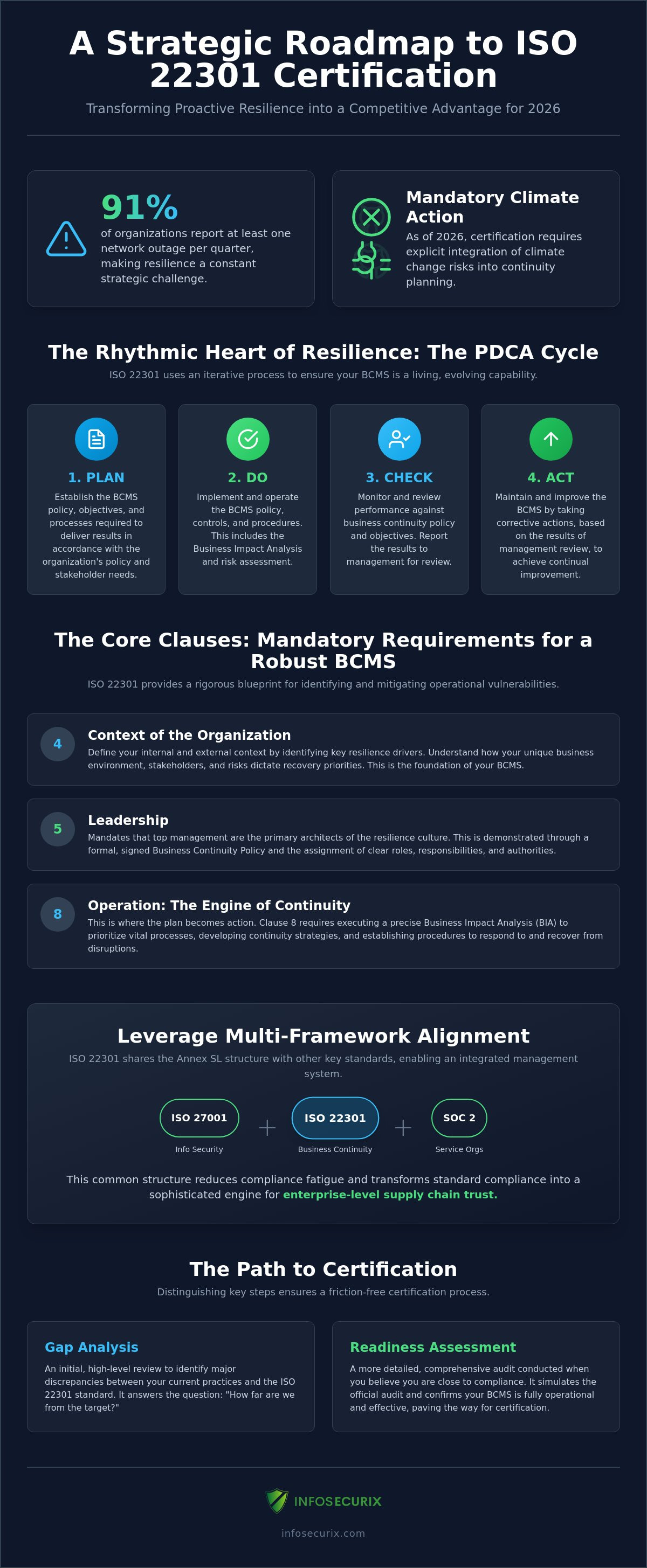
With 91% of organizations reporting at least one network outage per quarter as of 2025, the reality of operational risk has shifted from a theoretical concern to a constant strategic challenge in 2026. You understand that maintaining trust requires more than just reactive recovery: it demands a proactive, orchestrated system that fortifies every layer of your enterprise. However, the path to meeting ISO 22301 certification requirements often feels buried under a mountain of technical documentation and complex regulatory expectations.
It’s natural to feel the weight of partner demands for proven resilience while fearing the friction that new protocols might introduce. We’ve designed this roadmap to bridge that gap; we aim to transform rigorous compliance into a sophisticated engine for growth. You’ll gain a clear, non-academic understanding of how to achieve certification without stalling your momentum. This guide provides a framework that aligns your business continuity management with SOC2 and ISO 27001, creating a unified, future-proof shield for your organization.
Key Takeaways
- Understand how the ‘Plan-Do-Check-Act’ cycle serves as the rhythmic heart of your resilience strategy, ensuring your business continuity management remains dynamic and effective.
- Identify the critical internal and external drivers that define your organizational context, establishing a foundation that secures executive commitment and resource allocation.
- Master the core ISO 22301 certification requirements by executing a precise Business Impact Analysis to prioritize your most vital operational processes.
- Distinguish between a gap analysis and a readiness assessment to ensure your mandatory internal audit effectively paves the way for a friction-free certification.
- Leverage multi-framework alignment with SOC2 and ISO 27001 to transform standard compliance into a sophisticated engine for enterprise-level supply chain trust.
Decoding the ISO 22301:2019 Framework in the 2026 Resilience Landscape
ISO 22301 represents the definitive international benchmark for establishing a Business Continuity Management System (BCMS). It’s more than a technical manual; it’s a strategic architecture designed to protect your organization’s core purpose. By 2026, the standard has moved beyond the “disaster recovery” mindset of the previous decade. While recovery focuses on getting back on your feet, true operational resilience focuses on staying upright regardless of the shock. Understanding the full scope of ISO 22301 certification requirements is the first step toward building a shield that protects your reputation and your revenue.
The rhythmic heart of the standard is the Plan-Do-Check-Act (PDCA) cycle. This iterative process ensures that your resilience isn’t a static achievement but a living capability. You plan by setting the scope and identifying risks; you do by implementing the necessary controls; you check by auditing the system’s performance; and you act by refining your strategies. In the current environment, this cycle must account for rapid shifts in technology and global stability. A major update to this landscape is the mandatory 2024 Climate Action Amendment. For 2026 certification, organizations must now explicitly demonstrate how they’ve integrated climate change risks into their continuity planning. It’s no longer an optional consideration; it’s a foundational requirement for modern enterprise trust.
The Philosophy of Operational Resilience
Modern resilience requires a holistic view that transcends simple data backups. It involves a sophisticated orchestration of people, processes, and technology. When you move beyond reactive incident response, you adopt a proactive stance that enables growth. Adhering to ISO 22301 certification requirements helps you de-risk high-stakes enterprise contracts. Large-scale partners in 2026 don’t just look for your ability to deliver; they look for proof that you won’t fail when their own supply chain is under pressure. This shift transforms compliance from a cost center into a powerful competitive advantage.
Understanding the High-Level Structure (Annex SL)
ISO 22301 is built upon the Annex SL high-level structure, which it shares with other critical standards like ISO 27001 and ISO 9001. This commonality is a significant benefit for executive decision-makers. It allows for an integrated management system, drastically reducing compliance fatigue across the organization. Clauses 1 through 3 of the standard establish the necessary groundwork:
- Clause 1: Scope – Defining exactly what parts of the business the BCMS covers.
- Clause 2: Normative References – Aligning with the supporting documents required for the standard.
- Clause 3: Terms and Definitions – Establishing a shared vocabulary to ensure clarity across all departments.
This structured approach ensures that your resilience efforts are methodical, logical, and perfectly aligned with your broader corporate excellence goals.
The Core Clauses: Mandatory Requirements for a Robust BCMS
Building a Business Continuity Management System (BCMS) requires a methodical transition from high-level vision to granular execution. The ISO 22301:2019 requirements serve as a rigorous blueprint, ensuring that every operational vulnerability is identified and mitigated. Clause 4 initiates this process by requiring an organization to define its internal and external context. This step involves identifying the resilience drivers that matter most to your stakeholders. It’s not just about listing threats; it’s about understanding how your unique business environment dictates your recovery priorities.
Leadership as the Foundation of Resilience
Success starts at the top. Clause 5 mandates that leadership isn’t a passive observer but the primary architect of the resilience culture. This requirement is satisfied through a formal Business Continuity Policy, signed by top management, which provides the strategic direction for the entire organization. You must assign clear roles, responsibilities, and authorities to ensure that accountability is never in question. When leaders actively participate, they prevent the BCMS from becoming mere “shelf-ware” documentation. This visible commitment is what transforms ISO 22301 certification requirements into a living, breathing organizational capability.
Clause 6 moves the focus toward planning. Here, you establish measurable business continuity objectives and address the risks that could prevent you from achieving them. It’s about setting the bar for performance. Clause 7 provides the support structure, focusing on the competence and awareness of your team. You need to ensure that every individual understands their role during a disruption. This clause also mandates the maintenance of documented information, creating a trail of evidence that your system is both designed and operating as intended. If you’re feeling overwhelmed by the documentation burden, an independent internal audit can often clarify which records are essential for compliance.
Integrating Climate Risk into Organizational Context
As of 2026, the 2024 Climate Action Amendment (Amd 1:2024) is a mandatory component of Clause 4.1. You must now explicitly document how environmental factors impact your supply chain continuity. This isn’t a vague environmental statement; it’s a data-driven analysis of how extreme weather or resource scarcity could disrupt your specific operations. We suggest incorporating climate risk data directly into your annual management review process. This ensures that your resilience strategy evolves alongside the changing physical environment, fulfilling a critical part of the modern ISO 22301 certification requirements.
The cycle concludes with Clauses 9 and 10. Clause 9 focuses on performance evaluation through monitoring, measurement, and internal audits. It’s the “Check” phase of the PDCA cycle. Clause 10 represents the “Act” phase, requiring continuous improvement through corrective actions. When you identify a non-conformity, you don’t just fix the immediate problem; you analyze the root cause to prevent recurrence. This iterative nature ensures your organization doesn’t just reach a standard but consistently exceeds it.
Clause 8: The Operational Engine of Business Continuity
Clause 8 is where the strategic vision of leadership meets the reality of daily operations. It’s the most granular part of the ISO 22301 certification requirements, serving as the blueprint for tactical execution. Clause 8.1 requires you to establish the criteria for your resilience processes; this isn’t just a simple checklist. It’s about defining the operating parameters that keep your business functional during a crisis. You’re building the controls that ensure your continuity strategies are implemented as intended, creating a steady foundation for the more complex analytical work that follows.
Mastering the Business Impact Analysis (BIA)
The BIA is the analytical core of Clause 8.2. You start by identifying critical functions and determining their Maximum Tolerable Period of Disruption (MTPD). This is the absolute limit your business can survive without a specific process. From there, you’ll define Recovery Time Objectives (RTO) and Recovery Point Objectives (RPO). While RTO tells you how fast you need to be back up, RPO defines the maximum amount of data loss your organization can sustain. Leveraging professional business impact analysis services helps uncover hidden dependencies that internal teams often overlook. This precision ensures that your recovery tiering is based on hard data rather than assumptions.
Once the BIA and Risk Assessment are complete, Clause 8.3 requires you to select appropriate strategies and solutions. You aren’t just looking for any solution; you’re looking for the specific options that balance cost, efficiency, and risk. Clause 8.4 then translates these strategies into tactical Business Continuity Plans and Procedures. These documents must be concise, accessible, and actionable. They serve as the high-stakes playbook your team will follow when the pressure is at its peak, ensuring that response remains logical and measured.
The Exercise Program: Validating Your Strategy
A plan is only a theory until it’s tested. Clause 8.5 mandates a robust exercise program to validate your Business Continuity Management efforts. Testing shouldn’t be a one-size-fits-all event. You need a mix of tabletop exercises for decision-makers and full-scale failovers for technical teams. The frequency of these tests should reflect your organization’s changing risk profile. If you’ve recently migrated to a new cloud architecture or expanded into a new market, your testing schedule must accelerate. Crucially, Clause 8.6 requires you to document “lessons learned” after every exercise. This feedback loop ensures that your ISO 22301 certification requirements are met through a commitment to constant refinement. It’s this culture of validation that separates a resilient enterprise from one that’s merely compliant.
The Road to Certification: Gap Analysis and Readiness
Achieving formal recognition for your resilience program requires a transition from internal preparation to external validation. The journey begins by distinguishing between a gap analysis and a readiness assessment. A gap analysis is your initial diagnostic; it identifies the distance between your current state and the full ISO 22301 certification requirements. In contrast, a readiness assessment is a final dress rehearsal. It ensures that your Business Continuity Management System (BCMS) is not only documented but also effectively operating before the external auditors arrive. This distinction is vital for maintaining a predictable timeline and avoiding the friction of unexpected non-conformities during the final audit.
Conducting an Effective Gap Analysis
Most enterprises don’t start from zero. You likely have existing disaster recovery plans and emergency protocols in place. An effective gap analysis maps these legacy documents against the rigorous ISO 22301 standard to identify “missing links.” Common oversights often include a lack of formal supply chain risk management or the absence of structured communication protocols for external stakeholders. By identifying these voids early, you can establish a realistic budget and a precise timeline for your implementation project. This methodical approach ensures that resources are allocated where they have the most significant impact on your resilience posture.
A mandatory milestone in this journey is the performance of a formal internal audit. This isn’t just a suggestion; it’s a core requirement of the standard. Conducting a thorough information security internal audit provides the objective evidence needed to prove that your controls are functioning as intended. Once satisfied, you’ll engage a certification body for a two-stage external audit. Stage 1 focuses on a documentation review to ensure your framework is sound; Stage 2 involves a deep-dive into your operational effectiveness. For a typical enterprise, this entire implementation lifecycle usually spans six to twelve months.
Synergy with ISO 27001 and SOC2
Strategic leaders recognize that ISO 22301 certification requirements don’t exist in a vacuum. There is a powerful synergy between business continuity and other security frameworks. For example, the availability controls within ISO 22301 directly support your ISO 27001 certification readiness by addressing one of the three pillars of the CIA triad. Similarly, there is significant overlap with the SOC 2 readiness checklist, particularly regarding the Trust Services Criteria for availability and disaster recovery. Adopting a multi-standard approach signals a mature governance model that significantly enhances enterprise valuation and investor confidence. To ensure your framework is perfectly aligned for success, we invite you to explore our professional ISO 22301 readiness assessments today.
Strategic Resilience with InfoSecurix: Beyond Compliance
Achieving the standard is a significant milestone, yet true mastery lies in the seamless integration of these principles into your corporate DNA. Meeting ISO 22301 certification requirements shouldn’t be viewed as a static destination; it’s the foundation upon which you build an unshakable enterprise reputation. InfoSecurix acts as your seasoned guide, navigating the intricate nuances of ISO 22301 business continuity to ensure your framework is as functional as it is compliant. While automated tools might offer a surface-level scan of your systems, our boutique approach relies on expert human judgment to address the complex, bespoke risk scenarios that define the 2026 landscape.
The InfoSecurix Readiness Methodology
Our engagement model is designed for executive clarity and absolute confidence. We provide a fixed-fee structure that grants your organization total budget certainty, eliminating the unpredictability often found in traditional professional service contracts. With over 25 years of industry experience, our consultants bring a legacy of success to every audit and assessment. We don’t just identify problems. Instead, we architect strategic corrective actions that align with your specific operational flow. This ensures that every adjustment made to satisfy ISO 22301 certification requirements adds tangible value to your internal processes rather than creating unnecessary friction or operational lag.
By focusing on multi-framework alignment, we help you leverage your continuity efforts to satisfy other rigorous standards like ISO 27001 and SOC2. This holistic perspective reduces compliance fatigue and ensures that your resilience strategy is a unified shield rather than a series of disconnected protocols. It’s a methodical approach that transforms a technical necessity into a high-level management asset.
Empowering Your Future Growth
A mature Business Continuity Management System (BCMS) is a powerful enabler of bold business moves. When your stakeholders and global enterprise partners see the shield of certification, they recognize an organization that remains unfazed by complexity. This level of proven resilience often leads to tangible financial benefits, such as reduced cyber insurance premiums and a significant increase in supply chain trust. To further explore how to protect your organization’s financial stability, learn more about comprehensive business insurance options. It’s about future-proofing your growth through meticulous standards that protect your most vital assets and your long-term vision.
We invite you to transform your compliance journey into a distinct competitive advantage. Our team is ready to provide the bespoke readiness assessments and strategic gap analyses required to secure your position as a resilient leader in your industry. Reach out to InfoSecurix today to begin building a legacy of enterprise trust that stands the test of time.
Architecting a Future of Uninterrupted Growth
Transforming your operational risk into a strategic advantage requires a shift from reactive recovery to proactive resilience. You’ve seen how the ISO 22301 certification requirements serve as a sophisticated blueprint for this evolution; they move beyond simple documentation to create a living, breathing management system. By mastering the tactical execution of Clause 8 and aligning your continuity efforts with frameworks like ISO 27001 and SOC2, you position your organization as a trusted pillar in the global supply chain.
InfoSecurix stands ready to guide you through this complex landscape with a boutique, high-touch consultancy model that prioritizes your unique business context. We bring over 25 years of strategic compliance expertise to every engagement; this ensures your readiness journey is both methodical and friction-free. We invite you to Partner with InfoSecurix for Expert ISO 22301 Readiness Services and secure your enterprise against the uncertainties of tomorrow. Your commitment to these rigorous standards today is the foundation for your boldest business moves in the years ahead.
Frequently Asked Questions
What are the mandatory documents required for ISO 22301 certification?
Mandatory documentation for ISO 22301 certification requirements includes the Business Continuity Policy, the defined scope of the BCMS, and the results of both the Business Impact Analysis and Risk Assessment. You must also maintain documented procedures for incident response and business continuity; these serve as the tactical playbook during a disruption. Finally, records of competence, internal audits, and management reviews are essential to prove the system’s operational maturity to an external auditor.
How does the 2024 Climate Action Amendment affect my ISO 22301 requirements?
The 2024 Climate Action Amendment requires organizations to explicitly determine whether climate change is a relevant issue within their organizational context under Clause 4.1. You must now document how environmental factors, such as extreme weather or resource scarcity, could disrupt your specific supply chain or critical functions. This mandate ensures that your resilience strategy accounts for modern physical risks; it shifts climate considerations from a corporate social responsibility goal to a core operational requirement.
What is the difference between a Business Impact Analysis (BIA) and a Risk Assessment?
A Business Impact Analysis (BIA) focuses on the consequences of a disruption; it identifies your most critical functions and establishes recovery timelines like Recovery Time Objectives (RTO). In contrast, a Risk Assessment identifies the specific threats that could cause those disruptions, such as cyberattacks or natural disasters. While the BIA tells you what needs to be protected and how fast, the Risk Assessment identifies the vulnerabilities that could compromise those assets.
Is ISO 22301 mandatory for businesses in the United States?
ISO 22301 is not a federal legal requirement for all US businesses, but it is increasingly mandated by regulators and enterprise partners as a condition of trade. Specific sectors, such as finance under emerging resilience acts, face intense pressure to prove operational maturity through recognized standards. Many organizations adopt the standard to satisfy the due diligence requirements of high-value clients who demand proof of continuity before signing enterprise-level contracts.
Can we integrate ISO 22301 with our existing ISO 27001 management system?
You can seamlessly integrate ISO 22301 with an existing ISO 27001 management system because both standards share the Annex SL high-level structure. This alignment allows you to use a single set of management reviews, internal audits, and document control processes for both frameworks. Integrating these systems reduces administrative overhead and ensures that your information security and business continuity strategies operate as a unified shield for your enterprise.
How long does it typically take to achieve ISO 22301 certification?
Achieving certification typically takes between six and twelve months for a national enterprise; this timeline depends heavily on the current maturity of your business continuity protocols. The process involves a diagnostic gap analysis, the implementation of mandatory controls, and a period of operational testing before the external audit. Organizations that leverage expert readiness assessments often move faster by avoiding common pitfalls and focusing resources on the most critical compliance gaps.
What is the role of an internal audit in the ISO 22301 certification process?
The internal audit is a mandatory requirement that serves as a final validation of your BCMS before the certification body arrives for the formal assessment. It provides an objective, independent review of your processes to ensure they align with ISO 22301 certification requirements. This internal check identifies any remaining non-conformities; it allows your team to implement corrective actions proactively, ensuring a smoother and more predictable external audit experience.
How often must we test our business continuity plans to remain compliant?
The standard requires you to test your business continuity plans at planned intervals or whenever significant changes occur within your organization. While many firms conduct tabletop exercises annually, high-risk environments often perform more frequent validations to account for shifting threat landscapes. Documenting the results of these exercises is critical; it proves that your procedures are not just theoretical but are capable of protecting the business during a real-world crisis.