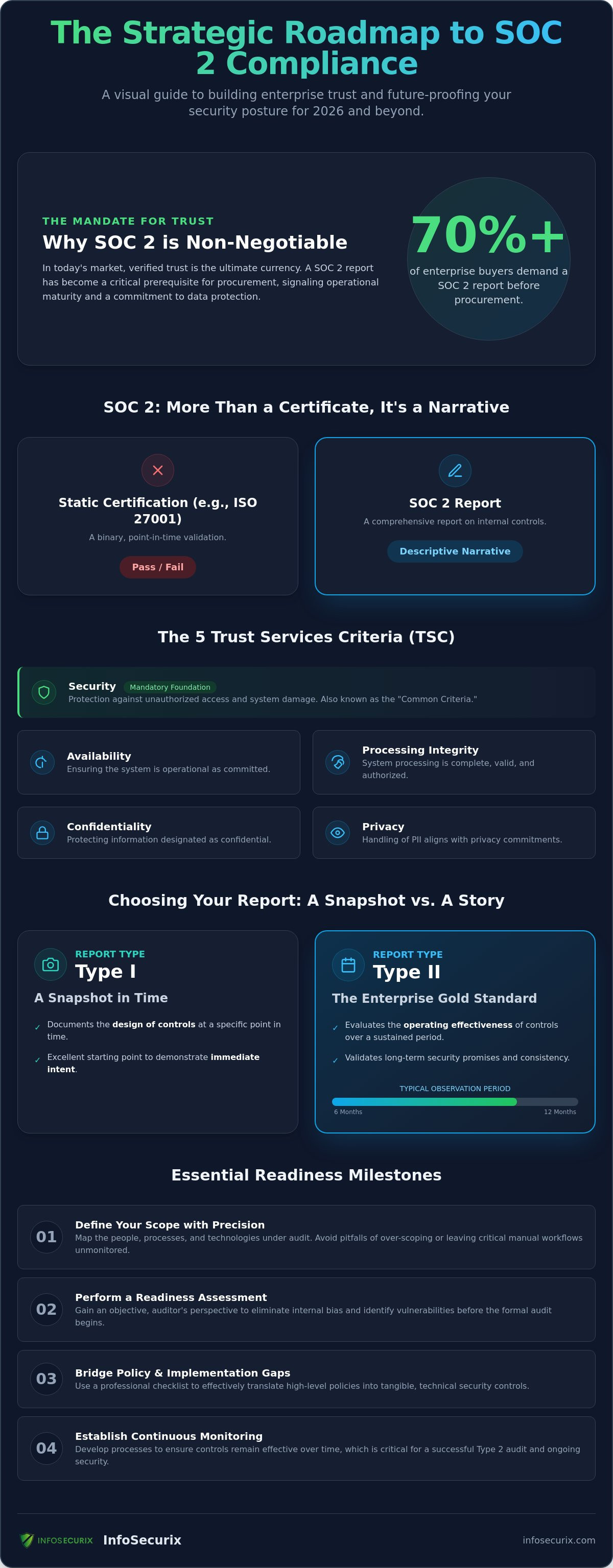
Over 70% of enterprise buyers now demand a SOC 2 report as a non-negotiable prerequisite for procurement. It’s a staggering figure that underscores a simple reality: without verified trust, your market position is at risk. You’ve likely felt the pressure of potential audit failure or the looming threat of lost contracts while your internal IT teams struggle to keep pace. Utilizing a comprehensive SOC 2 readiness checklist isn’t just about passing a test; it’s about building a resilient framework that protects your data and empowers your organization to scale with absolute confidence.
We recognize that the complexities of the 2026 AICPA Peer Review Guidance can feel overwhelming, especially when your primary focus remains on innovation. This roadmap promises to demystify the compliance process by providing a clear, actionable path that minimizes remediation costs and validates your existing security controls. We’ll guide you through selecting the appropriate Trust Services Criteria, addressing AI-related data exposure risks, and establishing the continuous monitoring required to secure a successful Type 2 audit.
Key Takeaways
- Distinguish between static certifications and the SOC 2 reporting model to establish a sophisticated foundation for managing enterprise data trust.
- Define your organizational system with precision to avoid the common pitfalls of over-scoping and unnecessary administrative burden.
- Utilize a professional SOC 2 readiness checklist to bridge the gap between policy development and technical control implementation effectively.
- Secure an objective auditor’s perspective through a readiness assessment to eliminate internal bias and identify vulnerabilities before the formal audit begins.
- Transition from generic templates to a bespoke security framework that future-proofs your organization against the complexities of the 2026 regulatory environment.
Understanding the SOC 2 Framework: Why Readiness is the Foundation of Trust
Establishing a culture of transparency begins with a deep understanding of the System and Organization Controls (SOC) framework. Developed and governed by the AICPA, this standard has evolved from a specialized audit requirement into a cornerstone of enterprise valuation. It’s essential to recognize the fundamental shift in how trust is measured. Unlike the binary, pass-fail nature of an ISO 27001 certification, SOC 2 represents a comprehensive report of a firm’s internal controls. It doesn’t just certify that you have a policy; it narrates how those policies function in the real world to protect client interests. This distinction is vital for executive leaders who view security not as a hurdle, but as a catalyst for growth.
Approaching this process through a professional SOC 2 readiness checklist transforms a daunting compliance exercise into a strategic architectural review. In 2026, the landscape of cloud security has shifted significantly. Enterprise clients no longer accept surface-level assurances. They demand granular evidence that your security posture is resilient against modern threats, particularly as AI adoption outpaces traditional control structures. Proactive readiness ensures that your organization isn’t merely reacting to an auditor’s request. Instead, you’re actively building a moat around your market position. This strategic alignment doesn’t just satisfy a procurement requirement; it increases the tangible value of your business by proving operational maturity to potential acquirers and high-value partners.
The Five Trust Services Criteria (TSC)
Navigating the selection of criteria requires a meticulous evaluation of your specific service commitments. The Security category, often called the “Common Criteria,” is the mandatory foundation for every report. It addresses the fundamental protections against unauthorized access and system damage. Depending on your business model, you may choose to include Availability, Confidentiality, or Processing Integrity. Organizations handling sensitive personal data must also integrate the Privacy criteria. This addresses the complex regulatory requirements surrounding personal identifiable information (PII), ensuring your framework is as comprehensive as the data you protect.
Type I vs. Type II Reports: Choosing Your Narrative
Selecting the right report type is a critical decision that impacts your organization’s perceived reliability. A Type I report provides a snapshot, documenting the design of your controls at a specific point in time. It’s often an excellent starting point for organizations needing to demonstrate immediate intent. However, the enterprise gold standard remains the Type II report. This version evaluates the operating effectiveness of your controls over a sustained period, typically six to twelve months. Achieving a successful Type II report demonstrates a legacy of consistency that a single point-in-time check simply cannot match; it’s the ultimate validation of your long-term security promise.
Defining the Scope: Mapping Controls to Your Business Objectives
Defining the boundaries of your engagement is perhaps the most critical step in your SOC 2 readiness checklist. This process, known as scoping, determines exactly which people, processes, and technologies will be under the auditor’s lens. While modern automation platforms offer a quick start, they often focus solely on digital integrations. A seasoned guide knows that a truly robust system includes manual workflows and physical security measures that software alone cannot monitor. Relying on a narrow, automated scope risks leaving significant gaps in your security narrative. Conversely, over-scoping leads to an unnecessary resource drain on internal teams and inflated audit fees. Striking the right balance ensures your report is both cost-effective and comprehensive enough to satisfy the most discerning enterprise procurement teams.
Aligning cross-functional leadership is essential for a seamless transition to compliance. It’s a common misconception that SOC 2 is strictly an IT initiative. In reality, your HR department manages background checks, Legal oversees vendor contracts, and DevOps maintains the integrity of the production environment. Each of these pillars must be synchronized with your compliance objectives. Following the guidance provided by the AICPA SOC for Service Organizations, you can build a framework that reflects the actual operational reality of your business. If you’re unsure where your boundaries should lie, engaging in a professional SOC 2 readiness assessment can provide the clarity needed to proceed with confidence.
Inventory of Information Assets
Precision in asset management is the bedrock of a secure environment. You must begin by classifying your data into distinct categories; public, private, and highly sensitive customer information. Mapping how this information flows through your organization is equally vital. You need to visualize every entry point, internal transition, and exit path. This exercise often reveals hidden third-party dependencies. Your report’s validity depends on how well you manage the risks associated with these vendors, making vendor risk management a non-negotiable component of your scope.
Risk Assessment: The Driver of Control Selection
A formal information security risk assessment serves as the strategic engine for your entire compliance journey. You shouldn’t pick controls at random. Instead, link every selected control to a specific threat identified during your assessment. This methodology ensures that your security measures are purposeful rather than performative. By prioritizing remediation based on the likelihood and impact of potential occurrences, you can allocate resources more effectively. This structured approach directly maps your risks to the relevant Trust Services Criteria, ensuring no vulnerability is left unaddressed.
The Strategic Choice: Professional Readiness Assessment vs. Self-Evaluation
Choosing the methodology for your compliance journey is a pivotal decision that dictates your long term success. Many organizations initially fall into the self assessment trap. It’s a common scenario where internal teams, despite their technical proficiency, struggle with operational blindness. They naturally focus on how systems should work rather than how an auditor will verify they actually do. While a simple SOC 2 readiness checklist can provide a baseline, it cannot replace the nuanced judgment of a seasoned guide who understands the specific expectations of the 2026 AICPA Peer Review Guidance. Relying solely on internal perspectives often leads to overlooked vulnerabilities that only surface during the formal audit, when the cost of correction is at its highest.
The true ROI of a professional readiness assessment lies in its ability to prevent the catastrophic consequences of a Qualified Opinion. In the world of SOC 2, this is essentially a failure that signals to your enterprise clients that your controls are unreliable. The financial impact of such a report extends far beyond the audit fee; it includes lost contracts, damaged reputation, and the massive cost of emergency remediation. By securing an auditor’s perspective early, you transform compliance from a looming threat into a predictable, managed process. This foresight allows your internal IT teams to remain focused on core innovation while you build a legacy of trust with your stakeholders. Integrating a SOC 2 readiness checklist into a broader professional engagement ensures that every step you take is purposeful and verified.
Comparing Methodologies
Self-evaluation is typically best suited for very early stage startups with exceptionally simple environments and limited data footprints. However, for mid market and enterprise facing organizations, professional readiness is essential. We often recommend a hybrid approach for growing firms. This involves leveraging automation tools for continuous evidence collection while utilizing expert consultants to provide the high level strategy and interpretation that software cannot offer. This combination ensures technical accuracy and strategic alignment with your broader business goals.
The Value of an Independent Internal Audit
Engaging a cybersecurity internal audit firm provides a vital dry run for the real engagement. This phase is where you distinguish between control gaps, where a necessary safeguard is missing, and evidence gaps, where the control exists but cannot be proven to an auditor. Establishing this distinction early is the difference between a smooth audit and a stressful, resource intensive scramble. It fosters a culture of continuous compliance, moving your organization away from a check the box mentality toward a state of permanent operational readiness.
The SOC 2 Readiness Checklist: Essential Milestones for 2026
Achieving compliance requires a methodical transition from high-level strategy to granular execution. This phase of the journey is defined by five distinct milestones that transform your security posture into a verifiable narrative. By following a structured SOC 2 readiness checklist, you ensure that every technical control is backed by a robust administrative framework. Phase 1 focuses on governance and policy development; this is where you create the paper trail of intent that auditors rely on to understand your organizational goals. Phase 2 shifts toward technical control implementation, securing both the perimeter and the core of your infrastructure. In Phase 3, you establish operational excellence through incident response and change management protocols. Phase 4 involves rigorous evidence collection to build a digital archive for the auditor, while Phase 5 serves as the final gap analysis; it’s the last mile check that ensures you’re fully prepared before the CPA arrives.
Critical Controls to Prioritize
Precision in technical implementation is non-negotiable for a successful audit. You must prioritize access management by enforcing the principle of least privilege and mandatory multi-factor authentication (MFA) across all systems. Encryption remains a cornerstone of data protection, requiring you to secure information both at rest and in transit throughout your environment. Additionally, a mature vulnerability management program is essential. You need to establish a consistent cadence for scanning and patching to address emerging threats before they can be exploited.
The Documentation Toolkit
Effective documentation bridges the gap between organizational policy and daily practice. You need to author information security policies that staff can actually follow, avoiding overly dense jargon in favor of clear, actionable directives. Standard operating procedures (SOPs) are equally vital as they document the specific “how” behind your security controls. Utilizing a SOC 2 readiness checklist during the documentation phase ensures that no critical SOP is overlooked. Testing your resilience is also a key requirement; regular tabletop exercises for your incident response plans ensure your team remains calm and effective under pressure.
The Human Element
Your employees are your first line of defense, making security awareness training a critical investment. Transforming staff from potential liabilities into security assets requires ongoing engagement and education. Securing the employee lifecycle through rigorous background checks and formalized onboarding and offboarding processes is also essential. The control environment represents the collective values and ethical standards that serve as the cultural foundation of compliance within your organization. If you’re ready to validate your milestones, you can schedule a professional SOC 2 readiness assessment to ensure your organization is truly audit-ready.
Partnering for Compliance: How InfoSecurix Future-Proofs Your Security Posture
Transitioning from the technical milestones of a SOC 2 readiness checklist to a successful formal audit requires more than just a list of completed tasks. It demands a partner who understands the strategic implications of every control. While generic templates might offer a baseline, they often fail to account for the unique architectural nuances of a growing enterprise. InfoSecurix provides a bespoke advisory approach that prioritizes your specific business objectives, ensuring that compliance becomes a catalyst for growth rather than a recurring administrative hurdle. We look beyond the immediate requirements to build a framework that reflects your organization’s commitment to excellence.
InfoSecurix leverages over 25 years of experience to guide organizations through the increasingly complex regulatory landscape of 2026. Our role as a seasoned guide means we’ve seen every possible audit scenario, allowing us to remain unfazed by technical complexity. We don’t just identify what needs to be fixed; we provide the strategic vision necessary to align your security posture with global standards. This high-level consultancy ensures that your investment in SOC 2 readiness delivers tangible ROI by strengthening your market position and instilling absolute confidence in your enterprise partners.
Our Strategic Readiness Process
Our methodology begins with a tailored gap analysis designed to uncover the specific hurdles within your unique environment. This isn’t a surface-level scan. It’s a deep dive into your people, processes, and technologies to ensure no vulnerability is overlooked. Once identified, we provide strategic corrective actions that offer a clear “how-to” for remediation. This level of detail empowers your internal teams to fix issues efficiently without the guesswork often associated with self-evaluation. Finally, we serve as your professional auditor liaison. By helping you select the right CPA firm and managing the communication throughout the engagement, we ensure the process remains smooth, professional, and free of unexpected friction.
Building Long-Term Operational Resilience
Securing your data today is only the first step toward achieving a permanent state of readiness. By integrating your current efforts with ISO 27001 certification readiness, we help you create a unified framework that facilitates global market access. This forward-thinking approach moves your organization away from the stress of point-in-time audits toward a culture of continuous monitoring and resilience. Meticulous standards today pave the way for seamless scaling tomorrow. We invite you to schedule your SOC 2 Readiness Assessment with InfoSecurix today and take the first step toward future-proofing your enterprise trust.
Securing Your Legacy of Operational Excellence
Building a culture of transparency is a sophisticated undertaking that extends far beyond a simple audit. It requires a meticulous approach to scoping, a deep understanding of the Trust Services Criteria, and a commitment to continuous monitoring. Utilizing a strategic SOC 2 readiness checklist is the first step in this transformation, allowing your organization to identify vulnerabilities and implement robust controls before the formal engagement begins. By prioritizing professional readiness over internal guesswork, you ensure that your security posture is resilient enough to meet the highest enterprise standards of 2026.
InfoSecurix offers over 25 years of information security expertise and provides national coverage for complex enterprise compliance. We specialize in bridging the gap between technical controls and executive strategy, serving as the seasoned guide you need to navigate this journey with absolute confidence. Secure your enterprise trust with a professional SOC 2 Readiness Assessment from InfoSecurix today. Your path to verified security is a narrative of achievement; let’s build that legacy together.
Frequently Asked Questions
How long does a SOC 2 readiness assessment typically take?
A professional readiness assessment typically spans four to eight weeks; however, the exact duration depends on the complexity of your technical environment and the number of Trust Services Criteria in scope. This timeline allows for a thorough gap analysis and the development of a strategic remediation plan. Taking this time early in the process ensures that your internal teams aren’t rushed during the high stakes formal audit.
Can we use a SOC 2 readiness checklist to perform a self-audit?
You can certainly use a SOC 2 readiness checklist to perform an internal review, but this approach often lacks the objective rigor required for enterprise success. Internal teams frequently suffer from operational blindness, potentially overlooking subtle control gaps that an independent advisor would identify immediately. Relying solely on self-evaluation can lead to expensive remediation costs if vulnerabilities are discovered too late in the process.
What is the most common reason organizations fail a SOC 2 audit?
Insufficient documentation and inconsistent evidence collection are the primary reasons organizations struggle during a formal audit. Even if a control exists, failing to provide a verifiable digital archive of its effectiveness over time leads to qualified opinions. Establishing a culture of continuous monitoring and methodical record-keeping is the best way to ensure your report remains clean and authoritative.
Do we need both a readiness assessment and a formal audit?
While only the formal audit by a CPA firm results in the official report, a readiness assessment is a vital strategic investment that ensures you don’t fail the engagement. It functions as a dry run, allowing you to validate your controls and minimize remediation costs before the formal audit begins. Think of it as a roadmap that guarantees your organization is fully prepared for the auditor’s scrutiny.
How does SOC 2 readiness overlap with ISO 27001 requirements?
Significant overlap exists between these frameworks, particularly within the Common Criteria of SOC 2 and the Annex A controls of ISO 27001. By mapping your SOC 2 readiness checklist to both standards, you can create a unified security posture that addresses multiple regulatory requirements simultaneously. This strategic alignment streamlines the path to global market access and reduces the administrative burden on your IT teams.
What is the cost difference between a Type I and Type II readiness engagement?
A Type II readiness engagement generally requires a higher investment than a Type I review because it evaluates the operating effectiveness of controls over a sustained period. The increased scope involves more rigorous evidence testing and documentation review, reflecting the deeper level of trust required by enterprise clients. This investment is justified by the long term market advantage a Type II report provides.
How often should we update our SOC 2 readiness checklist?
You should update your checklist annually or whenever significant changes occur in your technology stack or business processes. In the fast moving landscape of 2026, staying current with AICPA guidance and emerging AI risks is essential for maintaining a resilient security posture. Regular updates ensure that your framework evolves alongside your business, protecting your data and your reputation.
Is a SOC 2 report mandatory for all SaaS companies in 2026?
A SOC 2 report isn’t a legal requirement for all SaaS companies, but it has become a non-negotiable prerequisite for enterprise procurement. Most high value clients won’t consider a service provider without a verified Type II report, making compliance a critical component of your market position. It’s the standard by which modern businesses verify that their partners take data security seriously.