
What if the capital allocated toward your security framework wasn’t a sunk cost, but the primary catalyst for your next enterprise expansion? You’ve likely felt the mounting pressure to justify every dollar of your ISO 27001 certification cost to a board that often views cybersecurity as a defensive overhead. It’s a common frustration to see high-value deals stall because a prospect demands a level of recognized trust that your current documentation can’t provide.
This framework empowers you to master the financial and strategic metrics required to transform ISO 27001 from a compliance expense into a high-yield business asset. We’ll explore a clear ROI formula that accounts for reduced cybersecurity insurance premiums and improved deal velocity. By aligning your security posture with the ISO/IEC 27001:2022 standard, you’ll learn to quantify the value of avoiding the $4.61 million average cost associated with non-compliant data breaches; this approach ensures your security investment drives measurable growth while future-proofing your organization through meticulous, board-ready standards.
Key Takeaways
- Reframe certification from a compliance burden to a strategic growth engine by calculating the ratio of net business value to total implementation costs.
- Accelerate deal velocity and capture enterprise-level contracts by leveraging ISO 27001 as a verified mark of trust that shortens the sales cycle.
- Optimize your ISO 27001 certification cost by avoiding the “double-spend” trap associated with low-cost consultants and subsequent remediation.
- Secure tangible financial returns through reduced cybersecurity liability premiums and the systematic mitigation of high-impact data breach risks.
- Implement a structured mathematical model to present a clear, board-ready ROI case that balances total investment against revenue enablement.
The Strategic Framework for ISO 27001 ROI: Beyond Compliance
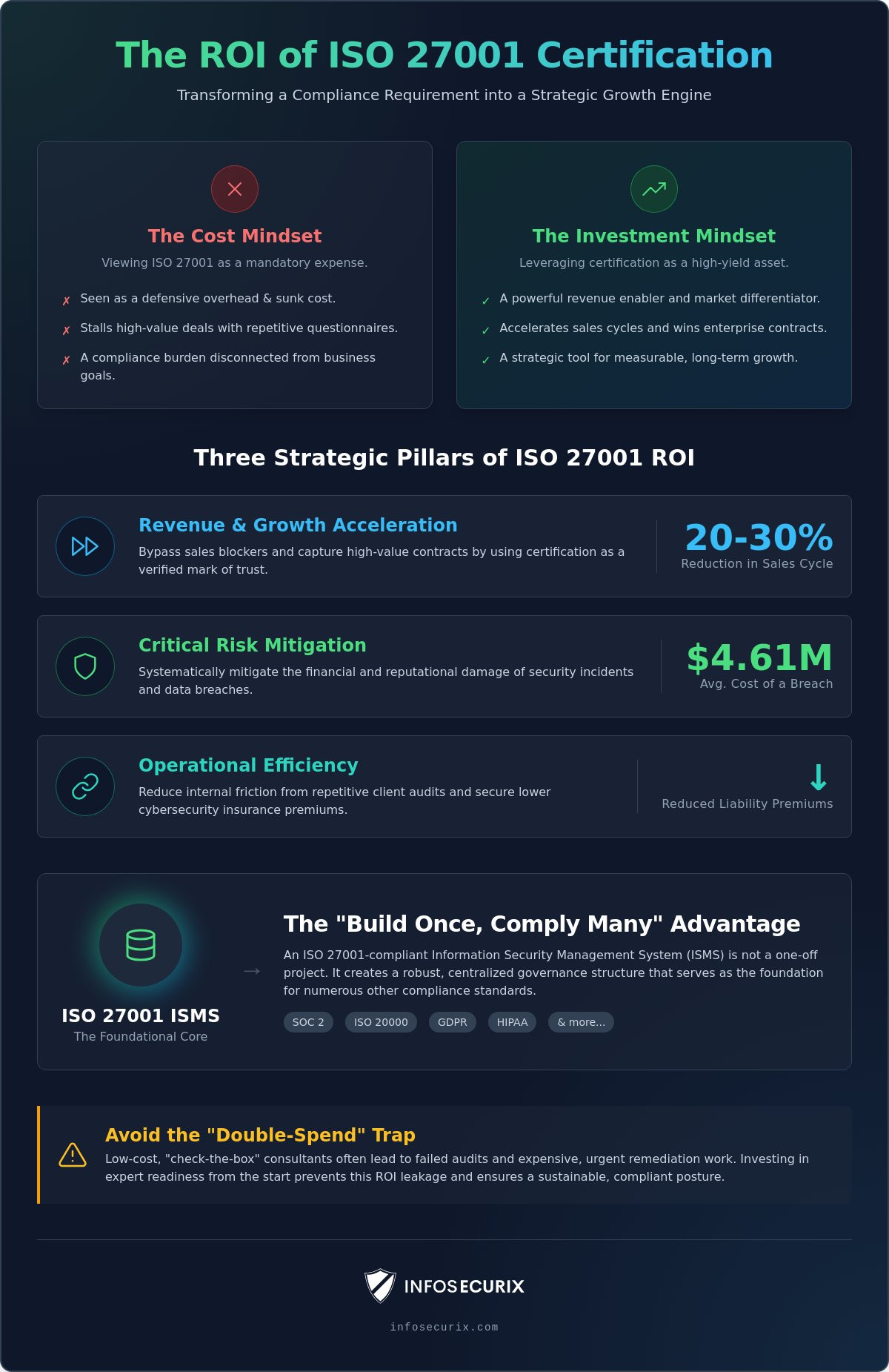
Evaluating the true ISO 27001 certification cost requires a shift in perspective; it’s an investment in market credibility rather than a simple line-item expense. From an executive standpoint, Return on Investment (ROI) is defined as the ratio of net business value generated to the total cost of implementation. While many organizations view the ISO/IEC 27001 standard as a regulatory tax, seasoned leaders recognize it as a powerful revenue enabler. This framework moves security from a defensive posture to an offensive business strategy.
Three strategic pillars support this framework to ensure the investment yields measurable dividends:
- Revenue Protection: Securing existing contracts and qualifying for high-value enterprise deals that require rigorous security validation.
- Operational Efficiency: Reducing the internal friction of repetitive audits and ad-hoc security requests from clients.
- Risk Mitigation: Avoiding the catastrophic financial impact of data breaches, which cost non-compliant organizations an average of $4.61 million in 2025 according to industry research.
The Shift from Defensive to Offensive Security
Sales teams often find themselves trapped in a cycle of repetitive security questionnaires that can stall deals for weeks. Certification changes this dynamic entirely. By presenting a valid certificate, you allow your sales force to bypass these hurdles, accelerating the sales cycle and securing revenue that might otherwise be lost to competitors who already hold the credential. Trust signals are particularly critical during the RFQ process for national or international contracts; without a recognized standard, your bid may be disqualified before it’s even reviewed. ROI is a measure of long-term resilience rather than short-term savings.
Foundational Value of the ISMS
Building an Information Security Management System (ISMS) isn’t just about passing an audit. The ISO 27001 certification readiness process streamlines internal governance by centralizing control and clarifying accountability. This creates a “build once, comply many” environment where the work done for ISO 27001 serves as the foundation for other standards like SOC 2 or ISO 20000. This multi-standard synergy is essential for optimizing your ISO 27001 certification cost over several years.
A well-implemented system offers longevity that a “check-the-box” approach simply cannot match. Instead of frantic, annual scrambles to remediate gaps, your organization maintains a steady state of compliance. This maturity reduces the likelihood of failed audits and the subsequent costs of emergency remediation, positioning your business as a reliable, steady partner in an increasingly volatile digital landscape.
Direct vs. Indirect Returns: Quantifying the Intangible
Quantifying the impact of a security framework requires looking beyond the immediate balance sheet. While the initial ISO 27001 certification cost is a primary focus for procurement, the most significant returns are often found in the strategic elimination of operational friction. These returns manifest as both direct financial gains and indirect improvements in market positioning. By standardizing security protocols, organizations move away from a reactive, ad-hoc culture toward a model of predictable excellence.
Accelerating the Sales Pipeline
The security questionnaire is a notorious bottleneck in the modern enterprise sales cycle. Sales leaders often report that these detailed inquiries consume dozens of hours of senior technical time per major deal. ISO 27001 certification acts as a pre-validated credential that allows your team to bypass these hurdles. Industry data indicates that certified organizations can reduce their sales cycle by an average of 20 to 30 percent. This acceleration doesn’t just save time; it increases the net present value of every contract signed. In competitive bidding for national contracts, having this certification often provides the decisive edge over non-certified rivals.
Risk-Based Financial Benefits
Cybersecurity insurance underwriters increasingly view ISO 27001 as the gold standard for reasonable security. By following a recognized ENISA risk management framework, businesses demonstrate a level of maturity that directly correlates with lower liability premiums. The foundation of this maturity is a rigorous information security risk assessment, which identifies vulnerabilities before they become liabilities. This proactive stance effectively reduces the frequency of third-party audit requests from your own clients, further lowering the hidden ISO 27001 certification cost associated with maintaining those relationships.
Beyond insurance and sales, the certification builds significant brand equity. It signals to the marketplace that your organization is a safe harbor for sensitive data. This reputation reduces compliance debt; this is the compounding cost of managing fragmented, inconsistent security policies across different departments. Establishing this level of trust is a foundational step for any scaling enterprise. If you’re ready to move beyond basic compliance, engaging with a seasoned guide like InfoSecurix can help you realize these returns more efficiently while future-proofing your operations.
The Hidden Cost Trap: Why Readiness Prevents ROI Leakage
The total ISO 27001 certification cost often balloons when organizations succumb to the “Double-Spend” phenomenon. This occurs when a business pursues the path of least resistance, hiring low-cost consultants or relying solely on automated software, only to face significant non-conformities during the formal audit. The result is a secondary, much higher expenditure required to remediate the system under emergency conditions. Software platforms provide a useful structure, but they cannot interpret the nuanced requirements of your specific business context; only an expert-led gap analysis can identify the silent vulnerabilities that lead to audit failure.
Beyond direct financial outlays, poorly designed security frameworks create “Compliance Friction.” This is the invisible tax on employee productivity caused by fragmented or overly restrictive policies that don’t align with operational reality. When security measures are perceived as a hindrance rather than a safeguard, internal morale drains and talent retention becomes a challenge. Strategic readiness ensures that your Information Security Management System (ISMS) integrates seamlessly into existing workflows, preserving the velocity of your workforce while maintaining rigorous standards.
The True Price of Audit Failure
A failed Stage 1 or Stage 2 audit carries penalties far beyond the standard daily rate for external auditors. You’ll face immediate re-audit fees and the administrative burden of managing corrective action plans under strict deadlines. More critically, the opportunity cost of a delayed certificate can be devastating when a major contract is contingent on its delivery. This is particularly evident in high-stakes environments like the Cybersecurity Maturity Model Certification (CMMC) Program, where compliance is a mandatory prerequisite for participation. Readiness is a one-time investment to prevent recurring financial loss.
Remediation vs. Proactive Readiness
Comparing the cost-per-hour of strategic implementation against emergency firefighting reveals a stark disparity. Proactive organizations utilize a rigorous information security internal audit as a primary ROI-protection mechanism. This process identifies potential failures in a controlled environment, allowing for calm, methodical correction before a registrar ever sets foot on-site. Leveraging 25+ years of experience allows a seasoned guide to spot the subtle non-conformities that inexperienced observers miss. This level of precision ensures your ISO 27001 certification cost remains predictable while maximizing the long-term value of your security infrastructure.
The Mathematical Model: A Step-by-Step ROI Calculation
Translating security maturity into a financial ledger requires a disciplined approach to data. To determine the true ISO 27001 certification cost, executives must look beyond the initial invoice; they must account for the total economic impact over a multi-year horizon. This mathematical model provides a transparent structure for presenting your business case to the board. It moves the conversation from abstract protection to concrete fiscal performance.
- Step 1: Calculate Total Investment. Sum the external consulting fees, certification body audit costs, and the internal man-hours dedicated to the project team.
- Step 2: Quantify Revenue Enablement. Aggregate the total value of new contracts secured specifically because of the certification. Factor in the interest saved by accelerating deal closure through reduced security friction.
- Step 3: Factor in Cost Avoidance. Calculate the projected savings from cybersecurity insurance premium reductions. Include the probabilistic value of avoiding a data breach, which averaged $4.61 million in 2025.
- Step 4: Apply the ROI Formula. Use the standard calculation: [(Total Benefits – Total Investment) / Total Investment] x 100. This yields a percentage that reflects the efficiency of your security spend.
- Step 5: Adjust for the Compliance Multiplier. Recognize that the foundational work performed in year one provides diminishing costs and increasing value over the subsequent three-year cycle.
Defining Your Investment Variables
Accurate estimation begins with understanding internal resource allocation. You must calculate man-month costs by identifying the percentage of time your IT, legal, and HR teams spend on implementation. It’s essential to differentiate between CAPEX for the initial setup and OPEX for ongoing maintenance. If your organization is pursuing a broader digital transformation, consider the synergy of a multi-standard approach. Budgeting for ISO 20000 implementation alongside your security framework can significantly lower the combined ISO 27001 certification cost by sharing governance resources.
Projecting the 3-Year Value Horizon
ROI should never be judged on the first twelve months alone. A full certification cycle includes the initial audit plus two annual surveillance audits. As your Information Security Management System (ISMS) matures, the internal effort required to maintain it decreases; this maturity shifts your focus from remediation to optimization. This phase also generates a residual risk reduction that serves as a financial buffer against market volatility. To build a custom financial model for your organization, connect with our strategic advisors at InfoSecurix today. We help you quantify these variables to ensure your investment drives maximum enterprise value.
InfoSecurix: Maximizing ROI Through Expert Readiness
Achieving a high-yield return on your security investment requires more than just following a checklist; it demands a partnership with a veteran who understands the intricacies of the global certification landscape. InfoSecurix serves as that strategic ally, ensuring the investment side of your ROI equation remains optimized from day one. By leveraging 25+ years of specialized experience, we help you navigate the complexities of the current standard, significantly reducing audit risks and the prohibitive remediation costs that often plague unguided implementations.
CFOs and executive decision-makers value predictability, especially when managing the total ISO 27001 certification cost. Our fixed-fee engagement model provides absolute budgetary certainty, eliminating the financial volatility associated with hourly consulting rates and open-ended project timelines. We don’t just identify gaps; we design strategic corrective action plans that transform audit findings into tangible operational improvements. This approach ensures that every dollar spent contributes to a more efficient, resilient business infrastructure that is built to scale.
The Value of a Seasoned Guide
Navigating the certification process without expert oversight often leads to scope creep, which is one of the primary drains on total project ROI. Our seasoned consultants provide the precision required to keep implementation focused on what truly matters for your specific business context. High-quality, professional documentation is another critical factor; it directly impacts audit speed and success rates by providing registrars with a clear, logical narrative of your security posture. This transition turns compliance from a burdensome task into a sharp competitive edge that resonates with enterprise clients and national partners alike.
Securing Your Organization’s Future
Long-term success in the digital economy is built on a foundation of operational resilience and deep-rooted enterprise trust. While the initial ISO 27001 certification cost is a necessary threshold, the enduring value lies in the future-proofed standards your organization adopts today. By standardizing your Information Security Management System (ISMS), you create a scalable framework that supports aggressive growth while protecting your most valuable assets. This methodical approach ensures you remain calm under pressure and ready for the complexities of tomorrow.
Ready to transform your security posture into a high-yield business asset? Schedule a strategic readiness assessment to begin your ROI journey with confidence. Request a Consultation for ISO 27001 Certification Readiness today and secure your organization’s legacy of excellence.
Realizing the Strategic Dividend of Information Security
Transitioning your security posture from a defensive necessity to a strategic business asset requires a fundamental shift in executive perspective. By applying the mathematical model we’ve explored, you can move beyond the surface-level ISO 27001 certification cost to uncover the compounding returns of accelerated sales cycles and reduced insurance premiums. True ROI isn’t found in the cheapest path to certification; it’s realized through the elimination of operational friction across your entire enterprise.
Success in this complex landscape depends on the precision of your initial roadmap. InfoSecurix brings 25+ years of information security expertise to every engagement, providing the authoritative guidance needed to navigate the current 2022 standards. Our fixed-fee readiness model ensures complete budgetary certainty, while our expert-led gap analysis prevents the costly remediation cycles that often derail internal efforts. This methodical approach transforms a compliance requirement into a powerful catalyst for growth.
Secure Your Strategic ISO 27001 Roadmap with InfoSecurix
Future-proofing your organization through meticulous standards is the most reliable way to enable long-term expansion and build lasting enterprise trust. We look forward to partnering with you to turn your security framework into your greatest competitive advantage.
Frequently Asked Questions
How long does it typically take to see a positive ROI on ISO 27001?
Positive returns usually manifest within 12 to 24 months of achieving certification. While the first year requires a higher capital outlay for implementation, the subsequent reduction in sales friction and insurance costs begins to offset the investment quickly. By the second surveillance audit, the framework typically pays for itself through newly enabled enterprise contracts and improved deal velocity.
Can a small business achieve a high ROI with ISO 27001 certification?
Small businesses frequently achieve the highest proportional returns on their security investment. Holding a recognized certification allows smaller entities to “punch above their weight” and compete for national contracts that would otherwise be out of reach. It effectively levels the playing field by providing instant, verified trust to larger procurement departments that require rigorous vendor validation.
What are the most common hidden costs that sink an ISO 27001 budget?
The most frequent hidden costs include emergency remediation following a failed gap analysis and the “compliance friction” that slows down internal operations. Organizations often underestimate the internal man-hours required for documentation and staff training. These unexpected expenses can significantly inflate your total ISO 27001 certification cost if the project isn’t managed by a seasoned guide from the outset.
How much can ISO 27001 reduce cybersecurity insurance premiums?
Cybersecurity insurance premiums can see reductions between 5% and 15% depending on the underwriter’s specific risk model. Insurers view the standard as a benchmark for reasonable security, which significantly lowers your perceived risk profile. This direct financial saving is a key component of the cost-avoidance pillar used to justify the framework to executive stakeholders.
Is software automation enough to guarantee a positive ROI?
Software automation is a valuable administrative tool, but it’s not a substitute for a bespoke risk management strategy. Automation handles the “what” of compliance, while expert guidance addresses the “how” and “why” specific to your unique business context. Relying solely on software often leads to strategic gaps and silent non-conformities that result in costly audit failures.
What happens to the ROI if we fail our initial certification audit?
A failed audit dramatically reduces your ROI by introducing immediate re-audit fees and delaying critical revenue streams. The opportunity cost of a stalled contract often exceeds the direct financial penalty of the audit itself. Ensuring readiness through a rigorous internal audit is the most effective way to protect your initial investment and maintain project momentum.
How does ISO 27001 ROI compare to SOC 2 compliance?
ISO 27001 often provides a superior long-term ROI for organizations with international ambitions. While SOC 2 is highly valued in North America, ISO 27001 is the global standard for information security management. Its comprehensive structure allows you to build a foundational system that easily maps to other regional or industry-specific requirements, embodying a “build once, comply many” philosophy.
Should I include internal staff time in my ROI calculation?
You must include internal staff time to achieve a transparent and accurate ROI calculation. Neglecting to account for the man-month costs of your IT, legal, and HR teams creates an artificially inflated view of your returns. A professional framework treats internal resource allocation as a primary investment variable to ensure absolute budgetary certainty for the board.