
Over 70% of enterprise buyers now demand a SOC 2 report as a non-negotiable prerequisite for procurement. This reality often places immense pressure on your team to deliver immediate compliance results while facing the daunting task of selecting the right Trust Services Criteria. Our comprehensive SOC 2 audit readiness checklist serves as your strategic foundation; it transforms a complex regulatory hurdle into a clear competitive advantage. By focusing on meticulous preparation rather than reactive fixes, you’ll ensure that your security posture resonates with the high standards of the modern enterprise.
We understand that the fear of a “Qualified” auditor opinion or the perceived costs of remediation can feel overwhelming. You deserve a path that leads to a clean report and accelerated sales cycles. This guide provides an actionable roadmap designed to demystify the 2026 audit landscape. We’ll examine the ROI of a thorough readiness assessment and outline the systematic steps required to future-proof your organization against evolving threats.
Key Takeaways
- Recognize why enterprise procurement departments now view SOC 2 compliance as a mandatory baseline for managing vendor risk.
- Leverage our detailed SOC 2 audit readiness checklist to establish robust board-level oversight and clear communication protocols.
- Distinguish between the point-in-time design of a Type 1 report and the sustained operational effectiveness required for a Type 2 report.
- Execute a systematic roadmap that prioritizes formal gap analysis and proactive remediation to ensure a clean auditor opinion.
- Transform your compliance journey from a technical hurdle into a strategic asset that builds lasting trust with your most valuable prospects.
Understanding the SOC 2 Framework and the Role of Audit Readiness
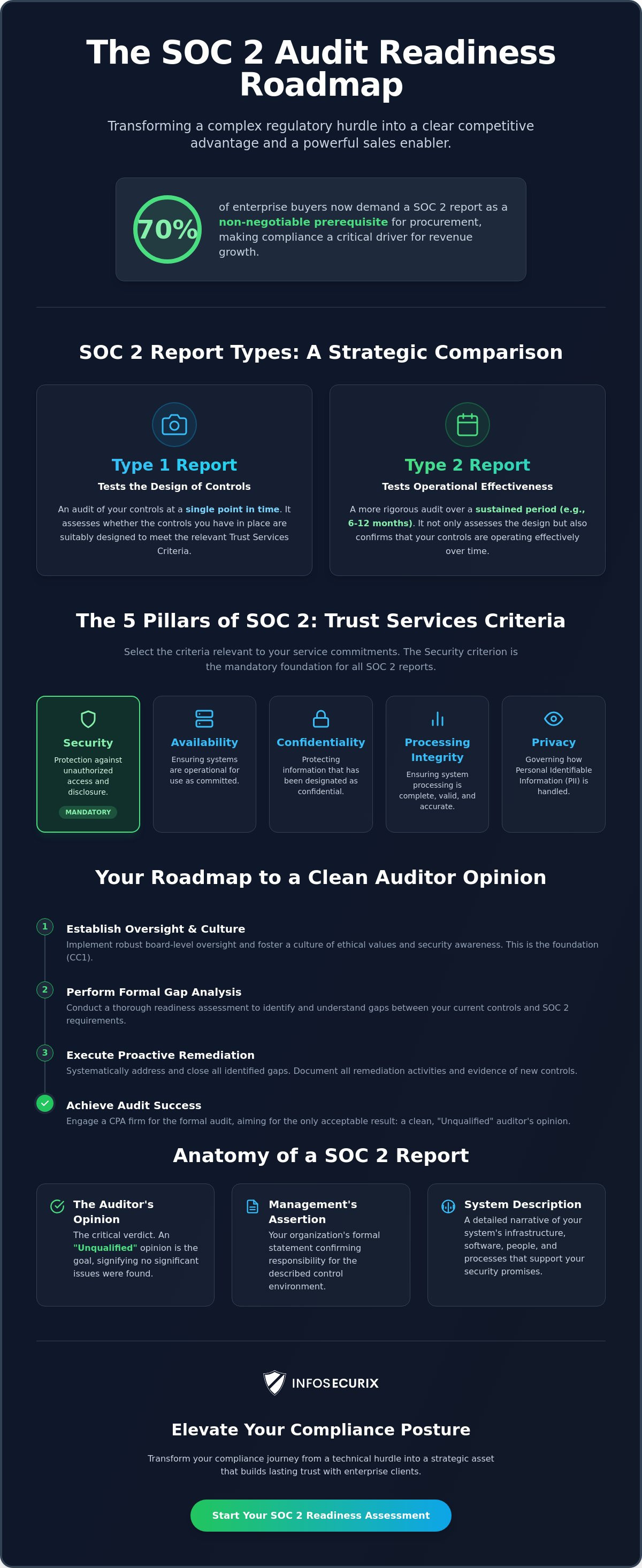
The SOC 2 framework represents more than a mere compliance exercise; it’s a sophisticated standard established by the AICPA to provide transparency into how service organizations manage data. Unlike financial audits, this voluntary reporting standard focuses on non-financial internal controls. It’s categorized under the broader System and Organization Controls (SOC) reporting suite. SOC 2 is an attestation of a company’s commitment to protecting client data through rigorous, auditable controls. By the year 2026, the market has reached a tipping point where enterprise clients no longer view this as an optional “gold star” but as a mandatory baseline for vendor risk management. Research indicates that over 70% of enterprise buyers now require a SOC 2 report as a prerequisite for procurement, making it a critical driver for revenue growth.
Success in this environment requires a proactive stance. Utilizing a comprehensive SOC 2 audit readiness checklist allows your organization to align its internal processes with these rigorous expectations before the formal examination begins. This preparation ensures that you aren’t just reacting to auditor requests but are instead demonstrating a mature, well-documented security posture that resonates with executive decision-makers.
The Five Trust Services Criteria (TSC)
The framework is built upon five distinct pillars, known as the Trust Services Criteria. Your organization must select the criteria that are most relevant to the services you provide and the commitments you’ve made to your clients.
- Security: Often called the “Common Criteria,” this is the mandatory foundation for every report. It addresses whether systems are protected against unauthorized access or unauthorized disclosure.
- Availability and Confidentiality: These criteria focus on ensuring systems are operational for use as committed and that information designated as confidential is protected as agreed.
- Processing Integrity and Privacy: These ensure that system processing is complete, valid, and accurate, while also addressing how personal identifiable information (PII) is collected, used, and retained.
The Anatomy of a SOC 2 Report
A successful audit culminates in a detailed report that serves as a powerful sales enabler. Understanding the components of this document is vital for any leadership team.
- The Auditor’s Opinion: This is the heart of the report. An “Unqualified” opinion is the only acceptable result, indicating that your controls are designed and operating effectively without significant exceptions.
- The Management Assertion: This is your organization’s formal statement. It confirms that you’ve maintained the control environment as described throughout the audit period.
- System Description: This narrative outlines the boundaries of your system. It’s your opportunity to craft a clear story of your technical and operational landscape, showing how your infrastructure supports your security promises.
The Comprehensive SOC 2 Audit Readiness Checklist: Core Controls
Building a resilient security program requires moving from abstract theory to concrete execution. This phase of your journey is where the SOC 2 audit readiness checklist becomes an indispensable asset for your leadership team. It serves as a rigorous framework to ensure that every administrative and technical control is not only designed well but is also operating effectively. Central to this process is the Control Environment (CC1), which necessitates establishing absolute board-level oversight and a culture of ethical values. Without a clear signal from the top, technical controls often lack the institutional weight required to survive a thorough examination.
Effective compliance also hinges on Communication and Information (CC2) and Risk Assessment (CC3). You must ensure that both internal staff and external partners fully understand their specific security responsibilities. In 2026, auditors are placing a much higher premium on how organizations identify and mitigate threats through proactive monitoring and control activities (CC4-CC5). This includes a modern focus on AI-specific risks and the complex web of third-party subprocessors that define the contemporary tech stack. If you find the complexity of these requirements daunting, engaging in a formal SOC2 Readiness Assessment can provide the clarity needed to bridge existing gaps.
Logical and Physical Access Controls
Securing your digital perimeter starts with the Principle of Least Privilege (PoLP). For 2026 audits, there’s increased scrutiny on time-bound privileged accounts and ensuring that access is strictly limited based on necessity. Multi-factor authentication (MFA) remains a non-negotiable standard, but it must be coupled with robust identity management protocols that span across all cloud environments. Beyond the digital realm, you must also account for the physical infrastructure. This involves validating the security of third-party data centers and ensuring that physical access remains as restricted as your virtual databases.
System Operations and Change Management
Operational resilience is proven through your ability to handle the unexpected. Your checklist must include formalized incident response procedures and regular disaster recovery testing to validate system uptime. Change management is equally vital; you need a disciplined software development life cycle (SDLC) that mandates code reviews and rigorous testing before any deployment. Finally, a mature vulnerability management program is essential. This requires consistent scanning and a proactive patch management schedule to address emerging threats before they can be exploited. Auditors now place greater emphasis on how you evaluate and manage the security posture of your vendors, particularly those serving as subprocessors in your delivery chain.
Strategic Comparison: Choosing Between SOC 2 Type 1 and Type 2
Selecting the correct report format is a pivotal strategic decision that dictates how prospects perceive your brand’s reliability. While both reports utilize the same underlying SOC 2 audit readiness checklist, their scope and the confidence they instill differ significantly. Type 1 establishes your security baseline, while Type 2 proves your security legacy. For organizations facing immediate pressure from enterprise prospects, understanding the nuances between these two options is essential to avoid redundant costs and missed sales opportunities.
A SOC 2 Type 1 report provides a valuable snapshot; it validates that your controls are designed correctly at a specific point in time. It’s often an excellent starting point for younger organizations needing to show progress quickly. However, the Type 2 report remains the recognized benchmark for mature enterprises. It evaluates the operating effectiveness of those same controls over a sustained period, proving that your security practices are consistent and reliable. In 2026, many high-growth companies are choosing to bypass the Type 1 stage entirely if their internal controls are already robust, aiming directly for the Type 2 report to satisfy procurement requirements faster.
The Observation Period: A Test of Consistency
Consistency is the cornerstone of enterprise trust. A standard reporting window of 6 to 12 months allows auditors to verify that security is a continuous practice rather than a temporary effort for the audit. During this time, managing “exceptions” becomes critical. Auditors recognize that no system is perfect; they look for how your team identifies, documents, and remediates a single failure. To maintain compliance between these annual audit cycles, organizations utilize Bridge Letters to reassure clients that their security posture hasn’t wavered since the last report was issued.
Cost vs. Value: The ROI of Mature Compliance
Investing in a Type 2 report offers a substantial return by drastically shortening the RFP process for high-value contracts. While the direct-to-Type 2 strategy requires a higher upfront commitment in terms of time and resources, it eliminates the secondary audit fees associated with a two-step approach. You can further optimize this journey by leveraging ISO 27001 readiness to streamline your efforts. Mapping controls across both frameworks allows you to build a unified compliance program that scales with your global ambitions. Achieving a clean Type 2 report doesn’t just satisfy a checklist; it positions your company as a protective force that enables your client’s growth.
The Roadmap to Success: Executing a SOC 2 Readiness Assessment
Achieving compliance is a methodical journey that requires more than just installing a software agent. While automation platforms provide a helpful baseline, they often overlook the human-centric governance and management oversight that professional auditors scrutinize. A strategic roadmap begins with Step 1: a formal gap analysis to identify where current controls fall short of the Trust Services Criteria. Once these vulnerabilities are exposed, Step 2 involves remediating findings by formalizing internal policies and technical safeguards. It’s during this phase that many organizations realize their unwritten rules need to become documented, auditable standards.
Moving forward, Step 3 focuses on executing a practice audit to replicate the rigor of an external examination. This readiness assessment allows your team to experience the pressure of evidence requests without the risk of a qualified opinion. Finally, Step 4 requires you to finalize your System Description and gather organized evidence for the formal observation period. Utilizing a comprehensive SOC 2 audit readiness checklist ensures that no detail is overlooked as you transition from preparation to the live audit. To ensure your organization is fully prepared for this journey, consider scheduling a professional SOC2 Readiness Assessment today.
The Critical Role of Internal Audits
Many organizations find that information security internal audits are the most reliable predictors of SOC 2 success. By sampling your own evidence before the official auditor arrives, you can identify inconsistencies that would otherwise lead to audit exceptions. If you discover a control failure during a Type 2 observation period, you must remediate it in flight. This proactive approach demonstrates to auditors that your monitoring systems are functioning as intended, even when human error occurs. It transforms the audit from a stressful test into a validation of your existing operational excellence.
Aligning Risk and Scope
A common pitfall is a mismatch between the audit scope and the actual operational risks of the business. You must ensure that your SOC 2 scope perfectly aligns with your most recent information security risk assessment. This alignment helps you document the why behind your control choices, providing auditors with a clear rationale for your security architecture. Rather than treating compliance as a static event, use your SOC 2 audit readiness checklist as a living document. This ensures continuous compliance and future-proofs your organization against the evolving expectations of enterprise prospects. You can find more details on this process in our SOC 2 readiness checklist guide.
Elevating Your Compliance Posture with InfoSecurix
InfoSecurix brings over 25 years of seasoned expertise to the table, having guided hundreds of organizations through the most complex regulatory landscapes. We’ve witnessed the evolution of compliance from a niche technical requirement to a critical global business imperative. Our “Trusted Advisor” philosophy ensures that we don’t just help you tick boxes on a SOC 2 audit readiness checklist; we help you build a foundation of operational resilience. This methodology transforms compliance from a periodic hurdle into a continuous strategic asset that enables your business to scale with absolute confidence.
Every organization possesses a unique risk profile and distinct enterprise objectives. We reject the “one-size-fits-all” approach often found in automated platforms. Instead, we deliver bespoke readiness assessments that are meticulously tailored to your specific infrastructure and service commitments. By focusing on the strategic impact of technical processes, we help executive decision-makers understand the long-term value of their security investments. This vision includes future-proofing your organization by integrating SOC 2 requirements with ISO standards, creating a unified compliance framework that simplifies global expansion and strengthens your market position.
Why a Professional Readiness Assessment is a Non-Negotiable Investment
The stakes of a SOC 2 audit are exceptionally high. Receiving a “Qualified” or “Adverse” auditor opinion doesn’t just result in a failed report; it causes significant reputational damage that can stall your sales pipeline for years. A professional readiness assessment serves as your primary defense against these outcomes. We identify control gaps and operational weaknesses before they ever reach the auditor’s eyes. This proactive approach significantly reduces the burden on your internal IT and security teams, preventing the burnout that often accompanies high-pressure audit cycles. More importantly, it fosters a genuine culture of security that extends far beyond the final audit report, ensuring that your team remains vigilant and prepared for the threats of 2026.
Partner with the Experts
InfoSecurix excels at bridging the gap between granular technical requirements and high-level executive strategy. We understand that your leadership team needs clear, actionable insights rather than technical jargon. Our seasoned guides provide the clarity required to make informed decisions about resource allocation and risk mitigation. We are committed to transparency and partnership, which is why we offer fixed-fee engagements and milestone-based success criteria. This ensures that our goals are perfectly aligned with your own. You don’t have to navigate this complexity alone; we are here to act as your collaborative ally throughout the entire process. Take the first step toward securing enterprise trust and ensuring a clean audit report by utilizing a proven SOC 2 audit readiness checklist and expert guidance.
Schedule your SOC 2 Readiness Consultation with InfoSecurix
Securing Your Competitive Edge through Strategic Compliance
Successfully navigating the 2026 audit landscape requires shifting your perspective from a one-time technical hurdle to a continuous strategic asset. By implementing a comprehensive SOC 2 audit readiness checklist, you’ve already taken the first step toward establishing a culture of security that resonates with high-value enterprise prospects. You now understand the critical distinction between a point-in-time Type 1 report and the operational excellence proven by a Type 2 observation period. This clarity allows you to move forward with precision and purpose.
Realizing these rigorous standards doesn’t have to be a journey you take alone. With over 25 years of information security excellence, InfoSecurix serves as a national compliance expert dedicated to your long-term growth. We offer strategic partnerships through fixed-fee engagements that provide the clarity and confidence your leadership team requires. It’s time to transform your compliance posture into a powerful sales enabler that protects your clients and future-proofs your business. Secure Your Enterprise Trust with a Professional SOC 2 Readiness Assessment today. Your path to a clean audit report and accelerated growth is well within reach.
Frequently Asked Questions
Can we move directly to a SOC 2 Type 2 without a Type 1 report?
Yes, you can proceed directly to a Type 2 audit if your internal controls are already mature and well-documented. While many organizations use Type 1 to establish a design baseline, skipping it can accelerate your path to the “gold standard” report required by major enterprises. This strategy requires a high degree of confidence in your operational effectiveness; a professional readiness assessment is essential to ensure you don’t encounter failures during the live observation period.
What is the typical cost of a SOC 2 readiness assessment in 2026?
Industry data for 2026 suggests that a professional readiness assessment typically ranges from $5,000 to $25,000. This investment depends on the complexity of your technical environment and the specific Trust Services Criteria you select. Utilizing a comprehensive SOC 2 audit readiness checklist during this phase helps identify gaps early, which prevents the significantly higher costs and reputational risks associated with a qualified or adverse audit opinion.
How long does the SOC 2 Type 2 observation period need to be?
The standard observation period for a Type 2 report typically ranges from 3 to 12 months. While a 3-month window is the minimum accepted by most auditors, enterprise prospects generally view a 6 or 12-month period as the benchmark for true operational trust. Longer windows provide more substantial evidence that your security controls remain consistent through various business cycles, personnel changes, and emerging threats.
Will a SOC 2 Type 1 report satisfy my enterprise customers’ security requirements?
A Type 1 report may satisfy procurement needs for smaller contracts or early-stage partnerships, but it’s rarely sufficient for major enterprise deals. Most large-scale buyers view Type 1 as a temporary stepping stone; they ultimately require the Type 2 report to verify that your controls actually operate effectively over time. Relying solely on a Type 1 report can create significant friction during the final stages of high-value procurement cycles.
What happens if an auditor finds an exception during our Type 2 audit?
An exception doesn’t automatically result in a failed audit; auditors evaluate the significance of the failure and your organization’s response. If you identify the issue and implement remediation promptly, the auditor may still issue an unqualified opinion while noting the exception and your corrective actions. Demonstrating a mature process for identifying and fixing control failures can actually strengthen the auditor’s confidence in your management oversight and operational resilience.
How often should we update our SOC 2 audit readiness checklist?
You should update your SOC 2 audit readiness checklist at least annually or whenever you implement significant changes to your technical infrastructure. As the AICPA periodically updates its points of focus and your business adopts new technologies, your checklist must evolve to remain relevant. Continuous monitoring ensures that your compliance posture is a living reflection of your current security practices rather than a static document that only exists for the audit.
Is SOC 2 compliance mandatory for SaaS companies operating nationally?
SOC 2 is technically a voluntary standard, but it’s practically mandatory for any SaaS company targeting the enterprise market. While no federal law requires it, procurement departments for over 70% of enterprise buyers now mandate a Type 2 report as a non-negotiable prerequisite for doing business. Operating without this attestation can significantly limit your market reach and cause your sales team to lose momentum during critical contract negotiations.
How does SOC 2 readiness differ from ISO 27001 certification preparation?
SOC 2 readiness focuses on providing an attestation report regarding specific Trust Services Criteria, whereas ISO 27001 preparation centers on building a certified Information Security Management System (ISMS). SOC 2 is often perceived as more flexible and report-based; ISO 27001 is more prescriptive and focused on the management framework itself. Many mature organizations map their controls across both standards to create a unified compliance posture that satisfies both domestic and international enterprise requirements.