

The true value of your certification isn’t found in the initial achievement; it’s earned through the daily discipline of maintaining it. With the global average cost of a data breach reaching $4.44 million in 2025, the stakes for your Information Security Management System (ISMS) have never been higher. Many organizations fall into a post-certification slump, yet the most resilient firms view the annual review as a strategic opportunity rather than a bureaucratic burden. Utilizing a comprehensive ISO 27001 surveillance audit checklist ensures your security posture remains a living, breathing asset that protects your growth.
It’s natural to feel a sense of resource fatigue after the intensity of your first certification. You want the assurance that your internal processes are evolving alongside emerging threats, not just existing on paper. This guide provides a professional framework to master the complexities of the ISO 27001:2022 requirements for 2026. You’ll gain a clear roadmap for mandatory evidence and internal audit procedures designed to secure a successful audit with zero major non-conformities. We’ll explore the essential themes of the 2022 revision, from organizational controls to technological safeguards, giving you the confidence to lead your organization toward operational excellence.
Key Takeaways
- Understand the strategic nuances of the three-year certification cycle: this perspective allows you to move beyond simple maintenance and toward a proactive security posture.
- Utilize a comprehensive ISO 27001 surveillance audit checklist to verify that internal audit results and management review records meet the rigorous standards of 2026.
- Implement a decentralized compliance calendar that assigns clear ownership for recurring tasks, effectively neutralizing resource fatigue and operational silos.
- Learn to present previous non-conformities as narratives of institutional improvement by focusing on root-cause corrective actions rather than temporary patches.
- Prepare for a seamless audit experience by conducting a professional gap analysis that aligns your current controls with the latest ISO 27001:2022 expectations.
Understanding the Scope and Frequency of ISO 27001 Surveillance Audits
Maintaining the integrity of an Information Security Management System (ISMS) requires a shift in perspective from achievement to endurance. While the initial certification marks a significant milestone, the subsequent surveillance audits serve as the vital pulse check that ensures your security controls remain robust and relevant. These audits represent a periodic review of your ISMS health, verifying that the standards established during your initial assessment are being consistently applied and improved. It’s a validation that your security posture hasn’t stagnated after the initial celebration of certification.
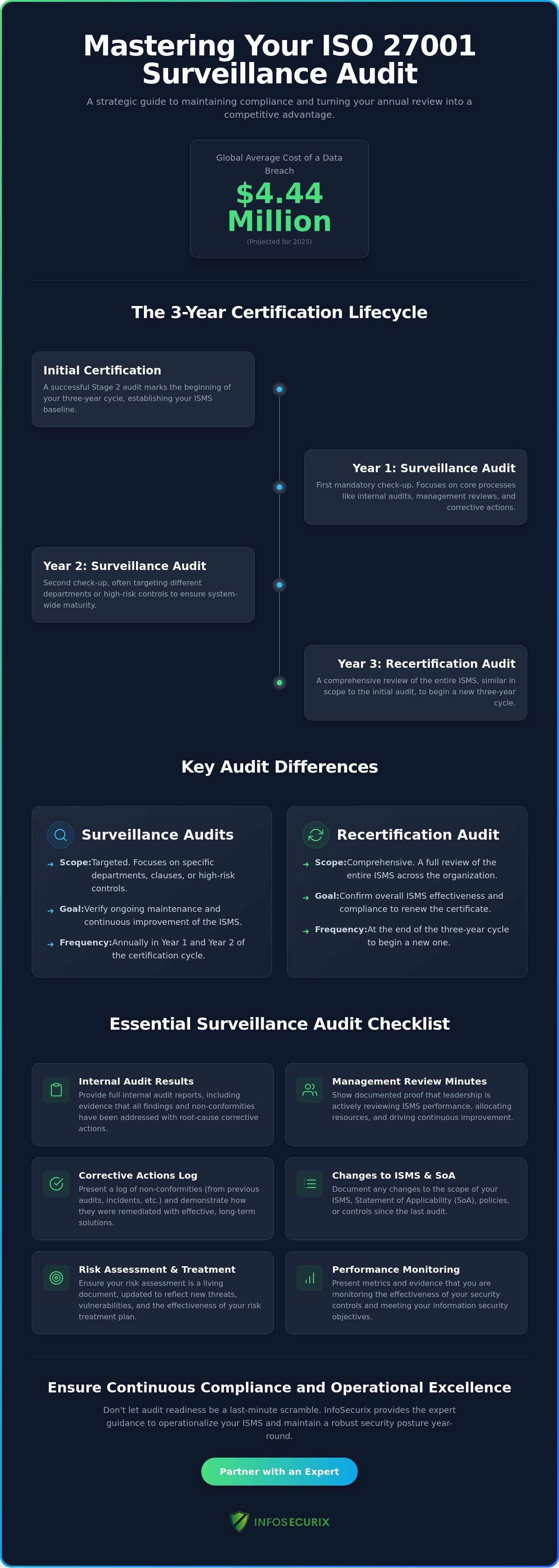
The ISO/IEC 27001 standard operates on a clear three-year cycle. Following your successful Stage 2 audit, you’ll undergo surveillance audits in Year 1 and Year 2. These sessions are typically shorter than the initial certification audit, yet they’re notably more process-deep. Auditors aren’t looking for a broad re-introduction; they’re scrutinizing the operational reality of your security culture. Every single year, certain mandatory elements stay under the microscope. You must demonstrate the effectiveness of your internal audits, the transparency of your management reviews, and the rigor of your corrective action processes. Using a structured ISO 27001 surveillance audit checklist helps you track these recurring requirements with the precision an auditor expects.
Surveillance vs. Recertification: Key Differences
Unlike a full recertification, a surveillance audit often targets specific departments or high-risk controls rather than the entire organization. This targeted approach allows for a granular examination of how your system handles change. Auditors pay close attention to modifications in your Statement of Applicability (SoA), ensuring that any new risks or technological shifts are properly documented. The primary metric for success here is continuous improvement. It’s not about being flawless. It’s about proving that your organization identifies weaknesses and remediates them with precision.
The Audit Schedule: What to Expect in 2026
Adhering to the 12-month window rule is non-negotiable for your first surveillance audit. Missing this deadline can lead to certificate suspension, a risk no executive wants to navigate. In 2026, the trend toward hybrid and remote audits has solidified, with many firms opting for virtual evidence reviews to maximize efficiency. To prepare, you need to build a meticulous audit trail starting from the day you were first certified. An effective ISO 27001 surveillance audit checklist should prioritize the collection of logs, meeting minutes, and risk treatment updates to ensure your compliance story remains cohesive and ready for inspection.
The Essential ISO 27001 Surveillance Audit Checklist for 2026
Operationalizing your security strategy requires moving beyond static policies and into the realm of verifiable evidence. While the initial certification confirms your system was designed correctly, the surveillance audit proves it’s actually working in the wild. This distinction is critical because auditors in 2026 aren’t just checking boxes; they’re looking for the maturity of your security culture. Aligning your daily operations with the NIST definition of information security ensures that confidentiality, integrity, and availability remain at the forefront of every business decision. A robust ISO 27001 surveillance audit checklist serves as your blueprint for this level of scrutiny.
To secure a successful outcome, your documentation must reflect active management rather than passive existence. You should prioritize the following core areas of evidence:
- Internal Audit Results: Presenting the full report from your most recent internal audit, including evidence that any identified non-conformities were addressed with systemic fixes rather than temporary patches.
- Management Review Minutes: Documentation that proves executive leadership is actively reviewing ISMS performance, allocating necessary resources, and making informed decisions about risk.
- Risk Treatment Plan (RTP) Execution: Clear logs showing that the actions defined in your RTP are being implemented according to your established timelines.
- Incident Remediation: A comprehensive register of all security incidents, no matter how minor, detailing the response steps taken and the lessons learned to prevent recurrence.
- Security Awareness Training: Participation records that confirm both long-standing employees and new hires have completed their required training modules for the current year.
Engaging in a collaborative partnership for ISO 27001 Certification Readiness can help you refine these records to meet the sophisticated expectations of modern auditors.
Mandatory Documentation and Records
Maintaining a current Statement of Applicability (SoA) is vital for 2026 compliance. Your SoA must reflect the evolving threat landscape, specifically addressing how your organization manages risks associated with supply chain vulnerabilities and emerging technological shifts. Additionally, keep detailed maintenance records for all physical and digital assets. This includes evidence of regular hardware servicing and software patch management. Don’t overlook third-party risk; you must show that vendor assessments have been updated to reflect any changes in your service provider ecosystem.
Core Process Performance Metrics
The auditor will look for proof that your Key Performance Indicators (KPIs) aren’t just numbers on a spreadsheet but tools for actual analysis. You need to demonstrate the “Plan-Do-Check-Act” (PDCA) cycle in your daily business-as-usual (BAU) operations. If a metric falls below your target threshold, show the documentation of the subsequent investigation and the corrective action taken. This level of integration proves that your ISMS is a functional part of the business rather than a peripheral compliance requirement.
Addressing Non-Conformities: Shifting to Strategic Corrective Action
Excellence in information security isn’t defined by the absence of errors but by the sophistication of your response to them. During a surveillance visit, auditors expect to see that your organization identifies its own weaknesses and remediates them with precision. This is where many firms stumble by confusing a simple correction with a strategic corrective action. While a correction is a point-in-time fix, such as resetting a misconfigured access right, a corrective action is a systemic change that prevents the error from recurring. Utilizing an ISO 27001 surveillance audit checklist allows you to categorize these findings and track the maturity of your remediation efforts over time.
It’s beneficial to reframe previous audit non-conformities as success stories of institutional growth. An auditor is often more impressed by a well-documented, resolved non-conformity than by a perfectly clean report that suggests a lack of internal scrutiny. However, “Open” non-conformities from a previous cycle are a significant red flag. They suggest management neglect or a lack of resources, which can quickly lead to certificate suspension. Demonstrating that you’ve closed previous findings with a robust Root Cause Analysis (RCA) proves that your ISMS is a functional, evolving asset.
The Root Cause Analysis Framework
To move beyond surface-level fixes, you must employ structured methodologies like the “5 Whys” or the Ishikawa fishbone diagram. These tools help your team dig past the immediate technical failure to find the underlying process or training gap. Once you implement a change, you must document an “Effectiveness Review” to prove the fix actually worked under real-world conditions. InfoSecurix transforms identified gaps into governance strengths by aligning technical remediation with long-term strategic objectives.
Managing Minor vs. Major Non-Conformities
The distinction between minor and major findings dictates your immediate operational priority. A minor non-conformity typically requires a plan of action within 90 days, though the certificate remains valid. A major non-conformity is more severe: it indicates a total breakdown of a requirement and requires immediate, intensive remediation to avoid suspension. The most effective way to avoid these high-stakes scenarios is to leverage a regular information security internal audit to catch and resolve issues long before the external auditor arrives. By treating every finding as an opportunity for refinement, you ensure your ISO 27001 surveillance audit checklist remains a record of continuous improvement rather than a list of failures.
Operationalizing the ISMS: Maintaining Audit Readiness Year-Round
Transitioning your ISMS from a high-intensity project to a continuous operational cycle is the definitive hallmark of a mature organization. Establishing a comprehensive “Compliance Calendar” ensures that recurring tasks, such as quarterly access reviews and biannual policy updates, are treated as standard business procedures rather than last-minute emergencies. This systematic approach transforms your ISO 27001 surveillance audit checklist from a stressful preparation document into a routine validation of daily excellence, ensuring your organization remains audit-ready at all times.
Assigning “Control Owners” across various departments effectively decentralizes the burden of evidence collection and fosters a culture of shared responsibility. Rather than the security officer bearing the entire weight of compliance, the HR lead manages personnel security records while the Facilities manager oversees physical access logs. Conducting quarterly mini-gap analyses prevents the “Audit Rush” that frequently leads to oversight or human error. While automated tools offer significant efficiency in capturing technical logs, they cannot replace the seasoned perspective of expert manual reviews for validating the strategic intent and operational effectiveness of a control.
Engaging professional support for a targeted Internal Audit can help solidify this decentralized framework and ensure your evidence meets the highest standards of accuracy.
The Role of the Internal Audit in Surveillance Prep
Completing your internal audit well before the external surveillance visit is a non-negotiable requirement for maintaining certification. It provides the essential lead time needed to identify and remediate potential non-conformities before they are observed by the certification body. Selecting an independent auditor, whether internal or external, is vital for ensuring objective results that stand up to external scrutiny. Integrating these internal findings into the Management Review cycle demonstrates to the auditor that your organization possesses a functional mechanism for self-correction and continuous improvement.
Executive Engagement and Management Review
Briefing leadership on ISMS performance requires a sophisticated focus on strategic impact rather than granular technical mechanics. You must ensure that resource allocation for security initiatives, whether in the form of budget for new tools or time for staff training, is clearly documented in meeting minutes to satisfy auditor inquiries regarding management commitment. Linking security compliance to ISO 22301 business continuity standards further enhances enterprise resilience, proving that your security posture directly supports long-term operational stability. This documented executive oversight is the final piece of evidence that confirms your ISMS is fully operational and supported at the highest levels of the organization.
Ensuring Continuous Compliance with InfoSecurix Expert Guidance
Achieving a successful surveillance outcome requires more than a completed document; it demands a sophisticated understanding of how auditors interpret the maturity of your security culture. InfoSecurix acts as a collaborative ally, providing a seasoned perspective that anticipates auditor inquiries before they’re even voiced. While a standard ISO 27001 surveillance audit checklist provides the necessary structure, our expert guidance ensures that your evidence reflects a living system rather than a static paper exercise. We specialize in transforming complex technical requirements into strategic business assets that instill absolute confidence in stakeholders and certification bodies alike.
The value of a professional pre-surveillance gap analysis cannot be overstated. This targeted exercise identifies potential vulnerabilities in your audit trail, allowing for bespoke remediation strategies that align with your specific business growth objectives. We don’t just help you pass an audit. We future-proof your ISMS against an evolving regulatory landscape, ensuring your controls remain resilient as technology and threats shift. By focusing on the strategic impact of your technical processes, we help you maintain a steady, calm posture even under the pressure of external scrutiny.
Why a Seasoned Guide Matters for Surveillance
Certification bodies and their auditors often have nuanced expectations that aren’t explicitly written in the standard. Navigating these variations requires a guide who’s seen every possible scenario and remains unfazed by complexity. Our involvement significantly reduces the internal stress on your compliance team, freeing them to focus on core operations. Ensuring your iso 27001 certification readiness translates into long-term ROI involves more than just keeping the certificate; it’s about building a robust foundation for enterprise trust.
Next Steps for Your 2026 Surveillance Audit
Preparation is a deliberate process that begins long before the auditor arrives on site. To ensure your organization is positioned for success, consider these immediate actions:
- Review your internal audit schedule: Confirm that all required departments have been audited and that findings are being tracked.
- Validate your Risk Treatment Plan: Ensure that every identified risk has a current status update and that treatment timelines are being met.
- Update your evidence repository: Use your ISO 27001 surveillance audit checklist to verify that logs, training records, and meeting minutes are organized and accessible.
Securing the future of your information security program requires a partner invested in your long-term achievement. Contact InfoSecurix today for a professional readiness assessment and transform your next surveillance audit into a definitive demonstration of operational excellence.
Mastering the Path to Sustained Information Security
Navigating the transition from initial certification to a mature, operationalized ISMS requires a shift in perspective: from a one-time achievement to a continuous culture of excellence. By integrating your ISO 27001 surveillance audit checklist into your daily business-as-usual routines, you transform a periodic compliance requirement into a strategic advantage that protects your organization’s long-term growth. Success in 2026 depends on decentralized ownership, rigorous management oversight, and a commitment to systemic improvement.
InfoSecurix brings over 25 years of information security expertise to every partnership. We combine a national reach with a boutique, high-touch consulting approach; we specialize in the strategic corrective actions and root cause analyses that satisfy the most discerning auditors. Our seasoned guides are dedicated to ensuring your security posture remains a living asset that evolves alongside emerging threats.
Secure your certification with an InfoSecurix Readiness Assessment. Your commitment to these rigorous standards today ensures a resilient and secure future for your entire enterprise.
Frequently Asked Questions
How long does an ISO 27001 surveillance audit typically take?
A surveillance audit typically spans between one and three days: this duration is notably shorter than the initial Stage 2 assessment. The exact timeframe depends on your organization’s total headcount, the complexity of your digital environment, and the number of physical locations included in your ISMS scope. Auditors focus on a representative sample of your controls rather than a exhaustive review of the entire system.
What happens if we fail an ISO 27001 surveillance audit?
You don’t typically “fail” an audit in a single day; instead, you may receive non-conformities that require remediation. Minor findings must be addressed before the next audit, while a major non-conformity requires a formal corrective action plan within a strict window, often 90 days. Failure to resolve a major non-conformity within the specified timeframe can lead to the suspension or withdrawal of your certification.
Can we change our Statement of Applicability (SoA) between audits?
Yes, you should update your Statement of Applicability whenever your risk profile or business operations evolve. The SoA is a living document: auditors expect it to reflect the current reality of your organization in 2026. If you’ve adopted new technologies or decommissioned old ones, documenting these changes in your SoA demonstrates the continuous improvement that is central to the ISO 27001:2022 standard.
Is an internal audit mandatory before every surveillance audit?
Conducting an internal audit is a mandatory requirement under Clause 9.2 of the standard. This internal review must be completed and documented before the external auditor arrives to prove that your system is being monitored effectively. Including the results of this internal review in your ISO 27001 surveillance audit checklist is essential for demonstrating that your ISMS remains healthy and operational.
Does the auditor look at every Annex A control during surveillance?
No, the auditor will not review every Annex A control during a single surveillance visit. They prioritize mandatory clauses, such as internal audits and management reviews, alongside a rotating selection of Annex A controls. Over the course of the three-year certification cycle, the auditor will eventually verify the effectiveness of every control within your scope to ensure comprehensive coverage.
How much does an ISO 27001 surveillance audit cost?
The cost of a surveillance audit is primarily determined by the number of “audit days” required by your chosen certification body. These fees are generally lower than the initial certification costs because the audit duration is shorter. Organizations should also account for the internal resource time required to gather evidence and host the auditor, as these operational costs are vital for a smooth assessment process.
Can a surveillance audit be conducted remotely in 2026?
Remote and hybrid audits have become a standard industry practice in 2026 for organizations with cloud-based infrastructures. Provided your evidence is managed digitally and your team can facilitate video interviews, many certification bodies offer remote options for surveillance visits. This approach often reduces travel expenses and minimizes operational disruptions while maintaining the same level of rigorous scrutiny as an on-site visit.
What is the most common reason for a major non-conformity in Year 1?
The most frequent cause for a major non-conformity is the “post-certification slump”: this happens when an organization neglects mandatory tasks like management reviews or internal audits after the initial certificate is issued. If an auditor finds no evidence of these activities occurring since the last visit, they will likely issue a major finding. Consistent execution of your ISMS tasks is the only way to ensure a successful surveillance outcome.