
Most organizations perceive the journey toward certification as an insurmountable mountain of paperwork; however, the most resilient enterprises understand that documentation serves as their most potent strategic asset. Mastering the intricate landscape of ISO 27001 documentation requirements requires a deliberate balance between rigorous compliance and operational agility. While it’s common to feel that an extensive volume of policies might obscure your primary security goals, clarity remains the most effective antidote to complexity.
We recognize that your objective extends beyond mere box-ticking; you’re building a foundation of trust that empowers your organization to expand with confidence. This framework addresses exactly which documents are mandatory for ISO 27001:2022 and how to structure them without drowning in bureaucracy. We’ll outline the essential mandatory records and provide a sophisticated strategy for maintaining a lean, audit-ready posture. By following this guide, you’ll transform your documentation from a perceived hurdle into a robust blueprint for enterprise excellence.
Key Takeaways
- Identify the definitive list of mandatory documents required by the 2022 revision to ensure your ISMS aligns with global compliance standards.
- Learn to utilize the Statement of Applicability as a strategic bridge for mapping your ISO 27001 documentation requirements to specific security controls.
- Differentiate between foundational policy structures and the dynamic operational records that serve as vital evidence during formal audit procedures.
- Implement a sophisticated governance framework to maintain documentation accuracy through meticulous version control and proactive review cycles.
- Execute a comprehensive gap analysis to secure your audit readiness and avoid the common pitfalls of generic documentation templates.
The Core Pillar: Mandatory ISO 27001:2022 Clauses 4-10
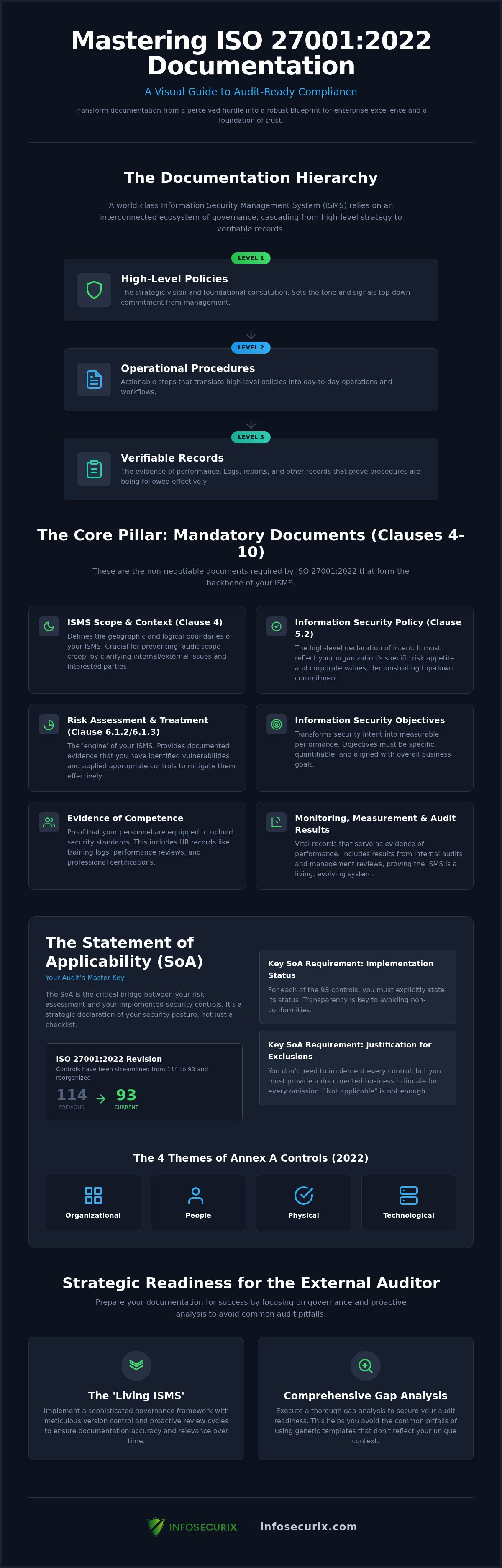
The architecture of a world-class Information Security Management System (ISMS) relies on a structured hierarchy of records. Understanding the mandatory ISO 27001 documentation requirements starts with recognizing that these aren’t isolated files; they’re an interconnected ecosystem of governance. At the peak sits your high-level policies, which cascade down into operational procedures and verifiable records. This top-down approach ensures that every security action taken by your team is rooted in management’s strategic vision.
Defining Scope and Context
Precision at the beginning prevents expensive complications during the audit phase. Clause 4 requires you to document the internal and external issues that influence your security posture, such as regulatory shifts or technological dependencies. Defining the boundaries of your ISMS prevents the common pitfall of audit scope creep, where vague definitions lead to auditors inspecting departments you hadn’t prepared. The ISMS scope is the geographic and logical boundary of your security promise. By documenting the requirements of interested parties, you demonstrate a sophisticated understanding of your organization’s unique threat landscape.
The Planning and Support Framework
Strategic planning transforms intent into measurable performance. Clause 5.2 establishes your Information Security Policy as the organization’s foundational constitution, signaling a top-down commitment to protecting data assets. This document shouldn’t be a generic template. It must reflect your specific risk appetite and corporate values. This commitment is further solidified in Clauses 6.1.2 and 6.1.3, which mandate documented evidence of your risk assessment and treatment processes. These are the engines of your ISMS. They prove you’ve identified vulnerabilities and applied appropriate controls to mitigate them effectively.
Achieving ISO 27001 certification readiness requires a meticulous approach to the support clauses. You must maintain documentation of your information security objectives, ensuring they’re measurable and aligned with your business goals. Evidence of competence is equally vital. HR records such as training logs, performance reviews, and professional certifications become part of your ISO documentation because they prove your personnel are equipped to uphold your security standards. Maintaining these ISO 27001 documentation requirements throughout the planning phase ensures your framework remains audit-ready and supported by a capable, informed workforce.
The Statement of Applicability: Your Audit’s Master Key
The Statement of Applicability (SoA) represents the most critical junction in your security journey. It acts as the definitive bridge between your high-level risk assessment and the granular technical controls you choose to implement. Within the framework of ISO 27001 documentation requirements, the SoA isn’t merely a list; it’s a strategic declaration of your organization’s security posture. The 2022 revision streamlined this process by consolidating the previous 114 controls into 93 more relevant categories. This shift requires a more integrated approach to documentation, as many controls now overlap across different functional areas of your business.
Failing to provide a clear implementation status for each control is a frequent cause of Stage 1 audit non-conformities. Your SoA must explicitly state whether a control is in place, planned, or partially implemented. Auditors look for this level of transparency to verify that your ISMS isn’t just a theoretical exercise but a functional reality. If you’re unsure how your current records align with these new standards, engaging in a professional readiness assessment can provide the clarity needed to proceed with confidence.
Justifying Control Exclusions
The art of defensible exclusion is what separates a mature ISMS from a basic checklist. You aren’t required to implement every Annex A control; however, you must provide a documented business rationale for every omission. The SoA is the primary document reviewed by auditors to understand your risk appetite. Simply stating a control is ‘not applicable’ without evidence will likely trigger further scrutiny. You must explain why a specific risk doesn’t exist within your scope, ensuring your reasoning is rooted in operational reality rather than convenience.
Mapping Controls to Annex A
The 2022 standard organizes its 93 controls into four intuitive themes: Organizational, People, Physical, and Technological. This structure makes it easier to cross-reference your internal policies with specific Annex A control IDs. For example, your remote work policy should directly map to both the ‘People’ and ‘Technological’ themes. Creating a clear matrix that links these IDs to your internal documentation demonstrates a high level of organizational maturity. It shows the auditor that your security framework is cohesive and that every control has a corresponding policy or procedure backing it up.
Operational Documentation and Evidence of Performance
Static policies provide the rules of engagement; however, dynamic operational records provide the objective evidence of their execution. While foundational policies define your strategic intent, the ISO 27001 documentation requirements demand a continuous stream of records that prove your ISMS is functioning as intended. This distinction is vital during a formal audit. An auditor doesn’t just want to see that you have an incident management policy. They want to see the specific logs, communication chains, and remediation steps taken during your last three security events. Mandatory records like internal audit results, management reviews, and non-conformity logs serve as the historical narrative of your security maturity.
Maintaining the Risk Treatment Plan (RTP) as a living document ensures your security posture evolves alongside your shifting threat landscape. It’s not a “set and forget” file; it’s a dynamic roadmap that requires regular updates as risks are mitigated or as new vulnerabilities emerge. Executing a thorough information security internal audit acts as the ultimate validation step for this entire process. It verifies that your operational reality matches your documented promises, identifying gaps before an external auditor discovers them.
Documenting the Risk Assessment Results
Producing a comprehensive Risk Assessment Report is a non-negotiable requirement for compliance. This document must detail the methodology used, the specific risks identified, and their potential impact levels on business continuity. Securing explicit risk owner approval is a critical step that many organizations overlook during the rush to certify. Without a documented sign-off from the individual responsible for the risk, your ISMS lacks the accountability and governance auditors require. You must also ensure total consistency between your Risk Register and the Statement of Applicability. Any discrepancy here suggests a fragmented security strategy that could lead to a major non-conformity.
Monitoring and Measurement Records
Quantifying security performance requires the definition of clear, measurable Key Performance Indicators (KPIs). You must document the results of your security monitoring to demonstrate that controls remain effective over time rather than just at the moment of implementation. Management Review minutes represent the pinnacle of this leadership trail. When an auditor reviews these minutes, they’re looking for evidence that leadership is actively engaged in the security process. They want to see that management has reviewed internal audit results, addressed non-conformities, and allocated the necessary resources for continuous improvement. These records provide the ultimate proof of a healthy, functioning ISMS that is supported from the top down.
The ‘Living ISMS’: Governance and Version Control
Governance serves as the heartbeat of a successful security framework. It ensures that your ISO 27001 documentation requirements don’t become stagnant artifacts but remain active, relevant guides for your personnel. A static ISMS is a failing ISMS. To maintain the integrity of your certification, you must implement a standardized document control system that tracks review dates, versioning, and formal approval signatures. This level of meticulous detail signals to an auditor that your organization treats security as a continuous commitment rather than a one-time project.
Establishing a robust policy review cycle is essential for staying ahead of emerging threats. While an annual review is the industry baseline, the most resilient organizations adopt event-driven reviews triggered by significant infrastructure changes or new regulatory mandates. You should avoid the trap of template fatigue; auditors easily recognize generic, unedited documents that lack organizational context. Bespoke documentation, tailored to your specific operational reality, demonstrates genuine ownership and a deep understanding of your risk landscape. Integrating ISO 20000 implementation concepts can further elevate your ISMS by aligning security documentation with high-level IT service management standards.
Establishing a Document Control Procedure
A systematic approach to document management prevents process pollution and ensures every team member works from the most current information. Follow these four essential steps to secure your governance trail:
- Step 1: Define a clear document naming and storage convention to ensure files are easily searchable and logically organized.
- Step 2: Assign a specific owner for every mandatory policy to establish clear lines of accountability for future updates.
- Step 3: Implement a formal approval workflow that requires leadership sign-off before any document is published or revised.
- Step 4: Retire and archive obsolete documentation immediately to prevent outdated procedures from being used by mistake.
Ensuring Accessibility and Awareness
Documentation loses its value if your employees cannot access it during critical moments. Managing a central repository that is intuitive and always available is a foundational requirement for compliance. This aligns directly with Clause 7.3, which mandates that personnel must be aware of the information security policy and their contribution to the effectiveness of the ISMS. Mapping policy awareness through training logs and internal communication records proves to the auditor that your security culture is widespread. If you’re ready to move beyond generic templates and build a truly audit-ready framework, our team can guide you through a comprehensive ISO 27001 certification readiness assessment.
Strategic Readiness: Preparing Documentation for the External Auditor
Finalizing your preparation requires a shift in perspective. You’re no longer just building a system; you’re preparing to defend it. Conducting a rigorous “Documentation Gap Analysis” serves as your essential pre-flight check, ensuring that every one of the ISO 27001 documentation requirements has been meticulously addressed. This process involves creating what we call an “Auditor’s Portfolio”: a curated digital repository of evidence that allows for a seamless, professional review. When your evidence is logically organized and easily accessible, you project an image of absolute control and maturity. This systematic approach streamlines the auditor’s work, often resulting in a more favorable and efficient audit experience. This foundational work allows you to move beyond basic compliance and focus on information security risk assessment mastery, where the true value of your ISMS is realized.
The Stage 1 Audit: The ‘Document Review’ Phase
The Stage 1 audit represents the first formal hurdle in the certification process. During this phase, the external auditor scrutinizes your documentation to ensure it meets the mandatory requirements of the standard. If a gap is identified, the auditor will issue a non-conformity. A minor non-conformity might involve a slight administrative oversight, while a major non-conformity suggests a total failure to address a required clause. Stage 1 is purely a ‘design’ check of your documentation, not its implementation. It’s an opportunity to receive professional feedback on your ISMS structure before the auditor begins testing your operational controls in Stage 2. Addressing these findings promptly is vital for securing permission to proceed and maintaining your certification timeline.
InfoSecurix: Your Partner in Meticulous Preparation
InfoSecurix serves as a seasoned guide for organizations that refuse to settle for generic, “off-the-shelf” security. We leverage over 25 years of industry experience to help you build a lean, audit-ready ISMS that reflects your unique business environment. Our specialized readiness assessments are designed to identify missing links in your documentation chain, preventing costly failures during the formal audit. We help you avoid the “template trap” by developing bespoke records that satisfy auditors while remaining practical for your team to maintain. This partnership ensures you approach your audit with absolute confidence, knowing your documentation is both compliant and strategic. Secure your certification readiness with InfoSecurix.
Elevating Your Security Posture for Global Excellence
Building a resilient ISMS requires more than a checklist; it demands a sophisticated understanding of how every record serves your broader business objectives. We’ve explored how the interconnectedness of Clauses 4 through 10 provides a foundational constitution, while a precise Statement of Applicability acts as your audit’s master key. By moving beyond generic templates and embracing bespoke, dynamic governance, you transform your ISO 27001 documentation requirements into a strategic asset that fuels enterprise growth and client trust.
Mastering this complex landscape becomes a streamlined journey with a seasoned guide at your side. InfoSecurix combines over 25 years of compliance excellence with a high-touch, boutique approach to ensure your organization remains truly audit-ready. We offer national reach with a curated focus on your specific operational needs, helping you identify missing links and secure a successful Stage 1 review. Partner with InfoSecurix for Expert ISO 27001 Readiness and take the first step toward a future-proof security framework. Your journey toward certification is an opportunity to redefine your commitment to excellence, and we’re here to ensure you succeed with absolute confidence.
Frequently Asked Questions
What are the absolutely mandatory documents for ISO 27001:2022?
The 2022 revision requires approximately 13 to 15 core mandatory documents, including the ISMS scope, information security policy, and risk assessment methodology. You must also maintain the Statement of Applicability and the risk treatment plan. These documents form the structural foundation of your framework. While additional records like training logs are necessary, these core policies represent the non-negotiable elements required to pass your Stage 1 audit successfully.
Can I use templates for my ISO 27001 documentation?
While templates provide an initial structure, relying solely on them often leads to the “template trap” where documentation doesn’t reflect your operational reality. Auditors quickly identify generic content that lacks organizational context. We recommend using templates only as a baseline. You should meticulously customize every document to align with your specific risk appetite and internal processes, ensuring your ISMS is both practical and audit-ready.
How long does it take to prepare all the required ISO 27001 documentation?
Developing a comprehensive set of ISO 27001 documentation requirements typically takes between four to twelve months depending on organizational complexity. A small startup might finalize their records faster, whereas a global enterprise requires more time for stakeholder alignment and policy approval. This timeline includes the initial gap analysis, drafting phases, and the mandatory internal audit period required to generate sufficient evidence for the external auditor.
What is the difference between a policy, a process, and a record in ISO 27001?
A policy establishes high-level rules and management intent, whereas a process defines the specific sequence of actions needed to achieve a goal. A record serves as the final evidence that a process was followed correctly. For example, your Access Control Policy sets the rules; the User Provisioning Process explains how to add employees; and the signed access request form is the record that proves compliance.
Is a Statement of Applicability (SoA) mandatory even for small businesses?
The Statement of Applicability is an absolute requirement for every organization regardless of size or industry. It serves as the definitive map connecting your risk assessment to the specific controls you’ve chosen to implement. Small businesses often find the SoA particularly useful because it allows them to justify the exclusion of complex controls that don’t apply to their limited physical or digital footprint.
What happens if I am missing a mandatory document during my ISO 27001 audit?
Missing a mandatory document during a Stage 1 audit typically results in a major non-conformity, which halts your certification progress. The auditor cannot recommend you for a Stage 2 assessment until the gap is remediated and verified. It’s much more efficient to identify these missing links during a preliminary readiness assessment rather than discovering them during the high-pressure environment of a formal external review.
How often should ISO 27001 policies be reviewed and updated?
You should review your information security policies at least annually or whenever a significant change occurs within your business environment. Triggers for an event-driven review include major infrastructure migrations, leadership changes, or new regulatory requirements. Regular updates ensure your documentation remains a “living” part of your organization rather than a stagnant file that no longer reflects your current security posture or threat landscape.
Does ISO 27001 require a specific software for documentation management?
ISO 27001 doesn’t mandate the use of specific software for managing your ISO 27001 documentation requirements. You can achieve compliance using standard office suites or dedicated GRC platforms as long as you maintain strict version control and accessibility. The most important factor isn’t the tool itself; it’s your ability to demonstrate a clear audit trail of approvals, reviews, and evidence that proves your controls are functioning effectively.