
The most significant threat to your information security management system isn’t a sophisticated external breach; it’s an executive leadership team that views your security governance as a tedious checkbox exercise. Many organizations struggle with a dry, technical ISO 27001 management review meeting agenda that satisfies Clause 9.3.2 requirements but fails to offer any real business value. It’s exhausting to facilitate meetings where the primary goal is simply to avoid an audit non-conformity rather than to drive strategic resilience.
Our framework transforms this mandatory compliance obligation into an empowering tool for corporate governance. By shifting the focus from granular mechanics to high-level strategic impact, you can turn a routine meeting into a demonstration of true ISMS maturity. This guide provides a meticulous roadmap for your 2026 reviews, including a compliant template and a clear breakdown of required outputs. We’ll show you how to orchestrate a session that secures both your data and the unwavering confidence of your board.
Key Takeaways
- Understand how Clause 9.3 serves as the vital link between technical security operations and high-level corporate governance within the PDCA cycle.
- Master the mandatory ISO 27001 management review meeting agenda inputs, ensuring every requirement from Clause 9.3.2 is addressed to prevent audit non-conformities.
- Learn to synthesize complex security data into executive intelligence that resonates with the Board and secures their long-term commitment to the ISMS.
- Utilize a structured agenda template to facilitate a professional review that moves efficiently from previous action items to future-focused strategic planning.
- Discover how independent internal audits and seasoned consultancy expertise can elevate your review from a compliance task to a driver of organizational maturity.
Understanding ISO 27001 Clause 9.3: Why Management Reviews Matter
Clause 9.3 is the definitive bridge between technical security controls and executive governance. It functions as the critical “Check” and “Act” phase within the Plan-Do-Check-Act (PDCA) cycle; it’s the mechanism that ensures your Information Security Management System (ISMS) isn’t just a static collection of policies. Without this high-level oversight, security remains siloed within technical departments, often disconnected from the broader business objectives it’s intended to protect. Transforming these requirements into a strategic advantage requires moving beyond simple compliance checklists.
A common misconception persists that the ISO 27001 management review meeting agenda is merely a technical status update for IT staff. This couldn’t be further from the truth. External auditors specifically look for evidence that “Top Management” is actively steering the ISMS. They aren’t just looking to see that a meeting occurred; they’re searching for documented decisions that demonstrate leadership is engaged in managing risk and allocating resources. Demonstrating this level of engagement is often the difference between a seamless certification and a challenging audit experience.
The Purpose of the ISMS Management Review
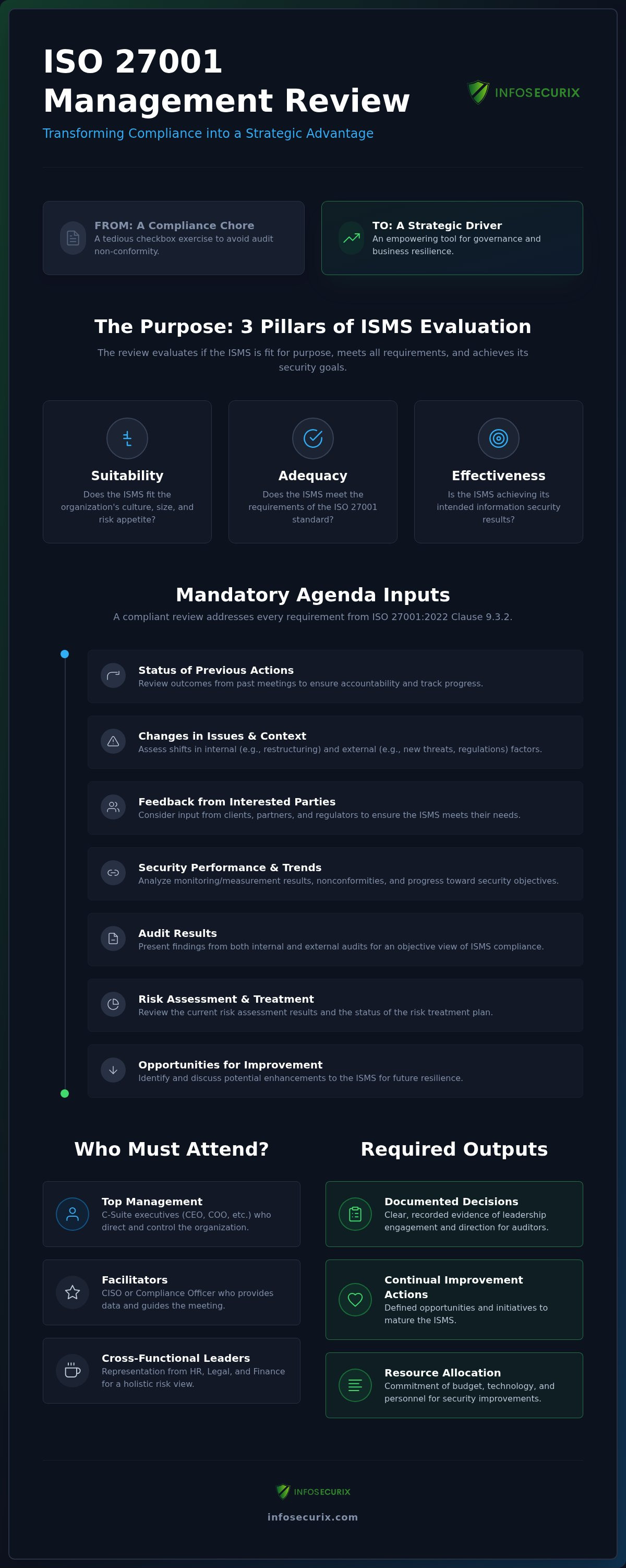
The primary objective of this review is to evaluate the suitability, adequacy, and effectiveness of the system. Suitability asks if the ISMS still fits the organization’s culture and size: adequacy determines if it meets the standard’s requirements: effectiveness measures if it’s actually achieving its intended security results. By rigorously assessing these three pillars, you align information security with the strategic direction of the enterprise. This ensures that your security posture directly supports long-term business resilience rather than acting as a bureaucratic hurdle.
Who Must Attend? Defining the Executive Review Board
Identifying “Top Management” is vital for compliance. This group includes individuals who direct and control the organization at the highest level, such as the CEO, COO, and other C-suite executives. While the CISO or Compliance Officer typically facilitates the ISO 27001 management review meeting agenda, they aren’t the primary decision-makers in this context. Their role is to provide the data that allows the board to make informed choices.
Including cross-functional representation is equally essential for a mature ISMS. Involving leaders from diverse departments ensures a holistic view of organizational risk:
- HR: Addresses insider threats, training needs, and personnel security.
- Legal: Manages regulatory changes and contractual obligations.
- Finance: Oversees the budget required for necessary security improvements and risk treatment.
The Mandatory Agenda: Required Inputs Under ISO 27001:2022
Constructing an effective ISO 27001 management review meeting agenda requires a precise understanding of Clause 9.3.2. This clause specifies the mandatory inputs that must be presented to leadership to ensure the ISMS remains robust. While many organizations treat these as a simple list of items to mention, a strategic approach involves analyzing how these factors intersect to influence the company’s risk profile. It isn’t enough to state that changes occurred; you must explain why those changes matter to the board’s long-term vision. This transformation of raw data into governance intelligence is what separates a mature security posture from a basic compliance exercise.
The review begins by addressing the status of actions from previous management sessions. This creates a narrative of accountability and continuous improvement. Leadership needs to see that their past decisions led to concrete outcomes. Following this, the agenda must cover changes in external and internal issues. This includes shifts in the regulatory environment, new technological threats, or organizational restructuring. By assessing feedback from interested parties, such as clients or regulators, you demonstrate that the ISMS is responsive to the needs of the entire business ecosystem. This holistic view prevents the security system from becoming an isolated technical project.
Analyzing Audit Results and Security Performance
Presenting information security internal audit findings is a cornerstone of the review process. These results provide an objective look at how well the system functions in practice. Instead of overwhelming executives with granular technical failures, focus on trends in nonconformities and the effectiveness of corrective actions. Using Key Performance Indicators (KPIs) allows you to quantify security success, showing exactly how well the organization is meeting its stated security objectives. It’s helpful to present these metrics in a way that highlights progress over time. If you’re unsure how to translate these findings into executive-level insights, engaging a partner for ISO 27001 certification readiness can provide the necessary clarity and professional distance.
Risk Assessment and Incident Trends
A comprehensive summary of the current risk landscape is vital for future-proofing. You should report on the results of the latest risk assessments and highlight any significant changes in the threat environment. This section of the ISO 27001 management review meeting agenda should also detail security incidents and the performance of your response measures. Analyzing these patterns reveals where the ISMS is strong and where it requires reinforcement. Identifying trends in security incidents allows leadership to allocate strategic resources to the areas of highest organizational vulnerability. This data-driven approach ensures that budget and manpower are directed toward mitigating the most likely and impactful threats to the business.
Strategic Preparation: Transforming Data into Executive Intelligence
The success of an ISO 27001 management review meeting agenda hinges on the quality of preparation performed weeks before the actual session. Executives don’t need to see raw firewall logs or granular patch management reports; they require synthesized intelligence that highlights how security investments protect the bottom line. This preparation phase is your opportunity to frame technical data as business risk. Conducting pre-meeting briefings with key stakeholders, such as the CFO or Legal Counsel, ensures that potential friction points are addressed early. This allows the actual review to focus on strategic decision-making rather than technical disputes.
Establishing a consistent governance cycle is another hallmark of a mature organization. While the standard requires reviews at “planned intervals,” relying solely on an annual session often leads to a reactive posture. Moving to a quarterly cycle allows for more agile resource allocation: it ensures that security remains a constant priority for the board. This regular cadence transforms the review from a stressful compliance event into a powerful tool for justifying security budgets. When the board sees a direct correlation between resource allocation and risk reduction, securing necessary funding becomes a data-driven conversation rather than a negotiation.
Visualizing ISMS Maturity for 2026
Leadership teams respond best to clear, visual representations of progress. Developing high-level summaries of your ISO 27001 certification readiness status helps the board understand exactly where the organization stands on its journey toward compliance. Instead of listing every technical vulnerability discovered, focus on “residual risk,” which is the risk that remains after controls are applied. Highlighting major achievements in the security posture, such as the successful implementation of multi-factor authentication or a reduction in incident response times, demonstrates that the ISMS is evolving and providing tangible value.
The Role of Independent Evidence
Objectivity is the currency of trust in corporate governance. External perspectives from a professional information security internal audit firm carry significantly more weight with the board than self-assessments alone. Independent evidence provides a seasoned perspective that validates the internal team’s efforts while identifying blind spots that might be missed. Preparing documentation that stands up to third-party auditor scrutiny requires that all inputs be data-driven and objective. This meticulous approach ensures that when the certification auditor arrives, your management review records serve as irrefutable proof of top management engagement.
Executing the Meeting: A Professional Agenda Template
Execution is the precise moment where meticulous preparation meets organizational governance. A well-structured ISO 27001 management review meeting agenda ensures the conversation remains focused on strategic outcomes rather than getting lost in technical minutiae. Begin the session by reviewing the minutes and action items from your previous meeting. This established continuity demonstrates to auditors that the ISMS is a living, breathing system that responds to executive direction. It’s not enough to simply complete tasks; you must show that leadership is tracking progress and holding owners accountable for security outcomes.
The core of the meeting involves stepping through the mandatory Clause 9.3.2 inputs you’ve prepared. Treat these as catalysts for strategic discussion rather than a checklist to be read aloud. When addressing resource adequacy, be direct about what the security function needs to remain effective. This is your primary opportunity to align the security budget with the organization’s risk appetite. Conclude the meeting by formalizing decisions and assigning clear ownership for new action items. If your leadership team needs support to bridge the gap between compliance and strategy, our team can provide the ISO 27001 certification readiness guidance necessary to facilitate these high-stakes sessions.
Mandatory Meeting Outputs (Clause 9.3.3)
Clause 9.3.3 specifies the required outputs of your review, and these are often the first items an auditor will examine. You must document specific decisions and actions related to:
- Continual Improvement: Explicitly record how the ISMS will evolve to address new threats or inefficiencies.
- System Changes: Note any approved modifications to the ISMS scope, security policies, or organizational objectives.
- Resource Allocation: Document the formal approval of budgets, new hires, or technological investments required for the coming period.
These outputs serve as the “Act” component of the PDCA cycle. They prove that management is actively steering the system’s trajectory based on the data presented during the review.
Writing Minutes That Satisfy Auditors
Meeting minutes are the primary evidence of ISMS governance. To satisfy a third-party auditor, your documentation must go beyond a simple summary of topics. It needs to capture the essence of the executive dialogue, essentially recording “who said what” to prove that top management was engaged and inquisitive. Ensure every action item resulting from the meeting has a specific owner and a firm deadline. This level of detail transforms a standard meeting record into a robust audit trail. It confirms that your leadership isn’t just informed about security but is actively responsible for its success.
Securing Certification: How InfoSecurix Elevates Your Management Review
Navigating the transition from technical security operations to executive governance requires more than a checklist; it demands a partner who understands the nuances of corporate risk. Leveraging over 25 years of industry experience, InfoSecurix serves as the seasoned guide organizations need to transform their compliance obligations into strategic assets. We specialize in helping you refine your ISO 27001 management review meeting agenda so that it speaks the language of the board. Our boutique consultancy approach ensures that your governance framework is bespoke, reflecting your specific organizational complexity rather than a generic template.
A primary challenge in any management review is providing objective, data-driven inputs that stand up to scrutiny. InfoSecurix provides the independent internal audits required to satisfy Clause 9.3.2, offering a level of professional distance that internal teams often cannot achieve. This independent evidence carries significant weight during certification audits, as it proves a commitment to transparency and rigorous self-evaluation. We act as the bridge between your technical experts and executive leadership, translating granular security metrics into the high-level intelligence necessary for resource allocation and strategic planning.
From Readiness to Resilience
Our ISO 27001 certification readiness services are designed to ensure a “no-surprises” audit experience. We don’t just help you pass; we help you build a sustainable governance model that outlasts the initial certification. By identifying strategic corrective actions that actually improve your security posture, we ensure your ISMS remains effective in an evolving threat landscape. This focus on resilience means your management reviews become proactive sessions that anticipate future risks rather than reactive updates on past failures.
Strategic Partnership for National Compliance
While automated software platforms offer convenience, they often lack the strategic depth required for complex enterprise-level risk management. A true partnership involves understanding your business objectives and ensuring that information security acts as a competitive advantage. InfoSecurix provides the visionary yet grounded guidance needed to future-proof your organization. We invite you to schedule a consultation to refine your ISO 27001 governance strategy and discover how a meticulously constructed ISO 27001 management review meeting agenda can drive your organization’s long-term success.
Elevating Your Governance for a Resilient Future
Mastering the ISO 27001 management review meeting agenda is more than an exercise in compliance; it’s an opportunity to solidify the trust between your security function and executive leadership. By shifting from granular technical reporting to strategic risk governance, you ensure that your ISMS remains a dynamic force that enables organizational growth. We’ve explored how meticulous preparation and data synthesis can transform mandatory inputs into high-level intelligence that resonates in the boardroom. This approach doesn’t just satisfy auditors; it builds a culture of security that is both resilient and future-proof.
With over 25 years of strategic security expertise, InfoSecurix provides the seasoned perspective necessary to navigate these complex requirements. Our boutique consultancy offers national reach and a proven track record in ISO and SOC2 compliance, ensuring your organization is prepared for any challenge. Partner with InfoSecurix for Expert ISO 27001 Readiness to refine your governance framework and secure your certification with absolute confidence. You have the tools to turn mandatory reviews into strategic advantages, and we’re here to guide you every step of the way.
Frequently Asked Questions
How often must an ISO 27001 management review be held?
ISO 27001 requires management reviews at planned intervals, but it doesn’t mandate a specific timeframe like “once per year.” Most mature organizations conduct these reviews annually at a minimum; however, quarterly sessions are increasingly common for businesses managing volatile risk environments. This frequent cadence ensures that security remains a strategic priority and allows for more agile resource allocation throughout the fiscal year.
Who is required to attend the ISO 27001 management review meeting?
Top management, defined as the person or group who directs and controls the organization at the highest level, must attend the review. This typically includes the CEO and other C-suite executives who hold decision-making authority over resources and strategy. While the CISO or Compliance Officer facilitates the meeting, their presence alone doesn’t satisfy the standard’s requirement for leadership engagement and oversight.
What are the mandatory inputs for an ISO 27001 management review agenda?
The mandatory inputs for an ISO 27001 management review meeting agenda include previous action items, changes in internal and external issues, and feedback from interested parties. You must also present information on security performance, such as nonconformities, audit results, and the fulfillment of security objectives. Addressing risk assessment results and the status of corrective actions ensures that the board has a comprehensive view of the system’s effectiveness.
What is the difference between an internal audit and a management review?
An internal audit is a formal verification process to ensure the ISMS meets the standard’s requirements, whereas a management review is a strategic evaluation of the system’s overall performance. Audits provide the objective data and findings that serve as a primary input for the review. While auditors look for technical compliance, top management uses the review to assess whether the system still aligns with the organization’s strategic goals.
Can the management review be part of existing board meetings?
You can integrate the management review into existing board meetings provided that all mandatory agenda items are addressed and formally documented. This approach often increases executive engagement by placing security within the context of general business operations. However, you must ensure that the meeting minutes clearly distinguish the ISMS review components to provide a clean evidence trail for your certification auditor during their assessment.
What happens if we miss a mandatory agenda item during the review?
Missing a mandatory agenda item typically results in a non-conformity during your external certification audit. Auditors specifically check for evidence that every input required by Clause 9.3.2 was presented and discussed. If an item was overlooked, you should schedule a follow-up session immediately to address the gap. Documenting this corrective action demonstrates that your organization maintains a proactive approach to ISMS governance and continuous improvement.
How long should the management review meeting minutes be kept?
Organizations should retain management review minutes for at least three years to cover a full ISO 27001 certification cycle. This duration ensures that you can provide evidence of historical governance and continuous improvement during surveillance and recertification audits. Your internal document retention policy might specify a longer period based on legal or regulatory requirements, but three years is the standard expectation for demonstrating ISMS maturity over time.
What evidence do auditors look for to prove top management commitment?
Auditors look for detailed meeting minutes that capture executive-level discussions, decisions, and formal approvals for resource allocation. They want to see that leadership isn’t just receiving a report but is actively questioning the data and directing the ISMS. Evidence of specific budget approvals or changes to the ISO 27001 management review meeting agenda based on leadership feedback provides strong proof of genuine, top-down commitment to information security.